


Strategize for First Parent Meeting
February 25, 2015
 By Scott Westfall
MSU Institute for the Study of Youth Sports
Coaches often cite parents as one of the most uncontrollable and frustrating aspects of coaching.
Let’s face it, when this relationship goes south, there can be pent-up frustration and hard feelings between the two parties which can result in a negative experience for everyone involved – especially the player who is often caught in the middle.
Establishing positive relationships with parents should happen from the moment you stand in front of them at your annual parent meeting.
Throughout this meeting, parents will be asking themselves: “Can I trust this coach with my child?” “Will this coach be fair in his/her decisions?” and “Will this coach always have my child’s best intentions in mind?”
In order to put them at ease, you must do everything possible to establish yourself as a person of integrity who is altruistic and 100 percent trustworthy. Below is a coaching checklist that will help you establish trust and credibility with your team’s parents:
Transparency – Do things openly and share information as much as possible. If something bad happens on your team, be sure that you do not sweep it under the rug. Be open and consistent with your decisions, and always follow through on what you say you are going to do.
Demonstrate Respect – Be polite and sincere with parents and let your actions show that you care. Sometimes the little things you do will resonate louder than the big things.
List Expectations – Have high expectations for the conduct of both the players and parents in your program. List these expectations, distribute them, and then talk about them with the parents. Meanwhile, let them know what they can expect from you in return (proper dress attire, appropriate language, great sportsmanship, impeccable conduct, proper treatment of game officials, etc.).
Express Loyalty – As often as possible, be sure to praise your players, assistants, and the people associated with your program. Be sure that you never take credit for other people’s work, and remember to use the word “we” as often as possible.
Be Accountable – This means taking the blame for bad results– even when it wasn’t necessarily your mistake. Admitting when something goes wrong on your watch doesn’t mean that you are a bad coach or you’ve lost control of your program. True leaders are accountable for the mistakes that happen in their programs.
Deliver Results – This is not necessarily wins and losses. Instead, deliver results on the things that really matter, such as developing a respectable team, coaching players with all passing grades and having players who do not get into trouble or break the law.
No parent meeting would be complete without a healthy dose of paperwork. To make it easier for parents to keep these papers organized, try to color-coordinate the forms and go over them slowly one at a time.
Below are the basic documents you should supply at the parent meeting (Note: Try to also have these documents accessible on your team’s website):
Coaching Philosophy – Drafting a coaching philosophy will allow parents to better understand who you are and the reasons you coach. In this document, be sure to include your fundamental beliefs along with your personal approach to coaching. (Note: Be honest in this section – Do not advertise yourself as one type of coach, but then act like another). Include a lot of “I statements” such as, “I coach for the purpose of teaching life lessons,” “I believe that student comes before athlete,” and, “I am demanding but never demeaning.” Developing and drafting a coaching philosophy not only gives parents insight into you and your program, but it also gives you an opportunity to reflect upon why you do things the way you do.
Team Policies – This is perhaps the most important document you will distribute to your team’s parents. It should list all team rules pertaining to player conduct, grades, eligibility, attendance, discipline, communication, and of course playing time! Include statements such as, “Playing time is earned – not given,” “All decisions will be made based on what is best for the team,” and, “If you have a problem, please talk to the coach.” Inform parents that student-athletes will receive equal opportunities but not equal things. These opportunities include instruction, off-season strength and conditioning programs, and support for their classes. How well student-athletes take advantage of these opportunities (attendance, focus, effort, attitude, and self-discipline) often dictates their levels of success. (Note: Before distributing this document, make sure your school’s administration/athletic director supports your team policies 100 percent).
Student-Athlete Character Contract – While many schools have had an athletic code of conduct in place for years, teams today are including an additional written set of norms for players to follow. A character contract outlines how players agree to conduct themselves as a person, student, and athlete. If you want to create more buy-in, consider drafting this contract each season with your players!
Parent Pledge Form – This document establishes the expectations you have for the parents in your program. Be sure that you include expectations for their conduct at games, having a positive disposition around the team, the treatment of players on your team along with the treatment of your opponents, letting the coaches coach, and how to act toward game officials.
Team Calendar – Be sure to include detailed information on the times and locations of all practices, team events, games, and places that players need to be. If changes are made to the team calendar throughout the course of the season, be sure you inform parents through several forms of communication (a printed note sent home, an announcement on the team website, email list, social media, etc.).
Athletic Physicals – While most doctors’ offices have a copy of these blank forms on hand, it is convenient for parents to have access to them through your school.
Athletic Fees (if you are a “pay for play” district) – Some districts have a mandatory athletic participation fee, while other districts do not. Some districts have a waiver form for students who are on free/reduced lunch. In any of these cases, make sure you are on top of this information so you can properly inform your team’s parents at the meeting.
Conflict Resolution – The occasional conflict is almost inevitable while working in an emotionally charged environment such as athletics. However, conflicts can often be avoided or at least more easily resolved through proper forms of communication.
- Inform parents that you are always willing to listen to their concerns; let them know that you would prefer they address an issue with you, rather than taking their frustrations to the next game and venting to anybody in the bleachers who is willing to listen.
- In your team documents consider a statement such as, “The best tool we have in our relationship is an open line of communication. My door is always open and so is my mind.”
- Finally, be sure to let them know that if they are upset about something to not send it through email. Email is good for information, but not communication. Try to communicate and resolve conflicts in person as much as possible.
Once you have established trust and credibility with your team’s parents, you can start building the relationship. Caution: Building a relationship with your team’s parents is not developing close friendships with them. Becoming close friends with parents actually can lead to bigger problems as you open yourself to criticism of playing favorites. Instead, build working relationships, generated through mutual respect and understanding for each other’s position in the quest of helping the young individual become a successful student-athlete. These working relationships help parents understand their optimal level of involvement, such as where and how they can fit into your program. Below are some tips for building working relationships with parents:
- Learn their names and where they work.
- Learn what the family likes to do when they are outside of the school setting.
- Invite them to a team event such as a team picnic, fundraiser, or team trip.
- Ask parents for help with certain jobs. Many parents appreciate being asked to help with team functions as it gives them an opportunity to get to know other parents and makes them feel like they matter.
- Call them at least once per season to say hello, report on their child’s progress, and ask if there is anything you can do to be of assistance.
- Offer additional support for their child. Helping the student-athlete outside of coaching with things such as academics and typical teen issues shows you care.
- Offer support to the parents as well. If they are struggling to get a message across to their child, oftentimes a coach sending or reinforcing the same message makes all the difference. As a coach you hold a powerful platform with your student-athletes; use it to help with their development and maturity whenever possible.
Establishing yourself as a trustworthy and credible coach is the first step in getting parents to buy into your program. Meanwhile, providing parents with sufficient information will help them feel like you are keeping them informed and want them as a partner in your program.
Creating working relationships with parents takes time, but will be the cornerstone in establishing a positive experience for the years their children are involved with your program. While some parents may have a different background or mindset, listing your expectations will help them better understand your team’s culture and how they can fit in.
If done right, these positive working relationships should alleviate much of your coaching frustration and pay tremendous dividends in the future.
Scott Westfall has spent the last 10 years as a teacher, coach, and athletic director in Fort Collins, Colo. He currently is working on his Doctorate at Michigan State University, with an emphasis in Sport Psychology and Athletic Administration, and assisting the MHSAA with its student leadership programs. Westfall is a former athlete who participated in football, wrestling, tennis and cross country at the high school level, and rugby at the collegiate level. He can be reached at [email protected].
Martin Brings LA Marathon Championship Experience Home as Jackson High Coach
By
Doug Donnelly
Special for MHSAA.com
April 23, 2026
Nathan Martin has the best possible example a coach can give when it comes to the old phrase, “It’s never over, until it’s over.”
 Last month, the Jackson cross country head coach and track assistant captured national attention when he miraculously came from behind to win the Los Angeles Marathon.
The winning margin was one hundredth (0.01) of a second.
“I didn’t really know if I won,” said Martin. “I tried not to get too emotional or celebrate too much. Then people around me started confirming it.”
Martin, 36, was running his race when, with about five miles to go, he had a surge and passed the pack he was with to get comfortably into second place.
“There was only one guy to catch at that point; he was so far ahead,” Martin said. “I couldn’t even see him. At that point, it was like, ‘Okay, let’s push, let’s finish, be strong, and all that kind of stuff.”
Slowly, the leader came into focus.
“Within the last mile, I’d say, he came into view,” Martin said. “By 800 meters to go I thought I had a serious shot to try and win.
“I made one final surge. That last 800 was super painful. I was thinking to myself maybe I’ll catch him, maybe I won’t, but I definitely wanted to make sure I crossed that finish line with no regrets, knowing I left everything out there.”
As he and the leader, Michael Kimani Kamau of Kenya, approached the finish, the crowed braced for the finish.
“It was the last 50 to 80 meters where the true opportunity to win presented itself and I took full advantage of it,” Martin said. “When I crossed the line, it was so close. I was trying to hold back the excitement and emotions and all of that kind of stuff. People started confirming it, and it was surreal. I just started absorbing the moment and everything going on.”
He credits his own coach, James McCurdy, with preparing him with everything from the right nutrition to handling the Los Angeles heat to the running strategy.”
“It was painful, but I still had something left in the tank,” he said. “If the race would have been a couple miles longer, I would have been okay (to finish).”
Martin finished with a personal best time of 2 hours, 11 minutes, 16.5 seconds. It was the closest finish in LA Marathon history.
 “It was pretty special,” Martin said.
Martin was born in Chicago Heights, Ill., and moved with his family to Three Rivers before he started school. He began running in middle school and competed throughout high school. He ran the mile in high school and the 5K in college.
“I had a lot of success in my running journey,” he said. “Eventually, my coach thought I had what it takes to run a marathon.”
It wanted until late in his college career at Spring Arbor University that Martin ran his first marathon. He was 23.
“I won the 10K, then 36 hours later I won the marathon,” he said. “My coach was like, ‘Okay, you need to do this.’”
Martin is now a professional runner and has sponsors. He was at the Boston Marathon on Monday making appearances and connecting with people in the running community.
After college he began substitute teaching while trying to advance his running career. That’s when he launched his coaching career.
“There was a year where I was substitute teaching and going to races to try and place well,” he said. “By year two or three, I was coaching and I’ve continued that on.”
Martin said coaching is rewarding, “Especially seeing a kid overcome some kind of challenge.
“It’s being able to use my experiences to give back,” he added. “I want to help kids along their running journey. Even if they don’t become a big-time runner, I hope the types of lessons they learn, they can apply in life.
“Just see them be able to fight through something makes me feel like I am making a positive impact in the world.”
Martin has run fewer than 20 marathons in his life. “If you are training at an insanely high level, you usually look at doing one, maybe two or three a year,” he said.
He has taken some time away from marathon training recently as he’s made several national appearances.
And an assistant at Jackson this year, he said he’s noticed a buzz around the distance runners.
“There’s way more interest in distance running,” he said. “Normally they give me my two minutes of fame, then they are back to being high school students. This has been different. They’ve made me feel like definitely I’ve done something.”
He will begin ramping up his training and plans on competing in a half marathon soon, then has set his sights on either the New York or Chicago Marathon.
“It’s been pretty cool,” he said of the running community in Jackson. “They’ve been showing me a lot of love, and they are super proud. If I did Chicago, I imagine I would get a chunk of people down to watch. I’ve had so many people supporting me. It’s a really good feeling.”
 Doug Donnelly has served as a news and sports reporter at the Adrian Daily Telegram and the Monroe News for 30 years, including 10 years as city editor in Monroe. He's written a book on high school basketball in Monroe County and compiles record books for various schools in southeast Michigan. He is now publisher and editor of The Blissfield Advance, a weekly newspaper. E-mail him at [email protected] with story ideas for Jackson, Washtenaw, Hillsdale, Lenawee and Monroe counties.
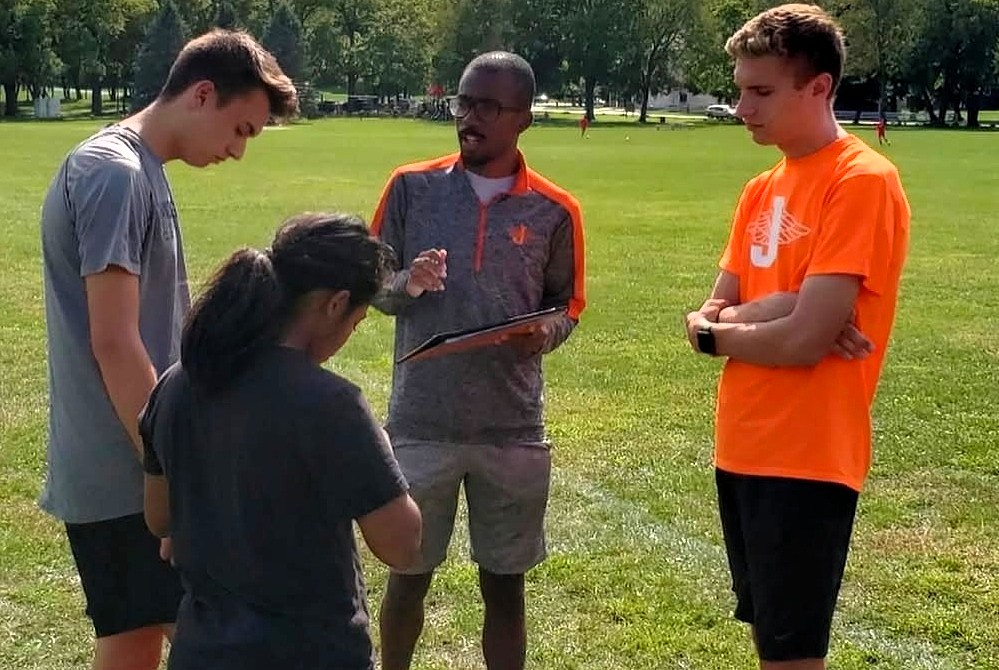
PHOTOS (Top) Nathan Martin, middle with clipboard, coaches his Jackson distance runners. (Middle) Martin poses for a photo with a community award he received from the school. (Photos courtesy of Nathan Martin.)