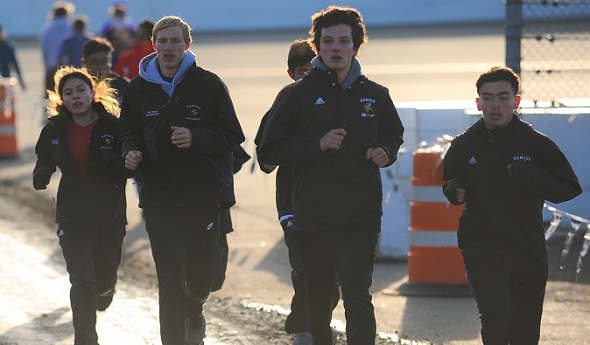
Workout Basics: Warm-Ups & Cool-Downs

February 3, 2021

By Nick Parkinson, M.Ed., AT, ATC, TSAC-F
Henry Ford Health Systems

You may know a good warm-up — and cool-down — are essential to getting a good workout. You may also know that warming up your muscles and stretching them out after exercise can help prevent injury and keep you at the top of your game.

They’re the two bookends that help maximize a workout. Unfortunately, a lot of exercise enthusiasts don’t know how to warm up and cool down correctly.

Warm-Up Basics

A warm-up is exactly what it sounds like: The goal is to warm up your muscles and prepare your body for whatever you’re asking it to do. Warming up increases your body temperature and helps blood flow to the muscles that you’re using.

So if you’re going to play soccer, your warm-up should touch all of the muscles in your legs and core. Shooting hoops? You’ll need to add shoulders and arms to your routine. Circuit training at the gym? Choose a warm-up that flexes all of the muscles you’re about to use.

The thing that all warm-ups have in common is that they require dynamic (or constantly moving) motion, not static stretching (holding poses for a certain amount of time). In fact, static stretching prior to a workout can inhibit power and strength, especially if you’re doing something like weightlifting.

The anatomy of a solid warm-up:

• Before any activity, do about 10 minutes of light cardiovascular activity, whether walking, biking or jogging.

• Dynamic stretches. After you get your muscles moving, do a series of lunges, jumping jacks or toe touches to stretch a bit.

• Dive in. When you start your workout, begin slowly and gradually increase power and speed.

Cool-Down Basics

After you’ve put your body through a challenge, a good cool-down is essential. It helps slow down your heart rate gradually, relax your muscles and stretch them out.

Cool-down routines should always include some type of motion before you get to static stretching, especially if you’ve just finished a high-intensity workout. Static stretching improves flexibility and performance and it can also help stave off future injury.

As with warm-ups, the right cool-down exercises depend on the activity you engaged in. If you biked for 20 miles, you might coast on your cycle for a while before coming to a stop. If you ran, you might jog or walk before you begin stretching. As with your warm-up, the key is addressing every muscle group you worked during your workout.

The anatomy of a solid cool-down:

• At the end of your workout, slow the pace and intensity of whatever activity you’re doing. So, if you’re running, slow to a jog and then a walk for 5 to 10 minutes before stopping.

Stretch out the muscles you work, but don’t push past the point where you feel tight. Then, hold the position for at least 30 seconds. That’s how long it takes for the body to overcome its stretch reflex.

• Breathe through your stretches and make sure to finish your cool-down with deep, belly breaths.

Running short on time? Target muscle groups you may have injured in the past or that tend to get sore after activity. Cooling down will preserve your athleticism — and your ability to participate in daily activities — over the long term.

Be Good to Your Body

While there’s some controversy about whether warming up and cooling down can help prevent injury, there’s little dispute that they can help you ease in and out of activity.

The key is to find something that works for you. Your warm-up could be as simple as walking to the gym and doing a set of jumping jacks when you arrive. Your cool-down might just involve ending your workout 10 minutes early so you can slow down.

It doesn’t have to be complicated. It just has to give your heart and blood vessels a chance to breathe before and after activity.

Nick Parkinson, M.Ed., AT, ATC, TSAC-F, is the Supervisor of Athletic Training with Henry Ford Sports Medicine and also leads Sports Performance training at the William Clay Ford Center for Athletic Medicine. Learn more about Nick.

Want to learn more? Henry Ford Health System sports medicine experts are treating the whole athlete, in a whole new way. From nutrition to neurology, and from injury prevention to treatment of sports-related conditions, they can give your athlete a unique game plan.

Visit henryford.com/sports or call (313) 972-4216.

Century of School Sports: Predecessors Laid Foundation for MHSAA's Formation

By Geoff Kimmerly
MHSAA.com senior editor

January 14, 2025

We have celebrated throughout this school year the 100th anniversary of the Michigan High School Athletic Association – our “Century of School Sports.” But the first high school sports in this state were being played more than a half-century before the MHSAA was established in December 1924 – and it’s important to recognize our predecessor organizations for their pioneering work.

To keep things very brief, it’s fair to say that high school athletics in Michigan followed the increase in number high schools across the state – especially public schools – as well as interest in sports predominantly at the college level.

In lieu of citing detail by detail, the following is based on research from “Athletics in Michigan High Schools – The First Hundred Years” by L.L. Forsythe, who served as the first president of the MHSAA Representative Council after playing a leading role in its creation as an officer of the previous Michigan Interscholastic Athletic Association. Newspaper reports of the day also contributed to what's summarized below.

It is also key to keep in mind a few things about the organizations that regulated high school athletics before the MHSAA, and to understand their relation to our work today:

  • Schools at the start of organized athletics sought primarily to create competitive equity and a safe playing environment for their teams and athletes.
  • Schools looked to the statewide organization to uphold and consider appeals for those rules regulating eligibility and fair play.
  • Schools later asked for the statewide organization to take over sponsorship of the statewide championship events that began to crop up over the 30 years before the MHSAA formed.

According to Forsythe’s research, the first public high schools in Michigan opened during the middle of the 19th century – as of 1850, only 3-4 existed, but after the Civil War that number began to grow, and with it an interest in athletics as part of student life. Football and baseball were main draws, later to be joined by basketball and track & field – which would be among the MHSAA’s first championship offerings several years later.

The Beginning (1895-1909)

Forsythe notes that 1895 saw the first steps toward regulating high school athletics on a statewide basis. A few entities took on roles in an attempt to bring structure.

  • The Michigan State Teachers Association, which in 1895 began to recruit schools to become part of an organization that would require eligible athletes to be enrolled students, succeeding academically with at least a “passing grade,” and participating in no more than five seasons or years of a sport. However, the MSTA did not have a program of activities, as those of the day were generally organized by universities.
  • The University Athletic Association was formed by University of Michigan in 1898, and was the main organizer of invitational “state” championships in partnership with the MSTA.
  • Another organization, the Michigan Inter-School Athletic Association, also pops up in 1895 as the host of what aspired to be an annual field day.

Michigan Interscholastic Athletic Association (1909-1924)

The Michigan Schoolmasters’ Club absorbed control of athletics from the MSTA in April 1909, forming the MIAA and immediately introducing a series of regulations including an age limit of 21 years old, an eligibility limit of four years, and a restriction on participation by athletes who had competed professionally.

The MIAA would continue to set other eligibility rules, charge dues ($1), and also write into bylaws that member schools could play only member schools. That latter detail was a big driver of growth – the revised MIAA constitution in 1921 added that regulation, and the association grow from 26 schools in 1920 to 130 in 1921, to 284 in 1922 to 305 schools in 1923.

On the event side, the MIAA conducted its first state track meet in 1912, then did so coordinating with Michigan State College. The 1921 basketball tournament saw the first mention of classes – Class B for schools with 250 or fewer students, and Class A for schools with more than 250.

It should also be noted that during the early 1920s, MIAA representatives helped form the organization (first of Midwest states) that would become the National Federation of State High School Associations (NFHS) – which continues to write game rules for nearly all MHSAA sports.

The MIAA continued operating into its annual meeting in December 1923, when leaders were presented with an unwelcome surprise announcement – the Michigan legislature, at the close of its recent session, had transferred supervision of interscholastic athletics to the state Superintendent of Public Instruction (to the superintendent's surprise as well, Forsythe noted).

The negotiations between schools and the state over the following year resulted in the dissolution of the MIAA on Dec. 5, 1924 – and the first meeting of the MHSAA eight days later.

Previous "Century of School Sports" Spotlights

Jan. 9: MHSAA Blazes Trail Into Cyberspace - Read
Dec. 31: 
State's Storytellers Share Winter Memories - Read
Dec. 17: 
MHSAA Over Time - Read
Dec. 10:
On This Day, December 13, We Will Celebrate - Read
Dec. 3:
MHSAA Work Guided by Representative Council - Read
Nov. 26: 
Finals Provide Future Pros Early Ford Field Glory - Read
Nov. 19:
Connection at Heart of Coaches Advancement Program - Read
Nov. 12:
Good Sports are Winners Then, Now & Always - Read
Nov. 5:
MHSAA's Home Sweet Home - Read
Oct. 29:
MHSAA Summits Draw Thousands to Promote Sportsmanship - Read
Oct. 23:
Cross Country Finals Among MHSAA's Longest Running - Read
Oct. 15:
State's Storytellers Share Fall Memories - Read
Oct. 8:
Guided by 4 S's of Educational Athletics - Read
Oct. 1:
Michigan Sends 10 to National Hall of Fame - Read
Sept. 25: MHSAA Record Books Filled with 1000s of Achievements - Read
Sept. 18:
Why Does the MHSAA Have These Rules? - Read
Sept. 10: 
Special Medals, Patches to Commemorate Special Year - Read
Sept. 4:
Fall to Finish with 50th Football Championships - Read
Aug. 28:
Let the Celebration Begin - Read