

Be the Referee: Baseball Pitch Count
By
Paige Winne
MHSAA Marketing & Social Media Coordinator
May 7, 2024
Be The Referee is a series of short messages designed to help educate people on the rules of different sports, to help them better understand the art of officiating, and to recruit officials.
Below is this week's segment – Baseball Pitch Count - Listen
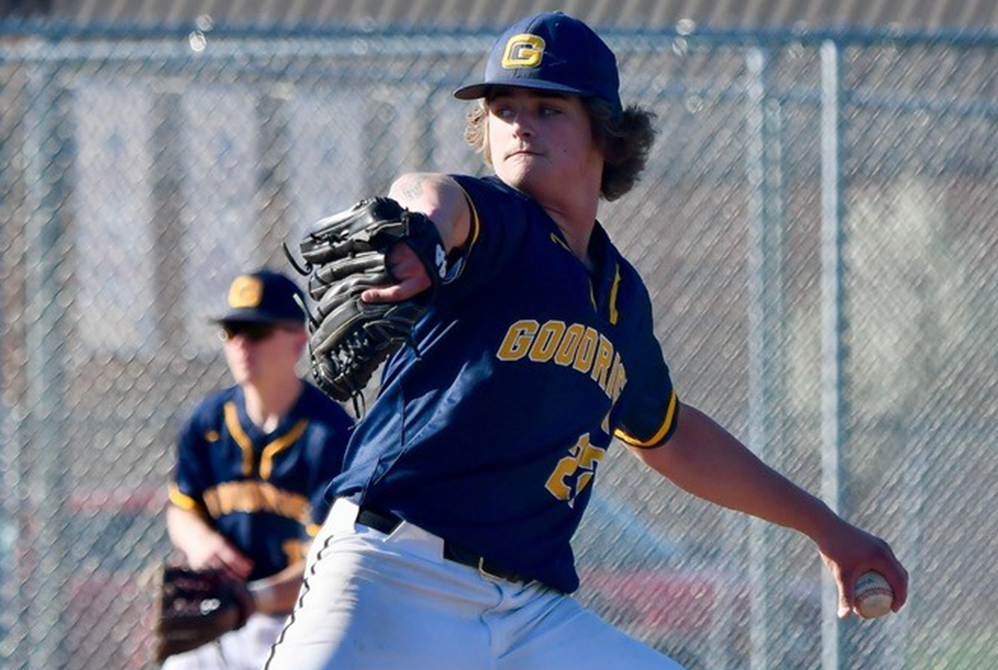
Do you know the pitch count limits for high school baseball in Michigan?
- If a pitcher throws 25 pitches or less, he can throw again the next day with no rest.
- If 26 to 50 pitches are thrown, one day of rest is required.
- 51 to 75 pitches require two days of rest.
- And throwing 76 or more pitches requires three days of rest.
The maximum pitch count for one day is 105 pitches. But if pitch number 105 occurs during the middle of an at-bat, the pitcher can finish that at-bat, but then must be taken out.
Teams are required to track all pitch counts and indicate before a game who is ineligible to pitch that day.
In the postseason, a neutral person tracks the pitch count. If a violation occurs, the pitcher becomes ineligible, and his team forfeits the game he pitched in.
Previous Editions
April 30: Boys Lacrosse Helmets - Listen
April 23: Softball Interference - Listen
April 16: Soccer Red Card - Listen
April 9: Batted Baseball Hits Runner - Listen
March 12: Basketball Replay - Listen
March 5: Hockey Officials - Listen
Feb. 27: Less Than 5 - Listen
Feb. 20: Air Ball - Listen
Feb. 13: Hockey Penalties - Listen
Jan. 30: Wrestling Tiebreakers - Listen
Jan. 23: Wrestling Technology - Listen
Jan. 9: 3 Seconds - Listen
Dec. 19: Unsuspecting Hockey Hits - Listen
Dec. 12: No More One-And-Ones - Listen
Nov. 21: Football Finals Replay - Listen
Nov. 14: Volleyball Unplayable Areas - Listen
Nov. 7: Pass/Kick Off Crossbar - Listen
Oct. 31: Cross Country Interference - Listen
Oct. 24: Soccer Overtime - Listen
Oct. 17: Tennis Spin - Listen
Oct. 10: Blocked Kick - Listen
Oct. 3: Volleyball Double & Lift - Listen
Sept. 26: Registration Process - Listen
Sept. 20: Animal Interference - Listen
Sept. 13: Feet Rule on Soccer Throw-In - Listen
Sept. 6: Volleyball Jewelry - Listen
Aug. 30: Football Rules Similarities - Listen
Aug. 23: Football Rules Differences - Listen
Be the Referee: Puck on Goal Netting
By
Paige Winne
MHSAA Marketing & Social Media Coordinator
December 9, 2025
Be The Referee is a series of short messages designed to help educate people on the rules of different sports, to help them better understand the art of officiating, and to recruit officials.
Below is this week's segment – Puck on Goal Netting - Listen
We’re on the ice today, where after being last touched by Team A, the puck comes to rest on top of the goal netting. What happens?
New this year in high school ice hockey: If a puck is on the top of the goal netting, it’s an immediate stoppage. The puck is considered out of play.
It goes back into play via a faceoff from the nearest faceoff dot in the defending team’s zone.
Why the change from previous years? Because a puck on top of the netting creates too many problematic scenarios to be considered playable – you could have high sticking, closed hand (handling of the puck), goalkeeper contact or player-in-the-goal-crease.
If the puck is on top of the goal netting, blow the whistle and resume with a faceoff.
Previous 2025-26 editions
Dec. 2: Goaltending vs. Basket Interference - Listen
Nov. 25: Football Finals Instant Replay - Listen
Nov. 18: Volleyball Libero Uniforms - Listen
Nov. 11: Illegal Substitution/Participation - Listen
Nov. 4: Losing a Shoe - Listen
Oct. 28: Unusual Soccer Goals - Listen
Oct. 21: Field Hockey Penalty Stroke - Listen
Oct. 14: Tennis Double Hit - Listen
Oct. 7: Safety in Football - Listen
Sept. 30: Field Hockey Substitution - Listen
Sept 23: Multiple Contacts in Volleyball - Listen
Sept. 16: Soccer Penalty Kick - Listen
Sept. 9: Forward Fumble - Listen
Sept. 2: Field Hockey Basics - Listen
Aug. 26: Golf Ball Bounces Out - Listen
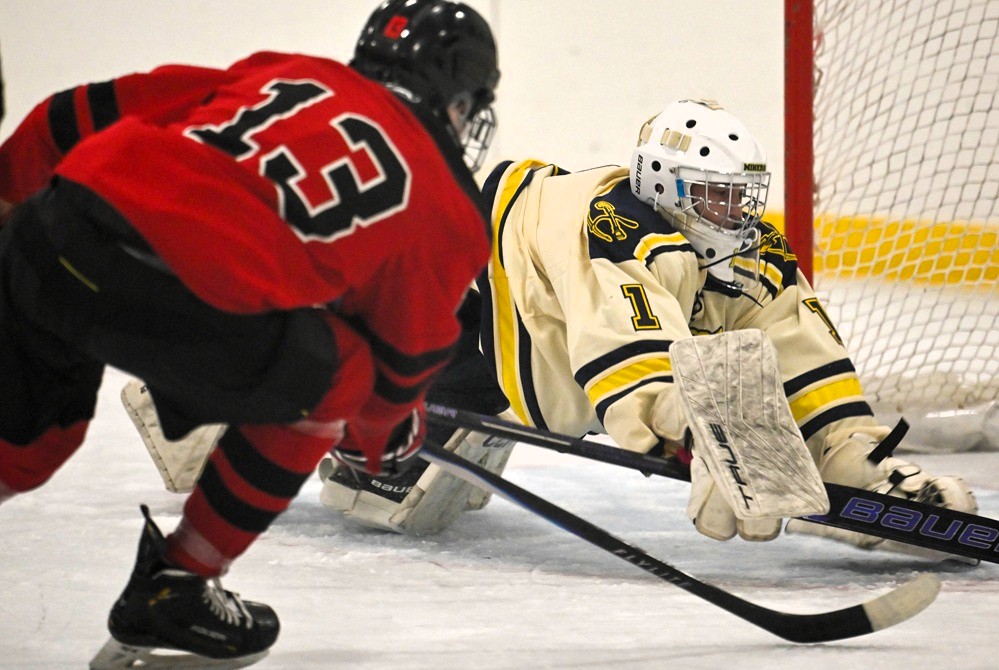
PHOTO Marquette's Skyler Blackburn and Negaunee goalie Kurt O'Brien scramble for the puck during a Nov. 8 matchup. (Photo by Randy Ritari.)