

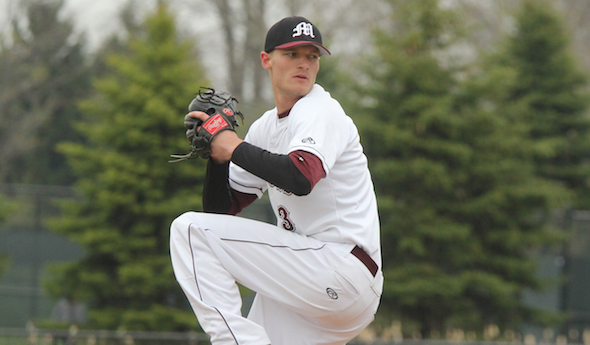
Performance: Holland Christian's Mike Mokma
April 29, 2016
 Mike Mokma
Holland Christian senior – Baseball
Mokma has accomplished more than most during a varsity career now in its fourth season. But until last week, he’d never achieved perfection. The 6-foot-6 right-hander struck out eight of the first nine Holland batters he faced April 19 in tossing his first perfect game, a 3-0 victory that also has earned him the Michigan National Guard Performance of the Week.
Mokma has helped his team to District championships the last two seasons, and last spring despite an injury that briefly kept him off the mound – although he still contributed as the team’s first baseman. He’s back to full strength and has started this season 4-0 with a save, an ERA of 0.53 and 40 strikeouts against only three walks, and while also hitting .425 with 12 runs batted in. He’s been clocked on the mound consistently in the high 80s, topping out at 91 mph, and mixes in a curve that drops from the top of the zone and a slider that rips across the plate. Over the last three seasons, Mokma is 12-3 with a 1.07 ERA and 153 strikeouts with only 24 bases on balls; he’s also hit .410 with 17 doubles, three triples and three home runs. He finished his perfect game with 15 strikeouts, and Holland Christian now stands 14-2.
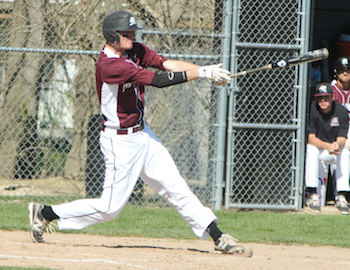
 Also the center on the Maroons' basketball team, Mokma has had his heart set on a college baseball career since elementary school and committed to Michigan State University during the fall of his sophomore year. He carries a 3.3 grade-point average and will major in kinesiology – but has some unfinished business first as he hopes to help a strong senior class carry the team into this season’s final week for the first time since 2006.
Coach Jim Caserta said: “When your best pitcher is a leader, it sets the tone for the whole team. We have a lot of confidence when Mike is on the mound. There’s some pressure that comes with that, but he’s handled that great. He’s contributed not only pitching, but batting as well. But more importantly than that, he’s supported his teammates. Really this year, he’s seen the importance of being a senior leader and taking ownership of the team. We have a nice group of seniors; Mike has contributed a lot the last four years, obviously, and for him and the other seniors being the guys leading the team, it's great. He’s a baseball guy. He studies the game and he’s been around it a lot, and that carries over to his teammates.”
Performance Point: “It was always a childhood dream of mine to throw (a perfect game), and I had put a lot of work into it. I didn’t know (I was close) until the seventh inning, to be honest. With one out, there was a ground ball to second base and our second basemen (Brandon Riemersma) made a heck of a play on it. Our third baseman (Josh Sternberg) turned to me and took a huge deep breath and said, ‘You’ve got a perfect game going.’ From there, the adrenaline started pumping a little bit. … The pitch calls, our catcher (David Williams) did a heck of a job with that; it was probably the best game he’s ever called. Our coach had a big deal with that too, suggesting stuff to throw. The off-speed, the curveball, was probably the best it’s ever been.”
Swing and miss: “Besides the fastball, (my favorite pitch) is probably the slider. Just to see the swings and misses on it, they’re not always the prettiest.”
Dreams come true: “I’ve wanted to go somewhere for baseball since I was 6 or 7. It’s just been a dream of mine. My dad (Scott Mokma) played baseball through high school, and it was a big thing for me. … (MSU) is where I always wanted to go. My grandpa (Earl Mokma) was a big Spartan fan, my dad is a big Spartan fan, and I grew up a big Spartan fan. When they called and I got the offer, it was a no-doubter.”
 Lead the way: “The goal has been to win in Districts and Regionals, but we have a long way to go to get there. We have to put in a lot of work, but it’s been a good year so far; we know where we want to be, and we’ve got to put in a lot of work the next couple of weeks. I’ve been given a leadership role, and our coach has stepped back and told us seniors to take over with that. When someone isn’t hustling, he tells us to get on them. We ask them where they want to be in life, where they need to be specifically in baseball for us to be able to win. They usually get on it.”
Changing lives: “I want to do something with physical therapy or be a massage therapist. I’ve been going to a guy in Zeeland who is a massage therapist and I’ve gotten to know the guy really well, and it interests me. You can do a lot of different things, not just work on people, but see how their lives are and make a difference in their lives.”
– Geoff Kimmerly, Second Half editor
Every week during the 2015-16 school year, Second Half and the Michigan National Guard will recognize a “Performance of the Week" from among the MHSAA's 750 member high schools.
The Michigan Army National Guard provides trained and ready forces in support of the National Military Strategy, and responds as needed to state, local, and regional emergencies to ensure peace, order, and public safety. The Guard adds value to our communities through continuous interaction. National Guard soldiers are part of the local community. Guardsmen typically train one weekend per month and two weeks in the summer. This training maintains readiness when needed, be it either to defend our nation's freedom, or protecting lives and property of Michigan citizens during a local natural disaster.
Previous 2015-16 honorees
April 20: Abby Divozzo, Cadillac girls soccer - Read
March 30: Cassius Winston, Detroit U-D Jesuit boys basketball - Read
March 23: Kierra Fletcher, Warren Cousino girls basketball - Read
March 16: Jacob Montague, Grosse Pointe South swimming & diving - Read
March 9: Kyle Tuttle, St. Charles boys bowling - Read
March 2: Brittney Schnicke, Caledonia girls bowling - Read
Feb. 24: Kamari Newman, Detroit East English boys basketball - Read
Feb. 17: Jason Whitens, Powers North Central boys basketball - Read
Feb. 10: Rachel Hogan, Grand Ledge gymnastics - Read
Feb. 3: Nehemiah Mork, Midland Dow swimming & diving - Read
Jan. 27: Mardrekia Cook, Muskegon girls basketball - Read
Jan. 20: Sage Castillo, Hartland wrestling - Read
Jan. 13: Rob Zofchak, Dexter swimming & diving - Read
Jan. 6: Tyler Deming, Caro wrestling – Read
Dec. 15: Jordan Weber, East Jordan boys basketball – Read
Dec. 8: Kaitlyn Geers, Kent City girls basketball – Read
PHOTOS: (Top) Mike Mokma begins his move toward the plate. (Middle) Mokma also is a top hitter and plays first base when he's not on the mound. (Photos by BKBrewer Photography.)
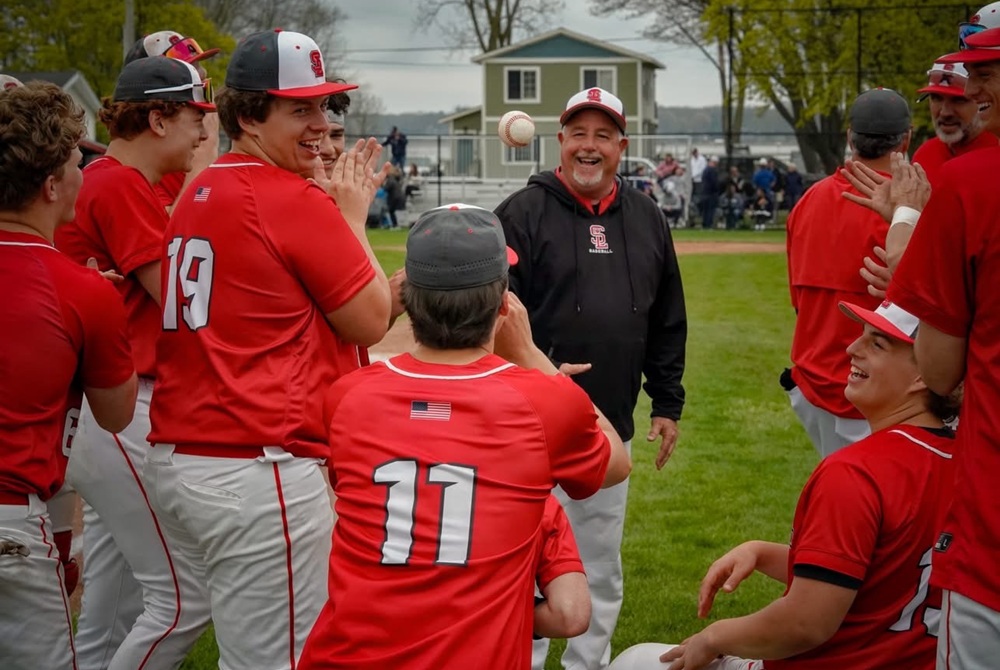
Senior-Powered Spring Lake Answering Anticipation, Pursuing High Expectations
By
Dean Holzwarth
Special for MHSAA.com
April 29, 2026
SPRING LAKE – The time is now for the Spring Lake baseball team.
 With the return of 11 veteran seniors, the Lakers entered this spring with lofty expectations and an eye on an extended postseason run.
Anticipation has come to fruition in the form of a state ranking and a nearly perfect start.
“Our motto is we are going to worry about next year next year, and we are going to do all we can this year,” Lakers fourth-year coach Bill Core said. “We knew we were going to have a big experienced group coming back, and that's just how the roster folded out. We have a lot of experience, a lot of returners and pretty high expectations.”
Spring Lake, which finished as Division 2 runner-up in 2024 and won a conference title last year for the first time since 2014, is off to an impressive 13-1 start (9-0 in the Ottawa-Kent Conference Black) and has climbed to No. 7 in the latest coaches poll.
Core said the vast number of returners, which includes five players who will play in college next year, has paid early dividends.
“I think that’s been a big difference,” he said. “We’ve played some younger teams that were breaking in sophomores or juniors or new kids, and our guys were ready to go right from the start. It’s been an advantage early on.”
Senior starting pitchers Oliver Smies and Maddux Kipling believe the strong bond among the senior class has been a major factor in the torrid start.
 “I think something that’s really important about this team is our team chemistry and the amount of seniors we have on the team,” Smies said. “That alone allows us to have a ton of experience, and I think that's a big reason why we are off to such a hot start. We have been playing good team baseball and complementary baseball with good defense and good offense.”
Added Kipling: “We genuinely like being around each other, and every day we show up ready to get a little better. Our team has a real gritty and energetic identity, and I think that shows in how we compete and support each other.”
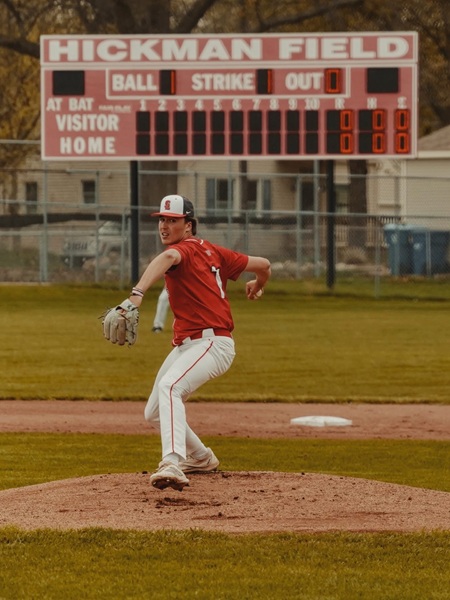
Kipling and Smies have been dominant on the mound this season. They haven’t allowed an earned run while combining for 80 strikeouts. Kipling earned a second-team all-state accolade as a junior and is headed to Michigan State next year. Smies will play at Calvin University.
“It starts with our pitching,” Core said. “Any time you are going to make a run, it starts with your pitching and we are pretty lucky, especially with our top two.”
Offensively, the Lakers possess a balanced lineup and boast a .330 batting average.
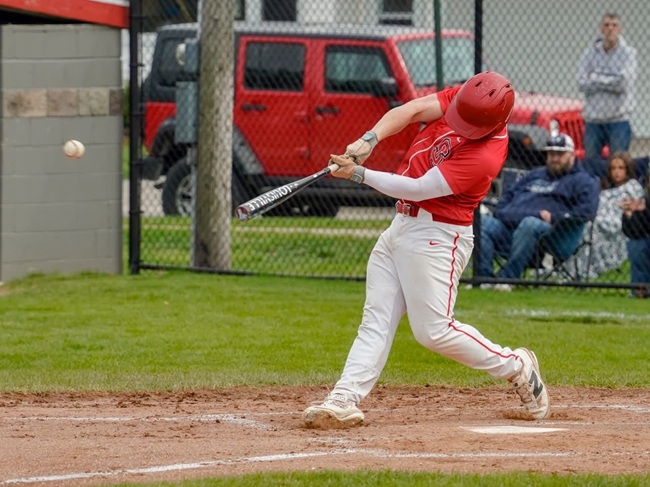
Senior Owen Smies, who will join his twin brother at Calvin, is hitting a team-best .432 with 13 RBIs. Seniors Alex Strauss (Adrian College) and Max Feltner (Muskegon Community College) are both batting .333 and have combined to score 25 runs.
As a team, Spring Lake has produced eight shutouts and nine wins by run differential.
“We got off to a good start, but we are going to play a lot better competition,” Core said. “This is a good week for us because we play Northview and state-ranked East Grand Rapids. We just picked them up, so we were excited to fill in the week with those two schools.”
Spring Lake is 62-6 over its last 68 games and trying to remain focused on each game as it attempts to erase the disappointment of last year’s early exit from the postseason.
 Despite winning 30 games, the Lakers suffered a 3-2 loss to Grand Rapids West Catholic in District play.
“I think there is some motivation there from that loss,” Oliver Smies said. “And I think that loss last year taught us that any team can beat any team, so you have to play your best baseball every single game no matter the opponent.”
Core said last year hasn’t been discussed, but believes it still sits in the back of his players’ minds.
“I think they think about that, but we've had quite a few mercies to start the season, and I said to them that when we get to the tournament it's going to be a one-run game and we are going to have to do the little things to make a difference because we are not going to win 14-0 all the time,” he explained. “We try to keep everyone in the moment.”
Kipling isn’t dwelling on the past – or looking too far ahead.
“As a group we’ve done a great job staying focused on the present and not getting caught up in the past or worrying too much about the future,” Kipling said. “My dad has always told me to focus on what you can control because putting energy into things you can’t control is a waste.
"That mindset has stuck with me, especially on the field. I try to live by ‘one pitch at a time,’ and because of that I haven’t really spent time thinking about last year’s loss. That’s behind us, and we’re just focused on what we can do right now.”
 Dean Holzwarth has covered primarily high school sports for Grand Rapids-based WOOD-TV for five years after serving at the Grand Rapids Press and MLive for 16 years along with shorter stints at the Ionia Sentinel and WZZM. Contact him at [email protected] with story ideas for Allegan, Kent and Ottawa counties.
PHOTOS (Top) Spring Lake baseball coach Bill Core tosses Maddux Kipling his home run ball after a win over Fruitport. (Middle) Kipling pitching at Spring Lake's Hickman Field. (Below) Senior Oliver Smies connects with a pitch. (Photos by Trevor McCue/Grand Haven Tribune.)