

Softball Standout Finds New Home in Addison Baseball Lineup
By
Doug Donnelly
Special for MHSAA.com
April 23, 2024
ADDISON – Alisha Gahn has a new bat, new mitt, and new uniform this season.
 The Addison senior didn’t transfer schools or move into a new district. She picked up a new sport – baseball.
“She’s doing really well,” said Addison head coach Rick Gramm. “She’s adjusted just fine.”
Gahn has had a love for softball from a young age and jumped into recreation and travel leagues early on while starting to pitch to her dad, Kelly.
She played for three years with the Addison varsity with her dad a co-head coach. When Addison decided to re-post the coaching job this past offseason, Kelly said he stepped aside. In the aftermath, Alisha decided to not play softball for Addison this spring.
Baseball became a possibility, and Kelly Gahn told his daughter he’d support whatever she decided.
“I just wanted to do something,” Alisha Gahn said. “I didn’t want to sit around and be sad that I didn’t play softball.”
She started attending Addison’s offseason baseball workouts.
“She told me she was leaning toward playing baseball rather than softball,” Gramm said. “We talked about it and checked into it. Opening day came, she showed up to the tryouts and she did well in the cage, and she throws the ball well.
“She’s just got a mind for the game. The rules of baseball and softball are basically the same, so she knows what she is doing out there.”
Gahn, who recently turned 18, is having a blast.
In a doubleheader against Tekonsha on Friday, Gahn went 2-for-3 at the plate. She’s playing mainly rightfield but also has been penciled into the Panthers lineup as a designated hitter.
The biggest thing for her personally is she’s no longer a pitcher. Last year she went 12-6 with 177 strikeouts in 107 innings for the Addison softball team in earning a Division 4 all-state honorable mention.
“Pitching is my thing,” she said. “That’s what I’ve done for years. That is what I did. That was my place on a team. That’s not my place in baseball.
It took some time to adjust to high school baseball pitching as well.
“The hitting is definitely different,” she said. “But I think that is what we work on as a team the most, so that helps.”
Gramm said Gahn - who hit .357 in 115 at-bats in softball last year - can hit on this diamond as well.
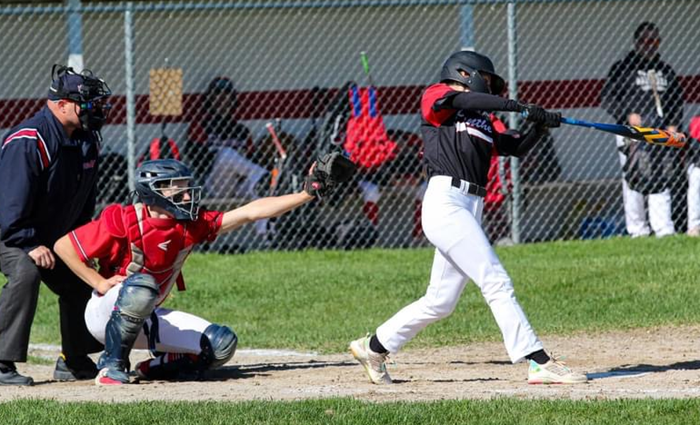 “We didn’t know how she would adjust to the pitching – the smaller ball, the distance (from the pitcher’s mound to home plate). She connects. She puts the ball in play. She does very good at the plate.”
Gahn said she likes baseball so far. She's even adjusting to her new mitt.
“I always knew there were differences between baseball and softball,” she said. “Whenever I watch Major League Baseball on TV, it looks like a bunch of guys trying to get home runs. After playing it, I like it. It’s pushed me and forced me to grow in the other positions.”
One of main differences is on the basepaths.
“On Friday, I got a hit and got on base,” she said. “My first base coach was talking to me. I got a little bit distracted, and I got picked off. I definitely learned something.”
Gahn said her new teammates have been great.
“Getting to know how to interact with a team of guys is different,” she said. “I have to find ways to connect with them. We are all playing the same sport, though. We are just players on the same team, just playing baseball. It’s slowly getting more comfortable. (But) there are times I miss playing on a team of girls.”
“She fits in just fine,” Gramm said of her move to baseball. “She’s part of the guys and part of the team. They just want to play and just want to win. The team has taken to her. They know her, and she’s part of that senior group anyways. I think she is having a good, fun time. It hasn’t been much of a transition at all. She’s been a welcome addition.”
Softball is still part of Gahn’s life.
Missouri is one of the few states that plays softball in the fall, which means travel softball season is in the spring. Gahn and her family pack up on the weekends and head south to play on a travel team, something the MHSAA allows since she is not currently playing softball in Michigan. It’s a seven-hour drive, one way.
“At first I was just going to go down south on the weekends and play softball,” she said. “Then I got to thinking what about baseball. We looked it up, went through the rules and it worked out perfectly. The MHSAA says softball is not the same sport as baseball. I can play baseball for Addison and go down south to play softball.”
Gahn, who also dances competitively and golfs – she tied for 18th in the latter at the Lower Peninsula Division 4 Final in the fall – wants to play softball in college. She’s talked to a few coaches, she said, who are supportive of her decision to play baseball this spring.
“I’ve put so much work into softball,” she said. “College is the next step for me. I’m super excited. At the end of the day, I just want to play softball.”
Gahn said her and her family did have a conversation about moving to a new district, but she was against that.
“I just want to graduate with my friends,” she said. “Sports are important to me, but I didn’t want to uproot my life. The easiest decision might have been to just move and go somewhere else. I didn’t want to do that. I’m happy right now.”
 Doug Donnelly has served as a sports and news reporter and city editor over 25 years, writing for the Daily Chief-Union in Upper Sandusky, Ohio from 1992-1995, the Monroe Evening News from 1995-2012 and the Adrian Daily Telegram since 2013. He's also written a book on high school basketball in Monroe County and compiles record books for various schools in southeast Michigan. E-mail him at [email protected] with story ideas for Jackson, Washtenaw, Hillsdale, Lenawee and Monroe counties.
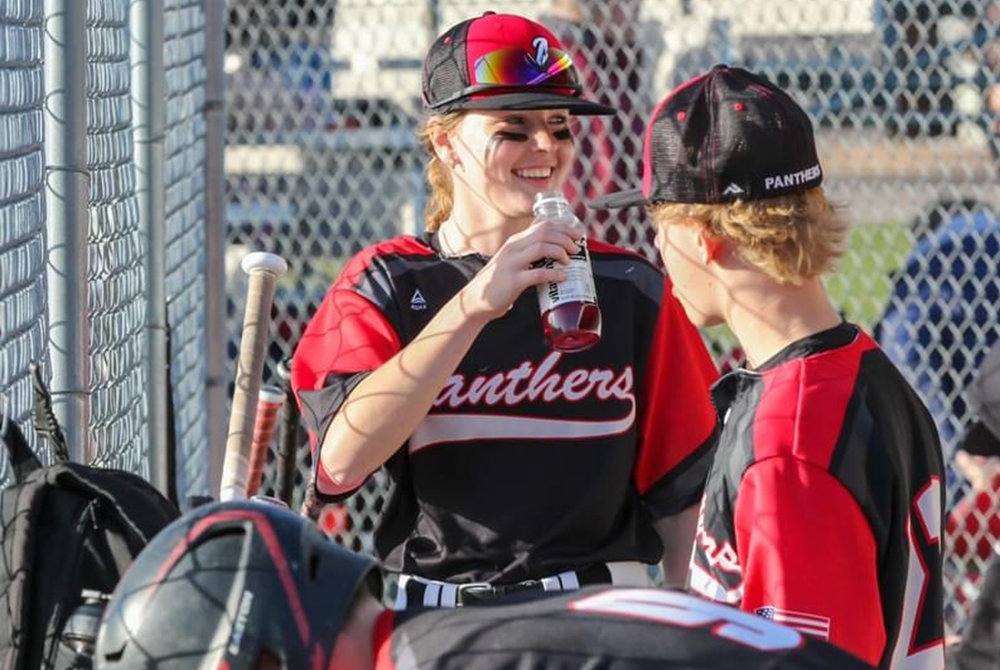
PHOTOS (Top) Alisha Gahn hangs out with her baseball teammates in the dugout this season. (Middle) Gahn, at bat, steps into a swing. (Photos courtesy of Kelly Gahn.)
Senior-Powered Spring Lake Answering Anticipation, Pursuing High Expectations
By
Dean Holzwarth
Special for MHSAA.com
April 29, 2026
SPRING LAKE – The time is now for the Spring Lake baseball team.
 With the return of 11 veteran seniors, the Lakers entered this spring with lofty expectations and an eye on an extended postseason run.
Anticipation has come to fruition in the form of a state ranking and a nearly perfect start.
“Our motto is we are going to worry about next year next year, and we are going to do all we can this year,” Lakers fourth-year coach Bill Core said. “We knew we were going to have a big experienced group coming back, and that's just how the roster folded out. We have a lot of experience, a lot of returners and pretty high expectations.”
Spring Lake, which finished as Division 2 runner-up in 2024 and won a conference title last year for the first time since 2014, is off to an impressive 13-1 start (9-0 in the Ottawa-Kent Conference Black) and has climbed to No. 7 in the latest coaches poll.
Core said the vast number of returners, which includes five players who will play in college next year, has paid early dividends.
“I think that’s been a big difference,” he said. “We’ve played some younger teams that were breaking in sophomores or juniors or new kids, and our guys were ready to go right from the start. It’s been an advantage early on.”
Senior starting pitchers Oliver Smies and Maddux Kipling believe the strong bond among the senior class has been a major factor in the torrid start.
 “I think something that’s really important about this team is our team chemistry and the amount of seniors we have on the team,” Smies said. “That alone allows us to have a ton of experience, and I think that's a big reason why we are off to such a hot start. We have been playing good team baseball and complementary baseball with good defense and good offense.”
Added Kipling: “We genuinely like being around each other, and every day we show up ready to get a little better. Our team has a real gritty and energetic identity, and I think that shows in how we compete and support each other.”
Kipling and Smies have been dominant on the mound this season. They haven’t allowed an earned run while combining for 80 strikeouts. Kipling earned a second-team all-state accolade as a junior and is headed to Michigan State next year. Smies will play at Calvin University.
“It starts with our pitching,” Core said. “Any time you are going to make a run, it starts with your pitching and we are pretty lucky, especially with our top two.”
Offensively, the Lakers possess a balanced lineup and boast a .330 batting average.
Senior Owen Smies, who will join his twin brother at Calvin, is hitting a team-best .432 with 13 RBIs. Seniors Alex Strauss (Adrian College) and Max Feltner (Muskegon Community College) are both batting .333 and have combined to score 25 runs.
As a team, Spring Lake has produced eight shutouts and nine wins by run differential.
“We got off to a good start, but we are going to play a lot better competition,” Core said. “This is a good week for us because we play Northview and state-ranked East Grand Rapids. We just picked them up, so we were excited to fill in the week with those two schools.”
Spring Lake is 62-6 over its last 68 games and trying to remain focused on each game as it attempts to erase the disappointment of last year’s early exit from the postseason.
 Despite winning 30 games, the Lakers suffered a 3-2 loss to Grand Rapids West Catholic in District play.
“I think there is some motivation there from that loss,” Oliver Smies said. “And I think that loss last year taught us that any team can beat any team, so you have to play your best baseball every single game no matter the opponent.”
Core said last year hasn’t been discussed, but believes it still sits in the back of his players’ minds.
“I think they think about that, but we've had quite a few mercies to start the season, and I said to them that when we get to the tournament it's going to be a one-run game and we are going to have to do the little things to make a difference because we are not going to win 14-0 all the time,” he explained. “We try to keep everyone in the moment.”
Kipling isn’t dwelling on the past – or looking too far ahead.
“As a group we’ve done a great job staying focused on the present and not getting caught up in the past or worrying too much about the future,” Kipling said. “My dad has always told me to focus on what you can control because putting energy into things you can’t control is a waste.
"That mindset has stuck with me, especially on the field. I try to live by ‘one pitch at a time,’ and because of that I haven’t really spent time thinking about last year’s loss. That’s behind us, and we’re just focused on what we can do right now.”
 Dean Holzwarth has covered primarily high school sports for Grand Rapids-based WOOD-TV for five years after serving at the Grand Rapids Press and MLive for 16 years along with shorter stints at the Ionia Sentinel and WZZM. Contact him at [email protected] with story ideas for Allegan, Kent and Ottawa counties.
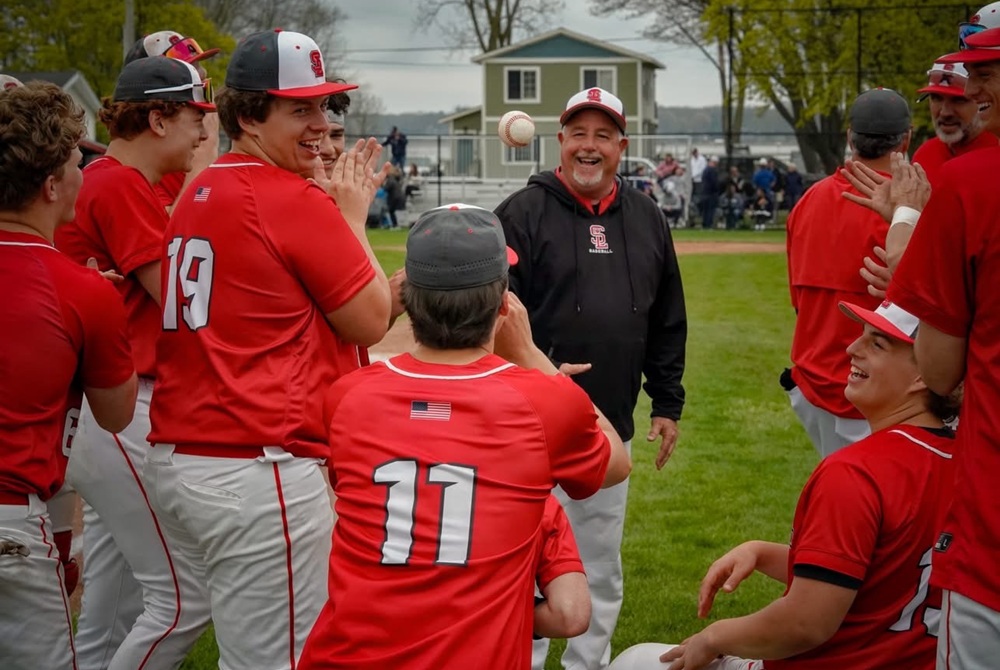
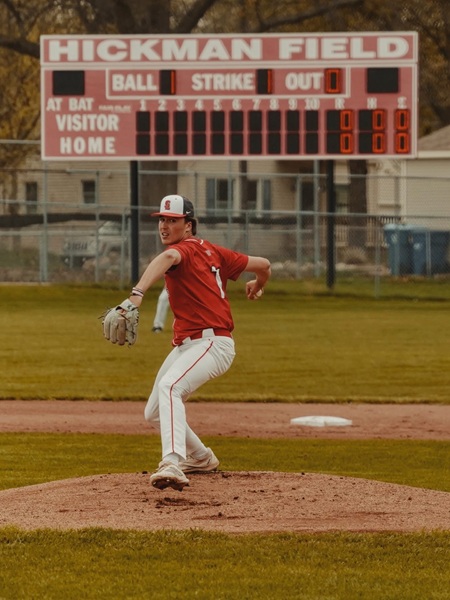
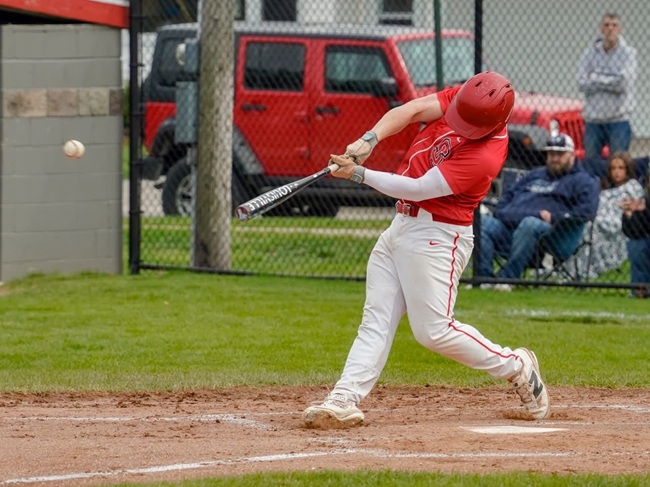
PHOTOS (Top) Spring Lake baseball coach Bill Core tosses Maddux Kipling his home run ball after a win over Fruitport. (Middle) Kipling pitching at Spring Lake's Hickman Field. (Below) Senior Oliver Smies connects with a pitch. (Photos by Trevor McCue/Grand Haven Tribune.)