

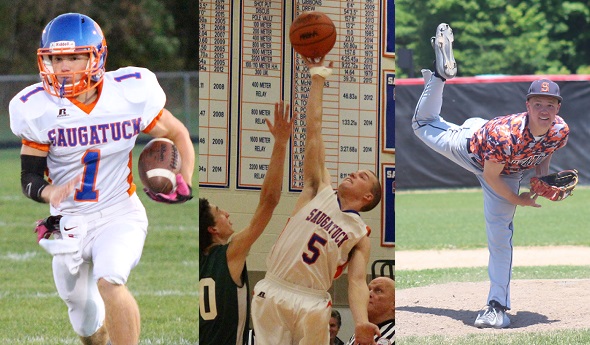
Standout Dunn Does it All for Saugatuck
April 22, 2016
By Dave Sontag
Reprinted from Prep Baseball Report
At times, he wears a uniform under his uniform.
The attire that rests inside his baseball jersey has an “S” on the chest. The “S” should stand for Superman. For Saugatuck multi-athlete Blake Dunn, he doesn’t think playing four varsity sports each school year is newsworthy.
“Personally, I have never wanted to give up on any sports. I have the support from all of the coaches. I never wanted to close the door to any of the sports,” Dunn said.
The talented junior is currently competing on his school’s baseball and track & field teams. He hopes to end his high school career earning 16 varsity letters, an unprecedented feat in Saugatuck history.
Dunn has been the starting quarterback for three years and starred on the basketball court for three winters. In an age when many high school athletes prefer to specialize in one sport, Dunn has a different attitude.
“High school only happens once,” Dunn said. “My parents are behind me and my coaches all support me.”
So how does Dunn prepare for each of his spring sports?
Track coach Rick Bauer allows Dunn to conduct his workouts in the morning – before school. Baseball coach Dave Gawlak then works with Dunn after school on the diamond. Game and meet conflicts are minimal during the spring sports season.
It helps that Saugatuck’s athletic director is Bill Dunn, Blake’s dad. The veteran AD has not scheduled many events when baseball and track are competing on the same day. However, Blake did have to make a decision his freshman year when both the track and baseball teams traveled to Bloomingdale High School on the same day.
Blake said that day at Bloomingdale was the most memorable he has had during his high school career.
“I started off playing baseball that day and singled in my first at bat,” Dunn said. “I then changed into my track uniform and won three straight events.”
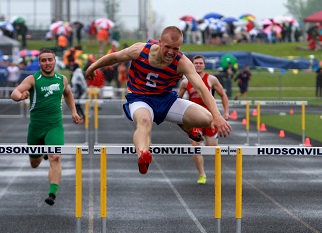
Dunn won the 110-meter hurdles, the 300 hurdles and as part of the 800 relay before changing back into his baseball uniform.
With the “S” etched on his chest, how did Dunn cap his full day of competition?
“I went back to the baseball field and hit a home run in my next at bat,” Dunn said.
Dunn not only intends to earn 16 varsity letters in his high school career, he also has earned all-state recognition in all four sports. He’s also recently been added to the MHSAA football record book for his accomplishments this past season.
Which sport does he like the best?
“I love them all so much. I really don’t know which one is my favorite,” Dunn said.
As an elementary student, Blake grew up on the gridiron with his dad, who is also Saugatuck’s football coach. Being a coach’s son, Blake serves as another coach on the field.
“He’s always hung around the field,” Bill Dunn said. “Ever since second or third grade, Blake has been around me on the football field.”
The 5-foot-11, 180-pounder said there is nothing like “the Friday night lights in football and the Friday night crowds in basketball.”
“I have limited opportunities to play sports. I don’t want to miss out on any of them,” Blake Dunn said.
Demonstrating talent on the basketball court, Dunn scored 51 points against Lawton this winter. He finished his junior year with more than 1,000 career points.
Dunn’s offseason schedule consists of playing travel baseball and working out with the school’s basketball and football teams.
“I don’t wear myself out playing one sport and possibly getting hurt,” Dunn said.
 Dunn does realize that college coaches encourage athletes to play multiple sports. In fact, statistics have proven that high school athletes who specialize in one sport are at an increased risk of injuries – especially knee and hip injuries.
David Bell, a professor of kinesiology and orthopedics and rehabilitation at University of Wisconsin, said after his school completed its recent study “Prevalence of Sport Specialization in High School Athletics” that parents need to be more cognizant of their children specializing in one sport.
Athletes who trained in one sport for more than eight months during the study were more likely to have a history of knee and hip injuries, Bell reported.
The MHSAA also is currently spearheading a task force to promote multi-sport participation.
“For years it seemed educators were alone in promoting the multi-sport experience as the best for young people,” Executive Director Jack Roberts said. “Major college football coaches, members of the USA Women’s World Cup Soccer championship team, Hall of Fame pitcher John Smoltz, PGA golfer Jordan Spieth and others demonstrate to us that the multi-sport experience is the healthiest and happiest way to participate in youth sports.”
While playing four sports has kept Dunn busy athletically, he has been able to keep his grades solid. He holds a 3.95 grade-point average with a rigorous schedule.
The two-way baseball player has made a verbal commitment to play at Western Michigan University after high school. He is not sure if he will continue at WMU on the mound or as a catcher – or both.
“They have talked to me about maybe catching and then closing on the mound,” Dunn said.
Staying close to home does not surprise his dad.
“He’s really a down-home kid,” Bill Dunn said of his son. “The relationship with Billy (Gernon, WMU’s coach) is awesome.
The elder Dunn is proud of his son’s work ethic.
“He has God-given skills, but he works at it.” Bill said. “I remember him coming off of a basketball game on a Friday night and heading to Kalamazoo the next morning at 6:30 to work out for three hours.”
The talented junior has been clocked pitching at 90 mph and ran a 6.7-second 60-yard dash.
The script for Dunn has been storybook-like. Peeling off one uniform only to compete in another sport, he has carved quite an athletic career.
But while Western Michigan is waiting for the multi-talented athlete to finish high school, Blake will continue doing what he does best – performing at the highest level on his way to 16 varsity letters.
PHOTOS: (Top) Dunn has starred in football, basketball and baseball during the 2016-17 school year. (Middle) Dunn also was a Lower Peninsula Division 4 champion last spring in the 300 hurdles and as part of the 1,600 relay. (Top photos courtesy of the Dunn family, middle photo by RunMichigan.com.)
Pickford Boys Dominance not to be Denied as Panthers Extend Title Streak to 5
By
John Vrancic
Special for MHSAA.com
May 31, 2026
KINGSFORD — The Pickford boys continued their winning ways here Saturday, taking home an Upper Peninsula Track & Field Finals championship trophy for the fifth-straight year.
Their current streak started in 2022 when they were still competing in Division 3. Since moving up to D-2, the Panthers have gone 4-for-4.
This time the Panthers scored 139 points, followed by Rudyard with 104 and Bark River-Harris at 77.
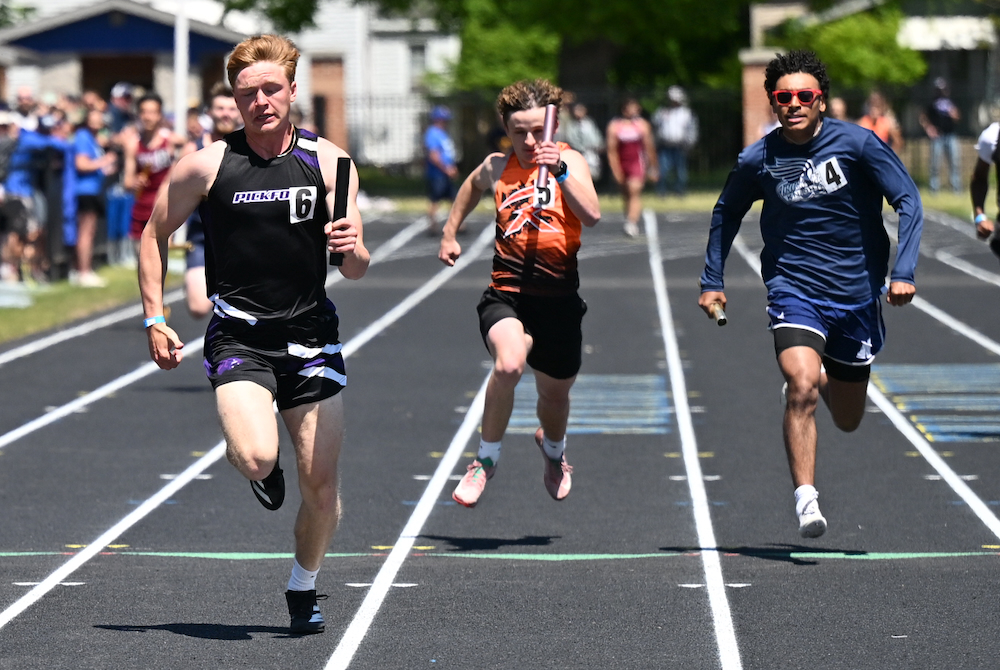
Pickford senior John Anderson became a triple-winner, taking the 300-meter hurdles in a personal-best 42.01 seconds, high jump with a leap of 6-6 and long jump at 20-2½. Classmate Gunner Bennin added a first in the 400 in a season-best 52.54 and helped the Panthers take the 400 relay. He also was runner-up in the 100 (11.57) and 200 (23.25).
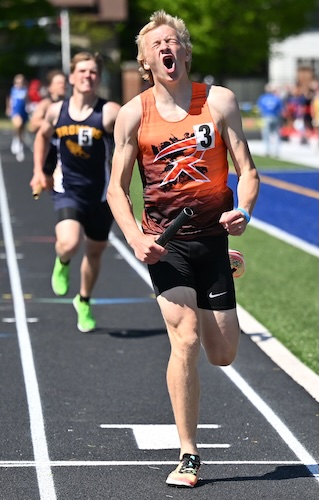 Rudyard senior Steve Kirschner also won three individual events including the 800 in a personal-best 2:04.6, the 1,600 (4:38.99) and 3,200 with a season-best 10:51.37 and helped the Bulldogs capture the 1,600 relay.
In the 3,200, Kirschner was followed by classmate Seth Templeton (11:08.33) and freshman teammate Jack LaLone (11:15.02).
Freshman Jett Sawyer provided the Bulldogs with an additional first with a leap of 11-0 in pole vault.
BR-H junior Gionni McDonough retained his title in the 110 hurdles with a 15.61, followed by Anderson in a personal-best 15.87 and Ironwood senior Talon Hughes (15.92). McDonough then placed second in the 300 hurdles in a season-best 43.81, and long jump with personal-best leap of 20-½. His classmate, Ben Knauf, was runner-up in the 800 (2:09.74) and 1,600 in a personal-best 4:43.
Norway senior Josh Schiltz won discus (127-2) and was part of the winning 800 relay, and Hughes became a double-winner by taking the 100 (11.36) and 200 (23.07).
Munising senior Avery Murk took shot put with a personal-best toss of 42-4 and classmate Dylan Adkins, who will attend classes at Michigan Tech this fall, was runner-up in the 400 (53.52) and third in the 100 (11.8).
“There were some fast people here today,” Adkins said. “I didn’t PR in anything, but I think the breeze had some effect in the backstretch. Overall, the day went okay. My starts were good. I haven’t had too many issues. I think my high school career went pretty good overall.”
PHOTOS (Top) In the 400 relay, Pickford's Gunner Bennin wins with Norway (4) and Rudyard (5) taking second and third respectively. Other members of the winning team included Joseph Lane, Josh Lovin, and Ethan Caldwell. (Middle) Rudyard's Steven Kirschner celebrates winning the 1,600 relay. Other members of the winning team were Ty LaLone, Eli Folkersma, and Jett Sawyer. (Click for more from Cara Kamps/RunMichigan.com.)