

2012 Boys Basketball Finals in Review
April 5, 2012
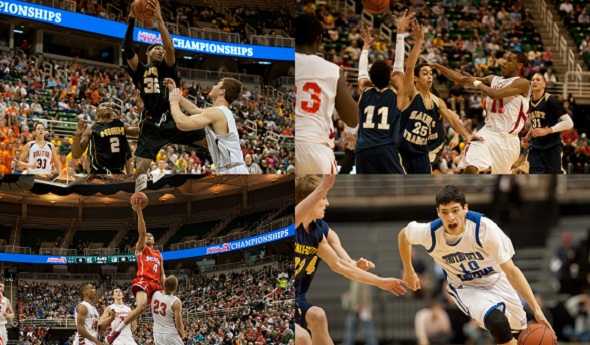
Did we just watch one of the greatest MHSAA boys basketball champions of all-time?
That’s a question being asked around the state coming off this season’s Boys Basketball Finals at Michigan State’s Breslin Center.
The team that brought up in those comparisons is Lansing Sexton, which won its second-straight Class B championship in convincing fashion. But that run was only one stroke of historical significance to emerge from this season’s Finals.
Saginaw added to one of the state’s strongest traditions with another championship in Class A. Flint Beecher posted the best finish of its successful run by finishing undefeated and champion in Class C. And Southfield Christian set the bar high with its first title run, finishing with one of the sharpest shooting displays in MHSAA history.
We wrap up the winter with a look back at those four tournaments, and a look ahead at teams we could see back at Breslin in 2013.
Four quarters
Saginaw wins No. 6: Class A conveniently played out to end with No. 1 Saginaw vs. No. 2 Romulus – until unranked Rockford crashed with a 62-61 win over the Eagles in a Semifinal. But the Rams, making their second MHSAA Final appearance, nearly earned their second championship. Rockford made 10 3-pointers and was tied with the Trojans as late as 4:36 to play before Saginaw finished on a 14-2 run. (Read the full report.)
Seeing Red again: Lansing Sexton concluded one of the most impressive runs in MHSAA history with a 67-32 win over No. 7 Stevensville-Lakeshore in the Class B Final. The Big Reds finished 27-1, winning all of their games by at least eight points despite playing a schedule loaded with many of the best from Class A. It was Sexton’s third-straight appearance in the B championship game, and second-straight title; the Big Reds also won back-to-back titles, in Class A, in 1959-60. (Read the full report.)
Best of Buc-Town: That’s another argument being made after Beecher became the 12th team in MHSAA history to win 28 games – one more than the best of the school’s other three championship squads. Beecher claimed Class C this season by beating reigning champion Schoolcraft by 20 in the Semifinal and Traverse City St. Francis 74-60 in the championship game. (Read the full report.)
Can’t-miss champs: Southfield Christian tied an MHSAA record with 12 3-pointers in the Class D Final, on 46 percent accuracy, in downing Climax-Scotts 76-44 after escaping Muskegon Catholic Central 78-74 in the Semifinal. Senior Chris Dewberry made 10 of 13 shots from the floor in the championship game, including 6 of 8 from 3-point range. (Read the full report.)
Numbers game
54,823: Total attendance of the eight Semifinals and four championship games, combined, at the 2012 Boys Basketball Finals. The total was roughly 5,600 more than attended in 2011.
74: Wins over the last three seasons by Lansing Sexton, tied for sixth-most in MHSAA history for a boys basketball team over that span of time.
19: Number of games, to one win, that Southfield Christian lost two seasons ago. The Eagles improved to 11-10 last season before going 24-2 and winning the Class D championship last month.
3: Runner-up finishes by Flint Beecher before beating St. Francis to win its first MHSAA championship since 1987. Those just-misses came in 2008, 2003 and in Class B in 2000.
11: Points scored by Saginaw, in a row, to close out the Class A championship game. The Trojans rode that final 11-0 run to a 54-42 win over Rockford.
Quotable
“They have a big influence in my life. Coach Thomas with all the help he has done for me this season; I could call him any time and get advice. And the same thing with Coach Dawkins. We’re brothers. It’s all about love and having that relationship. He texts me at night and lets me know how things are going, and I text him and ask him for advice about things. I was really appreciative of their support.” – Saginaw first-year coach Julian Taylor, on former championship-winning Saginaw coaches Marshall Thomas and Lou Dawkins, who sat behind the Trojans’ bench at Breslin during the Final
“Denzel is every father’s dream. Both my sons, Drew and Denzel. I’ve been very lucky to be able to coach both my sons and for them to enjoy the thing that I love most, basketball. Denzel’s been incredible. He’s done everything we’ve asked of him. His freshman year he had two knee surgeries. The doctor had to put his knee back together. He didn’t know if he was even going to play again, and he fought through some difficult struggles with his knee. We talked about adversity and different things. When he was being recruited by Michigan State, coach (Tom) Izzo said, ‘I’m not going offer you, because you can’t shoot it. You can do everything else.’ So Denzel, when he got done, he went to the gym and shot 500 shots. … That’s the kind of guy Denzel is. He’s going to do extra. I’m really proud of him. I love him. He’s my son, and for the people who doubted him and watched him play, I feel bad for them, because they just missed a fine, fine high school basketball player.” – Sexton coach Carlton Valentine on his son, senior Denzel Valentine.
“It was worth it. We’ve been putting in work all year, the offseason, way before the season; we didn’t just wait for the season to prepare for it. So it was worth a lot. We put a lot into this. And we appreciate this, and not just us, the whole community, the whole coaching staff. We made a lot of sacrifices to get here and finish the job. It’s just a blessing.” – Beecher senior Cortez Robinson, on coming back to win a title after losing in the Semifinals the last two seasons.
“We don’t take anybody for granted. We learned earlier in the year looking at film and seeing guys and going, ‘Oh, this is going to be a cake walk,’ and we come out and guys get up 30 on us and we’re looking like, ‘All right, now we’ve got to find a way.’ We played our hardest, and we just felt like if we played our hardest, we know we put in more work than them. That’s the confidence we have in our work that we put in, so we came out and let that show.” – Southfield Christian senior guard Lindsey Hunter III
See you next year …
Rockford: The Rams certainly were a surprise of the tournament, but won’t be if they make it back in 2013. Seven juniors should return to lead the way, including top guard Chad Carlson and key contributors Chase Fairchild and Kyle Short. (Honorable mention to Macomb L’Anse Creuse North, which made its first Semifinal appearance ever and should return all but two players, including its top two scorers.)
Muskegon Heights: The Tigers look good to return – it’s just a matter of if it will be in Class C or if the school will opt up into Class B, the class it played in this season. Muskegon Heights’ top three players were a junior and two sophomores, and 6-foot-4 forward Mike Davis showed star potential in the Semifinal while carrying more of the load because of an injury to 6-5 leading scorer Juwon Martin.
Beecher: The Buccaneers will graduate seven players off this season’s team, but return two-time reigning Associated Press Class C Player of the Year Monte Morris. With some help, he could carry Beecher back to Breslin for a fourth-straight season.
Climax-Scotts: Three starters during this run were juniors, including 6-7 all-stater Malachi Satterlee. He and the other returnees gained valuable experience during this runner-up finish, as did coach Steve Critchlow, who went 25-1 in his first season running the program.
Link up
To watch all 12 games and press conferences after each, click on MHSAA.tv.
PHOTOS courtesy of Terry McNamara Photography.
Beecher Earns Opportunity to 'Complete the Task' with Semifinal Win
By
Keith Dunlap
Special for MHSAA.com
March 23, 2023
EAST LANSING — Flint Beecher and Ecorse entered their Division 3 Semifinal on Thursday with at least one common thread of motivation.
Both lost in last year’s Semifinals, so both the Buccaneers and Raiders were looking to leave Breslin Center with some vindication.
Ultimately, Beecher was the team that did so, earning a 64-54 win over Ecorse and advancing to its seventh championship game since 2012.
Senior guard Robert Lee and senior forward Kevin Tiggs both scored 17 points to lead the way for Beecher (23-4).
“We’re not satisfied with this,” Beecher head coach Marquise Gray said. “This is just one part of completing the task.”
The difference in the game turned out to be that Beecher simply had more depth, which eventually wore down Ecorse.
Beecher featured an eight-player rotation, while Ecorse, with the exception of one substitution late in the third quarter, played its starters throughout until the game got away late.
“We figured we would wear them down,” Gray said. “Looking at their bench, we saw that they didn’t have a deep bench. But the focus, energy and effort was on us, and us executing defensively and offensively.”
 A big reason why Ecorse was short-handed was because one of its best players, senior Kenneth Morrast, was out after suffering a broken wrist in a Regional Final.
Ecorse head coach Gerrod Abram said he believes his team would have won this weekend’s championship if his squad was at full strength, but also heaped praise on Beecher and its playmakers.
Abram said before Morrast’s injury, his squad didn’t play any zone all year. But after he was injured, Abram said his team had to adjust on the fly and start playing a zone defense that he didn’t want to employ, but had to in order to keep players out of foul trouble.
Senior Malik Olafioye scored 22 points, and sophomore point guard Darrien Reddick scored 14 to lead Ecorse (20-5).
“Extremely proud of the effort we put out,” Abram said. “We knew it was going to be a big task with the way they play. We gave everything that we had. We just ran out of gas at the end.”
Beecher took a 40-34 lead into the fourth quarter, but Ecorse scored the first five points of the fourth to cut Beecher’s lead to one with 6:10 remaining in the game.
The Buccaneers answered, going on a 9-0 run to grab a 49-39 lead with 4:30 left.
Ecorse closed to within seven at 51-44 with 3:37 remaining following a 3-pointer by Reddick, but Beecher responded with four straight points to take a 55-44 lead with 2:42 remaining.
Beecher ultimately punctuated the win on a flying dunk by Lee with 1:09 remaining. Lee was also fouled on the dunk, and he made the free throw for a three-point play to give Beecher a 60-48 lead.
“What I really focused on was just trying to get my teammates involved,” Lee said. “Not try to force shots. Just let the game come to me.”
Now, Beecher will turn its focus to reclaiming its status as the best in the state.
“That’s something we have talked about, remembering the feeling that we had last year when we didn’t complete the job,” Gray said. “Guys have been taking it to heart. It’s not a rite. You have to earn your way here. It’s not a given.”
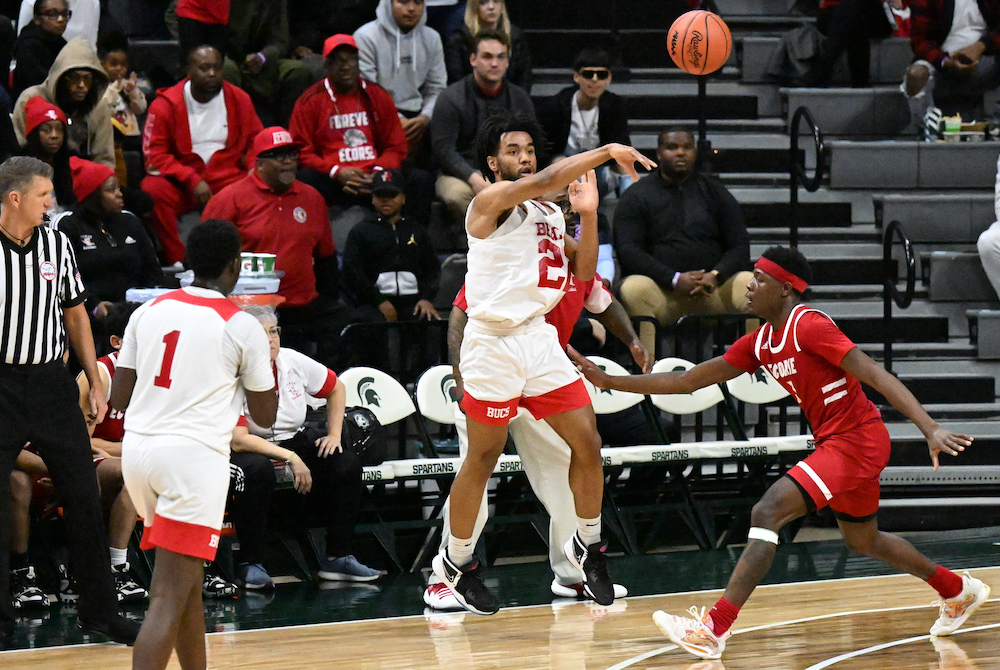
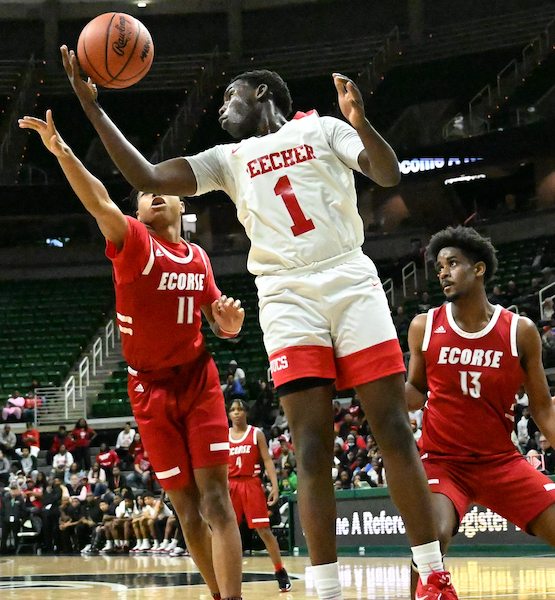
PHOTOS (Top) Flint Beecher’s Robert Lee Jr. (22) sends a pass into the post during Thursday’s Semifinal win over Ecorse. (Middle) The Bucs’ Kevin Tiggs Jr. (1) pulls in a rebound while Ecorse’s Deontae Jude (11) also grabs for the ball.