

60 Years Later, Chassell Streak Stands
March 22, 2016
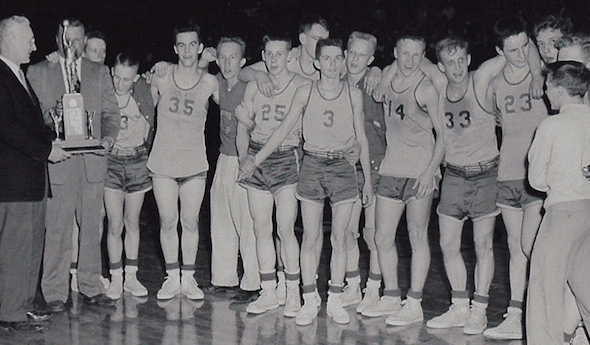
Sixty years ago, something happened in Michigan high school boys basketball that hadn’t happened before and hasn’t happened since – three Upper Peninsula teams won titles. Stephenson beat Detroit St. Andrew, 73-71 in overtime when “Marvelous” Mel Peterson made the first basket of sudden death; Crystal Falls (before it was called Forest Park) beat Berrien Springs, 71-69, in Class C; and Chassell won the first of three straight Class D titles, beating Portland St. Patrick, 71-68, by rallying from a 15-point deficit with less than four minutes to play.
The win was part of Chassell’s state record 65-game winning streak, which still stands. Below is an excerpt of a piece on the Chassell streak written before the teams were honored as part of the “Legends of the Games” program at the 1998 Boys Basketball Finals.
The old adage in sports states that records are made to be broken. The longer, however, the record stands, the more legendary the accomplishment becomes.
Chassell's wins were the centerpiece of Upper Peninsula success in the MHSAA Boys Basketball Tournament during the first 11 years after the format unified the two peninsulas. From 1932 to 1947, separate finals were conducted in both peninsulas. Between 1948 and 1958, Upper Peninsula schools won three Class B crowns (there were no Class A schools in the U.P. at the time), two Class C titles, and seven Class D championships – over one-third of the available first-place finishes.
Wrote the Marquette Mining Journal in 1956, the year that Stephenson in Class B, Crystal Falls in Class C and Chassell in Class D all won MHSAA titles, "All of these is a startling figure since in the period the U.P. has only 42 (schools) -- one eighth of all the lower class quarterfinalists.
"Under the law of averages, the U.P. should come up with one state champ every three years."
It looked at first that the law of averages would catch up with Chassell. After starting the 1955-56 season with 11 straight wins, the Panthers lost a close January game at Trout Creek, and then won their way downstate into the finals against Portland St. Patrick. In that final game, St. Patrick held a 15-point lead at 68-53 with less than four minutes to play.
Coach Ed Helakoski, the architect of the Chassell winning streak, called time out and told his team to apply full court pressure, a rarity at the high school level at that time.
Playing without standouts Terry Pokela and Tom Peters, who had fouled out, Chassell scored the final 18 points of the contest, the biggest game-ending rally in Finals history, and won the first crown, 71-68. Sophomore guard Don Mattson scored the winning points with only seconds to play, finished the game with a finals record 25 points, and the Panthers finished the season 25-1 with 14 consecutive victories.
During the 25-0 run to the crown in 1956-57, the only close games were regular-season wins against National Mine (71-66), L'Anse (64-63), Doelle (73-69), and a 58-50 decision over Stevensville in the championship game at Jenison Fieldhouse. Of the other 21 games, none were closer than 13 points, and the average margin of victory was 27 points.
The winning streak stood at 39 entering the 1957-58 season, and the 10-year state record of 59 consecutive victories by Mass from 1947-49 was within reach. However, Mattson was the only returning starter from the back-to-back championship teams, and perhaps Helakoski's greatest coaching job lay ahead to replace four starters in a school which had just over 30 boys enrolled in grades 9-12.
Doelle, which had given the Panthers one of its closest games the season before, was leading, 62-60, in an early-season contest. As time ran out, Bob Belhummer of Chassell was fouled at midcourt and sent to the free throw line with a one-and-one opportunity. Belhummer sank both shots to force the only overtime game of the streak, a 72-66 victory.
The new state record of 60 consecutive victories came in a 45-43 decision over Marenisco in the MHSAA District championship game. A trip over the newly-constructed Mackinaw Bridge came two weeks later and the Panthers became the first school to bring an MHSAA trophy across the structure when the 65th victory was recorded, a 66-61 decision over Owosso St. Paul. Mattson tallied 27 points in the finale to set another championship game record.
In the 40 years since Chassell's incredible feat, only twice has the winning streak been threatened. Flint Northwestern racked up 60 victories between January of 1984 and February of 1986; and Saginaw Buena Vista had a streak reach 55 games between December of 1991 and December of 1993.
In many communities, success streaks come and go, but a constant ideal of school sports then and today was captured by John Pyykkonen, a guard and forward on the 1956 and 1957 teams who summarized the events: "I remember the friendly competition amongst the members of the team and how well we worked together and how our parents, fans and the community were behind us 100 percent of the way. One of the greatest highlights in a young man's life and will never be forgotten."
Records were made to be broken. But legends, especially Legends of the Games like Chassell, endure the test of time.
GLORY DAYS ... Remembering The Streak
John Pyykkonen - 1956-57 Guard-Forward: "One thing I remember clearly, besides the games, is walking into Jenison Fieldhouse and being totally awestruck by the raised floor and the huge (in my eyes) guides who showed us around the building. I recall the game in 1956 when we were so far behind in points and we were able to overcome the point deficit by a full court press. The huge crowd gathered there were all cheering for the small-town team."
Robert Belhumer - 1956-1957-1958 Guard: "We had a great camaraderie among the members of our team. Also Chassell is a small town in the Upper Peninsula and the fans were there rooting for us during our seasonal games and were there for us at the championship games in Lansing."
Donald Jaakkola - 1956 Guard (On the championship game): "We ran out onto the court to a crowd of 12,000 people, most of whom were cheering for Portland St. Patrick. Needless to say, we felt a bit in awe as we came from Chassell, a small town in the Upper Peninsula.
"We were down 15 points with four minutes to go and two of our tallest players had fouled out earlier. Coach Ed Helakoski called a timeout and the basketball gods were with us. We threw a full court press defense and scored 18 points while holding St. Patrick scoreless. It gave us a screaming 71 to 68 victory. The crowd of 12,000 was now cheering for us."
Mike Wisti - 1956 Guard (On Coach Ed Helakoski): “I am quite sure there are many who will remember Ed Helakoski as a good coach. I'm sure he was a good coach; he had a knack for demanding discipline and teamwork, while not stifling the creativity of his players. However, I believe he should also be remembered as a great classroom teacher. He taught Government one year and Sociology the next and was the best classroom teacher that I had in high school. His ability to make Government interesting and explain how everything was designed to work is probably one of the biggest reasons for my lifelong interest in government and politics."
Kenneth Tormala - 1956-1957-1958 Forward: "The first year we surprised a lot of teams and people by winning the state championship. The second year we were picked to win when the year started and it would have been a real disappointment not to have done so. The third year was a real challenge since we lost so many players, but we had the backbone of the team, Don Mattson, who was an all-stater. This team was the most closely knit of all. We had a lot of very close games and had to dig down to everything we had learned to win many of them. A very satisfying year and we kept the winning streak going, to the surprise of many, including the previous teams.
"These memories will be fondly remembered until we die. Thank you to the late Mr. Helakoski."
James Komula, 1958 Guard (On what stands out from that season): "Being from a small town and playing in small gyms, the spaciousness and large crowd in Jenison Fieldhouse proved very exciting. Also, the reception and festivities upon our triumphant return to Chassell will forever be a highlight of personal memories. People were waiting in their vehicles nearly 30 miles from town to accompany our motorcade home.
"Although I didn't give it much thought, the experience and influence of playing on that team would set the direction for my career. Upon graduation from Michigan Tech, I was given an interim position to teach and coach at L'Anse High School. In 1966, I was assistant coach when L'Anse won the Class C state championship. After that I moved to Livonia, where in later years I was head coach at Bentley High School. Although I never intended, my high school basketball did influence my career to work with youngsters, and help them share in the rewards of the commitment and lifelong learning of athletics."
Terry Pokela, 1956-1957 Center: "We truly had a team. Coach Helakoski did not allow us to think of individual statistics or anything like that. He constantly emphasized the team concept. It certainly paid off.
"Also, we were one of the first teams to fast break after every missed shot by opponents. Our three-lane break broke many team's backs, as they couldn't keep up with us. Coach Helakoski emphasized rebounding position to enable the fast break to get started. We could also shoot field goals from any part of the court. Don Mattson would have scored 40 points a game if the three-point field goal would have been in effect."
Basketball Takes 'The Judge' Worldwide, Home Again as Love of Game Lives On
By
Doug Donnelly
Special for MHSAA.com
August 13, 2026
He’s been everywhere, man.
 Antoine Joubert, one of the best-known high school basketball players to come out of Michigan during the 1980s, has retired as a day-to-day basketball coach, but still gives back while continuing his lifelong dedication to the sport.
From being one of the most heavily recruited high school basketball players in the state, to playing four years at the University of Michigan and being drafted by the Detroit Pistons, to more than a decade of playing professionally overseas and in South America, Joubert remains humble and a fan of the game that has brought him so much in life.
“All of these things happened in my life because of basketball,” he said.
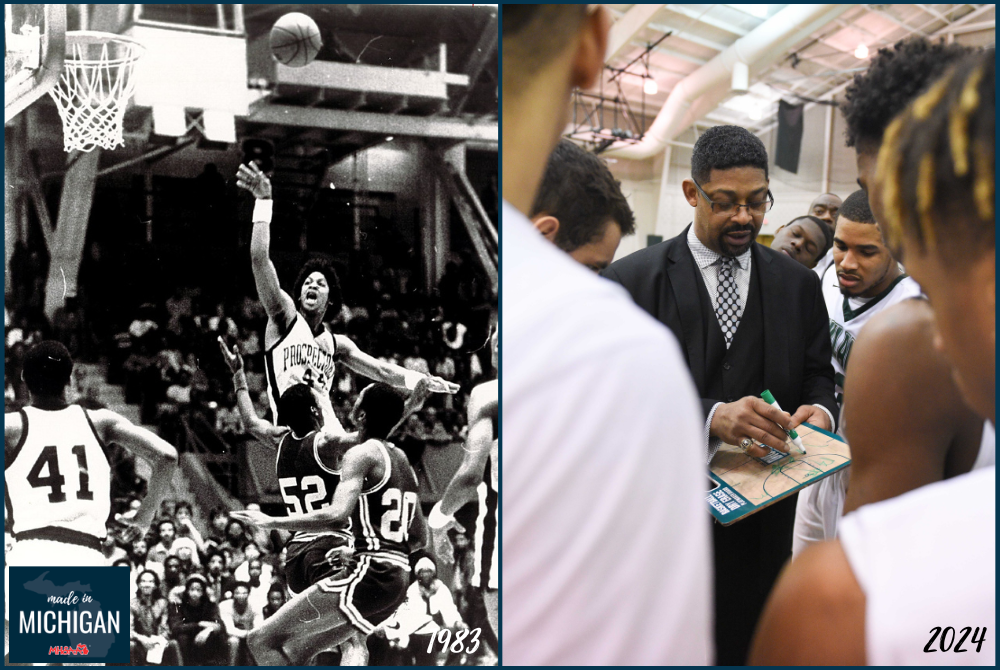
Joubert, who lives in Farmington, retired after the 2023-24 season after spending more than a decade coaching at Oakland Community College. He continues to host basketball camps – something he has done since 1992 – and has operated an AAU basketball program known as The Judge’s Court since 2006.
“The Judge” got the nickname from his older brother long before he was dominating opponents at Detroit Southwestern High School.
“My brother gave me that nickname,” he said. “I was in the locker room after a game and the media heard him call me that, and it stuck. ‘Here comes The Judge.’”
Joubert graduated in 1983 from Detroit Southwestern. He was Michigan’s Mr. Basketball Award winner and a McDonald’s All-American and recruited by nearly everyone from Indiana to Kentucky to UCLA before choosing Bill Frieder and Michigan.
As a high school junior, he averaged 30 points a game. He was even better as a senior, averaging 31.3 points, 14 rebounds and seven assists per contest. In his team’s 1983 Class A Semifinal, he scored 44 points. Two days later he scored 47 in the championship game against Flint Central, a tough 84-80 loss by the Prospectors that still ranks as one of the greatest Finals performances in state history.
“I was trying so hard to win that game,” Joubert said. “It was tough. Flint Central was a tough team.
“Playing in Michigan back those days was really great. The basketball was great, and there were some great coaches throughout the state. We’d go to camps and go play all over. We knew everybody, from Battle Creek to Lansing to Detroit, Ann Arbor, Traverse City. There was great basketball all over, and the kids all knew one another. I’ll never forget my high school career. I really loved it.”
Detroit Southwestern coach Perry Watson had coached Joubert’s uncle.
“He was like family,” Joubert said. “I knew him from when I was really young. He could play, too. He was a good ball player.”
The early 1980s were before the explosion of travel basketball, AAU programs and summer camps and shootouts. Joubert said while he did attend a few camps, including a national event in Indiana, he refined his skills at the Boys Club in Detroit and the legendary St. Cecilia gym that was a stopping point for some of the all-time greatest players from Michigan, from Dave Bing to Magic Johnson.
“That’s where our summer leagues were,” Joubert said. “Those were some great times.”
 As his stock rose nationally, he was able to play against high school players like Patrick Ewing and Doc Rivers.
“That really opened my eyes to a lot of things about how tough basketball is,” he said.
He remembers some tremendous battles in the Public School League as well.
“That was a rough league at the time,” he said. “I mean, the talent that came through Detroit was amazing. Every PSL school had two or three guys that were going on to play Division I or Division II basketball. It was so competitive and they had really good coaches, guys that cared and helped players back then.”
Watson helped forge Joubert’s game, but it was his brother, Ezekiel Joubert Jr., who was perhaps Antoine’s greatest influence. He’s also who gave Antoine the nickname Judge, which stuck and continues to live on to this day.
“He was five years older than me, so he put it on me more than a few times,” Joubert said. “I wanted to be like him and do everything like him in sports. Once I could beat him, I thought I could beat anybody in the world.”
While Joubert gravitated to basketball, his first love in sports was baseball.
“That was the first sport I was really good at,” he said. “I had letters from the Tigers, the Cincinnati Reds and Boston Red Sox at 15 years old. Then, I stopped playing.”
After high school, he took his talents to Ann Arbor. His teammates during his four years included Roy Tarpley, Gary Grant and Glen Rice. He was a starter beginning his freshman season and twice was named honorable mention all-Big Ten.
Joubert was drafted by the Detroit Pistons in the sixth round of the 1987 draft but injured his knee during training camp and was released. He was signed by teams from a variety of leagues but found a home when he went to Belgium. In 1990 he went to Mexico to play and made that league’s all-star game. In 1992 he played in Venezuela, where he earned league MVP honors.
“I got lucky,” he said. “My career took off.”
While playing in Europe, Joubert said he got a firsthand look at 7-foot players who could dribble like guards and shoot 3-pointers.
“I could see where the NBA was going to be, and that’s what it is like today,” he said.
Thanks to basketball, Joubert travelled the world.
“It was great. I played in Belgium, France, Spain, Poland, Italy, all through South America, Venezuela, Mexico, in Asia. Ball took me all around the world. I visited Egypt and Africa. I visited Jerusalem and Israel. I mean, I’ve been everywhere. I learned so many other languages and other cultures and made so many friends. It was all because of basketball. I got to travel the world and see how beautiful the world is.”
Because of basketball, he also got an education. He has a master’s degree.
“Basketball has meant a lot to me, still does,” he said.
After retiring as a player, Joubert returned home and started his AAU program. Soon after, he was hired to coach men’s basketball at Oakland Community College.
“It was challenging,” he said. “But I loved it, loved helping kids. I had players that played for years overseas and kids that are really doing well in life. It’s a blessing to see them grow up and become men, get their degrees and move on.”
Joubert remains a big fan of basketball – especially high school basketball.
“I go to games all of the time,” he said. “I love the tournaments and spending all day in the gym, talking to my friends and watching basketball. I’ll travel. I’m really enjoying myself.”
2026 Made In Michigan
Aug. 11: Nearly 25 Years After Leading Unexpected Run, Morton Directing Life-Changing Mission - Report
Aug. 7: Significance of Historic Run, Relationships Formed Live On for 1973 Unity Champs - Report
Aug. 4: Work Ethic Continues to Drive Van Dyk's Endeavors as Co-Owner of Family Farm - Report
July 24: Hackett Mentor's Care Sparked Lifetime in Hoops for BCAM President White - Report
July 24: Mackey Leaving Court with 500+ College Hoops Wins, Many More Lessons Shared - Report
July 16: Country Day Two-Time Champ Moore Building Perennial Winner at Harvard - Report
July 9: Multi-Sport Career at TC West Helps Gillis Thrive as Pro in Game She Once Left Behind - Report
July 2: Inspired by Home, Eager to Give Back, Spencer Hosts Hoop City Alumni Games - Report
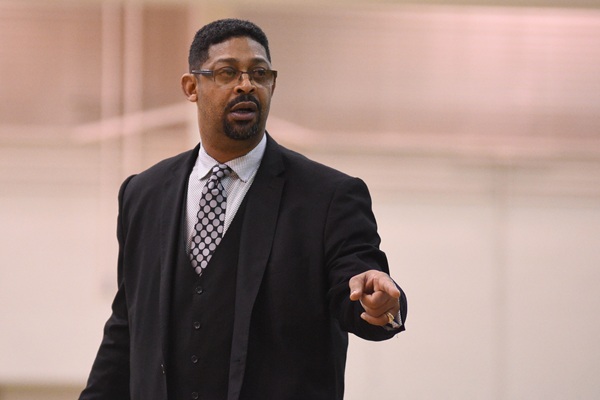
PHOTOS (Top) At left, Antoine Joubert puts up a shot during his highlight-filled career at Detroit Southwestern. At right, Joubert coaches Oakland Community College’s men’s basketball team. (Middle) Joubert finished his tenure at OCC in 2023-24. (Southwestern photo courtesy of the Detroit News. OCC photos courtesy of the OCC athletic department.)