

Changing of the Capital Guard
August 16, 2012
By Geoff Kimmerly
Second Half editor
Who would I pick to coach a Lansing area boys basketball Dream Team? Sportswriters get a lot of questions like that, from radio hosts or fans, or roommates who grew up nearby.
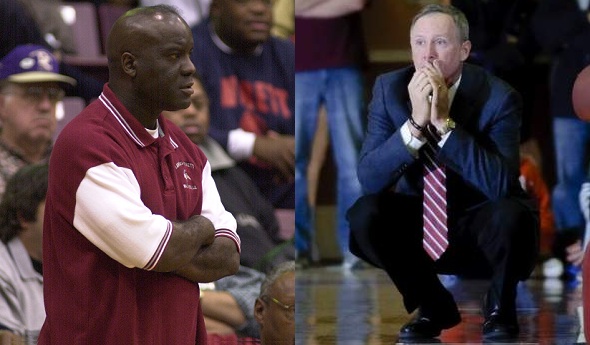
To not offend the other coaching friends I’d made in my decade-plus in Lansing, I kept that answer within the roommate circle for a long time – until I decided Okemos' Dan Stolz and Lansing Everett's Johnny Jones were so incredible their colleagues would understand my choice.
 I could’ve never picked between them. Their styles different, the results were the same. Both had stars over their decades, but I also saw both do more with less and in ways that regularly went unmatched during the 13 years I was a twice-weekly watcher of high school hoops for the Lansing State Journal.
It’s only a coincidence that both decided to retire from coaching during this same summer. But it’s certainly a double loss for mid-Michigan specifically and the statewide basketball community as a whole.
So why were these guys my Dream Team combo?
- Of course, they won a lot.
According to a report from local HOMTV, Stolz finished with a record of 428-99 at Williamston and then Okemos, where he took over for his father Stan in 1994-95. That win total is only eight more than Dad's, giving the family 828 wins over roughly four decades.
Tracking down Jones’ record wasn’t as easy. But based on the paper trail I’ve been running since I got my start in Lansing, he had 334 wins after the 2003-04 season, which likely means he too finished right around 400 – with a few hundred more leading the Vikings girls.
And they were the kind of standout high school players too whose stories had become legend – Jones for Battle Creek Central once taking down a top-ranked team by himself, while it was said Stolz could still dunk into his 40s after playing for his dad and the Chieftains back in his day.
- They won at the highest levels.
Jones is one of only a handful who has won MHSAA championships with both girls and boys teams – his girls teams won Class A in 2000 and 2001 and his boys won Class A in 2004. Everett’s girls program, by the way, was near-winless just a few years before Jones took over and led it to its first run to a Final in 1999.
Stolz never got his MHSAA title, his Chieftains falling to Saginaw Arthur Hill 85-84 in the 2006 Class A Final – the only MHSAA boys title game ever to go two extra periods. But against what many locals considered long odds, Stolz led Okemos from the cozy Class B-dominated Capital Circuit into the highest division of the Capital Area Activities Conference, where the Chieftains continued to win against the likes of Everett, Lansing Sexton, Lansing Eastern, Holt, Grand Ledge, East Lansing and Jackson in what is arguably the toughest league in the state.
Another interesting “by the way:” Stolz did lead Okemos’ softball (1999) and girls tennis teams (1993) to MHSAA championships.
- They won by doing the things others weren’t.
Jones’ girls teams were loaded with talent – a number of players went on to major college programs – but they were unstoppable because of a fullcourt press that handcuffed opponents and set a trend that others like Lansing Waverly and East Lansing also used to win Class A titles. Jones' best boys teams had an all-state post combo of Derick Nelson and Goran Suton, but still had to contend with Grand Ledge’s Al Horford (now of the Atlanta Hawks) two and three times a season.
And, it must be noted that Jones was one of fewer than 20 coaches who continued coaching both the boys and girls teams even after the girls season was moved from fall to winter for 2007-08.
Stolz similarly had his share of good players – Johnathon Jones maybe the best of all. But again, playing in a league with a number of other similarly-talented players (and in the postseason against Orchard Lake St. Mary’s Kalin Lucas and others), Stolz was unmatched in Greater Lansing when it came to gameday strategy. His teams always had a plan, and frequently made it work when the odds seemed stacked against -- which made apparent upsets hardly surprises at all.
Stolz has been replaced by Jeff Wonch, who led Bath to the MHSAA Class C title in 2007. He most recently coached at Potterville. Jones' replacement is former Everett star Desmond Ferguson, who played briefly in the NBA with the Portland Trail Blazers and was a volunteer assistant for the Vikings last season.
Basketball Takes 'The Judge' Worldwide, Home Again as Love of Game Lives On
By
Doug Donnelly
Special for MHSAA.com
August 13, 2026
He’s been everywhere, man.
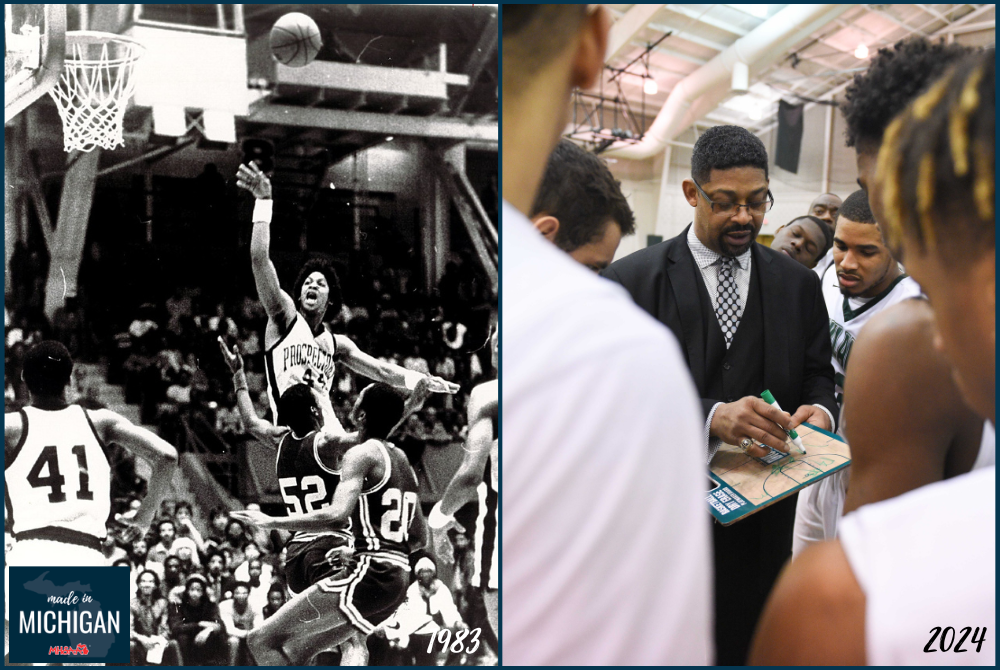
 Antoine Joubert, one of the best-known high school basketball players to come out of Michigan during the 1980s, has retired as a day-to-day basketball coach, but still gives back while continuing his lifelong dedication to the sport.
From being one of the most heavily recruited high school basketball players in the state, to playing four years at the University of Michigan and being drafted by the Detroit Pistons, to more than a decade of playing professionally overseas and in South America, Joubert remains humble and a fan of the game that has brought him so much in life.
“All of these things happened in my life because of basketball,” he said.
Joubert, who lives in Farmington, retired after the 2023-24 season after spending more than a decade coaching at Oakland Community College. He continues to host basketball camps – something he has done since 1992 – and has operated an AAU basketball program known as The Judge’s Court since 2006.
“The Judge” got the nickname from his older brother long before he was dominating opponents at Detroit Southwestern High School.
“My brother gave me that nickname,” he said. “I was in the locker room after a game and the media heard him call me that, and it stuck. ‘Here comes The Judge.’”
Joubert graduated in 1983 from Detroit Southwestern. He was Michigan’s Mr. Basketball Award winner and a McDonald’s All-American and recruited by nearly everyone from Indiana to Kentucky to UCLA before choosing Bill Frieder and Michigan.
As a high school junior, he averaged 30 points a game. He was even better as a senior, averaging 31.3 points, 14 rebounds and seven assists per contest. In his team’s 1983 Class A Semifinal, he scored 44 points. Two days later he scored 47 in the championship game against Flint Central, a tough 84-80 loss by the Prospectors that still ranks as one of the greatest Finals performances in state history.
“I was trying so hard to win that game,” Joubert said. “It was tough. Flint Central was a tough team.
“Playing in Michigan back those days was really great. The basketball was great, and there were some great coaches throughout the state. We’d go to camps and go play all over. We knew everybody, from Battle Creek to Lansing to Detroit, Ann Arbor, Traverse City. There was great basketball all over, and the kids all knew one another. I’ll never forget my high school career. I really loved it.”
Detroit Southwestern coach Perry Watson had coached Joubert’s uncle.
“He was like family,” Joubert said. “I knew him from when I was really young. He could play, too. He was a good ball player.”
The early 1980s were before the explosion of travel basketball, AAU programs and summer camps and shootouts. Joubert said while he did attend a few camps, including a national event in Indiana, he refined his skills at the Boys Club in Detroit and the legendary St. Cecilia gym that was a stopping point for some of the all-time greatest players from Michigan, from Dave Bing to Magic Johnson.
“That’s where our summer leagues were,” Joubert said. “Those were some great times.”
 As his stock rose nationally, he was able to play against high school players like Patrick Ewing and Doc Rivers.
“That really opened my eyes to a lot of things about how tough basketball is,” he said.
He remembers some tremendous battles in the Public School League as well.
“That was a rough league at the time,” he said. “I mean, the talent that came through Detroit was amazing. Every PSL school had two or three guys that were going on to play Division I or Division II basketball. It was so competitive and they had really good coaches, guys that cared and helped players back then.”
Watson helped forge Joubert’s game, but it was his brother, Ezekiel Joubert Jr., who was perhaps Antoine’s greatest influence. He’s also who gave Antoine the nickname Judge, which stuck and continues to live on to this day.
“He was five years older than me, so he put it on me more than a few times,” Joubert said. “I wanted to be like him and do everything like him in sports. Once I could beat him, I thought I could beat anybody in the world.”
While Joubert gravitated to basketball, his first love in sports was baseball.
“That was the first sport I was really good at,” he said. “I had letters from the Tigers, the Cincinnati Reds and Boston Red Sox at 15 years old. Then, I stopped playing.”
After high school, he took his talents to Ann Arbor. His teammates during his four years included Roy Tarpley, Gary Grant and Glen Rice. He was a starter beginning his freshman season and twice was named honorable mention all-Big Ten.
Joubert was drafted by the Detroit Pistons in the sixth round of the 1987 draft but injured his knee during training camp and was released. He was signed by teams from a variety of leagues but found a home when he went to Belgium. In 1990 he went to Mexico to play and made that league’s all-star game. In 1992 he played in Venezuela, where he earned league MVP honors.
“I got lucky,” he said. “My career took off.”
While playing in Europe, Joubert said he got a firsthand look at 7-foot players who could dribble like guards and shoot 3-pointers.
“I could see where the NBA was going to be, and that’s what it is like today,” he said.
Thanks to basketball, Joubert travelled the world.
“It was great. I played in Belgium, France, Spain, Poland, Italy, all through South America, Venezuela, Mexico, in Asia. Ball took me all around the world. I visited Egypt and Africa. I visited Jerusalem and Israel. I mean, I’ve been everywhere. I learned so many other languages and other cultures and made so many friends. It was all because of basketball. I got to travel the world and see how beautiful the world is.”
Because of basketball, he also got an education. He has a master’s degree.
“Basketball has meant a lot to me, still does,” he said.
After retiring as a player, Joubert returned home and started his AAU program. Soon after, he was hired to coach men’s basketball at Oakland Community College.
“It was challenging,” he said. “But I loved it, loved helping kids. I had players that played for years overseas and kids that are really doing well in life. It’s a blessing to see them grow up and become men, get their degrees and move on.”
Joubert remains a big fan of basketball – especially high school basketball.
“I go to games all of the time,” he said. “I love the tournaments and spending all day in the gym, talking to my friends and watching basketball. I’ll travel. I’m really enjoying myself.”
2026 Made In Michigan
Aug. 11: Nearly 25 Years After Leading Unexpected Run, Morton Directing Life-Changing Mission - Report
Aug. 7: Significance of Historic Run, Relationships Formed Live On for 1973 Unity Champs - Report
Aug. 4: Work Ethic Continues to Drive Van Dyk's Endeavors as Co-Owner of Family Farm - Report
July 24: Hackett Mentor's Care Sparked Lifetime in Hoops for BCAM President White - Report
July 24: Mackey Leaving Court with 500+ College Hoops Wins, Many More Lessons Shared - Report
July 16: Country Day Two-Time Champ Moore Building Perennial Winner at Harvard - Report
July 9: Multi-Sport Career at TC West Helps Gillis Thrive as Pro in Game She Once Left Behind - Report
July 2: Inspired by Home, Eager to Give Back, Spencer Hosts Hoop City Alumni Games - Report
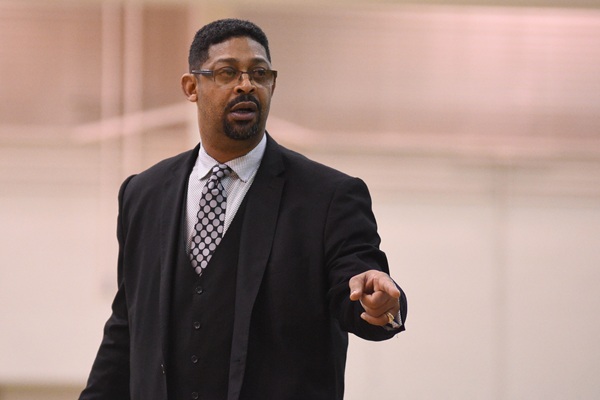
PHOTOS (Top) At left, Antoine Joubert puts up a shot during his highlight-filled career at Detroit Southwestern. At right, Joubert coaches Oakland Community College’s men’s basketball team. (Middle) Joubert finished his tenure at OCC in 2023-24. (Southwestern photo courtesy of the Detroit News. OCC photos courtesy of the OCC athletic department.)