

Hoops Finds Annual Home During Holidays
December 27, 2019
By Ron Pesch
Special for Second Half
Nothing says the Holidays like a high school basketball tournament.
It started, like many things do, with a drip. Well, make that a dribble.
The Michigan High School Athletic Association has allowed Holiday basketball tournaments for years. When was the first? That’s hard to establish. No one really kept track of such. A 1934 Wakefield News article indicates that a “Christmas Tournament will be held for the (Gogebic) Range teams at Wakefield December 27 and at Ironwood December 28.” Hurley, Bessemer, Ironwood and Wakefield were entered in the “blind” tournament, with opponents drawn just before game time. It was a new idea, at least in the Upper Peninsula.
“Nothing of its kind has ever been attempted in the Peninsula before,” stated the Ironwood Daily Globe. The tournament, won by Hurley, was a financial success. After expenditures, including the purchase of trophies, profit equaled enough that $22.42 was distributed to each school competing in the tournament. Plans were announced to bring back the tournament in a larger format the following year. It did return the following December, with the same teams in the same format but with all games played in Wakefield. This time out, Ironwood topped Hurley 22-21 for the tournament title.
In the Lower Peninsula in 1935, an All-Berrien County Holiday tournament was held Dec. 26, 27 and 28, with Three Oaks winning the Class B-C division title, 15-13 in the final over Berrien Springs. St. Joseph Catholic emerged as the Class D victor with a surprising 27-26 win over the reigning MHSAA state champ from Stevensville. The 14-team competition was played at Niles High School. Attendance was “slim, very slim” for the opening day of the tourney. The event did not return in 1936.
A similar, but much smaller, event was staged in Berrien County in 1941 with the Bridgman Class C Invitational. The tournament featured seven teams with contests spread over three nights. It was a success.
“Some 450 paid admissions were checked in Wednesday night for the championship finals, which Bridgman won from Berrien Springs. … The total paid admission for the three night event was 1,420 fans with a gross gate of approximately $400.”
By the mid-1940s, the idea of playing prep basketball during the Christmas lull had begun to take off across the state.
In December 1946, before a crowd of 1,500 at the Flint IMA Auditorium, Holland, the reigning Class A champion, downed Flint Northern 51-48 behind a pair of late field goals by Ken ‘Fuzz’ Bauman in the first annual Motor City Invitational. In Jackson, Detroit Catholic Central won the Michigan Catholic Invitational, beating Kalamazoo St. Augustine, 42-40. Bridgman again snagged the title at the Sixth Annual Berrien Class C Christmas Holiday Tournament. It was the Bees’ third Christmas championship in four years. The Little Eight Conference Holiday Tournament was played across four school gymnasiums as the calendar transitioned from 1946 to 1947. Bangor downed Covert, 34-29, in the championship contest hosted at Watervliet High School on Saturday, Jan. 4.
“Holiday tournament basketball has really caught on in Michigan,” said Hal Schram in the Detroit Free Press in 1947. “There will be no Christmas-New Year’s rest for at least 60 Michigan high school squads which have jumped at the chance to sharpen their collective shooting eyes for the long season ahead. … At last count, tournaments will be played between Dec 17 and Jan 3 at Flint, Saginaw, Grand Rapids, Jackson, Lincoln Park, Fremont, Negaunee, Marquette, Benton Harbor and Detroit.”
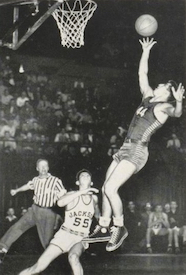 The same eight schools that played at the first Motor City tournament – Jackson, Grand Rapids Central, Holland, Muskegon Heights, Monroe, Midland, Flint Central and Flint Northern – were invited back for the second year. According to Schram, “Not a single participating school of a year ago wanted to be left out.”
Jackson downed Flint Northern in the title game, 39-34.
The Saginaw Invitational, hosted at Arthur Hill High School, boasted six Class A schools as well as Alma and Mount Pleasant, both Class B schools. Mount Pleasant surprised the field, winning the tournament with a 40-25 triumph over Dearborn Fordson in the championship game.
A year later in December, Schram wrote, “The Michigan High School Athletic Association wasn’t caught unaware when the tournament bug started to bite every sector of the state.”
“Never did we expect such a wave of tournament play as we will see during the next three weeks,” said Charles Forsythe, state director for the MHSAA, noting 34 Christmas vacation tournaments were scheduled between December 15 and January 8 during the 1948-49 basketball season. “Perhaps we’re lucky at that. The Oklahoma association has had to sanction 123 tournaments.”
Forsythe and Schram explained the reasons for the wave of popularity. Of particular interest was the fact that, at the time, a school sponsoring both football and basketball could play a total of no more than 24 games, combined, in the two sports. However, MHSAA rules allowed a basketball team the chance to play as many as three games during a Holiday tournament and be charged with only one of its allotted combination of 24 contests. (The MHSAA rules changed prior to 1972-73 to allow basketball teams a maximum of 20 games.)
Coaches could keep their squads sharp during the two-week layoff with games rather than just mandatory practices. And, as a bonus to all because tournaments were financed through gate admissions, invitations to larger tournaments meant teams got to “stay and eat at the best hostelries, go on sightseeing tours when not playing and play non-conference opponents from other sections of the state.“
Add in the chance to play before larger-than-normal crowds, and the formula for a successful tournament was cast.
Beginning with the 1950-51 season, the football-basketball rule was altered to count play in mid-season invitational tournaments as two contests. With the change, according to the Detroit Times, “the number of such meets dropped sharply.”
Only nine Holiday tournaments, involving 50-plus teams, were recorded by the MHSAA during the 1951-52 season: the 5th annual Flint Parochial Invitational, the Alpena Catholic Invitational (involving 16 teams), the 5th Annual Greater Lansing Invitational, the Albion College Invitational, the Twin-Five Conference Christmas Tournament (a 10-team replacement for the disbanded Little Eight Conference’s tournament), the Otisville Invitational, the Columbiaville Invitational and the 1st Annual Portland St. Patrick Christmas Invitational.
But by the 1960s, Holiday Tournaments were again regaining popularity, with more now focused on teams from a specific community or section of the state, especially among smaller schools.
The St. Patrick tournament was still going strong in 1966 – its 15th year – with an eight-team, four-day design. Williamston downed a Cinderella squad from Carson City, 64-44, before 1,100 fans at Portland to earn the championship. Other Mid-Michigan holiday tournaments played out in Chelsea and Swartz Creek at the same time.
The Flint Parochial League Tournament was a mainstay of the Holiday season until the breakup of the league in the early 1970s.
“Basketball tournaments have become popular around the state and nation in recent years,” wrote Wendy Foltz, longtime Battle Creek Enquirer sports editor, before the kickoff of the inaugural Battle Creek Central Holiday Cage Tournament in 1968. In a twist that harkened back to earlier days, the eight-team event represented nearly every section of lower Michigan. “Battle Creek never has been a rabid basketball town like some around the state,” added a hesitant Foltz, noting a hope that the event could at least break even.
Hosted at the Cereal City’s historic Fieldhouse, built in 1928, that first tournament was won by host Battle Creek Central, which downed Traverse City 71-53 before a crowd of 2,000. Phil Todd led the Bearcats with 29 points, including 21 in the first half, while 6-foot-8 Tom Kozelko paced TC with 24. Muskegon Heights won the consolation game, holding off a late Ypsilanti Willow Run rally, 78-77. Other schools competing were Battle Creek Lakeview, Grand Blanc, Romulus and recently-opened Jackson Lumen Christi.
Chuck Turner, Central’s head coach, and junior varsity coach Jack Schils had contacted 60 schools during the summer of 1967 to organize the 12-game schedule.
“The response was terrific,” said Schils, who added, “Many schools could not accept because of schedule commitments but want to enter a year hence.”
The Battle Creek tournament was back in 1969, again hosting teams from near and far. Schils noted that cost ran high when teams were brought in from long distances: “However, this type of tournament is highly desirable so we hope fans will support it.”
 But the event was discontinued following the 1970-71 season when the “eight team format became too unwieldy,” according to the Enquirer “… and both crowd and the quality of play declined.”
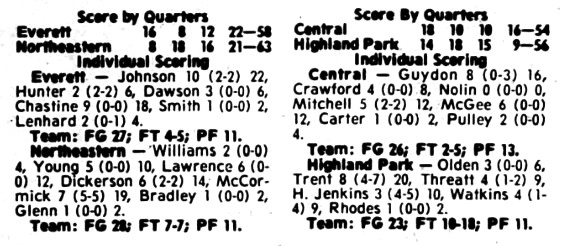
Pared down to a four-team format, it returned in a big way in December 1975. The tournament saw standing-room-only crowds of more than 3,000 for games between Battle Creek Central, Detroit Northeastern, Class A quarterfinalist Lansing Everett and reigning Class A champion Highland Park.
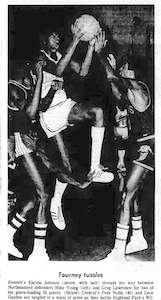
Detroit Northeastern downed Lansing Everett, 63-58 for the Cereal City championship trophy. Everett junior Earvin Johnson scored 22 points and, with teammate Reggie Chastine, was named to the all-tournament team along with Northwestern’s Wilbert McCormick, the tourney MVP, and his teammate Greg Lawrence. Highland Park’s William Trent and Battle Creek Central’s Leon Guydon also were named to the team.
By the 1980s, it seemed that the Christmas break nearly mimicked March in Michigan.
“I think a Christmas tournament really helps your program,” said Turner in 1980 to the Enquirer. He had taken over the head coaching position at Battle Creek in the fall of 1967 after a successful stint at Willow Run. “I don’t understand basketball teams having a preseason, playing three or four games, then taking two weeks off. When you get back, it’s like starting over.”
Besides Turner’s squad, the 1980 field included Detroit Western, Detroit Murray Wright and eventual winner Kalamazoo Central. The event would ultimately be re-christened the Battle Creek Central Chuck Turner Holiday Classic.
“The late Chuck Turner started bringing big games to the city over the holidays when he first started at the school in the 1960s,” wrote Bill Broderick in the Enquirer in 2018.
“Chuck started this because he wanted to give people the chance to come back home for the holidays and see everyone play. It’s been like a family reunion over the years,” Fred Jones told Broderick. Jones was a longtime assistant to Turner. “That we can keep it going in his name is great and hopefully we can keep if going for another 50 years.”
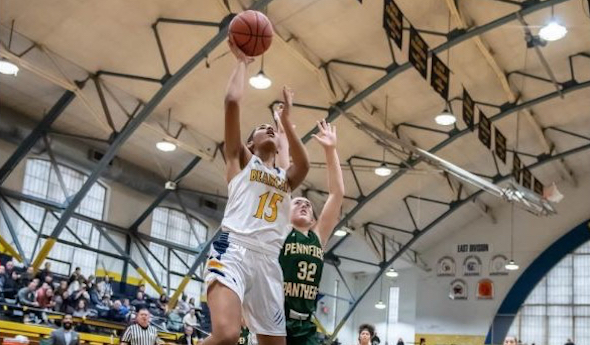
The girls are now part of the action. All five Battle Creek city schools – Central, Pennfield, Harper Creek, Lakeview, and St. Philip – were part of the event in 2018.
This year the Chuck Turner Central Field House Holiday Classic will again span two days – December 27 and 28 – and will again see all five city schools play on the historic floor.
Other Holiday tournaments scheduled this year include:
Petoskey Invitational – December 13-14
Raider Shootout – December 21
18th Annual Muskegon Area Sports Hall of Fame Classic – December 27
Earl McKee Classic – December 27-28
North Farmington Holiday Extravaganza – December 27
Motor City Roundball Classic – December 27
Cornerstone Invitational – December 27
Washtenaw Hoops Showcase – December 28
 Ron Pesch has taken an active role in researching the history of MHSAA events since 1985 and began writing for MHSAA Finals programs in 1986, adding additional features and "flashbacks" in 1992. He inherited the title of MHSAA historian from the late Dick Kishpaugh following the 1993-94 school year, and resides in Muskegon. Contact him at [email protected] with ideas for historical articles.
PHOTOS: (Top) The Battle Creek Central and Pennfield girls face off during the 50th Chuck Turner Classic. (Middle) Shaheen Shaheen scores two points for Flint Northern, which fell to Jackson 39-34 during the 1947 Motor City championship game. (Below left) Lansing Everett’s Earvin Johnson makes a move toward the basket against Detroit Northeastern during the 1975 Battle Creek event. (Below right) Box scores from the 1975 tournament include Johnson’s 22 points in the 63-58 loss. Photos courtesy of the Battle Creek Enquirer, Lansing State Journal and Ron Pesch archives.)
Basketball Takes 'The Judge' Worldwide, Home Again as Love of Game Lives On
By
Doug Donnelly
Special for MHSAA.com
August 13, 2026
He’s been everywhere, man.
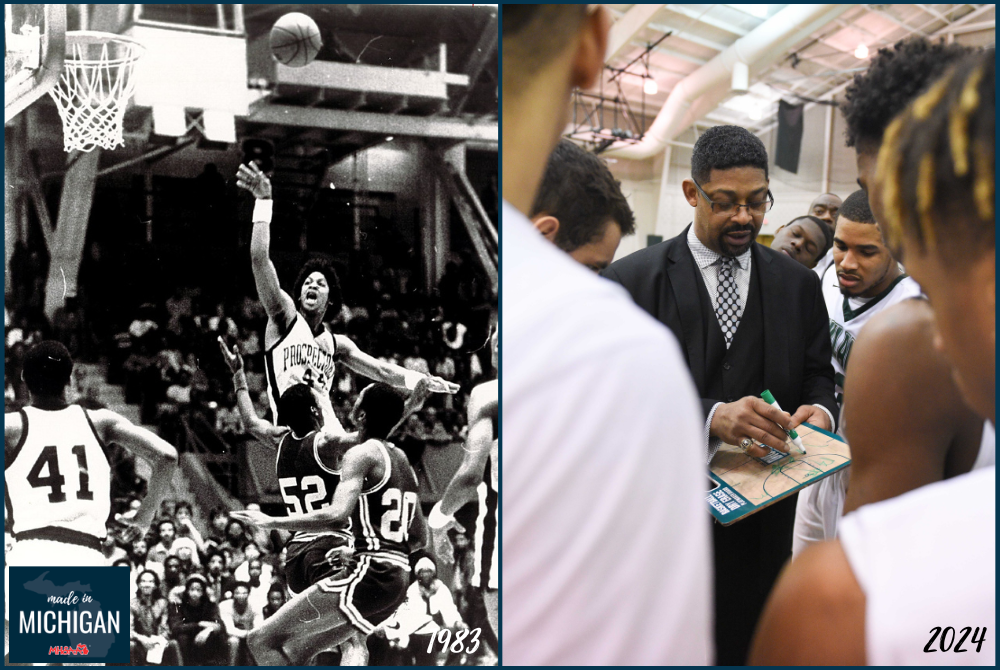
 Antoine Joubert, one of the best-known high school basketball players to come out of Michigan during the 1980s, has retired as a day-to-day basketball coach, but still gives back while continuing his lifelong dedication to the sport.
From being one of the most heavily recruited high school basketball players in the state, to playing four years at the University of Michigan and being drafted by the Detroit Pistons, to more than a decade of playing professionally overseas and in South America, Joubert remains humble and a fan of the game that has brought him so much in life.
“All of these things happened in my life because of basketball,” he said.
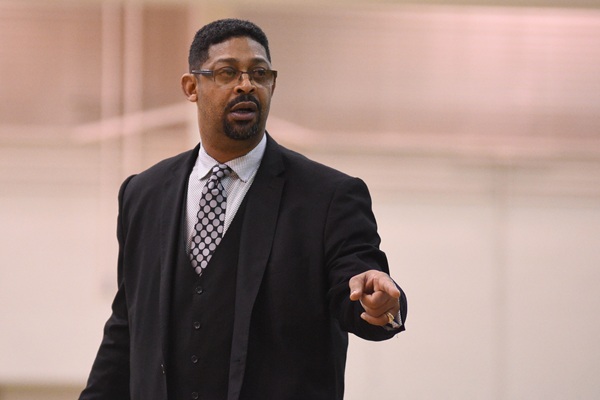
Joubert, who lives in Farmington, retired after the 2023-24 season after spending more than a decade coaching at Oakland Community College. He continues to host basketball camps – something he has done since 1992 – and has operated an AAU basketball program known as The Judge’s Court since 2006.
“The Judge” got the nickname from his older brother long before he was dominating opponents at Detroit Southwestern High School.
“My brother gave me that nickname,” he said. “I was in the locker room after a game and the media heard him call me that, and it stuck. ‘Here comes The Judge.’”
Joubert graduated in 1983 from Detroit Southwestern. He was Michigan’s Mr. Basketball Award winner and a McDonald’s All-American and recruited by nearly everyone from Indiana to Kentucky to UCLA before choosing Bill Frieder and Michigan.
As a high school junior, he averaged 30 points a game. He was even better as a senior, averaging 31.3 points, 14 rebounds and seven assists per contest. In his team’s 1983 Class A Semifinal, he scored 44 points. Two days later he scored 47 in the championship game against Flint Central, a tough 84-80 loss by the Prospectors that still ranks as one of the greatest Finals performances in state history.
“I was trying so hard to win that game,” Joubert said. “It was tough. Flint Central was a tough team.
“Playing in Michigan back those days was really great. The basketball was great, and there were some great coaches throughout the state. We’d go to camps and go play all over. We knew everybody, from Battle Creek to Lansing to Detroit, Ann Arbor, Traverse City. There was great basketball all over, and the kids all knew one another. I’ll never forget my high school career. I really loved it.”
Detroit Southwestern coach Perry Watson had coached Joubert’s uncle.
“He was like family,” Joubert said. “I knew him from when I was really young. He could play, too. He was a good ball player.”
The early 1980s were before the explosion of travel basketball, AAU programs and summer camps and shootouts. Joubert said while he did attend a few camps, including a national event in Indiana, he refined his skills at the Boys Club in Detroit and the legendary St. Cecilia gym that was a stopping point for some of the all-time greatest players from Michigan, from Dave Bing to Magic Johnson.
“That’s where our summer leagues were,” Joubert said. “Those were some great times.”
 As his stock rose nationally, he was able to play against high school players like Patrick Ewing and Doc Rivers.
“That really opened my eyes to a lot of things about how tough basketball is,” he said.
He remembers some tremendous battles in the Public School League as well.
“That was a rough league at the time,” he said. “I mean, the talent that came through Detroit was amazing. Every PSL school had two or three guys that were going on to play Division I or Division II basketball. It was so competitive and they had really good coaches, guys that cared and helped players back then.”
Watson helped forge Joubert’s game, but it was his brother, Ezekiel Joubert Jr., who was perhaps Antoine’s greatest influence. He’s also who gave Antoine the nickname Judge, which stuck and continues to live on to this day.
“He was five years older than me, so he put it on me more than a few times,” Joubert said. “I wanted to be like him and do everything like him in sports. Once I could beat him, I thought I could beat anybody in the world.”
While Joubert gravitated to basketball, his first love in sports was baseball.
“That was the first sport I was really good at,” he said. “I had letters from the Tigers, the Cincinnati Reds and Boston Red Sox at 15 years old. Then, I stopped playing.”
After high school, he took his talents to Ann Arbor. His teammates during his four years included Roy Tarpley, Gary Grant and Glen Rice. He was a starter beginning his freshman season and twice was named honorable mention all-Big Ten.
Joubert was drafted by the Detroit Pistons in the sixth round of the 1987 draft but injured his knee during training camp and was released. He was signed by teams from a variety of leagues but found a home when he went to Belgium. In 1990 he went to Mexico to play and made that league’s all-star game. In 1992 he played in Venezuela, where he earned league MVP honors.
“I got lucky,” he said. “My career took off.”
While playing in Europe, Joubert said he got a firsthand look at 7-foot players who could dribble like guards and shoot 3-pointers.
“I could see where the NBA was going to be, and that’s what it is like today,” he said.
Thanks to basketball, Joubert travelled the world.
“It was great. I played in Belgium, France, Spain, Poland, Italy, all through South America, Venezuela, Mexico, in Asia. Ball took me all around the world. I visited Egypt and Africa. I visited Jerusalem and Israel. I mean, I’ve been everywhere. I learned so many other languages and other cultures and made so many friends. It was all because of basketball. I got to travel the world and see how beautiful the world is.”
Because of basketball, he also got an education. He has a master’s degree.
“Basketball has meant a lot to me, still does,” he said.
After retiring as a player, Joubert returned home and started his AAU program. Soon after, he was hired to coach men’s basketball at Oakland Community College.
“It was challenging,” he said. “But I loved it, loved helping kids. I had players that played for years overseas and kids that are really doing well in life. It’s a blessing to see them grow up and become men, get their degrees and move on.”
Joubert remains a big fan of basketball – especially high school basketball.
“I go to games all of the time,” he said. “I love the tournaments and spending all day in the gym, talking to my friends and watching basketball. I’ll travel. I’m really enjoying myself.”
2026 Made In Michigan
Aug. 11: Nearly 25 Years After Leading Unexpected Run, Morton Directing Life-Changing Mission - Report
Aug. 7: Significance of Historic Run, Relationships Formed Live On for 1973 Unity Champs - Report
Aug. 4: Work Ethic Continues to Drive Van Dyk's Endeavors as Co-Owner of Family Farm - Report
July 24: Hackett Mentor's Care Sparked Lifetime in Hoops for BCAM President White - Report
July 24: Mackey Leaving Court with 500+ College Hoops Wins, Many More Lessons Shared - Report
July 16: Country Day Two-Time Champ Moore Building Perennial Winner at Harvard - Report
July 9: Multi-Sport Career at TC West Helps Gillis Thrive as Pro in Game She Once Left Behind - Report
July 2: Inspired by Home, Eager to Give Back, Spencer Hosts Hoop City Alumni Games - Report
PHOTOS (Top) At left, Antoine Joubert puts up a shot during his highlight-filled career at Detroit Southwestern. At right, Joubert coaches Oakland Community College’s men’s basketball team. (Middle) Joubert finished his tenure at OCC in 2023-24. (Southwestern photo courtesy of the Detroit News. OCC photos courtesy of the OCC athletic department.)