

Longtime Coach Researches Photos to Tell Story of Grand Rapids Sports' Past
By
Steve Vedder
Special for MHSAA.com
September 16, 2022
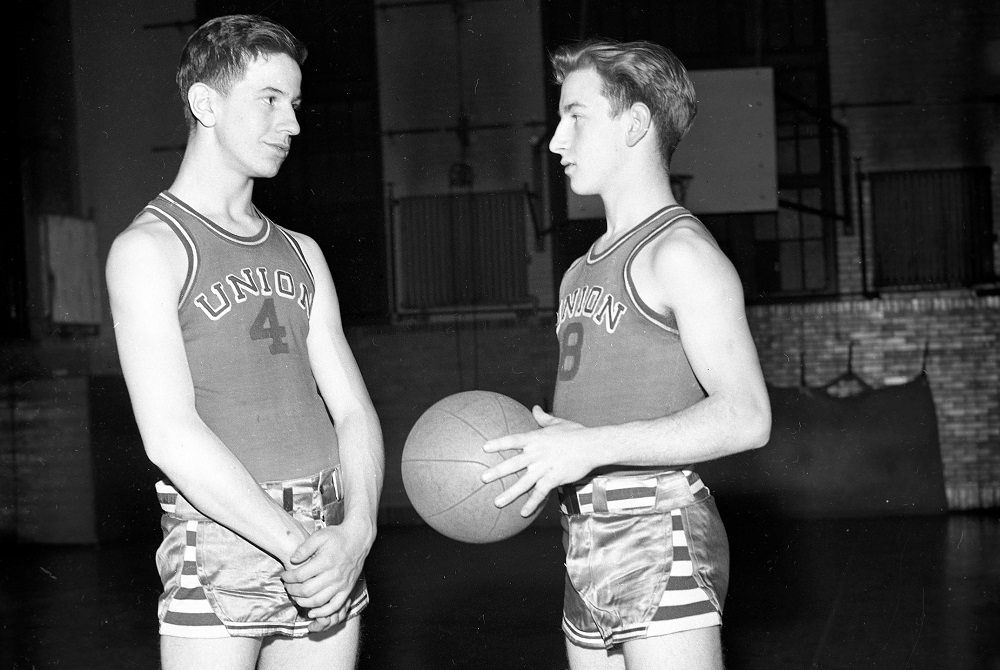
GRAND RAPIDS – Bob Schichtel always pauses when he comes across the ancient black and white photo long enough to ponder whatever became of the two youngsters adorned in Grand Rapids Union basketball uniforms.
The posed shot shows two players facing each other in a local gymnasium in a photo apparently taken four days after the Japanese surprise attack on Pearl Harbor in 1941 that launched the country into World War II. Only a handful of fans today would recognize the players' striped, ultra-short shots and simple sleeveless shirts with "Union" emblazed across the front as recognizable basketball uniforms. One holds a battered-looking basketball, while the other looks on. The two players, whose uniform numbers are "4" and "9," aren't really smiling, but still seem as close as any teammates, whether 81 years ago or today.
In fact, it's the look the youngsters share that intrigues Schichtel, whose thankless, pro bono job it is to identify the two players.
"Once you start," said Schichtel, a former longtime Grand Rapids basketball coach, "it's like looking down a deep rabbit hole."
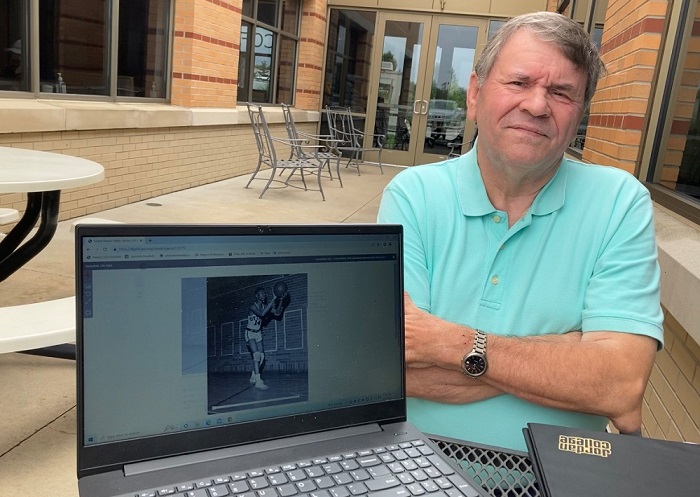 Schichtel works as a volunteer for the Grand Rapids Public Library trying to identify mostly former Grand Rapids City League basketball players from approximately 1938 through the early fifties. The online photos are mostly from the Robinson Photo Studio Collection taken in conjunction with the Grand Rapids Herald newspaper. The library says the unique collection spans some 950 basketball negatives from the entire Robinson/Herald collection that totals well over 900,000 Grand Rapids photos.
While the work – which amounts to a ton of patience combined with a detective ability – can be exhausting, it's still what Schichtel describes as a labor of love. For example, there's the shot of the two still-unidentified Union players. Schichtel looks at the photo and can't help but wonder whatever happened to the kids. Were they exceptional athletes? Did they leave their marks on Grand Rapids history, whether it was in education, politics, business, industry, the arts or another field? He doesn't even know, as in many photos from this era, whether the two entered the military and thus even survived World War II.
Schichtel has searched everywhere for the answers, but has come up short. Too many times, in fact.
Which isn't to say he'll quit looking or chalk up his research as inconsequential. Schichtel said the foremost reason he spends hours on the project is that many of the athletes he identifies deserve the recognition for achievements far beyond basketball. In many cases former City League basketball, football, baseball, track and tennis athletes became the foundation on which Grand Rapids was built. If Schichtel can uncover an old photo which depicts these youngsters during their high school careers, so much the better, he said.
"It's important to recognize Grand Rapids sports history, and I don't know if we've given enough attention to their past," Schichtel said. "They are what got us here, and I'm a firm believer they need to be recognized for it."
Figuring out that history, however, ranges from, at the least, extremely time consuming to – in too many frustrating cases – virtually impossible. The City League was formed in the late 1920s and featured original schools Grand Rapids Central, Creston, South, Union, Ottawa Hills, Catholic Central and Davis Tech. The league was eventually folded into the Ottawa-Kent Conference in 2008.
"It was a long, evolving league," Schichtel said.
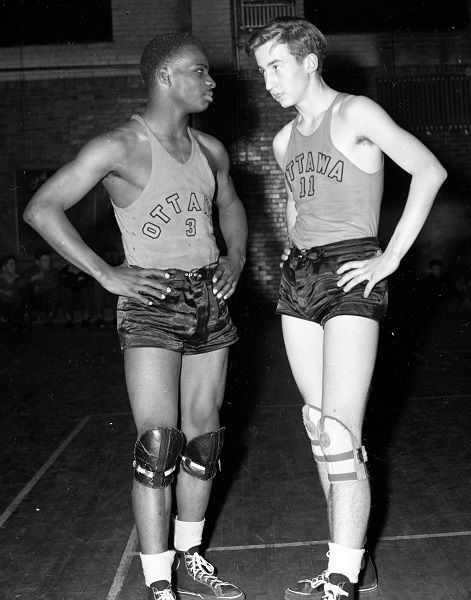 The identification tools available to Schichtel are actually more numerous than most would suspect. For starters, he's formed an impressive database of information by pouring through old City League yearbooks and programs, photos from other collections and microfilm of old newspapers, And then there's also the knowledge gathered by Schichtel himself, a 1968 Grand Rapids Catholic Central graduate. After playing in many old City League gymnasiums, Schichtel went on to compile a 389-197 record in 27 years as the Cougars girls basketball coach. He uses countless City League contacts as both a player and coach to identify athletes. In all, Schichtel taught in the Grand Rapids school system for 34 years.
He also uses the game itself to identify the photos. For instance, he can pinpoint some photos simply by the styles of the uniforms worn by players. He also figures out who is who by other clues such as what the players are doing in the photo. If a player is taking a set shot in the photo, it's likely pre-World War II. The beginnings of the jump shot, or what Schichtel calls "elevation while shooting," is probably mid-1940s. In addition, Schichtel can identify photos through pure basketball athleticism. Players can look a bit awkward in shots from the thirties as compared to players from the late 1940s who were beginning to play with a more obvious flare.
Put all the information together and Schichtel, who has uncovered more than two dozen personal connections to subjects in the photos, believes he has a reasonable shot at identifying them.
Since he signed on with the project, Schichtel figures he's identified about 10 percent of the photos he's viewed. Among the City League athletes he's found shots of Central's John Lavan, who was born in 1890 and played Major League Baseball during the Babe Ruth era and became a military hero who is buried in Arlington National Cemetery; Creston basketball player Roger Wilkins, an assistant United States attorney general during the Watergate hearings; Art Spoelstra of Godwin, a former NBA player and member of the Grand Rapids Hall of Fame; and Grand Rapids native Bill Cutler, who turned a chance post-World War II meeting with then-American League president Will Harridge into a position as commissioner of the Pacific Coast League,
Schichtel said gaining information through photos on the people who became the bedrock of Grand Rapids should be celebrated.
"I think it's a great approach for the community; they shouldn't be forgotten," Schichtel said. "Who else is going to do this? Why do I do it? I see a certain, for lack of a better word, a nobility. These kids played for the love of game, and they became the “Greatest Generation.” These kids did great things. It's not just, 'Well, there's No. 58,’ in a photo.
"You want to know more about them. That's the real intrigue for me."
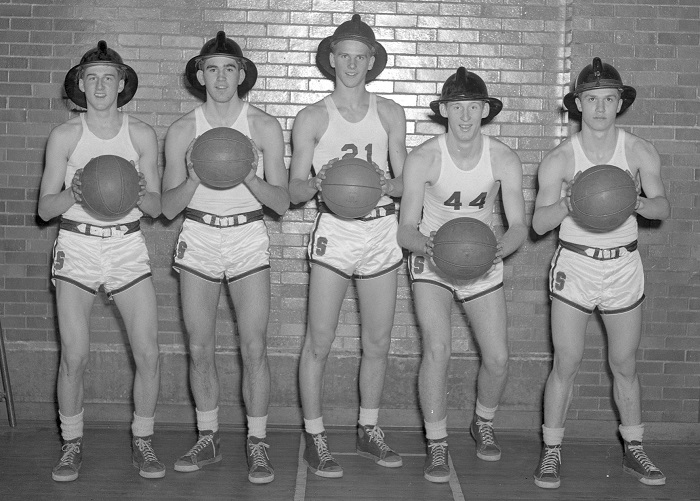 Tim Gloege of the Grand Rapids Public Library said the collection of photos – and their identification – is continually growing. As more people log onto the library's website, more people want to either add to the collection or have information that leads to an identification. The library estimates about 1,200 photos are searched monthly. But as time grows, many of the original photos are disintegrating. The library is in a constant state of preservation, Gloege said.
"It's a massive project, and we're working to get as many photos online as possible," he said. "The numbers (of photos) we have are rising pretty significantly as people post them on social media.
"When you think of the past and now, you need to realize these are people, kids who used to play basketball and did other things. The work is hard and very time-intensive, but it brings a whole new dimension to history."
Schichtel said he's "kind of picked the low-hanging fruit" on many of the easy photos to identify. But the work will continue.
"Yes, it can be frustrating," he said. "There are limitations if you want it to be accurate. Sometimes you look at a photo and you know it's not going to happen, and you move on. But this a chance to learn about people who made Grand Rapids what it is. That's important to me."
PHOTOS (Top) Two Grand Rapids Union basketball players stand for a photo taken Dec. 12, 1941. (2) Longtime area coach Bob Schichtel researches hundreds of photos that are part of the Grand Rapids Public Library archive. (3) Schichtel has identified these 1941 Grand Rapids Ottawa Hills basketball players as James Horn (left) and Chuch Reynier. (4) Schichtel identified Grand Rapids South High’s “Fireman Five” of, from left, Fred Esslair, Lee Morrow, Jack Carroll, Bob Youngberg and Bruce Bigford. (Historic photos courtesy of the Grand Rapids Public Library.)
Breslin Bound: Boys Report Week 1
December 16, 2019
By Geoff Kimmerly
Second Half editor
This boys basketball season needed just a few hours of opening night to satisfy the anticipation that’s been building since last season’s MHSAA Finals finished a little more than eight months ago.
 We’ll bank on that first week as an indication of what’s to come.
Below is our first “Breslin Bound” report of the boys season, powered by MI Student Aid and based on results and schedules posted for each school at MHSAA.com. Those results have become much more vital this winter – for the first time, there will be limited seeding of the top two teams at the District level based on their Michigan Power Rating (MPR). Check out how every team in the state ranks, and send corrections or missing scores to [email protected].
Week in Review
The countdown of last week’s five most intriguing results:
1. River Rouge 63, Ypsilanti Lincoln 53 – This high-profile matchup started the week and season, as reigning Division 2 runner-up Rouge handed reigning Division 1 champion Lincoln an opening defeat at Eastern Michigan University’s Convocation Center.
2. Grand Blanc 80, Detroit Douglass 77 – This Horatio Williams Showcase headliner featured one of the state’s best sophomores and juniors and two teams that should be making pushes in March in Divisions 1 and 2, respectively.
3. Saginaw 88, Saginaw Arthur Hill 76 – After scoring 101 points in its opener, Saginaw put up another big number in its first matchup of the season with the rival Lumberjacks.
4. Ferndale 66, Flint Beecher 55 – The Eagles also posted an impressive win at the Horatio Williams event, getting past a Beecher team looking toward contending in Division 3 again after making the Quarterfinals last season.
5. Ypsilanti Arbor Prep 48, Detroit U-D Jesuit 47 – Division 3 Arbor Prep started its season with a one-point win over the reigning Division 1 runner-up.
Watch List
With an eye toward March, here are two teams in each division making sparks:
DIVISION 1
Ann Arbor Huron (2-0) Last season’s 13-8 record was a bit deceptive; two losses were one-pointers and its District defeat came in overtime. The River Rats are starting out on the positive end of those close games this winter, with their first win 53-50 over returning Division 3 semifinalist Detroit Edison.
Marquette (2-0) For the second straight season, Marquette opened with wins over Brighton and Petoskey – this time by eight and three points, respectively. Last season, that start turned into a 19-4 finish with league and District championships.
DIVISION 2
Detroit Communication Media Arts (2-0) CMA improved five wins from 2017-18 last winter to get to 11-10, and may be on its way toward taking another step. The Pharaohs opened with a 74-48 win over Pershing to avenge last season’s one-point loss to the Doughboys, then got past Farmington in overtime 70-68 after Farmington had opened with an impressive win over Wayne Memorial.
Imlay City (3-0) The Spartans are coming off two straight sub-.500 seasons but did improve two wins last winter to 10-12. The Harry Moore Tournament at Capac gave them an opportunity for three wins during the first week, and Imlay City capitalized by defeating Deckerville in the championship game.
DIVISION 3
Burton Bendle (2-0) The Tigers are halfway to equaling last season’s 4-17 success thanks to double-digit wins over Flint Southwestern and Flint New Standard Academy. The 84-74 win over Southwestern avenged last season’s one and 11-point losses to the Jaguars.
Farwell (2-0) The Eagles haven’t won more than five games in a season since 2013-14, and tied that high of five last winter. But they are 2-0 for the first time in at least a decade, opening with a 65-64 win over Remus Chippewa Hills after losing to the Warriors by 17 a year ago.
DIVISION 4
Mayville (2-0) The Wildcats over the last six seasons have gradually climbed, progressing to an 8-14 finish a year ago. Last week gave them their best start in at least a decade, as Mayville stacked double-digit wins over Akron-Fairgrove and Caseville.
Three Oaks River Valley (3-0) The Mustangs doubled their success last season from 2017-18, going from 6-15 to 13-9 and despite a 1-3 start. River Valley opened last week with double-digit wins over Decatur and White Pigeon and then avenged a pair of losses from last season to Marcellus Howardsville Christian.
Can't-Miss Contests
Be on the lookout for results of these games coming up:
Tuesday – Sanford Meridian (1-1) at Beaverton (2-0) – Three wins over Beaverton last season played significant parts in Meridian winning the Jack Pine Conference title and reaching the Division 3 Quarterfinals.
Tuesday – Grand Rapids Catholic Central (1-0) at Grand Rapids Christian (2-0) – GRCC won the regular-season and District matchups between these two last season, the latter on the way to a Division 2 Regional Final.
Thursday – Pittsford (1-1) at Bellevue (1-0) – These two both won divisions of the Southern Central Athletic Association last season; Bellevue won their regular-season meeting and the rematch in the Division 4 Regional Final.
Friday – Kalamazoo Central (1-0) at Benton Harbor (2-0) – These annual southwestern powers are meeting for the first time since the 2014-15 season.
Saturday – Detroit U-D Jesuit (1-1) at Detroit Edison (1-1) – As noted above, both ended last season at Breslin Center, Jesuit in the Division 1 Final and Edison in the Division 3 Semifinals.
Second Half’s weekly “Breslin Bound” reports are powered by MI Student Aid, a part of the Office of Postsecondary Financial Planning located within the Michigan Department of Treasury. MI Student Aid encourages students to pursue postsecondary education by providing access to student financial resources and information. MI Student Aid administers the state’s 529 college savings programs (MET/MESP), as well as scholarship and grant programs that help make college Accessible, Affordable and Attainable for you. Connect with MI Student Aid at www.michigan.gov/mistudentaid and find more information on Facebook and Twitter @mistudentaid.
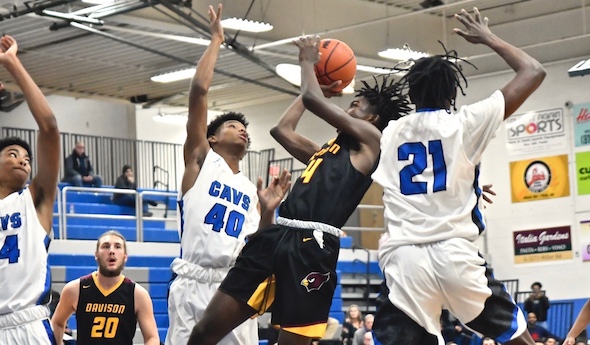
PHOTO: Flint Carman-Ainsworth opened the season last week with an 81-45 win over Davison. (Photo by Terry Lyons.)