

Longtime Coach Researches Photos to Tell Story of Grand Rapids Sports' Past
By
Steve Vedder
Special for MHSAA.com
September 16, 2022
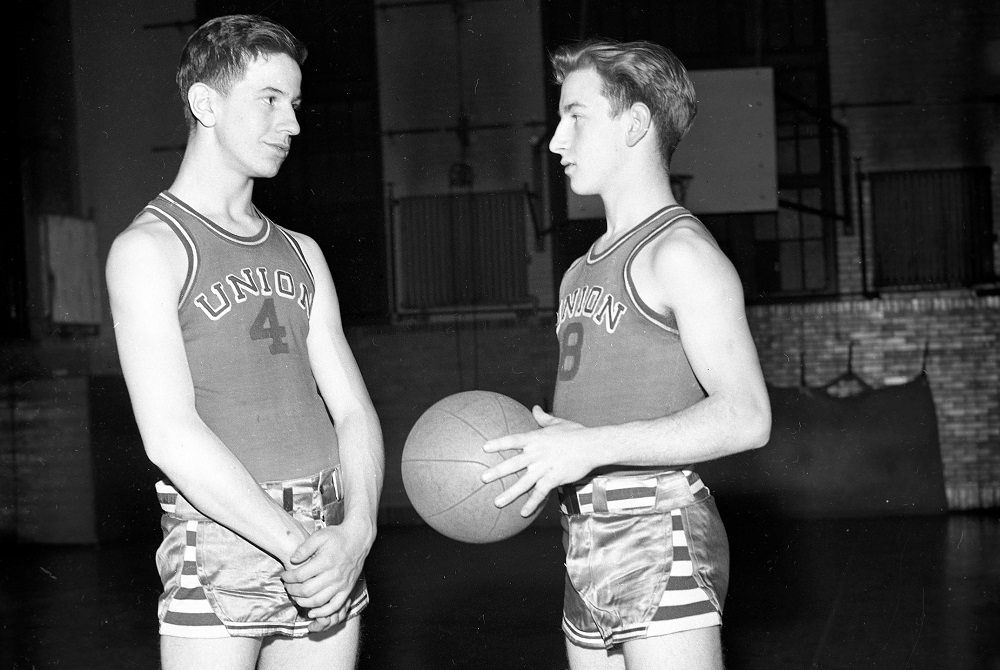
GRAND RAPIDS – Bob Schichtel always pauses when he comes across the ancient black and white photo long enough to ponder whatever became of the two youngsters adorned in Grand Rapids Union basketball uniforms.
The posed shot shows two players facing each other in a local gymnasium in a photo apparently taken four days after the Japanese surprise attack on Pearl Harbor in 1941 that launched the country into World War II. Only a handful of fans today would recognize the players' striped, ultra-short shots and simple sleeveless shirts with "Union" emblazed across the front as recognizable basketball uniforms. One holds a battered-looking basketball, while the other looks on. The two players, whose uniform numbers are "4" and "9," aren't really smiling, but still seem as close as any teammates, whether 81 years ago or today.
In fact, it's the look the youngsters share that intrigues Schichtel, whose thankless, pro bono job it is to identify the two players.
"Once you start," said Schichtel, a former longtime Grand Rapids basketball coach, "it's like looking down a deep rabbit hole."
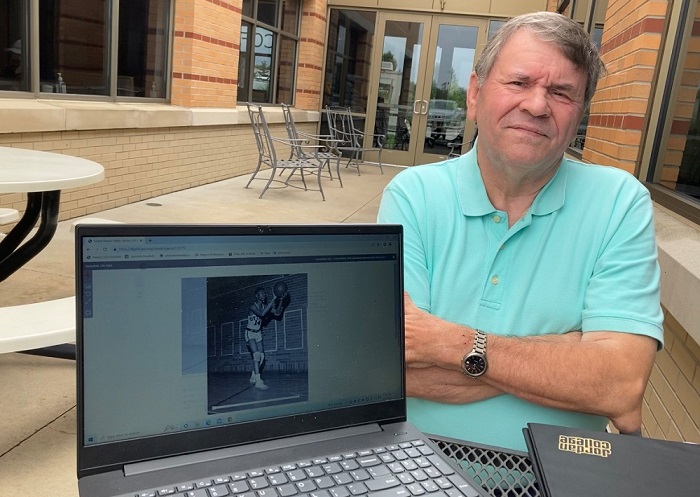 Schichtel works as a volunteer for the Grand Rapids Public Library trying to identify mostly former Grand Rapids City League basketball players from approximately 1938 through the early fifties. The online photos are mostly from the Robinson Photo Studio Collection taken in conjunction with the Grand Rapids Herald newspaper. The library says the unique collection spans some 950 basketball negatives from the entire Robinson/Herald collection that totals well over 900,000 Grand Rapids photos.
While the work – which amounts to a ton of patience combined with a detective ability – can be exhausting, it's still what Schichtel describes as a labor of love. For example, there's the shot of the two still-unidentified Union players. Schichtel looks at the photo and can't help but wonder whatever happened to the kids. Were they exceptional athletes? Did they leave their marks on Grand Rapids history, whether it was in education, politics, business, industry, the arts or another field? He doesn't even know, as in many photos from this era, whether the two entered the military and thus even survived World War II.
Schichtel has searched everywhere for the answers, but has come up short. Too many times, in fact.
Which isn't to say he'll quit looking or chalk up his research as inconsequential. Schichtel said the foremost reason he spends hours on the project is that many of the athletes he identifies deserve the recognition for achievements far beyond basketball. In many cases former City League basketball, football, baseball, track and tennis athletes became the foundation on which Grand Rapids was built. If Schichtel can uncover an old photo which depicts these youngsters during their high school careers, so much the better, he said.
"It's important to recognize Grand Rapids sports history, and I don't know if we've given enough attention to their past," Schichtel said. "They are what got us here, and I'm a firm believer they need to be recognized for it."
Figuring out that history, however, ranges from, at the least, extremely time consuming to – in too many frustrating cases – virtually impossible. The City League was formed in the late 1920s and featured original schools Grand Rapids Central, Creston, South, Union, Ottawa Hills, Catholic Central and Davis Tech. The league was eventually folded into the Ottawa-Kent Conference in 2008.
"It was a long, evolving league," Schichtel said.
 The identification tools available to Schichtel are actually more numerous than most would suspect. For starters, he's formed an impressive database of information by pouring through old City League yearbooks and programs, photos from other collections and microfilm of old newspapers, And then there's also the knowledge gathered by Schichtel himself, a 1968 Grand Rapids Catholic Central graduate. After playing in many old City League gymnasiums, Schichtel went on to compile a 389-197 record in 27 years as the Cougars girls basketball coach. He uses countless City League contacts as both a player and coach to identify athletes. In all, Schichtel taught in the Grand Rapids school system for 34 years.
He also uses the game itself to identify the photos. For instance, he can pinpoint some photos simply by the styles of the uniforms worn by players. He also figures out who is who by other clues such as what the players are doing in the photo. If a player is taking a set shot in the photo, it's likely pre-World War II. The beginnings of the jump shot, or what Schichtel calls "elevation while shooting," is probably mid-1940s. In addition, Schichtel can identify photos through pure basketball athleticism. Players can look a bit awkward in shots from the thirties as compared to players from the late 1940s who were beginning to play with a more obvious flare.
Put all the information together and Schichtel, who has uncovered more than two dozen personal connections to subjects in the photos, believes he has a reasonable shot at identifying them.
Since he signed on with the project, Schichtel figures he's identified about 10 percent of the photos he's viewed. Among the City League athletes he's found shots of Central's John Lavan, who was born in 1890 and played Major League Baseball during the Babe Ruth era and became a military hero who is buried in Arlington National Cemetery; Creston basketball player Roger Wilkins, an assistant United States attorney general during the Watergate hearings; Art Spoelstra of Godwin, a former NBA player and member of the Grand Rapids Hall of Fame; and Grand Rapids native Bill Cutler, who turned a chance post-World War II meeting with then-American League president Will Harridge into a position as commissioner of the Pacific Coast League,
Schichtel said gaining information through photos on the people who became the bedrock of Grand Rapids should be celebrated.
"I think it's a great approach for the community; they shouldn't be forgotten," Schichtel said. "Who else is going to do this? Why do I do it? I see a certain, for lack of a better word, a nobility. These kids played for the love of game, and they became the “Greatest Generation.” These kids did great things. It's not just, 'Well, there's No. 58,’ in a photo.
"You want to know more about them. That's the real intrigue for me."
 Tim Gloege of the Grand Rapids Public Library said the collection of photos – and their identification – is continually growing. As more people log onto the library's website, more people want to either add to the collection or have information that leads to an identification. The library estimates about 1,200 photos are searched monthly. But as time grows, many of the original photos are disintegrating. The library is in a constant state of preservation, Gloege said.
"It's a massive project, and we're working to get as many photos online as possible," he said. "The numbers (of photos) we have are rising pretty significantly as people post them on social media.
"When you think of the past and now, you need to realize these are people, kids who used to play basketball and did other things. The work is hard and very time-intensive, but it brings a whole new dimension to history."
Schichtel said he's "kind of picked the low-hanging fruit" on many of the easy photos to identify. But the work will continue.
"Yes, it can be frustrating," he said. "There are limitations if you want it to be accurate. Sometimes you look at a photo and you know it's not going to happen, and you move on. But this a chance to learn about people who made Grand Rapids what it is. That's important to me."
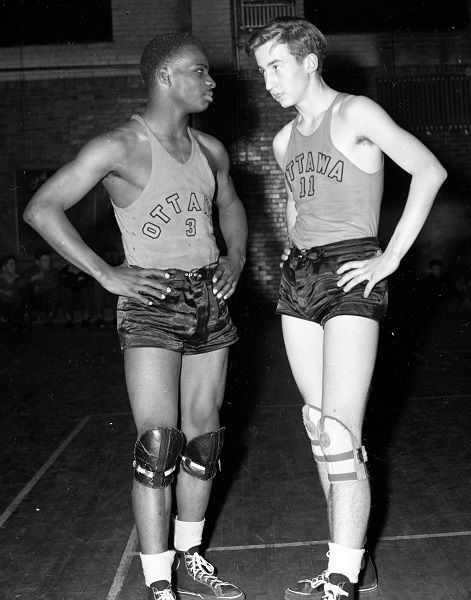
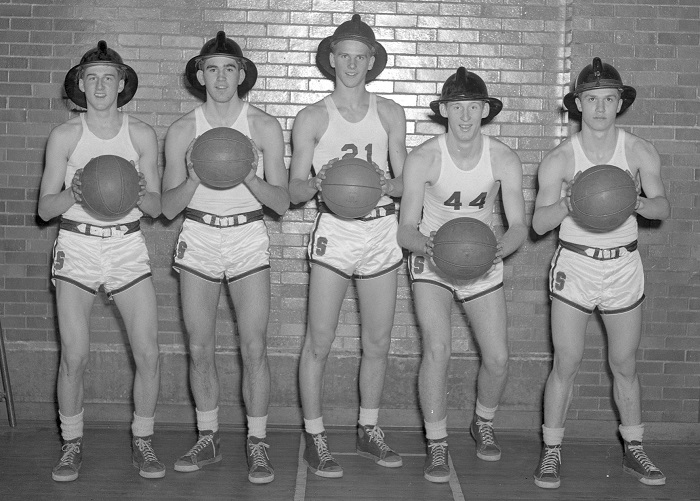
PHOTOS (Top) Two Grand Rapids Union basketball players stand for a photo taken Dec. 12, 1941. (2) Longtime area coach Bob Schichtel researches hundreds of photos that are part of the Grand Rapids Public Library archive. (3) Schichtel has identified these 1941 Grand Rapids Ottawa Hills basketball players as James Horn (left) and Chuch Reynier. (4) Schichtel identified Grand Rapids South High’s “Fireman Five” of, from left, Fred Esslair, Lee Morrow, Jack Carroll, Bob Youngberg and Bruce Bigford. (Historic photos courtesy of the Grand Rapids Public Library.)

'Who Will Cheer for the Nimrods?' Peterson IV, Watersmeet Found Fans Worldwide
By
Jason Juno
Special for MHSAA.com
July 15, 2025
WATERSMEET — George Peterson IV talks to a lot of people through his job as a police officer in the Green Bay, Wis., area. When some of those folks are headed up north for the weekend, he tells them he’s from the Upper Peninsula.
 Many are expecting to hear about one of the bigger towns located a couple of hours drive from Green Bay, like Iron Mountain or Escanaba. But they usually know his hometown, too.
“There’s more people than I would have thought know exactly – ‘Oh Watersmeet, the Nimrods,’” Peterson said.
Some surely know the tiny town because it’s not light years away from Green Bay – only about three hours. But Watersmeet’s dot on the map got a little bigger when Peterson was in school two decades ago, thanks to a run of media exposure that all started with an ESPN commercial that wondered: Without sports, who would cheer for the Nimrods?
Peterson and his teammates can look back on a high school sports experience unlike pretty much anyone else’s, which included the popular ESPN commercial, an appearance on “The Tonight Show” with Jay Leno, and an eight-part miniseries and media exposure from print and television outlets throughout the country. All because of their quirky nickname that has come to be an insult but was chosen because the biblical figure Nimrod was a mighty hunter, and hunting is a big deal in the U.P.
That era also coincided with the best basketball Watersmeet has ever seen. The 2004-05 team, with Peterson was a junior, won its only MHSAA Regional championship and only U.P. small-school team of the year award.
“Great memories from that year,” Peterson said.
The first moments he mentions from his time in high school sports as a aren’t of going to Hollywood – although that certainly came up later – or of being on ESPN. He instead recalled the camaraderie with his teammates, the bus rides, and proving people wrong even in elementary school that Watersmeet could be good.
“The Watersmeet Nimrods weren't supposed to be good,” he said. “We weren’t supposed to win elementary tournaments; we were supposed to fall apart.”
They definitely didn’t do that, as one of the smallest high schools in the state enjoyed instead an unforgettable three-year run.
The cameras first showed up when Peterson was a sophomore. ESPN staff came to get footage early that season, during a December 2003 game against rival Bessemer. The cameras didn’t faze the Nimrods, who upset the rival Speedboys that night; Peterson remembers Bessemer putting 100 on them later that season.
No one told the Nimrods when the commercials were going to air. Then one came on one night when Peterson was watching ESPN.
“That was really cool, just little surprises you weren’t expecting,” Peterson said.
Watersmeet was featured in major newspapers, “CBS Sunday Morning” came to town, and Nimrods merchandise flew off the shelves.
They were even on “The Tonight Show.”
“I would say Jay Leno was probably the coolest experience,” Peterson said. “A small-town kid from Watersmeet, all of us that went, getting treated like we were important, something that a lot of people don’t get to experience. They flew us out, we had limos, we had a hotel right down the road – I think it was a Hilton.”
After the national attention died down during their very successful 2004-05 year – which included the run to the Class D Quarterfinals – the cameras were back for Peterson’s senior year. This time it was the Sundance Channel for an eight-part miniseries about life in his team’s small town.
Those cameras were around that entire season. But if something came up along the way – and it did – the team could just ask the filmmakers to go away while they hashed it out privately. Peterson said they didn’t pressure him to do anything, and the staff members were great to he and his teammates, while doing what they could to make them feel comfortable.
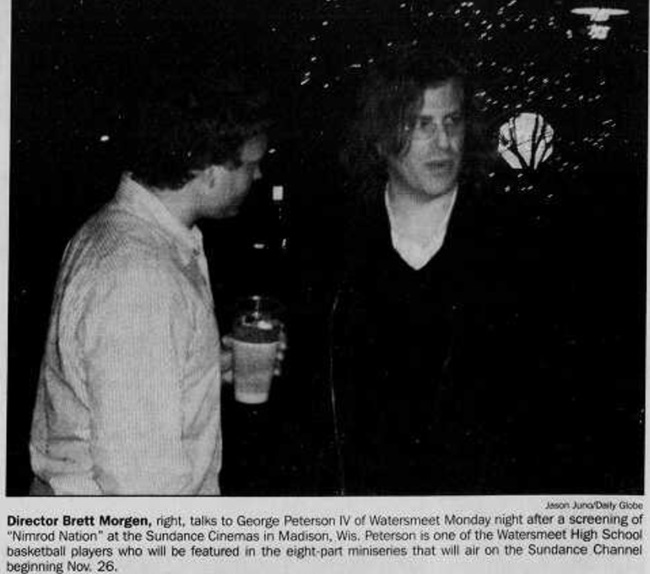
The buzz for the miniseries wasn’t quite the same as for the commercials. But Peterson enjoyed going to a screening ahead of its debut in Madison, Wis. And he can look back on scenes with his late grandfather.
“Now I can show my kids when they get older,” he said.
The basketball part of Peterson’s high school days was a pretty big deal as well.
Growing up, Peterson’s dad George Peterson III took him to the Regionals in Marquette each year. Rooting for area teams like Ewen-Trout Creek kept the fire going.
“I’d go back home, I’d shoot hoops and play ball,” Peterson IV said.
As he and his teammates entered in high school, the Nimrods finished well under .500 his freshman year. The next year, they flipped their regular-season record to 14-6, which included the early season upset of rival Bessemer with ESPN’s cameras recording commercial material.
“And then we were kind of like, ‘OK, we got something here,’” Peterson said.
They went to Michigan Tech’s basketball camp the following summer and won pretty much every game, including against the U.P.’s big schools like Marquette and Iron Mountain.
 The Nimrods also won constantly early in the 2004-05 season – until Baraga gave them another piece of humble pie. But that proved to be a quick bump in the road. They won their District tournament at home and then both Regional games by double figures.
Watersmeet then lost a heartbreaker in overtime in the Quarterfinal against Posen, but it didn’t diminish what they had accomplished.
For Peterson, he got to do it with his dad coaching, his brother Jordan playing with him and the whole community cheering for them. He still remembers the bus ride home and the reception they got going through Bruce Crossing, part of the E-TC school district.
“We got to experience something we never got to experience before,” Peterson said. “That was probably one of, if not my favorite, moments from my junior year.”
He learned a lot of lessons from that time in his life — just from playing sports but also from playing for his dad and with the kind of spotlight most small-school athletes don’t see.
“Being an athlete and working in law enforcement, a lot of the lessons learned go hand-in-hand with my profession, because you have to be teachable, you have to be coachable and you have to take the losses,” Peterson said. “Obviously in sports, every time you step foot on the court, we didn’t win. There’s some things in life that you don’t get what you want, but you just learn you gotta work harder for it and strive to be better. That helps me in my profession.”
His dad, who recently retired from coaching boys basketball after walking the sideline for more than three decades, taught his son many things like humility, how to be respectful, patience, and how to respond when things don’t work out.
“That doesn’t mean the door’s closed; you just gotta find a whole different way to get what you want,” Peterson IV said. “I remind myself of that every day when I’m at work.”
As for being in the spotlight, he took valuable lessons from that as well.
“It’s helped me learn to take a step back and not get too excited about certain things,” he said. “Like when I’m around a crowd or when I have stuff going on, like board meetings, or we just have a crowd where people could be mad or people could be in support. It’s helped me to learn to take a step back and mentally just prepare, take that deep breath and everything seems to run smooth.”
2025 Made In Michigan
July 10: Feeding 'Drive to Win,' Loy Norrix Grad Morgan Impresses with Strong USBC Showing - Report
July 9: After Blazing Multiple Volleyball Trails, Bastianelli Charting Next Career Path - Report
PHOTOS (Top) At left, George Peterson IV (12) puts up a jumper playing for Watersmeet in 2004. At right, Peterson holds his son George V while pictured with wife Elise and daughter Braelynn. (Middle) This Ironwood Daily Globe photo from 2007 shows Peterson talking with “Nimrod Nation” director Brett Morgan. (Past photos by Jason Juno; current photos courtesy of the Peterson family.)