

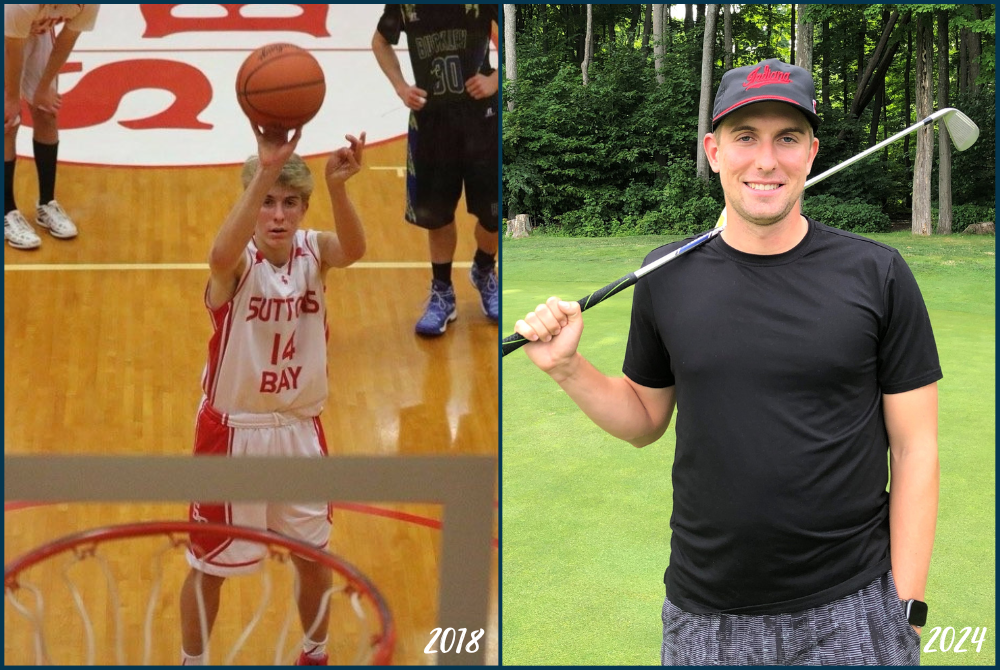
After Successful 'Sequel,' Suttons Bay's Hursey Embarking on Next Chapter
By
Tom Spencer
Special for MHSAA.com
July 30, 2024
Thomas Hursey’s story is a Hollywood writer’s dream. He really is the stuff of sequels.
 He could star in a remake of “Hoosiers” – titled in the singular as just “The Hoosier” – or maybe “Against All Odds II” is more fitting.
Hursey is a 2018 graduate of Suttons Bay High School. He was in a class of just 30 students. He grew up where there is snow on the ground, many argue, for six months of the year. He never played an Amateur Junior Golf Association tournament. And, he had zero scholarship offers from Division I colleges.
To top it off, basketball was his favorite sport in high school. It still is today.
Hursey, who admits he pretty much hated golf, switched his focus from the basketball court to the links midway through high school. He gave up on playing college basketball despite scoring 1,200 points during his career and achieving all-state status.
As a high school freshman, he helped a team comprised of only senior teammates win the Lower Peninsula Division 4 golf championship. He earned all-state in golf too and did receive a scholarship offer from Division II Ferris State University. He took it and excelled there.
So maybe his movie would be titled “The Bulldog.” Again, as a freshman at FSU, he had only senior teammates – and he was named Great Lakes Intercollegiate Athletic Conference Freshman of the Year.
Hursey went on to pick up individual titles and conference player of the year awards as he led the Bulldogs to GLIAC championships and trips to the NCAA Division II Tournament.
Today, many say Hursey could make a run at the PGA Tour – and they may wonder why he doesn’t. Instead, he is about to join a Philadelphia-based pharmaceutical company and put his science and business background to work.
He has a biology degree from Ferris and a master’s in business from Indiana University. He has no interest in playing an individual sport after his stellar high school team sports career at Suttons Bay. His preference is to work hard with teammates and relish a leadership role similar to the one he had playing for the Norsemen in golf, basketball and tennis and while running cross country.
“I am much more of a team-sport guy,” Hursey explained. “I can’t really get the same motivation when it’s just an individual tournament – I need to be surrounded by team.”
Unlike most Big Ten golfers, professional golf was never really on Hursey‘s mind. Veteran IU golf coach Mike Mayer believes Hursey is capable of continuing his golf career, but respects his decision to take another path.
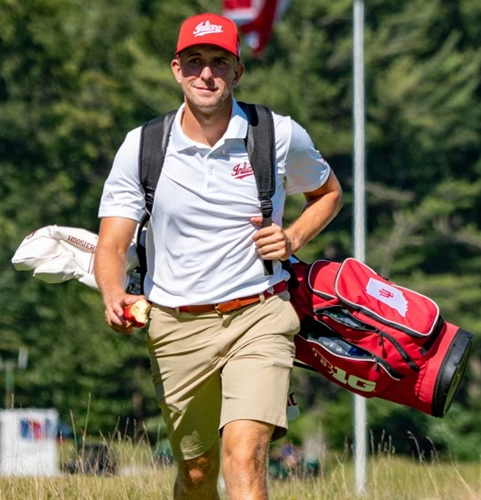
“Thomas was a gift to us,” Mayer said. “Very truthfully, Thomas Hursey might very well be at the top of the list as a great athlete, and great golfer, but more importantly a great person.
“I have had a lot of great student-athletes and you don’t rank them, but at the same time you know which ones stand out,” Mayer continued. “And Thomas Hursey simply stands out.”
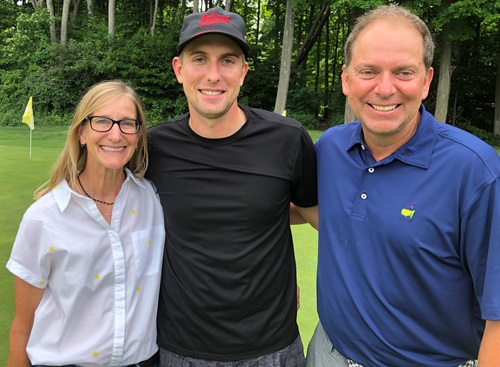
Hursey’s parents are former college athletes, retired teachers and longtime high school sports coaches. His father Todd was his high school coach and is now the golf coach at Traverse City West. His mother Nicki was the Suttons Bay softball coach and coached siblings Laura and Jane on the softball field, where they became all-staters as well. Jane, a 2015 Suttons Bay graduate, was also an all-state basketball player. Laura, a 2020 grad, also starred in volleyball.
Thomas Hursey had a reputation as a nice competitor, and his parents treasure that even more than the success he found in high school and college sports.
“I always, and so did Todd, looked out more and hounded him be humble more than anything,” Nicki said. “He had talent and God-given gifts, but what made me so proud was just the way he acted on the course and the number of parents that come up to me and say what a wonderful son you have.”
Mayer, too, proudly recalls Thomas’ politeness and humility.
“As a coach, that’s at least as equally, if not more than rewarding than winning,” he said.
Mayer admits he secretly wishes Hursey would try pursuing professional golf, but respects his decision to end his golf career while it was still a team sport.
“Thomas Hursey has the athletic ability to play professional golf,” Mayer confirmed. “I fully understand his decision – he is going to be successful in whatever he chooses to do.”
Hursey had four top-20 and two top-10 outings for IU during his last season, including an 18th place finish at the Big Ten Championship. During his career at IU, Hursey was named a Big Ten Distinguished Scholar, a Big Ten Sportsmanship Honoree and to the academic all-Big Ten team.
Hursey’s first love was basketball. He’s a fan of the Indiana Hoosiers program and became quite familiar over the years with Michigan State University coach Tom Izzo and his son, Steven.
 The Izzo connection started when Michigan State was recruiting Dwaun Anderson, a Suttons Bay graduate and the Mr. Basketball Award winner in 2011.
Hursey recalls all the hardest practices in basketball as he hoped to someday play at the college level. He had a tremendous work ethic on the court, and it helped his transition to golf.
Even though golf is the most difficult sport he’s taken on, Hursey mastered it more easily because of his desire to get better and not let anything get in the way of success.
“The chip on my shoulder – the grit I had – I think that helped me get to the next level in golf,” Hursey noted. “I really never felt I was as good as I was – I still don’t think I am.
“People tell me I’m good at golf, and I just don’t believe that because I just have this hunger to get better,” Hursey continued. “I am my biggest critic.”
Hursey quickly added he benefitted from two other critics – his sisters. He’s admitted he believes they possess more athleticism than he does.
“They always pushed me to get better, and they always pushed me to work harder,” he said. “They are kind of no-nonsense people.
“Growing up I never got more encouragement from them as much as I did critiquing,” he continued. “That was huge in terms of molding me.”
Hursey’s accomplishments are not at the top of the minds of his parents and former athletic director.
“I always say I am excited about the things he accomplished, but I am proud of the way he is as a person,” Todd Hursey said. “I am proud of how he is and how he handled himself.”
Retired Suttons Bay athletics director, Doug Periard agrees. He watched Hursey’s work ethic develop early and found him regularly at open gyms. Periard also singled out Hursey’s sportsmanship.
“I cannot think of a discouraging word the young man ever said to a teammate or opponent,” Periard said. “He was able to demonstrate both sportsmanship and leadership in defeat, and also in victory.”
2024 Made In Michigan
July 24: East Kentwood Run Part of Memorable Start on Knuble's Way to NHL, Olympics - Read
July 22: Monroe High Memories Remain Rich for Michigan's 1987 Mr. Baseball - Read
July 17: Record-Setting Viney Gained Lifelong Confidence at Marine City - Read
July 11: High School 'Hoop Squad' Close to Heart as Hughes Continues Coaching Climb - Read
July 10: Nightingale Embarking on 1st Season as College Football Head Coach - Read
June 28: E-TC's Witt Bulldozing Path from Small Town to Football's Biggest Stage - Read
PHOTOS (Top) At left, Suttons Bay's Thomas Hursey prepares to shoot a free throw during his senior season, and at right Hursey remains at home on the golf course. (Middle) Hursey grabs a quick snack during a round while golfing for Indiana. (Below) Hursey, recently, with his parents Nicki and Todd. (Recent photos by Tom Spencer; Indiana and Suttons Bay photos courtesy of the Hursey family.)
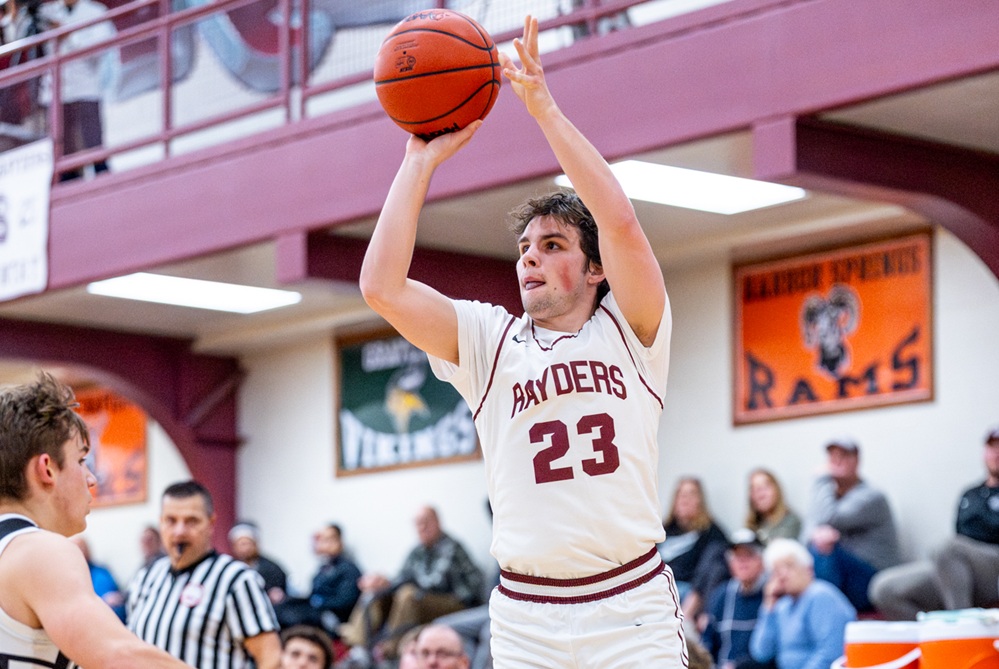
Gaffney Returns to Basketball Court for Opening Night, Continuing Incredible Recovery
By
Tom Spencer
Special for MHSAA.com
December 5, 2025
Joe Gaffney was in a familiar spot Tuesday night when Charlevoix opened the basketball season at home against Ellsworth.
 The all-state guard was in the starting line-up.
But as the game was wrapping up, the four-year starter was in an unfamiliar spot.
“He was the loudest one on the bench cheering,” said Charlevoix coach Anthony Troshak. “He was coaching, giving out reminders and that's awesome for a kid that normally, in the last three years, he's out there in crunch time. Instead, he's still like, ‘Hey, I can make an impact,’ and that was a really awesome thing to see.”
The fact Gaffney was in the game at all is arguably a miracle. Gaffney nearly lost his life this spring. He was in a car crash along with the entire Charlevoix boys golf team and coach Doug Drenth.
The team was on its way to spend the night at Crystal Mountain, returning from the first day of a two-day tournament at Arcadia Bluffs. Emergency personnel transported Gaffney, his coach and the entire golf team to Munson Medical Center. Gaffney sustained a ruptured diaphragm and shattered pelvis.
Gaffney had emergency surgery to repair his diaphragm April 27 and underwent a nine-hour surgery the next day. Munson Orthopedic Institute surgeons Michael McDonald and Matthew Schuch placed 76 screws in his pelvis and femur.
“The trauma team and the general surgeons are the ones who repaired his diaphragm, and they're the ones that saved his life – that wasn’t me,” Dr. McDonald pointed out. “Joe’s done a lot of hard work. All credit to him, because it's tough to go through what he went through and come to where he has.”
Gaffney spent nine days in Munson’s Intensive Care Unit and then stayed in Munson’s Mary Free Bed rehab facility until May 9. He was non-weight bearing until July 9.
Many wondered if Gaffney would ever get back on the basketball court. Few thought it would be as early as the opening night win over Ellsworth. Gaffney played just more than two quarters and hit two of three shots from 3-point land. He also contributed two rebounds before sitting out the Rayders’ all-out press in the fourth quarter – but instead led the bench’s support.
“That’s the type of person he is,” Troshak said. “He's one of the most, if not the most determined individuals I've ever come across.”
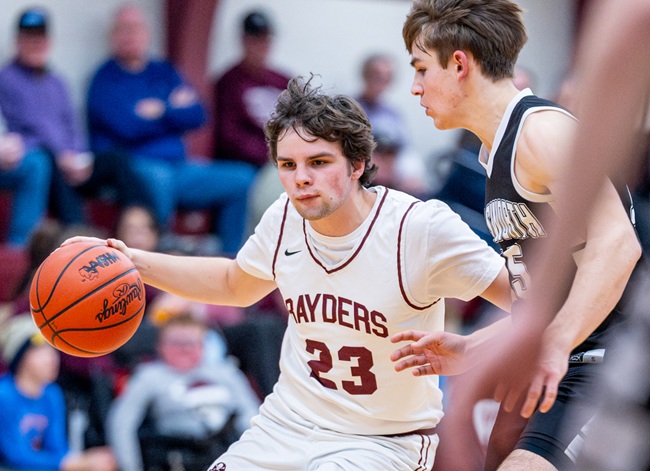 The crash and initial rehabilitation left Troshak thinking he’d likely have his star guard available only for something like a Senior Night appearance. But incredible community and medical support, and Gaffney’s hard work gradually changed Troshak’s hope.
“In the summer, I thought it might be maybe in January or February, and maybe a couple of minutes here and there,” Troshak said. “I never dreamed it would be game one – that's just how hard he's worked.”
Gaffney never lost sight of getting back on the court. He started physical therapy and occupational therapy in Traverse City three days a week until July and then transitioned closer to home for therapy in Charlevoix.
Gaffney was walking with a cane when he left Aug. 1 with his parents, Aaron and Karrie, for the Barwis Sports Performance Center in Deerfield Beach, Fla. He underwent therapy five days a week in Florida before returning to Charlevoix on Sept. 22.
His parents took turns flying back and forth to Florida every two weeks. They carried with them tremendous community support and prayers. When he left Florida Gaffney was able to jog about 100 yards. Therapy continued in Charlevoix, along with a home exercise program from Barwis.
“I had full confidence I would play again, and I didn't know exactly when,” Gaffney said. “As the season got closer, that date when I thought I could play got earlier and earlier until it was the first game. I really had confidence that this was going to happen very early on.”
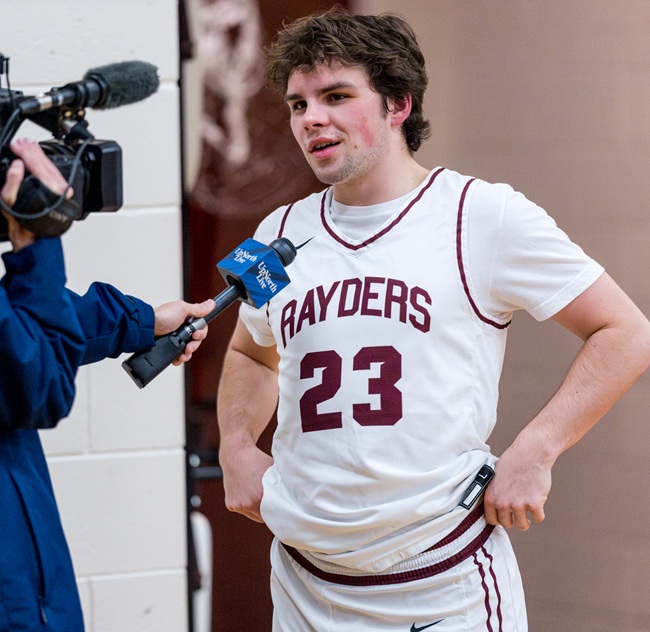
Gaffney was aware of the tremendous support the community was providing him and the entire golf team. But his awareness was heightened further when he realized starters would soon be introduced and the national anthem was playing Tuesday night.
“I've heard the hundreds if not thousands of prayers for the whole golf team and everything and all the letters,” Gaffney said. “I could really feel all the prayers and just everything people had done. And, I would say the moment, the game meant a lot more to everybody watching than it did to me.”
The Charlevoix gym was filled with supporters bearing signs for Gaffney. The team – except Gaffney – wore “Team Joe” warm-up T-shirts. Gaffney wore a “Team Doug” warm-up T-shirt in honor of his golf coach Doug Drenth, who spent months recovering in the hospital and also was in the crowd for the first basketball game.
At least one supporter was unable to attend the game. Logistic problems prevented Dr. McDonald from fulfilling his intent to make the trip from Traverse City. The surgeon is amazed, but not surprised Gaffney returned for opening night.
 “I think most probably would not have been able to do that,” McDonald said. “I think he put in the work, and he really had good community support that allowed him to do that. I think it's very, very impressive.”
Aaron Gaffney – who serves as superintendent for Ellsworth Community School – had thoughts on his mind from early conversations with McDonald as he watched his son get emotional before the contest. Seven months ago, Gaffney acknowledged, he didn’t think he’d see his son play basketball again. He also noted he never saw his son cry during those same seven months – until the tip-off neared.
“It was just great to see him back out there,” Aaron Gaffney said. “My wife asked the surgeon if he was ever going to walk again. He said, ‘Yeah, he's going to walk again.’ I asked him if he would ever play golf again, and the surgeon said, ‘Maybe.’ And then I asked him if he would ever run again, and he said, ‘Maybe.’”
The Gaffneys got answers Tuesday night as the Rayders started the season on a winning note. Talan Jacobs led Charlevoix with 12 points. Carter Greenacre added 11. Jason McNamara scored nine, and Peter Yanchulis chipped in seven.
Moments before the game, Gaffney returned a good luck charm his basketball coach had given him at a breakfast meeting as he was headed for Florida. It was bracelet bearing the words “Never Give Up.”
It was a gift Troshak’s brother had given him as he battled to recover from an eye injury he suffered while playing college basketball.
“I told Joe, ‘I want you to give this back to me when you check into a game, because in high school basketball you can’t wear bracelets,’” Troshak recalled.
Gaffney played Tuesday with empathy for the fans in attendance. The accident taught him more about the hard things going on in people's lives.
“The people there I could tell were there to support me, but there were probably people in that gym tonight that knew somebody or know somebody going through something themselves that was just as hard or harder than what I went through,” Gaffney said. “If people in the world can give them half the love or a quarter of the support that I got, I think that would just make this world a better place.”
Now that he is back on the court, the 1,000-point career milestone lies just ahead for Gaffney – he scored 952 heading into this weekend’s Will Lynch Invitational at Benzie Central. He’s happy about that but is more focused on his newer role. He is the only starter back from last year’s 16-8 team.
“That (1,000-point club) would definitely be a nice bonus, but I'm really just focused, trying to do my best to leave all the sophomores we have on the team with a little taste of what Charlevoix basketball is and what it feels like to win and what it feels like to be on the basketball team. I'm not the same player I was a year ago, but I can help mentor and lead these younger guys to be very successful when they become seniors.”
McDonald did watch a live stream of Tuesday night’s game. He’s making plans to attend another game this season.
Perhaps it will be the game Gaffney enters the 1,000-point club.
 Tom Spencer is a longtime MHSAA-registered basketball and soccer official, and former softball and baseball official, and he also has coached in the northern Lower Peninsula area. He previously has written for the Saginaw News, Bay County Sports Page and Midland Daily News. He can be reached at [email protected] with story ideas for Manistee, Wexford, Missaukee, Roscommon, Ogemaw, Iosco, Alcona, Oscoda, Crawford, Kalkaska, Grand Traverse, Benzie, Leelanau, Antrim, Otsego, Montmorency, Alpena, Presque Isle, Cheboygan, Charlevoix and Emmet counties.
PHOTOS (Top) Charlevoix’s Joe Gaffney elevates on a jumpshot Tuesday in his team’s season opener against Ellsworth. (Middle) Gaffney works to get past an Ellsworth defender. (Below) Gaffney is interviewed by a local TV station after his return to the court. (Photos by In Motion Images.)