

Spring Lake Takes Lead in Pool, Community
February 12, 2016
By Geoff Kimmerly
Second Half editor
The Spring Lake boys swimming and diving team has taken a turn toward the elite over the last two seasons, rising from average to one of the best on the west side of Michigan and in its division statewide.
 And Lakers over the last two seasons have matched their athletic prowess with a notable outside-the-pool contribution as well, spearheaded by one of its captains.
Spring Lake is the Applebee’s Team of the Month for January after nearly completing one of the most impressive regular seasons in Lower Peninsula Division 3 this winter, and also for an athlete-driven effort that has raised nearly $8,000 over two years to provide services to local cancer patients.
The Lakers finished 11-3-1 in dual meets and rank No. 9 in LP Division 3 after starting this season outside the top 10, with wins over No. 4 Holland Christian, No. 5 Grand Rapids Christian and No. 6 Hamilton twice. Spring Lake also beat LP Division 1 honorable mention Grand Haven for only the third time in program history and first time in at least four seasons – and the team’s losses were to LPD1 No. 6 Zeeland and LPD1 honorable mentions Byron Center and Grandville.
“Three years ago, we had a losing dual meet record. We were losing to teams, a lot of Division 3 teams, and those teams we’ve beaten (the last two seasons),” said Spring Lake coach Jason Lintjer, a three-time MHSAA champion for Grand Haven at 2008 who went on to swim at Michigan State University. “We’re definitely moving in the right direction. We’re getting better year by year.”
The Lakers have also won three invitationals this season: their own, at Ludington and at Bridgman, another honorable mention in LP Division 1. The team’s relays are especially strong – the 200 freestyle relay of Cam Peel, Jacob Weesies, Grant Stille and Evan Wujcik ranks sixth in LPD3 with a top time of 1:31.30, and the 200 medley relay of Peel, Marshall Bailey, Drew Fogel and Weesies is tied for sixth with a top time of 1:43.04. The 400 freestyle relay of Charlie Slajus, Peel, Keon Rick and Fogel is eighth in LPD3 at 3:27.13. All three have qualified for the MHSAA LPD3 Finals beginning March 11 at Eastern Michigan University.
But more than an interesting sidenote is how many athletes could step into those relays and contribute. Peel has the fastest 200 free split, but team’s seventh-fastest swimmer in that relay has been only 1.71 seconds slower. The difference in speed between Slajus’ team-leading split in the 400 free and seventh fastest is only 1.58 seconds.
 “The reason we’ve won so much is we’re so deep. Our depth is better than just about every team in every division," Lintjer said. "We don’t have state championship type of swimmers, but we might make a run at a relay because we have four swimmers who can contribute.”
All of this points to Spring Lake as a team on the rise statewide. But adding to these accomplishments has been the work to raise money to assist those fighting cancer, initiated by Rick, a senior.
He watched cancer’s effects first-hand as it took the health of his grandmother, who died in 2015. According to a Grand Haven Tribune report, Rick followed the lead of his brother, who had previously raised a donation to Bluebird Cancer Retreats, which provides programming including counseling for those living with cancer, survivors, and other loved ones and caregivers.
With just a few weeks of work in 2015, Rick raised more than $3,000 for those wishing to take part in Bluebird’s retreats. This year, he raised more than $4,200 with the help of his teammates, coaches and Manistee’s team during their Jan. 21 meet, a “Swim for Hope.”
Rick received donations door-to-door, from businesses and families, Lintjer said, and from Manistee’s program and community as well. Donors could sponsor specific events of the meet or lanes of Spring Lake's pool. Many made donations in the names of loved ones, and those names scrolled on the scoreboard throughout the meet.
In addition to physically organizing most of the meet festivities, Rick directed the effort, instructing teammates who took part as well.
“People are probably surprised he raised $4,000, but I wasn’t very surprised,” Lintjer said. “He’s one our team captains, and pretty much anything he does, he does a great job.”
Spring Lake’s swimming and diving team has 23 athletes this season and has set two pool records, one at home and one at Bridgman. The Lakers will look to repeat as Coastal Conference champions when they host the league meet Feb. 26-27.
Past Teams of the Month, 2015-16:
December: Saginaw Heritage girls basketball – Report
November: Ann Arbor Gabriel Richard volleyball – Report
October: Benton Harbor football – Report
September: Mason and Okemos boys soccer – Report
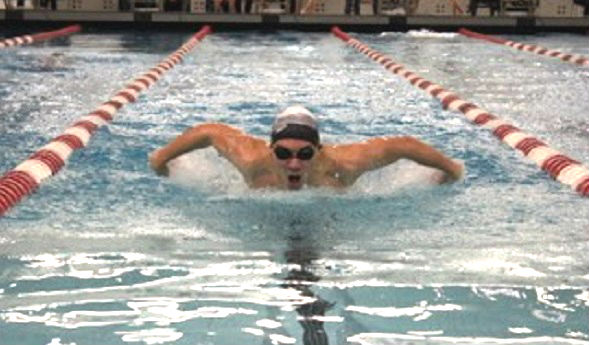
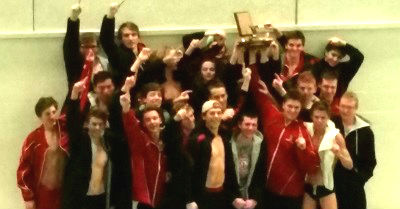
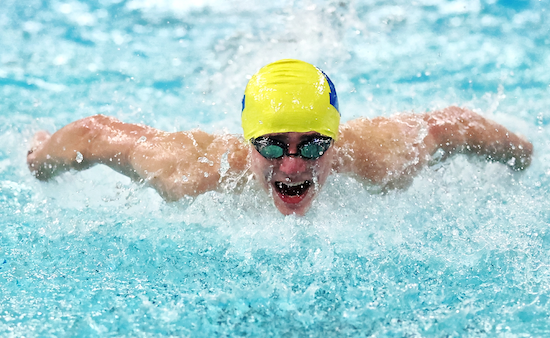
PHOTOS: (Top) Spring Lake's Eric Schock swims the butterfly during a meet this season. (Middle) Spring Lake athletes wave to the crowd with trophy in hand. (Photos courtesy of the Schock and Rick families).
Marquette Adds to Championship List As Newest Standouts Take Their Turns
By
Jason Juno
Special for MHSAA.com
February 17, 2024
MARQUETTE – Marquette has won so many Upper Peninsula Boys Swimming & Diving Finals team championships, it’s running out of wall space to celebrate them as the boys list already runs from the high ceiling to just about pool level.
They added one more Saturday, their fifth straight title and 31st in school history, and did so in dominating fashion finishing ahead of runner-up Houghton 319-214. The day saw a Marquette sweep as the girls team also breezed to a U.P. championship with its list of championships running just about as far down the same wall.
“Last year, we graduated some real studs,” Marquette coach Nathan McFarren said. “If you would have told me that both teams would be here winning it today last year at this time, I would have said you’re crazy. But our boys that were B and C swimmers were ready to shine. They wanted their moment, and they got it today.”
 Marquette junior Trevor Crandell won the 50-yard freestyle, finished runner-up in the 100 butterfly and helped Marquette to wins in the 200 medley relay and 400 free relay.
“It’s so rewarding,” Crandell said. “When you’re first starting the year, it’s so demotivating, you’re not swimming any meets, you’re not doing any good times. But when you get to the U.P. Finals, you’re on that taper, you’re on that block, you’re just ready to go, it’s something special.”
“Super-quiet kid, but this year found the eye of the tiger and really went after it,” McFarren said of Crandell. “So exciting to watch. He wanted it so bad this year, proud of him.”
Junior Isaiah Youngren picked up Marquette’s other individual race win, in the 100 breaststroke. Junior Chase Thomsen was the top diver with a score of 198.15.
Manistique’s Nathan Schoenow won the 100 and 200 freestyle races.
The senior had been sick in his other U.P. Finals appearances.
“It feels good; a lot of hard work in the pool and out of the pool came into this,” he said.
He looked to sprint through both races, including the 200.
 “Earlier this season, I didn’t have a whole lot of endurance,” Schoenow said. “I tried to pace myself, maybe hold back a little. But for this meet, since it’s my last time ever doing the 200, I just decided to sprint the whole thing and see how that would work. It hurt a lot, I was really tired after, but it worked – I got my best time by 3.5 seconds.
“The other one (100), same thing, I tried to sprint as hard as I could and the second I felt tired, I would just try to will myself to go faster.”
Other individual winners included Kingsford’s Joey Lundholm in the 200 individual medley and 100 fly, Rudyard’s Keith McDowell in the 500 free and Houghton’s Beau Haataja in the 100 backstroke.
Gladstone was third in the team standings with Kingsford fourth, Ishpeming/Negaunee fifth, Sault Ste. Marie sixth, Rudyard seventh, Manistique eighth and Ishpeming Westwood ninth.
McFarren made it a combined 17 Finals championships as coach for boys and girls for Marquette, tying Marquette’s Matt Williams for the meet record.
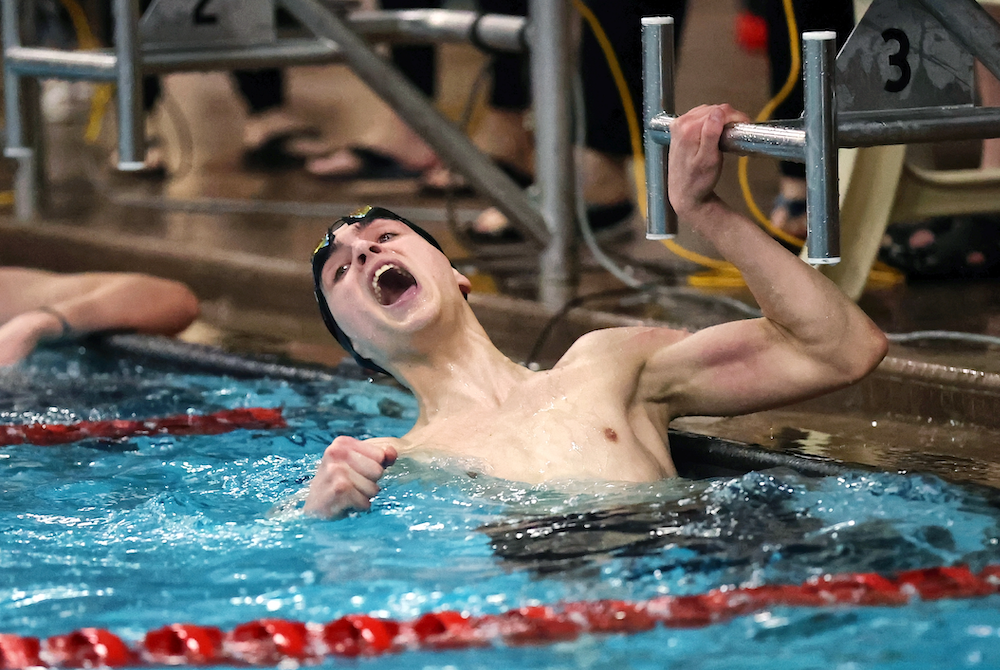
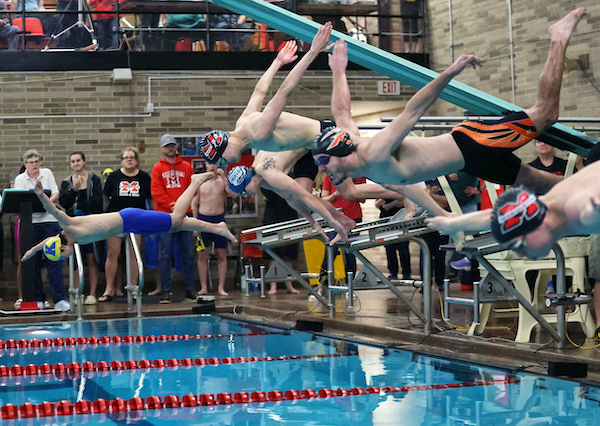
PHOTOS (Top) Marquette’s Trevor Crandell celebrates his victory in the 50-yard freestyle Saturday. (Middle) Swimmers launch at the start of the 50 championship race. (Below) Kingsford’s Joey Lundholm swims to a win in the 200 individual medley. (Click for more from Jarvinen Photos.)