

Holland Courts Honor Program Builder
By
Geoff Kimmerly
MHSAA.com senior editor
October 5, 2016
A few days after he stood in front of a group of admirers including friends, fellow coaches and former players – including some from his first Holland High School tennis team in 1972 – Dwayne “Tiger” Teusink drove past the courts that now bear his name.
It’s a welcoming sight honoring someone who has welcomed thousands though the sport over more than a half century as a coach and administrator.
Teusink, a 1954 graduate of Holland High and later Hope College, coached high school tennis at Jackson for seven years and then Holland for 35 while also lending a significant behind-the-scenes voice in the formation of high school tennis as it’s played in Michigan today.
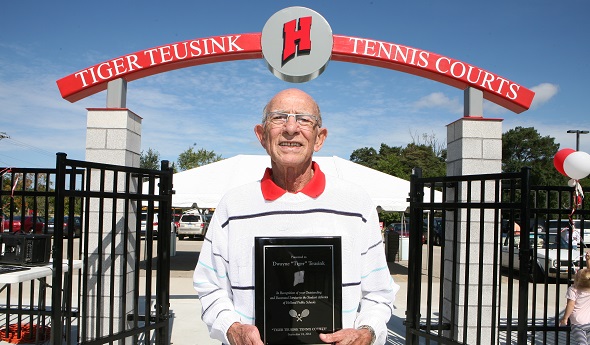
He was recognized for those and many more contributions during the Dutch’s Homecoming weekend Sept. 24 as reportedly more than 200 attendees cheered the renaming of the 5-year-old Holland High facility as the “Tiger Teusink Courts” in honor of the longtime teacher, athletic director and coach.
“The whole experience was overwhelming,” Teusink said Tuesday. “Our facility is a first-rate facility. Holland has always had a great tennis program. The community supports tennis, and this facility obviously belongs to the community, but it makes me really proud that my name is associated with it.”
He’s been associated with most of the foundation-setting of the sport both locally and statewide over the last five decades.
After his time at Jackson High, Teusink returned home to Holland in 1972 and continued as a teacher until 1989 and coach until 1998. He led high school teams to a 453-176-4 record with 13 conference and 16 MHSAA Regional titles, and his Holland boys team was a runner-up at the 1976 Class A Final. He also coached at Hope College from 1994-2009.
At a statewide level, Teusink’s work has affected thousands more. He was on the committee that in 1976 introduced the flighted MHSAA tournament structure developed to promote a team format that remains the standard today. While at Holland, Teusink managed 63 Regional and 17 MHSAA Finals tournaments, and he served on the Finals seeding committee from 1980-2011.
He continues to serve on the MHSAA tennis committee that annually considers rules changes and other business that pertains to the sport. He also has played a major role in the development of the Michigan Interscholastic Tennis Coaches Association, and held offices of president, vice president and secretary/treasurer over a 32-year span.
“He was a mentor to me on how to not only to teach the game, but more importantly teach kids the right way to compete and to enjoy the sport,” said Grand Haven Lakeshore Middle School principal Kevin Polston, who coached tennis at DeWitt from 1999-2002 and then both Buccaneers varsities from 2003-08, and served with Teusink on the MHSTeCA board. “I respected that he always stood for what was right, even if it wasn't easy. You always knew where Tiger stood on something, and he could clearly explain why he came to the conclusions he did. Quite simply, when Tiger spoke, people listened.”
Kevin O’Keefe played four seasons for Teusink before graduating in 1986 and has heard from a number of other alums how their coach was ahead of his time.
As the current Dutch coach since 2008, O’Keefe inherited the “big binder bible” of Teusink’s lesson and practice plans that also contains his mentor’s thoughts on everything from conducting challenge matches to motivating players and working with parents.
“He’d come every day with a plan in mind and with an agenda,” O’Keefe said. “The logistics of how it works still work. A lot of it is still quite relevant.”
Other ways Teusink has become memorable and respected over the years are not known by many. His players always knew that being on time meant being five minutes early, and Teusink would have practices start at odd times like 3:14 or buses leave at 6:54 so his players wouldn’t forget. Polston received the mentor’s help one year running Grand Haven’s league tournament – and marveled at how Teusink allowed players to pick on which court they played, and then also kept track to make sure each school got to pick a court the same number of times.
A more significant philosophy surely benefited hundreds who have played for him. Teusink’s was a no-cut program; his teams regularly numbered 45-50 athletes. “That simply enhanced the things we did to teach teamwork, team discipline, belonging to a team and so on,” Teusink said.
Teusink earned induction into the Michigan High School Tennis Coaches Association Hall of Fame in 1986, the Michigan High School Coaches Association Hall of Fame in 1989 and the National High School Athletic Coaches Association Hall of Fame in 2003. He was named National High School Coach of the Year by the United States Tennis Association in 2005, receiving his award at the U.S. Open.
Teusink captained the Hope College men’s basketball team during the 1957-58 season for Russ DeVette, who taught Teusink much about "simply coaching, how to deal with people." Teusink’s first mentor was Joe Moran, who preceded Teusink as Holland’s tennis coaching legend and is the namesake of one of the city’s public parks and tennis courts.
And just as Teusink drove by the sign bearing his name last week, he’ll surely visit more in the future as he remains a sounding board both for his former player and many tennis decision-makers in our state.
“He comes to probably 2-4 matches a year. We stay in touch. I still call him for things,” O’Keefe said. “He’s always there, always ready to answer a question, give advice.”
PHOTO: Tiger Teusink stands with the plaque presented to him Sept. 24, when the Holland High School tennis courts were renamed in his honor. (Photo courtesy of the Holland athletic department.)
After Sending Every Flight to Championship Day, Seaholm Boys Secure 1st Title
By
Fred Kelly
Special for MHSAA.com
October 23, 2025
MIDLAND – Birmingham Seaholm had been knocking on the door of a first Finals boys tennis championship for the past couple of seasons.
This year, the Maples just busted it right down.
Seaholm entered this week’s Lower Peninsula Division 2 Finals as the top-ranked team in the state, and the Maples made that ranking hold up, finishing with 31 points Thursday to top a 21-team field and outlast second-place Byron Center (26 points) and second-ranked Midland Dow (22).
“Last year, we were right there in the end, tied with Dow with 24 points (heading into day two). This feels good, because these returners were motivated, and they worked their butts off in the offseason,” said Seaholm eighth-year coach Nick Shaheen, whose Maples were Division 2 runners-up the last two years.
“We knew it was going to be a tough tournament. Midland Dow is a great team, and I’ve got a lot of respect for their program, and for Byron Center as well,” Shaheen added. “It took a team effort. To get eight flights into the semis is tough. We felt like we were playing our best tennis at the end of the season, and sometimes that’s what you need to win a state championship.”
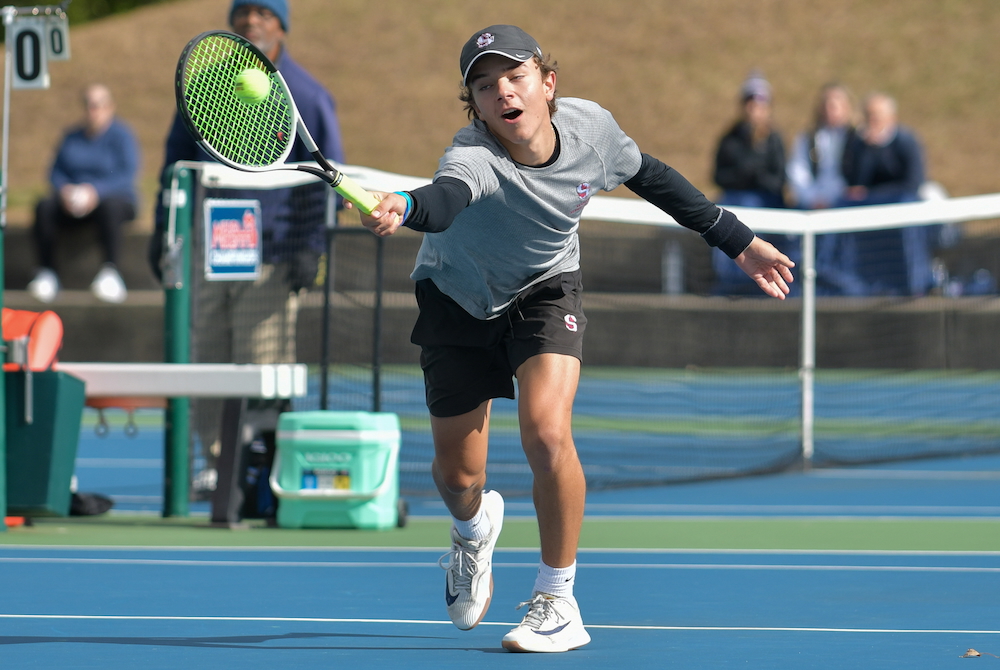
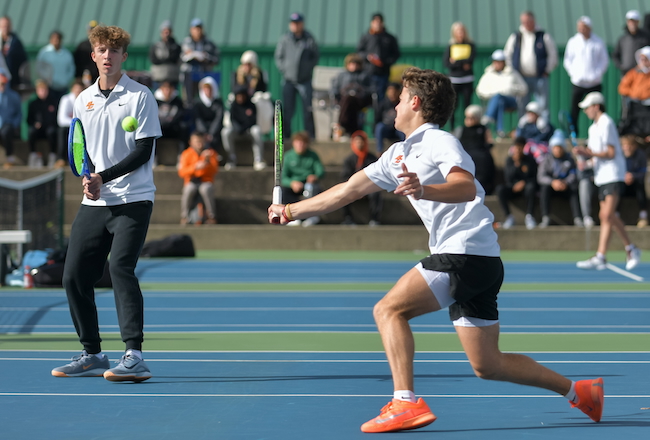
The Maples won titles at three flights, as second-seeded Charlie Griffith won the No. 3 singles championship, top-seeded Joaquim Flory earned the No. 4 singles title, and the second-seeded duo of Britton Leo and Alex Ting clinched the No. 1 doubles crown.
Griffith defeated third-seeded Ryan McKendry of Byron Center 6-3, 7-5 in Thursday’s semifinals, then edged top-seeded Roman Vuljaj of Detroit U-D Jesuit 3-6, 6-4, 7-6(6) in a thrilling three-set upset to clinch the title.
Flory won a tough three-setter 6-2, 6-7(4), 6-2 over fifth-seeded Oscar DeLuca of Grosse Pointe South in the semifinals, then beat third-seeded Cole Krauss of Byron Center 7-5, 6-4 in the title match.
Leo and Ting rallied to beat third-seeded Rylan Vandenberge and Casey Schans of Byron Center 2-6, 6-2, 6-4 in the semifinals before going on to upset top-seeded Matt McGaugh and Nathan Song of Dow 6-2, 6-2 in the final.
Shaheen said that advancing to the semifinals in four singles flights – and to the finals in three of them – helped his Maples get over the hump this year.
 “Traditionally, we’ve been known as more of a doubles power, so for us to send three flights into the singles finals was big. We really relied on the depth of our team,” he said.
“In past years, when we’ve had good runs, our singles haven’t been quite deep enough to get us there,” he added. “But on the first day (of this tournament), we went perfect, which is not easy to do. We benefitted from getting some serious all-year-around players at singles, and that helps.”
Seaholm had a Finals runner-up at No. 2 singles, as top-seeded Giorgio Materazzo beat Rei Hitachi of Grand Rapids Forest Hills Central 6-2, 6-2 in the semifinals, then lost 6-3, 6-1 to third-seeded Vikram Krishnan of Grand Rapids Forest Hills Northern in the title match.
In other action for the Maples on Thursday, second-seeded Carter Griffith lost 6-1, 6-2 to third-seeded Mason Crosby of South Lyon East in the No. 1 singles semifinals; fourth-seeded Saajan Mahadevan and JJ Bastani lost 6-2, 6-1 to top-seeded and eventual champion Nolan Booth and Brayden Slot of Byron Center in the No. 2 doubles semifinals; third-seeded Roger Harris and Kalil Wahab lost 6-4, 6-4 to second-seeded Aidan Banchoff and Ben Vander Stelt of Byron Center in the No. 3 doubles semifinals; and second-seeded Ryan McArdle and Gabe Christman lost 6-3, 7-6(1) to third-seeded Zeke Sandholm and Brady Slot of Byron Center in the No. 4 doubles semifinals.
In Thursday’s other flight finals, top-seeded Sam Schumacher of Portage Central beat Crosby 6-2, 0-6, 6-1 at No. 1 singles, Booth and Slot beat third-seeded Joseph Song and James Notarnicola of Forest Hills Central 6-1, 6-2 at No. 2 doubles, fifth-seeded Marcus Bernard and Drew Decker of Forest Hills Northern beat Banchoff and Vander Stelt 6-3, 6-3 at No. 3 doubles, and top-seeded Ethan Clark and Vettel Xu of Dow beat Sandholm and Slot 6-1, 2-6, 7-6(2) at No. 4 doubles.
According to Shaheen, Seaholm’s first team title on the boys tennis side has been a long time coming.
“I’m extremely proud of our guys. This is something our senior leaders have wanted for a long time,” he said. “They see on our fence back at Seaholm all of the girls state championships, and they so badly wanted to put one on the fence for themselves. We are extremely proud of the effort they put in.”
Shaheen was particularly pleased with how his Maples adjusted to the unpredictable weather in Midland, which prompted play to be bounced back and forth between the Greater Midland Tennis Center’s indoor and outdoor courts.
“For them to come out here and be adaptable – playing indoors, outdoors, indoors, outdoors – I give our boys a lot of credit, because that’s not easy,” he noted. “They were super tough this week. It's a tough, emotional week, so for them to handle that pressure and the ups and downs and come out on the other side is really awesome.”
(PHOTOS by High School Sports Scene.)