


Coach Taught Athletes to Enjoy Sports
By
Paul Costanzo
Special for MHSAA.com
May 16, 2018
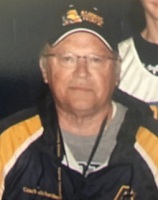
There are to be no ties worn Saturday at the memorial service for George Richardson. He didn't like funerals, so Algonac Muskrats and Michigan State Spartans gear is encouraged.
 And while some sadness is inevitable, people should be having fun telling stories of the longtime Algonac coach, who made it his mission to make sure all his athletes – whether in middle school or high school, in cross country, track, basketball or football – enjoyed themselves while under his tutelage.
“He enjoyed life, and he lived it to the fullest,” said Algonac cross country and girls track & field coach Dan Shafer, a longtime friend of Richardson’s. “George would want it to be a happy time, not a sad time. We won’t ever really be able to measure the impact he had, just because it’s so vast and over so many decades. He had a great impact on our community. To say that Algonac will miss him, that’s an understatement.”
Richardson, who was battling cancer, died on April 26. He was 76 years old and is survived by his wife of 50 years, Diane, his two children, Anthony and Lynn, his mother Martha, and his sister, Mother Maria of Jesus. The memorial service will be from 7-9 p.m. at Algonac High School, and the family has asked any expressions of sympathy take form of contributions to the Algonac athletic department.
It’s fitting that even in death Richardson is giving to Algonac athletics, as he gave more than any amount of money could cover during his life.
Richardson, a Detroit native, graduated from Michigan State University in 1963 and spent his first two years out of college teaching in Battle Creek. In 1964, he took a job as a physical education teacher at Algonquin Middle School in Algonac, and he remained in that position until retiring in 1999. He also began coaching in 1964, and his final season as a coach was the spring of 2017 when he coached the middle school boys track & field team at Algonquin.
His coaching duties included football, basketball, cross country and track at various levels.
“He was a guy, and I’ve heard several people say this, he never had a bad thing to say about any kid he taught or coached,” said Shafer, who began coaching at Algonac in 1977. “He loved kids and loved working with kids, and the kids loved him back.”
One of the main reasons the athletes loved Richardson was his way of making practices fun while still preparing them to succeed in their sport.
 “He’s very motivating, but he makes sure not to push the young kids too far,” said 2016 Algonac graduate Morgan Beadlescomb, a four-time MHSAA Finals champion in cross country and track. “He really focuses on teaching his athletes to enjoy running rather than being serious competitors at 11 years old, making sure they don’t burn out. He was very, very good at making all of us enjoy running. All the cross country kids loved running. We’d end practice sometimes and play two-hand touch football. We were doing little things you wouldn’t expect, and we all enjoyed it and didn’t really know we were working out.”
His approach helped feed athletes into the high school programs who were ready and excited to compete.
“We had a lot of success in track and cross country, and that’s something he should get a lot of credit for,” Shafer said. “He got them enthused about the sport, but didn’t run them to death to the point they were hating it. He really pushed that enthusiasm for the sport. Winning is great, but improving and having fun, that’s the key. Those kids would come out because they liked cross country in middle school, and because they liked track in middle school. He knew his stuff, too. He could coach all the events.”
Without Richardson, Algonac’s middle school cross country program may not have continued to exist. Shafer said that when the funding for the coaching position was cut in the 1990s, Richardson continued doing it for free to keep the program alive.
“He was a very giving person,” Shafer said. “I haven’t heard anybody say a negative word about him.”
Beadlescomb, who won the MHSAA Division 2 cross country titles in 2014 and 2015, and the MHSAA Division 2 1,600 meter titles in 2015 and 2016, now runs at Michigan State. Shafer said Richardson was always very proud of Beadlescomb, and that he had alerted him to the future star when Beadlescomb was just a sixth grader.
“George called me the first day of middle school practice; he said right from the get go, ‘I think he said he’s going to be your best runner ever,’” Shafer said.
Richardson and Beadlescomb have kept in touch, and Beadlescomb said they last talked a little more than a month ago.
“He stayed in touch, even when I was in college, and that was also something special,” Beadlescomb said. “He was always very supportive. I feel like he had some influence on everybody. He was their coach in one way or another.”
Even when he wasn’t coaching, Richardson was a constant presence at Algonac athletic events, whether it be standing along the fence during football games or volunteering his time at a track or cross country meet.
He was always there for Algonac, and while Shafer said he doesn’t know how many people will show up for the memorial service, he expects it will be a special night.
One person who will be there is Beadlescomb, who said he wouldn’t miss it despite being in the most crucial part of his track season at MSU.
“He’s the reason that I’m at Michigan State,” Beadlescomb said. “He’s the reason that I’m running competitively, essentially. I owe it all to him. He’s the reason that I’m able to run and still like to run. It’s important to me. I definitely need to be there.”
 Paul Costanzo served as a sportswriter at The Port Huron Times Herald from 2006-15, including three years as lead sportswriter, and prior to that as sports editor at the Hillsdale Daily News from 2005-06. He can be reached at [email protected] with story ideas for Genesee, Lapeer, St. Clair, Sanilac, Huron, Tuscola, Saginaw, Bay, Arenac, Midland and Gladwin counties.
PHOTO: Coach George Richardson, far right and back row, takes a photo with his 2016 Algonquin Middle School boys track & field team. (Photo courtesy of the Algonac athletic department.)
Bedford Follows Mifsud's Hall-of-Fame Formula to 7-0 Start, SEC Red Title Game
By
Doug Donnelly
Special for MHSAA.com
October 15, 2026
The rumors of Dave Mifsud living across the street from Temperance Bedford High School or being able to see the school from his kitchen window are greatly exaggerated.

Mifsud, in his first year coaching the Kicking Mules, actually lives about five minutes from the stadium. And, no, he can’t see the glow from the Friday night stadium lights from his house.
All joking aside, Mifsud may have found the perfect spot to continue his hall of fame career. After stops at Dearborn, Parma Western, Monroe and Brownstown Woodhaven, Mifsud took over the Bedford program in January and has the Mules off to a remarkable 7-0 start heading into Friday night’s Southeastern Conference showdown with powerhouse Saline.
“I feel like I'm at home right now,” Mifsud said this week. “I feel working and coaching at Bedford, being around this community, I feel like I'm at home.”
The funny part is, he wasn’t looking for one.
Mifsud said he moved to Temperance about five years ago to be closer to his son and three grandchildren in Toledo. He became the head coach at Brownstown Woodhaven and thought he had found his last coaching stop.
“When I took the Woodhaven job, I said, ‘This is it – I’m not going to change jobs again.’ But I put a disclaimer on there – and that was unless the Bedford job opened up.”
This past offseason, it did.
Mifsud said the distance driving to and from Woodhaven was the difference.
“I was driving 39 miles each way to work and spending an awful lot of time in the car,” he said. “I didn’t get to enjoy as many community events as I wanted to be involved in, even just going to basketball games or baseball games and things like that. It was just too far from home. So, this job was definitely a big attraction to me.”
He was hired.
By no means was he taking over a bad program. Quite the opposite. Bedford has been a perennial playoff team – they’ve qualified 14 times since 2009 – and contended among the top half of the SEC Red most of those years.
When Mifsud arrived, however, he had a blank slate. He had to bring in an almost entirely new football staff, overhaul the offense, and create a new-look defense.
“I spent hours and hours and lots of late, late nights interviewing coaching candidates,” he said. “I didn’t really know any of them ahead of time. There was one coach, Sean Stephens, that I had met and talked to a couple of times, but really, I didn’t know any of them.
“The foundation was, the thing that I started off explaining to each and every one of them, was my philosophy and what my goals were and where I was coming from. I wanted them to know how we were going to treat the kids and treat the program.”
Football, he said, teaches great life skills and life lessons.
“Our No. 1 goal is for the kids to have the best memories and the most positive memories from their high school days as being part of the football program,” he said.
He hired coaches from Toledo and the Downriver area, a former Bedford player and one coach who was on a previous Bedford staff. He named a football operations coordinator to handle things like media requests and statistics.
The offense, he said, is a combination of all of the offenses he’s run over the years while building a solid resume at Dearborn and Parma Western.
“We adapted and evolved a little,” he said. “I think we’ve cleaned up some of the things we were doing at Woodhaven.
His defense was constructed with the help of Mike Parker, who had coached at Toledo Whitmer, one of the largest schools in northwest Ohio.
The formula has worked wonders. The 7-0 start is something even Mifsud didn’t see coming.
“Going into it, of course you have high hopes,” he said. “I feel like there was the hope or possibility of being 7-0, but there was also this reality that we could be 3-4 or 4-3. You just don’t know how games are going to play out and how kids are going to respond.”
The biggest win was probably the first, a 20-13 victory over Sterling Heights Stevenson.
“The kids played their hearts out that game, and a really great win,” he said.
What’s followed have been six more in much the same fashion.
“We’ve continued on with the thinking that we just need to go 1-0 each week,” he said. “We’ve had to battle and compete in each game.”
Not only did Mifsud have to create a new coaching staff, but few of last season’s ball carriers were back this fall. One who might have been expected to be a starting running back, for example, transferred to an Ohio school. Other players moved positions and into new roles.
Masyn Moran has emerged as the top ball carrier with 636 yards and 12 touchdowns over seven games. Luke Whetstone has thrown for 841 yards while completing 64 percent of his passes. He’s also rushed for more than 500 yards. Jaxson Lestock has 20 catches for more than 300 yards. The Mules offense has been balanced with 263 rushes and 100 passes.
Bedford’s 7-0 start is the first for the program since 2013 and just the third in school history. Mifsud said the same formula that got Bedford to this point is what he plans on using this week against the also-undefeated Hornets. The winner will own the SEC Red title outright.
“There are some really good kids at Bedford, and they have bought into and committed to the new coach and system,” he said. “The school community has been awesome.”
 Doug Donnelly has served as a news and sports reporter at the Adrian Daily Telegram and the Monroe News for 30 years, including 10 years as city editor in Monroe. He's written a book on high school basketball in Monroe County and compiles record books for various schools in southeast Michigan. He is now publisher and editor of The Blissfield Advance, a weekly newspaper. E-mail him at [email protected] with story ideas for Jackson, Washtenaw, Hillsdale, Lenawee and Monroe counties.
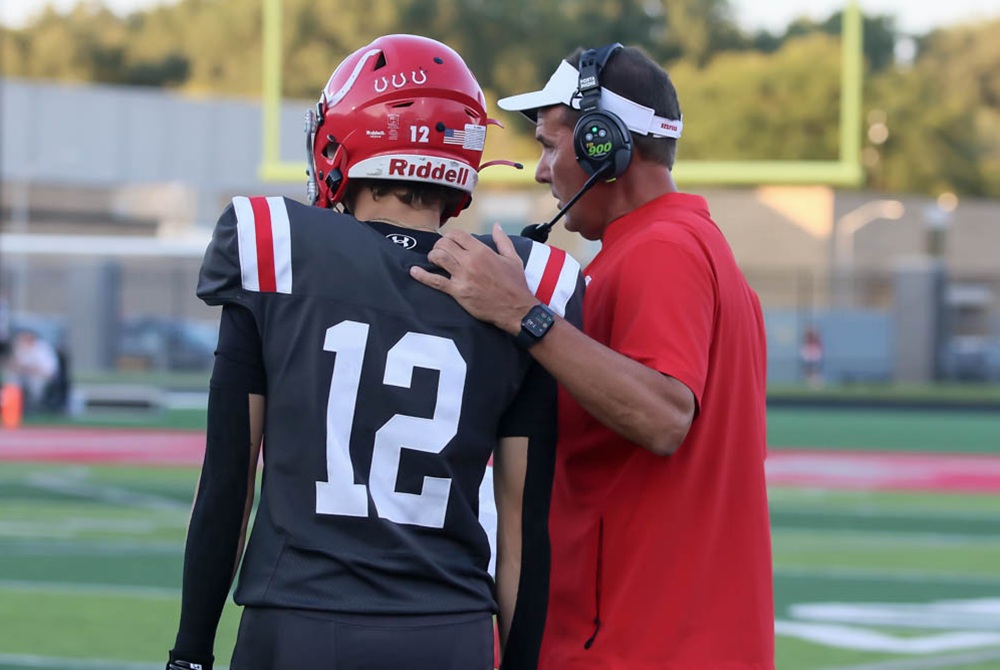
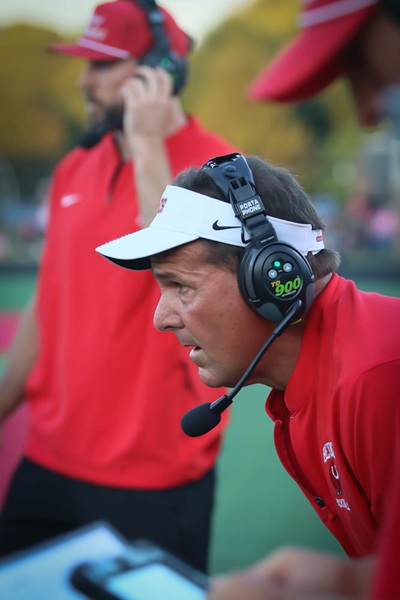
PHOTOS (Top) Temperance Bedford football coach Dave Mifsud instructs player Brady Boisselle during a game this season. (Middle) Mifsud monitors the action from the sideline. (Photos by Jaymee Beard/Temperance Bedford athletics.)