

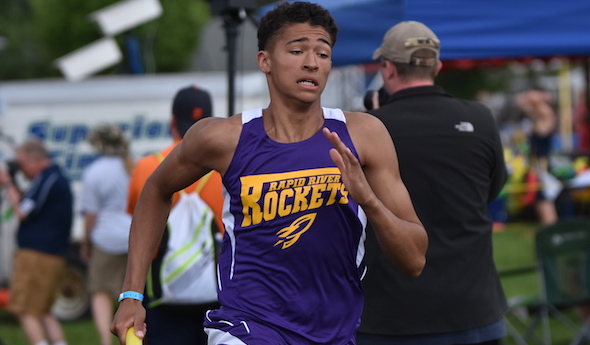
Rapid River Clinches on Final Relay
By
John Vrancic
Special for MHSAA.com
June 4, 2017
KINGSFORD — There appeared to be a sense of relief within the ranks of the Rapid River boys track team Saturday as it retained its Upper Peninsula Division 3 crown.
Rapid River edged Bessemer 108-104 for the title, but the teams were tied at 96 prior to the 1,600-meter relay.
Rapid River then secured the title by setting a meet record in the final race at 3 minutes, 34.52 seconds, topping the previous best (3:36.32) by Crystal Falls Forest Park run five years ago. Bessemer was runner-up (3:39.40).
“We really needed those points,” said senior Austin Wicklund, who anchored the Rockets’ 1,600 relay. “It feels great to win it in the last race. Our hard work paid off. Our first three legs were unbelievable. I couldn’t have asked for a better lead.
“Going out this way is great. Thanks to Coach O (Steve Ostrenga) and his assistants. They got us well prepared.”
The Speedboys pulled even in the 3,200 as Adam Mazurek placed third (10:54.31) and Isaiah Aili took fourth (10:58.94).
Senior Jared Anderson, however, kept the Rockets from falling behind by taking fifth (11:02.33).
Bessemer started the day by setting a meet record in the 3,200 relay (8:29.88), beating the old mark (8:30.1) by Powers North Central in 2004.
“I really had to push myself,” said junior Brayden Tomes, who anchored the winning relay. “The clock read 8:25, and I knew I had to gut it out. It was really close.”
Rapid River junior Lucas Sundling captured the 400 (52.41), helped the winning 800 relay (1:35.41) and was runner-up in the 100 (11.96) and 200 (23.76).
“I wasn’t feeling the best early in the meet,” said Sundling. “I didn’t have a good start in the 100, but managed to catch up. This is my first year in the 100, so I guess I can’t be too disappointed.
“Our first handoff in the 800 relay was bad. Our coach said we could have been under 1:35 without that.”
Junior Luke Gustafson provided the Rockets with a first in pole vault at 12 feet, took the second leg of the 1,600 relay and helped them place third in the 3,200 relay (8:55.61).
 “I’m happy to get first,” said Gustafson. “I wanted the U.P. record, but it didn’t work out. I was up and over the bar twice (at 13 feet), but hit it with my arm. I’m pleased with my day overall.”
Bessemer’s main strength was in the distances where Isaiah Aili took first in the 800 (2:07.35) and 1,600 (4:39.82). Cade Mazzon was runner-up in the 800 (2:09.06), and Uriah Aili took fourth in the 800 (2:10.59) and 1,600 (4:52.56).
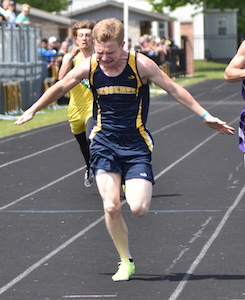
Tomes won the 200 (23.34) and placed third in the 300 hurdles (43.25).
“I had a good start in the 200,” said Tomes. “I wanted to take advantage of the first 50 meters where the wind was on our back. I knew I had to give our team some points. Having the competition helped me get a better time.”
Third-place Pickford’s lone win took place in high jump on Nick Edington’s leap of 6-2.
North Dickinson senior Garrett O’Neil was a triple winner, taking the 110 hurdles (16.34) and 300 (41.97), and long jump (18-10).
“My starts were good, but the races didn’t go as good as I wanted,” said O’Neil. “I hit a couple hurdles in the 110s and landed on the wrong foot on two of the first three in the 300s. I was going for the school record, but landing on the wrong foot made that difficult. I just had to push through and get to the finish line.”
Lake Linden-Hubbell senior Brendan Middleton took the 100 (11.83) and anchored the winning 400 relay (46.76).
Ewen-Trout Creek junior Jake Witt won shot put (45-5½) and was runner-up in discus (129-3), both with personal bests.
“I’ve been working on the glide the past week,” said Witt. “I brushed up on my technique, and with a little help from our assistant coaches I learned how to use my lower body. I threw eight feet further than in the Regional (at Wakefield), which definitely gave me some confidence.”
PHOTOS: (Top) Rapid River’s Luke Gustafson runs his leg of the 1,600 relay Saturday. (Middle) Bessemer’s Brayden Tomes stretches for the win in the 200. (Photos by Cara Kamps.)
Differing Paths Led East Kentwood Stars to Olympics, but All Included Finals Titles
By
Steve Vedder
Special for MHSAA.com
August 19, 2026
When one of his eighth-grade teachers trotted out an assignment to write down an ultimate goal, Brian Hyde didn't even flinch.
Even then, Hyde knew that one day he badly wanted to be an Olympian.
Eight years later, that's exactly what happened for the former East Kentwood distance runner. One of three Falcons to become Olympians, Hyde wound up starring at East Kentwood and William & Mary University before performing in the 1,500-meter run during 1996 Summer Games in Atlanta.
"I was in middle school when I first wrote that as a goal," said Hyde, now a pilot for the Utah-based Sky West Airlines. "Like a lot of people, I grew up watching the Olympics, and it was always a dream for me to run there. It was a long-term goal and there are a lot of things you have to go through to make that happen.
"But I think it's good to have goals for things you really want to do. You don't really have to share them, but it's good to have those goals."
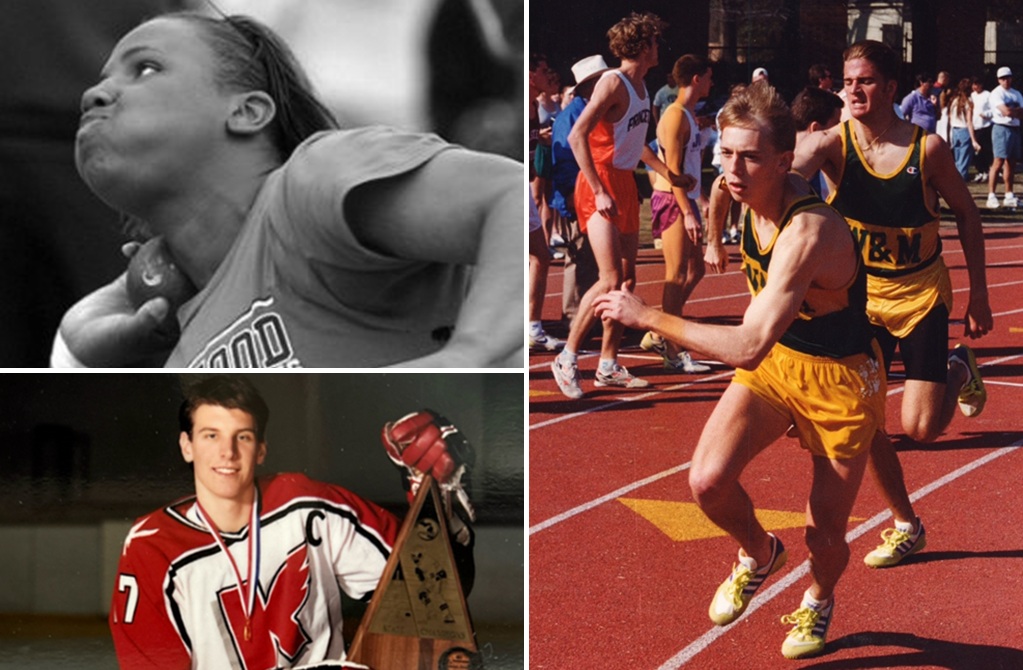
Hyde, a 1991 East Kentwood grad, joins hockey player Mike Knuble, who graduated in 1990, and shot putter Tia Brooks-Wannamacher, a 2008 graduate, as former Falcons who went on to the Olympics. What's unique about their stories isn't that they all became Olympians, but the radically different routes all three took to the Games.
All had major success in high school as Hyde won the 1991 Lower Peninsula Division 1 1,600-meter run (4:12.74), Brooks captured the 2008 shot put with a toss of 48-0.5 and Knuble scored 115 goals in 57 career games while helping the Falcons to the 1990 Class A title.
 All landed in the Olympics in different ways. For instance, Hyde said his No. 1 goal growing up was always to run in the Olympics. He trained fiercely with that in mind from an early age. While Brooks had designs of becoming a sprinter like her idol Marion Jones, East Kentwood coaches convinced the 6-foot Brooks that her track & field future was more likely as a thrower. A 34-year-old Knuble was on the backside of a 16-year NHL career when he finally earned the opportunity to skate in the 2006 Torino Winter Games in Italy.
Knuble said he had a "stick-to-it-ness" that led to his Olympic participation, Hyde said he grinded out long, solitary hours running on a track, and Brooks credits her Olympic story to a combination of natural athleticism and astute coaches who correctly saw her future more clearly than she did.
All took major steps toward the Olympics post-East Kentwood. Hyde went on to become the school record holder in the 1,500 and 1,000-meter runs at William & Mary, Brooks was a two-time NCAA champ in the shot at Oklahoma and Knuble tallied 96 goals over 114 games at Michigan before becoming the 76th player taken in the 1991 NHL draft.
Knuble said dates, age and even past resumes cannot define an athlete.
"Most Olympic athletes would be in their 20s," said Knuble, who would play 34 games with USA Hockey and scored a goal and had an assist in the Torino Games. "But there was a stick-to-it-ness for me. Guys can get written off – that's how I looked at it. You can get passed over when you're 30, and I didn't want to get written off. I wanted that door to stay open for me. I had kind of a career resurgence in my thirties."
Brooks, who retired from competitive track & field when she was 27, had exactly zero thoughts of becoming an Olympian until the January before the 2012 Summer Games in London. But after winning an NCAA shot put title in 2011 along with placing sixth at the Moscow World Cup and 13th in the world at Beijing's World Games, Brooks began considering London qualification.
"The coaches saw something in me and pushed me," said Brooks-Wannemacher, now a projects manager for the Grand Rapids-based Marvelous Style Outreach program. "They thought I had the potential of being an Olympian. I don't want to say it was happenstance, but I really didn't know much about the Olympics. I was competitive and grew up playing all sports and had a sibling rivalry with my brother where we would make up games to play."
Hyde said he became an Olympian through sheer hard work, dedication and sacrifice. He would miss Friday night Falcons football games, for example, because he was in bed making sure he had enough energy for a Saturday meet. Combine that sacrifice with a burning desire to make the Games and the talent he had as a runner, and Hyde said he was able to meet his personal goals.
"I loved to compete and trying to win," he said. "Sometimes there is a grind to it, but in running you're the only one out there. I would tell myself I'm doing this because I have a meet on Saturday and I want to win. You work, have these long-term goals because you tell yourself, 'I can do this.'
"I have no regrets for my career. You control the things you can control. You tell yourself no one is going to outrace you. It's not like you're not having fun, but I'd never miss a workout. Six days a week with Sunday being my rest day."
Knuble, Hyde and Brooks-Wannemacher agree that it's that work, dedication and looking big picture are keys. Lose sight of one, and it can have a domino effect.
"There are times when you're out there working and no one is watching, no one is paying attention," Knuble said. "But you have to put that work in. It's all about figuring out what you did wrong and then getting back at it."
Brooks-Wannemacher called the desire to become an elite athlete "watering a seed." In her case, the seed was the knowledge that the only way a young girl from a one-parent family was going to college was through an athletic scholarship. Places like Michigan and Michigan State had no interest, and the only offers came from Oklahoma and Central Michigan. While the dream was to emulate Marion Jones, Brooks bowed to the suggestions of East Kentwood coaches who said shot put was a ticket to a free education.
"I had a long talk with my mother and coaches, and they said this is the only way to college," she said. "So I started throwing the shot, broke the freshman record at Kentwood, became a Regional and state champ and I kept going. But people had to believe in me.
"It got so that I enjoyed the process. I had a natural talent, but I would push my body to the limit. But for me, the motivation was going to school for free."
Success aside, all overcame major hurdles to achieve it. Hyde suffered a swelling of the spine and terrible pain caused by a tightening of back muscles and wasn't able to finish a race five months before the summer Olympics. Brooks at one point suffered from a narrowing of the spine and bulging discs in her back amid suggestions from doctors she give up throwing a shot. Knuble was physically healthy, but he had to overcome the life-altering experience of dealing with the death of his father when he was 15.
But all say the dedication to athletics, the people they met along the way, great teammates and the will to succeed helped them to greater things.
"There are moments when it's just you and nobody else," Knuble said. "There's no person out there with you, no teammates telling you what to do, how to act, what to eat. For me, being on a team was structure.
"Timing for all of us is huge. You want to be at your peak when you're competing. You want to beat your best for that one race, that one throw, that one game. For me, I had a body of work to work from. I think the others did, too."
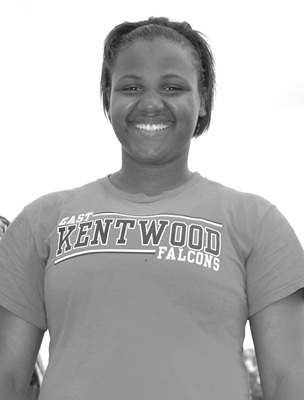
PHOTOS Clockwise from top left: East Kentwood’s Tia Brooks-Wannamacher prepares to launch the shot. Brian Hyde (front) takes a relay handoff for William & Mary. Mike Knuble holds up one of the many trophies the Falcons earned during his time on the ice. (Middle) Brooks-Wannamacher as a high school senior. (Knuble and Hyde photos courtesy of those individuals. Brooks-Wannamacher photo from MHSAA archives.)