


Committees Fail Critical Issues
June 7, 2013
Typically, each sport committee meets once each year for three to five hours, during which time it considers proposals that come from schools, leagues and the state’s coaches association for the sport; and the proposals most often deal with allowing more regular-season events and more qualifiers to the MHSAA postseason tournament.
Occasionally there is a proposal that might improve sportsmanship. But much more often the proposals would increase conflicts between academics and athletics and/or strain overstressed local budgets. And almost never is there a proposal that would address the health and safety of participants (the Wrestling Committee has been an occasional exception and the Competitive Cheer Committee is a routine exception).
While coaches associations must shoulder some of the blame because they’ve brought MHSAA committees “trivial” topics, at least in comparison to the tougher health and safety topics, much of the cause of MHSAA committee ineffectiveness is that the committees don’t meet long enough or often enough to research serious problems and develop well-thought-out solutions. That is forgivable because it is difficult to get commitments from busy people all across Michigan to be absent from their regular jobs and travel dozens or even hundreds of miles, and to do so multiple times each year – which is what it takes to more fully understand complex problems and more carefully construct solutions. Meetings have to be few and they have to be efficient.
However, facing the worst publicity football has seen since the mid-1970s, we knew we had to supplement the football committee process. We did so by appointing a special Football Task Force of optimum size and experienced, representative makeup to meet on however many occasions are necessary during 2013 to accomplish three purposes:
- Review practice policies to improve acclimatization of players and reduce head trauma.
- Review competition rules to reduce head trauma and the frequency of the sport’s most injurious game situations.
- Develop promotions that extol the value of football to students, schools and communities and the safety record of school-based football.
The promotional efforts have begun to be rolled out; game rule modifications are being investigated; and four proposals for changing football practice policies have been prepared. They will be the topic of our next posting.
Everyone Knows Riverview's ID: Pirates Bringing Full House with Powerful T
By
Doug Donnelly
Special for MHSAA.com
September 5, 2024
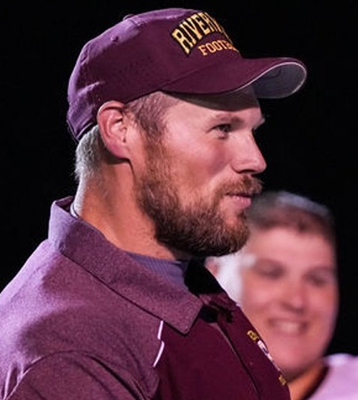
Several years ago, Riverview football coach Derek McLaughlin was talking to a colleague about his football team when something he said struck a chord.
 “I was talking to a coach that I had coached against when I was struggling, and he said something to the effect of we didn’t have an identity,” McLaughlin said.
Those days are long gone.
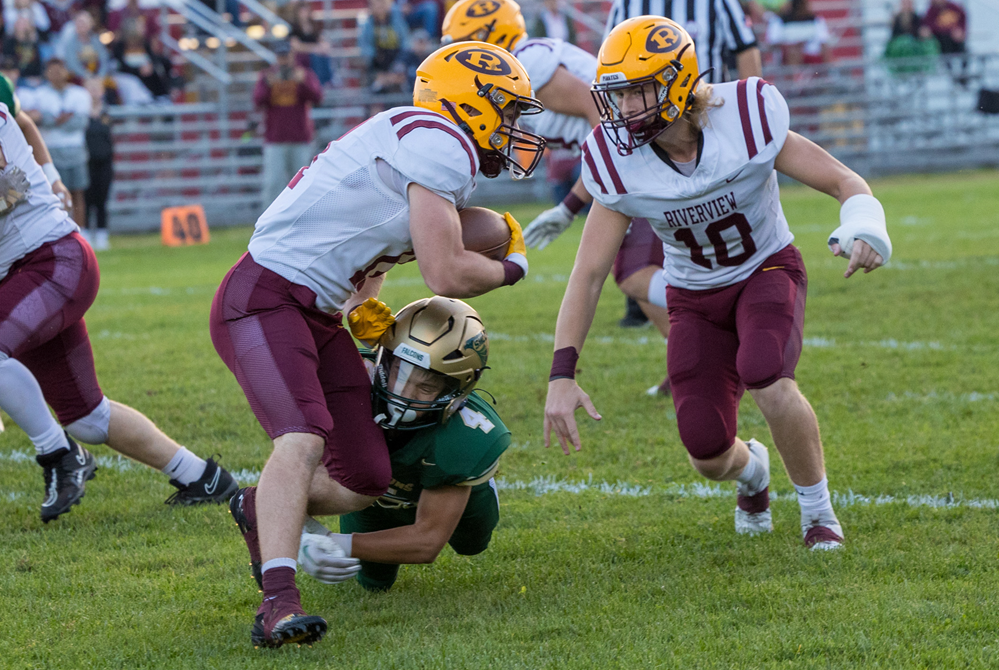
The Pirates and their full-house T rushing attack have become one of the most identifiable football programs in southeast Michigan. They have won or shared four straight Huron League titles, haven’t lost more than three games in a season since 2015 and are hoping for an eighth-straight playoff appearance this year.
McLaughlin said he learned by making mistakes.
“We really like the full-house T, and we went all in,” he said. “It wasn’t good the first year. It wasn’t good at all. We’ve gotten better coaching it. There is still stuff that we need to learn, but that’s what we are. We have an identity. “
Riverview has built its team around the full-house T. Opponents know what they are going to face – they just have to line up and defend it. The deeper the Pirates go into running the same system year-after-year, the harder it seems to stop.
“The kids come into our program or to the varsity and have a basic idea of what they need to do,” McLaughlin said. “It comes down to technique. You can hone in on your craft and get more reps. That’s the mindset that we have. It doesn’t always go perfectly. There are things you must do to get better.”
McLaughlin feels with the offense being so consistent from week-to-week and year-to-year, the coaches can spend more time in practice on teaching technique and, more importantly, focusing on defense.
 “You really don’t get the kids that long during a day,” he said. “We try to be consistent with our reps. We are all about limiting the mistakes.”
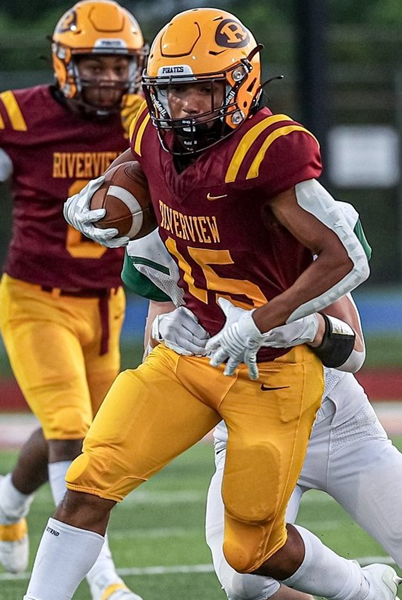
The Pirates have a host of returning players from last season’s 9-2 team that lost in the second round of the playoffs, including leading rusher Ian Adams, who ran for more than 1,500 yards and was one of the top tacklers on the team.
In the season opener against Detroit Renaissance, Adams carried the ball only four times but had 136 yards and two touchdowns. Another back, Nathan Pinkava, also had two touchdowns and more than 100 yards rushing.
Pinkava is one of the four team captains this season along with center/defensive lineman Garrett Timmerman, quarterback and safety Lucas Thompson, and linebacker and tight end Chris Sarnacki.
When the team voted to select them during the preseason, Timmerman was nearly unanimous.
“He’s a great kid who works really hard,” McLaughlin said.
There are 47 players total. Several will get a chance to carry the ball at some point.
“A lot of different backs carry the ball,” McLaughlin said. “In our offense, we’re trying to hide the ball and those four guys in the backfield all get touches at one time or another. We have plays for each of them in the system. There’s a fairly good distribution of who gets the ball.”
McLaughlin is 77-24 in 10 seasons at Riverview. In 2017 and 2022, the Pirates reached the MHSAA Semifinals.
The 2017 team rebounded from a 2-7 season the year before with a remarkable turnaround of nine wins.
As the Pirates’ legend grows, opponents tend to circle the Riverview game on their schedule. Everyone wants to knock off the team on top of the mountain.
 “Because of the success we have had – a lot of teams will come to play against us,” McLaughlin said. “They play us tough. We must be ready each week. Some of these kids have never played varsity before, and they do not quite understand yet that every week is a rivalry game. We get the kitchen sink thrown at us. It is great. I think our league prepares us well.”
Monroe St. Mary Catholic Central coach Adam Kipf is one of the league coaches who has to prepare every season for Riverview’s full-house T.
“I have a lot of respect for Coach McLaughlin,” Kipf said. “He does things the right way and demands a lot of his players. We know that when we play them, the pads are strapped tight and to be ready for a long, physical game. I think their style of play reflects him as a leader. It's nothing flashy, just hard-nosed football, gritty football, which resonates with those kids and the Riverview community.”
Riverview went 9-2 last season and shared the league title with Carleton Airport. The Jets defeated Riverview in Week 2, stopping Riverview’s 22-game Huron League win streak.
McLaughlin is not out for revenge this week when Riverview hosts Airport to start the conference schedule.
“None of that matters when you start a new year,” he said. “Nothing you’ve done in the past really matters. You have to make a difference now.
“It starts in the offseason and goes on through the summer. That is what we preach to the kids. It doesn’t make any difference if you had a bad season the year before or a great season the year before; you have to come to work. You have to make yourself better physically and be prepared.
“We focus entirely on one game at a time. That’s how we are always going to do it as long as I’m here.”
It’s an identity thing.
 Doug Donnelly has served as a sports and news reporter and city editor over 25 years, writing for the Daily Chief-Union in Upper Sandusky, Ohio from 1992-1995, the Monroe Evening News from 1995-2012 and the Adrian Daily Telegram since 2013. He's also written a book on high school basketball in Monroe County and compiles record books for various schools in southeast Michigan. E-mail him at [email protected] with story ideas for Jackson, Washtenaw, Hillsdale, Lenawee and Monroe counties.
PHOTOS (Top) Riverview’s Nathan Pinkava carries the ball and eludes a Monroe St. Mary Catholic Central defender during their 2023 matchup. (Middle) Pirates coach Derek McLaughlin shares a moment with his team. (Below) Ian Adams (15) attempts to break a tackle. (Pinkava photo by Stephanie Hawkins; McLaughlin and Adams photos courtesy of the Riverview athletic department.)