

A Game for Every Fan: Week 3
September 12, 2013
By Geoff Kimmerly
Second Half editor
This week has some of the best of everything for the Michigan high school football fan.
Two powers meet again in one of the most followed rivalry games in the state. Two neighbors face off in another that should draw an entire town. On perhaps a sadder but immediately urgent note, two more will meet again but for the final time.
See below for some of the best games to see in every corner of the state this weekend, and be sure to monitor all the scores at the MHSAA Score Center.
West Michigan
Rockford (2-0) at Muskegon (2-0)
Most seasons, this is arguably the most anticipated regular-season matchup in Michigan. And the excitement was tempered only slightly by Muskegon’s move to another division of the O-K Conference in 2012. Rockford holds a 4-2 advantage in the regular-season series since it began in 2007, but four of those games have been decided by eight or fewer points and Muskegon won last season, 21-9. The Big Reds, also last season’s Division 2 runner-up, have opened with big wins over Grand Haven and reigning Division 3 champ Grand Rapids Christian. Rockford’s slate has been similarly impressive – double-digit wins over Utica Eisenhower and Holt.
Others that caught my eye: Muskegon Mona Shores (2-0) at Caledonia (2-0), Grand Rapids West Catholic (0-2) at Grand Rapids South Christian (1-1), East Grand Rapids (2-0) at Holland West Ottawa (1-1), Ravenna (1-1) at Montague (1-1).
Bay and Thumb
Lapeer West (2-0) at Lapeer East (2-0)
These two schools will merge next fall, making this the final matchup between the rivals. West owns a 28-10 edge in the series dating to 1975, including seven wins in the teams’ last eight against each other. That said, East has bounced back from last fall’s three-win showing and outscored its first two opponents by a combined score of 51-0. West is playing this fall for a third straight playoff berth but this week for its first 3-0 start since 2009.
Others that caught my eye: Birmingham Brother Rice (2-0) at Flint Carman-Ainsworth (2-0), Essexville Garber (2-0) at Frankenmuth (1-1), Bay City Western (1-1) at Saginaw Arthur Hill (2-0), Freeland (2-0) at Saginaw Swan Valley (2-0).
Lower Up North
Traverse City Central (1-1) at Traverse City West (1-1)
The Nowak-Olson Memorial Trophy is again on the line with these rivals having split their last eight games against each other. This matchup also could go a long way toward deciding the Big North Conference champion. Central won 42-28 last season and finished undefeated in the league, while West settled for a second-place tie. Both rebounded from opening-night losses to win their first league game last week.
Others that caught my eye: Petoskey (2-0) at Cadillac (2-0), Traverse City St. Francis (1-1) at Elk Rapids (2-0), Suttons Bay (0-2) at Kingsley (1-1).
Upper Peninsula
Crystal Falls Forest Park (2-0) at Hurley, Wis. (2-0)
These two have built quite a rivalry in the Great Western Conference. At least one has won the league title over the last three seasons, and twice during that time they shared it – last season with Bessemer in a three-way split. The Trojans haven’t been tested yet, but Hurley had to fend off a challenge last week from Lake Linden-Hubbell in an eventual 30-20 win.
Others that caught my eye: Gwinn (1-1) at Manistique (0-2), Marquette (2-0) at Sault Ste. Marie (1-1), Powers North Central (2-0) at Lake Linden Hubbell (1-1), Kingsford (2-0) at Ishpeming Westwood (0-2).
Southwest and Border
Kalamazoo Central (2-0) at Portage Northern (2-0)
The Maroon Giants are back in some conversations they’ve missed out on the last few seasons thanks to their first 2-0 start since 2008 that could become their first 3-0 kickoff since 2004 – also the last season Kalamazoo Central made the playoffs. Portage Northern has beaten the Giants in eight straight, however, including 48-0 last season.
Others that caught my eye: Saugatuck (2-0) at Decatur (2-0), Plainwell (2-0) at Dowagiac (2-0), Portage Central (2-0) at Mattawan (1-1), Stevensville Lakeshore (2-0) at St. Joseph (2-0).
Greater Detroit and Southeast
Clinton Township Chippewa Valley (2-0) at Utica Eisenhower (1-1)
Chippewa Valley also has made its way back into the spotlight with its first 2-0 start since 2006 that’s included wins against regular playoff qualifiers Romeo and Dearborn. The good news for the Big Reds is they beat Eisenhower by two touchdowns in 2012 – which has be a confidence builder heading into a rematch with a rival that lost to a powerful Rockford team on opening night and is expected to be in Macomb Area Conference Red mix again.
Others that caught my eye: Warren Woods Tower (2-0) at Madison Heights Madison (2-0), Oak Park (2-0) at Rochester Adams (1-1), Harper Woods Chandler Park (2-0) at Warren DeLaSalle (1-1), Ottawa Lake Whiteford (2-0) at Clinton (2-0).
Mid-Michigan
Grand Ledge (0-2) at Lansing Sexton (2-0)
The surging Big Reds have made this game the no-brainer best in this area this week. Sexton has opened with solid wins over Chelsea and Monroe, and the smallest school in the Capital Area Activities Conference Blue now takes on the second-largest school in the entire Lansing area. Keep in mind the Comets’ start didn’t come against slouches; East Kentwood and Holland West Ottawa are among the strongest programs on the west side of the state. But Grand Ledge has to feel some urgency heading into a competitive league schedule.
Others that caught my eye: Fowlerville (1-1) at DeWitt (2-0), Portland (2-0) at Lansing Catholic (0-2), Haslett (1-1) at St. Johns (1-1), Charlotte (2-0) at Eaton Rapids (1-1).
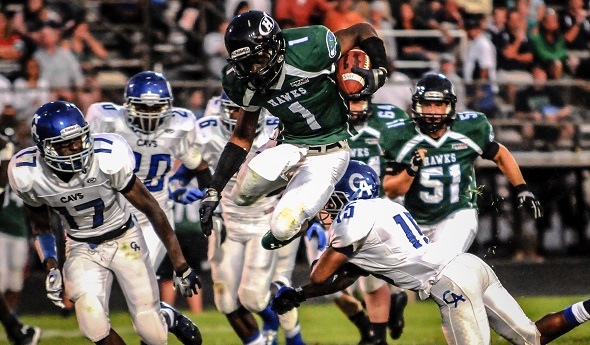
PHOTO: Flint Carman-Ainsworth (blue helmets) handled a solid Saginaw Heritage team last week, but gets another challenge this weekend in Birmingham Brother Rice. (Click to see more from High School Sports Scene.)
Bedford Follows Mifsud's Hall-of-Fame Formula to 7-0 Start, SEC Red Title Game
By
Doug Donnelly
Special for MHSAA.com
October 15, 2026
The rumors of Dave Mifsud living across the street from Temperance Bedford High School or being able to see the school from his kitchen window are greatly exaggerated.
Mifsud, in his first year coaching the Kicking Mules, actually lives about five minutes from the stadium. And, no, he can’t see the glow from the Friday night stadium lights from his house.
All joking aside, Mifsud may have found the perfect spot to continue his hall of fame career. After stops at Dearborn, Parma Western, Monroe and Brownstown Woodhaven, Mifsud took over the Bedford program in January and has the Mules off to a remarkable 7-0 start heading into Friday night’s Southeastern Conference showdown with powerhouse Saline.
“I feel like I'm at home right now,” Mifsud said this week. “I feel working and coaching at Bedford, being around this community, I feel like I'm at home.”
The funny part is, he wasn’t looking for one.
Mifsud said he moved to Temperance about five years ago to be closer to his son and three grandchildren in Toledo. He became the head coach at Brownstown Woodhaven and thought he had found his last coaching stop.
“When I took the Woodhaven job, I said, ‘This is it – I’m not going to change jobs again.’ But I put a disclaimer on there – and that was unless the Bedford job opened up.”
This past offseason, it did.
Mifsud said the distance driving to and from Woodhaven was the difference.
“I was driving 39 miles each way to work and spending an awful lot of time in the car,” he said. “I didn’t get to enjoy as many community events as I wanted to be involved in, even just going to basketball games or baseball games and things like that. It was just too far from home. So, this job was definitely a big attraction to me.”
He was hired.
By no means was he taking over a bad program. Quite the opposite. Bedford has been a perennial playoff team – they’ve qualified 14 times since 2009 – and contended among the top half of the SEC Red most of those years.
When Mifsud arrived, however, he had a blank slate. He had to bring in an almost entirely new football staff, overhaul the offense, and create a new-look defense.
“I spent hours and hours and lots of late, late nights interviewing coaching candidates,” he said. “I didn’t really know any of them ahead of time. There was one coach, Sean Stephens, that I had met and talked to a couple of times, but really, I didn’t know any of them.
“The foundation was, the thing that I started off explaining to each and every one of them, was my philosophy and what my goals were and where I was coming from. I wanted them to know how we were going to treat the kids and treat the program.”
Football, he said, teaches great life skills and life lessons.
“Our No. 1 goal is for the kids to have the best memories and the most positive memories from their high school days as being part of the football program,” he said.
He hired coaches from Toledo and the Downriver area, a former Bedford player and one coach who was on a previous Bedford staff. He named a football operations coordinator to handle things like media requests and statistics.
The offense, he said, is a combination of all of the offenses he’s run over the years while building a solid resume at Dearborn and Parma Western.
“We adapted and evolved a little,” he said. “I think we’ve cleaned up some of the things we were doing at Woodhaven.
His defense was constructed with the help of Mike Parker, who had coached at Toledo Whitmer, one of the largest schools in northwest Ohio.
The formula has worked wonders. The 7-0 start is something even Mifsud didn’t see coming.
“Going into it, of course you have high hopes,” he said. “I feel like there was the hope or possibility of being 7-0, but there was also this reality that we could be 3-4 or 4-3. You just don’t know how games are going to play out and how kids are going to respond.”
The biggest win was probably the first, a 20-13 victory over Sterling Heights Stevenson.
“The kids played their hearts out that game, and a really great win,” he said.
What’s followed have been six more in much the same fashion.
“We’ve continued on with the thinking that we just need to go 1-0 each week,” he said. “We’ve had to battle and compete in each game.”
Not only did Mifsud have to create a new coaching staff, but few of last season’s ball carriers were back this fall. One who might have been expected to be a starting running back, for example, transferred to an Ohio school. Other players moved positions and into new roles.
Masyn Moran has emerged as the top ball carrier with 636 yards and 12 touchdowns over seven games. Luke Whetstone has thrown for 841 yards while completing 64 percent of his passes. He’s also rushed for more than 500 yards. Jaxson Lestock has 20 catches for more than 300 yards. The Mules offense has been balanced with 263 rushes and 100 passes.
Bedford’s 7-0 start is the first for the program since 2013 and just the third in school history. Mifsud said the same formula that got Bedford to this point is what he plans on using this week against the also-undefeated Hornets. The winner will own the SEC Red title outright.
“There are some really good kids at Bedford, and they have bought into and committed to the new coach and system,” he said. “The school community has been awesome.”
 Doug Donnelly has served as a news and sports reporter at the Adrian Daily Telegram and the Monroe News for 30 years, including 10 years as city editor in Monroe. He's written a book on high school basketball in Monroe County and compiles record books for various schools in southeast Michigan. He is now publisher and editor of The Blissfield Advance, a weekly newspaper. E-mail him at [email protected] with story ideas for Jackson, Washtenaw, Hillsdale, Lenawee and Monroe counties.
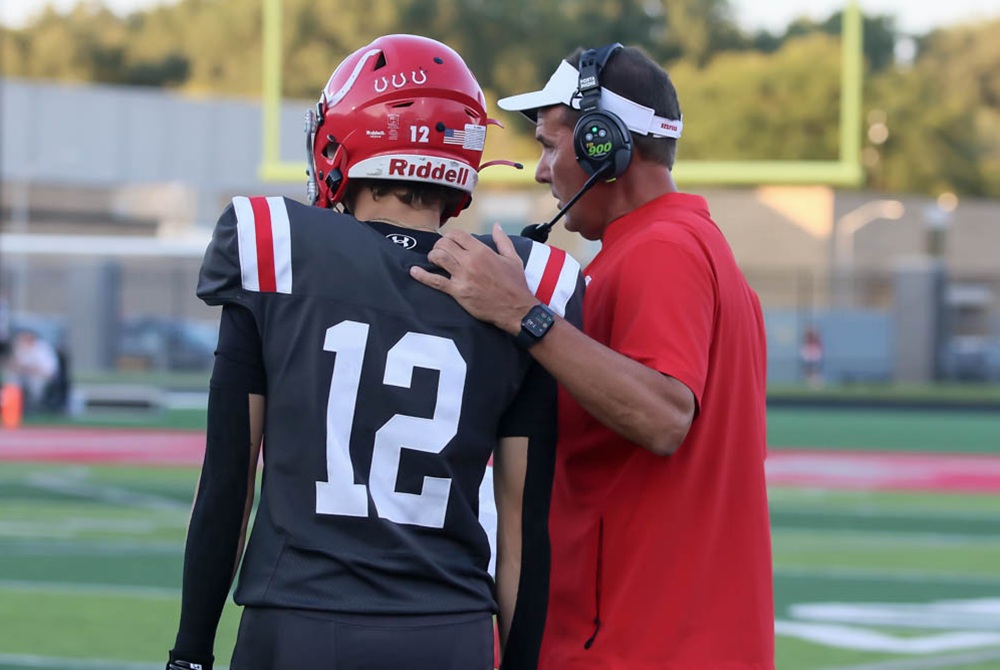
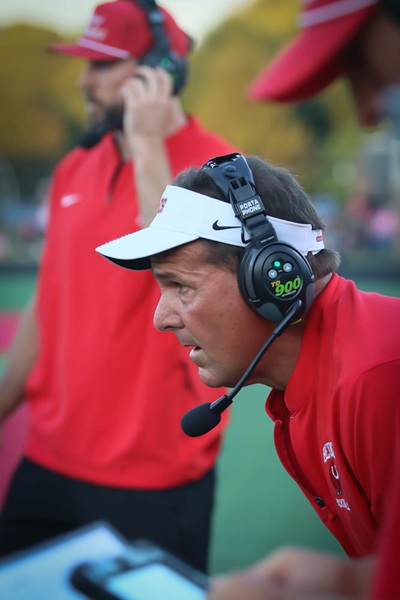
PHOTOS (Top) Temperance Bedford football coach Dave Mifsud instructs player Brady Boisselle during a game this season. (Middle) Mifsud monitors the action from the sideline. (Photos by Jaymee Beard/Temperance Bedford athletics.)