


Harrison Comes Back to Win Classic
August 23, 2016
By John Johnson
MHSAA Communications Director
As a new season of events launches this week on MHSAA.tv, this summer’s 80s Finals Flashback series concludes with one of the classic Football Finals of all time.
Our ninth and final game in the Flashback series is the 1989 Class B Final at the Pontiac Silverdome between Farmington Hills Harrison and DeWitt. Here’s a look at this week’s game, and click the score below to watch:
Week of August 22 – Farmington Hills Harrison 28, DeWitt 27 – 1989 Class B Football Final - In Class B, Farmington Hills Harrison scored a 28-27 victory over DeWitt in what many consider the greatest game of Michigan's 25-year playoff history. The defending Class B champions and top-ranked Hawks had their hands full with the Panthers. Tied 7-7 after one quarter, DeWitt grabbed a two-touchdown lead in the second on 32-yard run by John Tellford and a 35-yard pass play from Tellford to John Cowan. Harrison responded with a Matt Conley 1-yard run to cut the margin to 21-14 at the half. Hawks quarterback Mill Coleman knotted the score at 21 with a dazzling 16-yard run early in the fourth quarter, but DeWitt stormed back again, driving 75 yards on 13 plays. The series was highlighted by tight end Dave Riker's 24-yard, one-handed catch to the Hawks’ 3-yard line. Two plays later, quarterback Chris Berkimer slipped over from the 1, and DeWitt again took the lead, 27-21. With 2:12 remaining on the clock and the ball at the Harrison 33, Coleman went to work. Three quick completions moved the ball to the DeWitt 16, then Coleman let his legs do the rest of the work. Following a Hawks timeout, Coleman dashed right for seven more yards to the Panthers’ 9. Facing a 2nd-and-three, Coleman dropped back to pass, escaped the rush at the DeWitt 17, then scampered up the middle and dove into the end zone for the tying points. Steve Hill added his fourth PAT of the game with 1:34 remaining for the final margin, then secured the victory with an interception on the next series. (Watch Coleman’s game-winning touchdown by Clicking Here.)
DVDs may be purchased directly from the MHSAA.tv Website – just click the “Get DVD” button below the player. See the bottom of this screen for the rest of this summer’s “Flashbacks.”
The new season of games produced by members of the School Broadcast Program begins this week with live video of two football games scheduled as of noon Monday. Coming up on Thursday, the SBP at Montrose High School follows its Rams on the road for a game at Byron beginning at 6:40 p.m. At 7 p.m., Marquette High School will cover its home contest against Traverse City St. Francis. Check this release on the MHSAA Website for updates throughout the week as additional games are scheduled.
The NFHS Network has announced new pricing for 2016-17, eliminating the Day Pass and lowering the cost of a Month Pass to $9.95. Subscribers will have access to all live video and streaming statistics across the country. All content becomes available for free, on demand viewing 72 hours after being shown live. Some schools also will be selling Annual Passes at a discounted rate. A portion of every subscription sold by a school goes to benefit its program.
Now in its eighth year, the School Broadcast Program gives members an opportunity to showcase excellence in their schools by creating video programming of athletic and non-athletic events with students gaining skills in announcing, camera operation, directing/producing and graphics. The program also gives schools the opportunity to raise money through advertising and viewing subscriptions.
Schools interested in becoming a part of the School Broadcast Program should contact John Johnson at the MHSAA Office.
Previous Flashbacks
August 15: St. Joseph Lake Michigan Catholic 41, Ontonagon 39 – 1988 Class C Girls Basketball Final - Watch
August 8: Grand Rapids South Christian 69, Redford Bishop Borgess 66 – 1988 Class B Boys Basketball Final - Watch
August 1: Dearborn Divine Child 50, Okemos 45 (OT) – 1986 Class B Girls Basketball Final - Watch
July 25: Muskegon 16, Detroit Martin Luther King 13 – 1988 Class A Football Final - Watch
July 19: Northport 80, Beal City 78 – 1988 Class D Boys Basketball Final - Watch
July 12: Detroit Cass Tech 52, Saginaw 51 – 1987 Class A Girls Basketball Final - Watch
July 5: Traverse City 24, Detroit Catholic Central 14 – 1988 Class A Football Final - Watch
June 28: Saginaw Buena Vista 33, Flint Beecher 32 – 1986 Class B Boys Basketball Final - Watch
Talking Practice: Texas, Illinois Revise Policies
December 20, 2013
By Rob Kaminski
MHSAA benchmarks editor
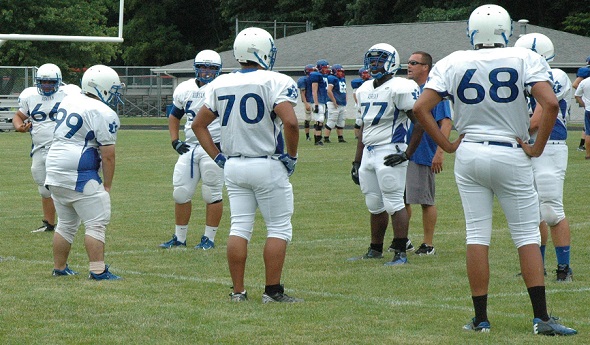
Coaches and players in Texas and Illinois adapted to new football practice limitations this fall, with the Texas policy focusing on contact, and the Illinois regulation emphasizing length of preseason practices.
Following are the main changes those states put in place heading into the 2013-14 season:
The University Interscholastic League, which governs school sports in Texas, put into writing that, “During the regular season and postseason, no football player is allowed to participate in more than ninety (90) minutes of full contact practice per week,” effective with the first day of practice this fall.
The complete policy follows:
For the purposes of the of rule, "full contact" is defined as football drills or live game simulations where "live action" occurs. Live action, as defined by USA Football, is contact at game speed where players execute full tackles at a competitive pace taking players to the ground. A team may continue to dress in full pads for practice, but may only participate in live action drills and game time simulations no more than ninety minutes per athlete per week. It is assumed that when players are in shells (shorts, shoulder pads, and helmets) no live action drills or simulations will occur. This rule is intended to limit live action drills and simulations and not the number of practices a team may participate in full pads. A team may participate in "air," "bags," "wrap," and "thud" drills and simulations at any point. These contact levels are defined below:
• Air - Players should run unopposed without bags or any opposition
• Bags - activity is executed against a bag, shield or pad to allow for a soft-contact surface, with or without the resistance of a teammate or coach standing behind the bag.
• Wrap - Drills run at full speed until contact, which is above the waist with the players remaining on their feet.
• Thud - Same as wrap but tempo is competitive with no pre-determined winner and the players are not tackling to the ground.
 The rule came to the UIL Legislative Council as a recommendation from the UIL Medical Advisory Committee, a permanent advisory committee to the Legislative Council which meets twice each year to discuss and review safety policies for UIL participants. The committee, which is made up of leading medical professionals in various specialties and includes representatives from the Texas High School Coaches Association, the Texas Girls Coaches Association, and the Texas State Athletic Trainer Association, unanimously recommended this limitation in full-contact football practice.
The rule formulates into a formal policy the existing actions of the majority of coaches across Texas, and most coaches have had to make few adjustments, if any. In fact, according to a story on statesman.com, the proposal caused more of an uproar on social media than from coaches.
“It’s not going to affect us in anyway,” Vandegrift HS coach Drew Sanders said in the story. “Most good coaches were way below that 90-minute amount already. Prior to legislation we still monitored it ourselves – the only change is now we have to keep up a log more publicly.”
Illinois put standards in place for its first 14 days of football practices, known as the state’s Preseason Football Acclimatization Practice Period. At the core of the policy is a three-hour practice limit for the first five days, during which teams can also conduct a one-hour walk-through.
 Teams must observe a minimum two hours rest between the practices and walk-throughs. Players may wear helmets only on the first two days, then helmets and shoulder pads for the next three. From days seven through 14 of the acclimatization period, schools may practice for a maximum of five hours per day, as long as that day is followed by a three-hour day, or an off day. During the five-hour days, no session can last more than three hours and must include a two-hour break between practices. Full pads may be worn for the final seven dates leading up to the first contest.
“This policy was the result of a collaborative effort between the IHSA Sports Medicine Advisory Committee and the Football Advisory Committee,” said SMAC committee member and University of Illinois Associate Professor of Orthopedic Surgery Dr. Preston M. Wolin. “The guidelines are based on the most recent scientific evidence, as well as the expertise of the coaches who will help implement them. Both committees believe the guidelines represent a significant positive contribution to the health of our athletes.”
“This new policy undoubtedly changes the way we, as coaches, approach preseason practice,” said Metamora HS coach Pat Ryan, who is a member of the FAC and a past President of the Illinois High School Football Coaches Association. “Coaches have to get more creative with when and how they schedule practices, as well what they do with their time. The proposals were strongly supported by both committees. It is a crucial final step to the process of being able to effectively prepare our teams in a safe manner. Change is always difficult, but the game is changing and we need to adapt to continue to put the safety of our players first.”
The IHSA offered multiple interactive online webinar meetings for high school coaches leading up to the start of practice where questions were answered, along with further clarifications on the policy and the science behind it.
“I think most coaches understood that changes were on the horizon,” said IHSA Executive Director Marty Hickman. “We wanted to be in a position to give our coaches as much information as possible to make sure they are comfortable with the new policy. Their input will be critical moving forward as we develop educational materials, like a best practices presentation. I commend our committees on a policy that is supported by medical experts, football coaches and school administrators.”