

Hearts Heavy, St. Mary's Keeps Promise
November 29, 2014
By Bill Khan
Special for Second Half
DETROIT — The most important football game in Brandon Adams' life suddenly didn't seem so important.
At a time when excitement should've been rising within the Orchard Lake St. Mary's junior, he was holed up in his bedroom, coming to grips with the lowest moment in his young life.
Football? Who cares about something as trivial as football — even a state championship game — when your mother just died two days earlier?
Playing a game may not have been important, but fulfilling a promise to his mother and continuing to live as she would have wished helped him to get up, get out of his room and move forward.
"At first, I didn't think I was going to play this game," said Adams, whose 1-yard run with 5:42 left in the first quarter was the only touchdown in the Eaglets' 7-0 victory over Muskegon in the MHSAA Division 3 Final on Saturday night at Ford Field.
"Thursday, after she passed, I was sitting in my bed at home. My dad walks in and says, 'I don't want you to sit here and sulk,' so I went to practice Friday. We had a team meeting at 1 before our practice at 2. All the guys gave their condolences and said, 'We're not losing this game. We're making a promise to God, to my mom and to the team that we're gonna win,' and we did. I don't know. It's just ..."
Adams' voice trailed off as he held the game ball, standing before reporters and bravely articulating his feelings while still in the midst of grief.
His mother, Katie, was diagnosed with Stage 4 lung cancer three months ago. She continued to follow her son's team, all the way up through the Semifinal victory over New Boston Huron just five days before she died on Thanksgiving.
"All the guys came to the hospital, because she was in hospice for her last hours," Adams said. "The one thing she was saying to all the guys was, 'I'm going to watch the game on TV and I want you guys to bring me back the trophy. Well, she's not here, but we did. It was a promise my brothers made to me and to my family and to each other that we would win the game.
"She never missed a game. Even with her chemo, she was sick as a dog and she'd come sit in her car and come watch. This was the first game in my football career she's missed."
In a time of tragedy for the team, St. Mary's coach George Porritt saw inspiration in the way Adams was supported by his teammates.
"The last 48 hours have been a whirlwind," Porritt said. "What's great is watching kids take care of kids when there are tough times. This team rallied behind this kid. Last night was special."
 From a football standpoint, Porritt supported Adams by giving him two straight carries after his fumble nearly ended the game's only scoring drive.
Adams broke through the line and appeared primed to scamper into the end zone on a 4-yard run from the 6-yard line, but he lost the ball, only to recover it himself.
Adams got the next carry, moving the ball one yard closer to the end zone, before going untouched around the left side to cap a nine-play, 34-yard drive.
Adams was appreciative of the opportunity to get the next two carries following his fumble.
"My coaches are very persistent on hanging on to the ball," he said. "After that fumble, it's human nature to get down on yourself and hang your head, but my coaches kept preaching, 'Hold your head up, we'll get through it,' and they gave it back to me again. I knew I was going to get into the end zone."
Porritt insisted that Adams wasn't given the chance to bounce back just because he was going through a hard time in his life.
"Sometimes we like the kid to get the ball right away, get it right back in his hands," Porritt said. "We had to have him."
Real life beyond the football field was also the theme for Muskegon as coach Shane Fairfield addressed his players after the Big Reds lost in an MHSAA Final for the third straight year. They lost to Birmingham Brother Rice in the last two Division 2 title games.
"It's not going to be easy," Fairfield told his team. "It hurts. It should hurt, because it means so much. ... We have to continue the pursuit of greatness in our lives."
Adams tempted fate with his early fumble, but wasn't as fortunate in the second quarter. On second-and-goal from Muskegon's 2-yard line, Alezay Coleman popped the ball loose from Adams' grasp and Taron Smith recovered for the Big Reds with 10:53 left in the first half.
Having escaped a possible early 14-0 deficit, Muskegon's offense began to click after its first three possessions resulted in only four yards on eight plays. The Big Reds marched 95 yards in 14 plays, taking 6:56 off the clock, but came away with no points when they also failed to score from the 2-yard line.
Those missed opportunities by each team from the opponents' 2-yard line would be the closest either would come to scoring after the Eaglets opened up with a touchdown.
The defensive standoff was surprising, given the fact St. Mary's averaged 47.5 points and Muskegon 37 in four playoff games.
"You never know what kind of game it's going to be," Porritt said. "We know we have a great defense and they have a great defense. So, that's what happens. The defenses were a little bit better than the offenses today."
The Eaglets nursed their 7-0 lead through a scoreless second half by not allowing Muskegon to get closer than 31 yards from the end zone.
The Big Reds had four possessions after halftime, with two ending in interceptions. Tyler Cochran picked off a pass on the first play of Muskegon's second possession of the third quarter. The key interception came with 6:37 left in the game when Dwayne Chapman came up with an errant pass on fourth-and-three from the St. Mary's 31.
Muskegon would never touch the ball again. St. Mary's ran out the final 6:37 by getting four first downs on a 14-play possession that covered 49 yards.
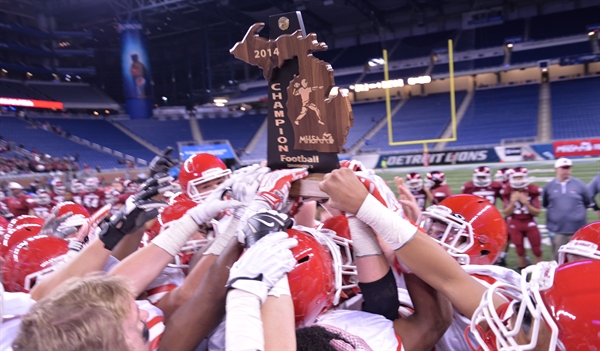
When time expired, St. Mary's had its sixth MHSAA title, while the Big Reds had to settle for the runner-up trophy for the third year in a row.
"A lot of teams around Muskegon can't say they've been there three years in a row," Muskegon senior lineman Rowland Sharp II said. "I've been here since my sophomore year. I'm very proud to say I made it to Ford Field. As I go into my career, I'll be able to say, yes, I played at Ford Field; that's an NFL stadium I played in."
Muskegon's explosive ground game was held to 109 yards on 33 carries. St. Mary's also struggled with its trademark running game, gaining 133 yards on 45 carries.
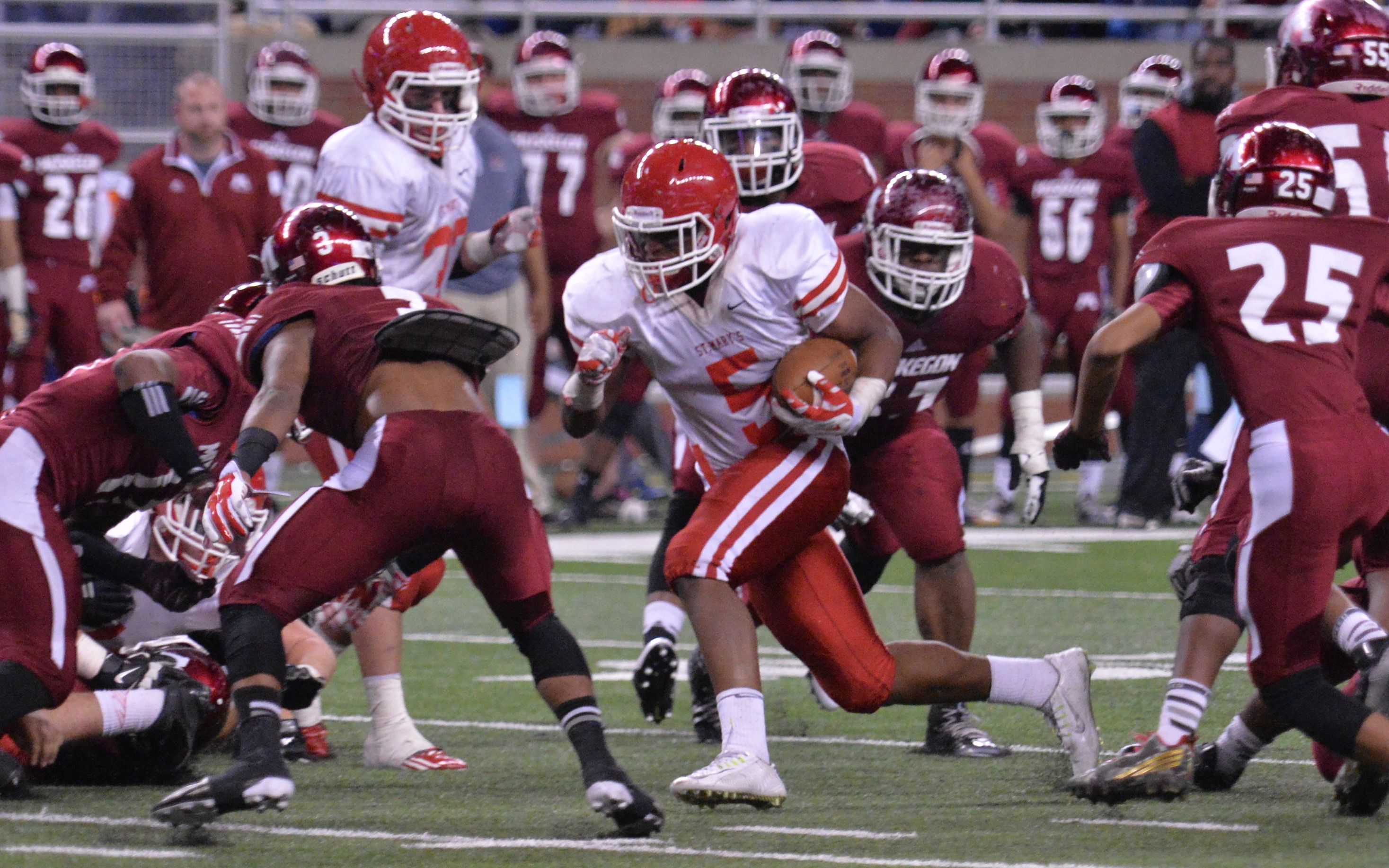
PHOTOS: (Top) Orchard Lake St. Mary’s hoists its Division 3 championship trophy after the final football game of the 2014 MHSAA season Saturday. (Middle) St. Mary’s Josh Ross (5) breaks through the line as Muskegon defenders pursue. (Click for action photos and team photos from Hockey Weekly Action Photos.)
VIDEO HIGHLIGHTS:
BIG REDS GOAL LINE TAKEAWAY - Early in the second quarter, Muskegon forces an Orchard Lake St. Mary's fumble, which is recovered by Alezay Coleman.
EAGLETS THWART MUSKEGON'S LAST CHANCE - Muskegon's last offensive chance came near the midpoint of the fourth quarter, where on a fourth down play, a Big Reds pass by intercepted by Orchard Lake St. Mary's Dwayne Chapman. The Eaglets then ran out the clock and won the Division 3 championship game, 7-0.
Watch the entire game and order DVDs by Clicking Here.
1st & Goal: 2026 Week 8 Preview
By
Geoff Kimmerly
MHSAA.com senior editor
October 15, 2026
Winner takes it all.
 That might be the most to-the-point expression in sports – and most exhilarating scenario.
And it’s going to play out all over Michigan this weekend, as one last game will determine several league championships and provide crowning achievements – at least for now – rewarding the last two months of work.
Games highlighted are tonight unless noted. Tune in to the NFHS Network to watch the majority and follow the MHSAA Scores page for results as they’re submitted. Keep an eye as well on the Playoff Point Summary page to watch how those lists are updated with every win and loss.
Bay & Thumb
Grand Blanc (7-0) at Davison (6-1)
The Saginaw Valley League South title has come down to these rivals for the third straight season, as neither has lost a conference game this fall although Davison has two remaining and Grand Blanc finishes up tonight. Last season it was the Bobcats with a 57-29 win that decided the league title, and they’ve won two straight championships after Davison’s most recent in 2023. Neither has been challenged much over the last month; the lone loss between them was the Cardinals’ in Week 2 to still-undefeated Detroit Catholic Central.
Keep an eye on these FRIDAY Flint Elite (5-2) at Burton Bendle (7-0), Goodrich (7-0) at Fenton (6-1), Frankenmuth (6-1) at Saginaw Swan Valley (7-0), Gladwin (5-2) at Sanford Meridian (7-0).
Greater Detroit
Detroit Cass Tech (7-0) vs. Detroit Martin Luther King (6-1) at Ford Field
Although King has defeated Cass Tech twice over the last five seasons, the Technicians have won all five of their city championship game rematches and will attempt to add this time to a 20-7 victory over the Crusaders in Week 5. That was easily the toughest challenge Cass Tech has faced this season, and if King generates more offense this time it could make a run at breaking a four-game losing streak against its rival.
Keep an eye on these FRIDAY Detroit Central (6-1) vs. Detroit Denby (5-2) at Ford Field, Ecorse (7-0) at Detroit Edison (6-1), Clarkston (7-0) at Harper Woods (6-1), Walled Lake Western (6-1) at South Lyon East (6-1).
Mid-Michigan
DeWitt (6-1) at Grand Ledge (7-0)
Despite suffering its first regular-season loss this fall since 2023, DeWitt still has a 21-game Capital Area Activities Conference Blue winning streak intact and a familiar challenge ahead as these two also decided the league title last season. DeWitt won that one 59-7 amid a perfect fall that ended with a Division 3 championship victory, and the lone loss this season came to still-unbeaten Mason. The Comets will work to slow the Panthers’ offense, but instead may have to answer it with a similarly successful attack.
Keep an eye on these FRIDAY Fowler (6-1) at Ithaca (7-0), Napoleon (6-1) at Leslie (4-3), Hastings (52) at Mason (7-0), Olivet (5-2) at Lake Odessa Lakewood (6-1).
Northern Lower Peninsula
Marquette (5-2) at Petoskey (5-2)
Petoskey has been chasing in the Big North Conference since falling to Cadillac 22-20 in Week 5, but the Northmen have lost twice by a combined five points this fall and can finish with a share of the league title by getting past the Sentinels. Marquette already owns a share and won last year’s meeting 20-7. After opening this fall with a pair of nonleague losses to Negaunee and Menominee, the Sentinels have run through the BNC unscathed, with a 33-27 win over Cadillac especially of note.
Keep an eye on these FRIDAY Escanaba (3-4) at Cadillac (5-2), Charlevoix (5-2) at Elk Rapids (5-2), East Jordan (6-1) at Frankfort (5-2), Evart (3-4) at McBain (5-2).
Southeast & Border
Monroe Jefferson (7-0) at Monroe St. Mary Catholic Central (7-0)
It’s difficult to imagine a better way to end an era, as this will be the final Huron League matchup between these neighbors for now with St. Mary moving to the Catholic High School League next fall. The Falcons are seeking a third-straight Huron title on their way out, having won it outright in 2024 and then sharing with Jefferson and Riverview last season. That split title was the product in part of SMCC’s 20-15 win over Jefferson, and both have fended off close challenges this fall to set up this winner-take-all scenario.
Keep an eye on these FRIDAY Saline (7-0) at Temperance Bedford (7-0), Adrian Madison (6-1) at Clinton (6-1), Ida (6-1) at Hudson (6-1). SATURDAY Hanover-Horton (6-1) at Manchester (6-1).
Southwest Corridor
Vicksburg (7-0) at Edwardsburg (7-0)
This isn’t quite winner-take-all, but the winner will earn a share of the Wolverine Conference title although Vicksburg must still face Paw Paw next week and Edwardsburg will travel to see three-time reigning champ Niles. An Eddies win tonight would give them their first Wolverine championship since 2022, while Vicksburg is seeking its first since the league went to one division again in 2015. Vicksburg won both of last season’s matchups, 38-35 during the regular season and 43-30 in a Division 4 District opener.
Keep an eye on these FRIDAY Reading (4-3) at Bronson (5-2), Coldwater (5-2) at Marshall (6-1), Lawton (5-2) at Parchment (4-3), Portage Northern (4-3) at Kalamazoo Loy Norrix (4-3).
Upper Peninsula
Kingsford (7-0) at Menominee (7-0)
The Western Peninsula Athletic Conference Copper could send five of its seven teams to the playoffs this season, and great matchups have abounded all fall – but this is the title decider most have anticipated. Kingsford won 14-12 in 2024 to claim the championship, and Menominee stormed back with a 49-14 clincher last season on the way to also claiming the Division 7 title. Both are coming off close wins last week, Kingsford over Ishpeming Westwood and Menominee over Negaunee.
Keep an eye on these FRIDAY Manistique (4-3) at Bark River-Harris (6-1), Hancock (3-4) at L’Anse (3-4), Houghton (2-5) at Negaunee (4-3), Calumet (4-3) at Gladstone (1-6).
West Michigan
Ravenna (6-1) at North Muskegon (6-1)
North Muskegon is 27-0 in the West Michigan Conference Rivers since the league split into divisions in 2022, but arguably the most consistent challenges during that run have come from Ravenna – which actually avenged a title-deciding loss in 2022 with a 10-7 playoff win over the Norsemen. North Muskegon did win last year’s meeting 36-29 and has extended its streak in part with a one-point victory over Shelby in Week 3 and 11-pointer over Manistee in Week 6.
Keep an eye on these FRIDAY Middleville Thornapple Kellogg (6-1) at East Grand Rapids (5-2), Cassopolis (6-1) at Saugatuck (5-2), Rockford (4-3) at Hudsonville (5-2), Grand Rapids Kenowa Hills (6-1) at Lowell (5-2).
8-Player
Mendon (7-0) at Climax-Scotts (6-1)
One of these two has won their league the last four seasons, with Mendon already securing a share of the Southern Central Athletic Association Red championship this fall. The Hornets will attempt to make that title outright with a third-straight victory over Climax-Scotts (including a 2024 Regional win). But the Panthers can grab a share as well as they’ve rebounded nicely from a Week 4 loss to Colon, putting up a combined 157 points over three wins since scoring eight in that defeat.
Keep an eye on these FRIDAY Powers North Central (5-2) at Felch North Dickinson (4-3), Pickford (6-1) at Gaylord St. Mary (7-0), Marion (7-0) at Onekama (6-1). SATURDAY Mio (5-2) at Merrill (6-1).
MHSAA.com's weekly “1st & Goal” previews and reviews are powered by MI Student Aid, a division within the Department of Lifelong Education, Advancement, and Potential (MiLEAP). MI Student Aid encourages students to pursue postsecondary education by providing access to student financial resources and information. MI Student Aid administers the state’s scholarship and grant programs that help make college Accessible, Affordable and Attainable for you. Click to connect with MI Student Aid and find more information on Facebook and Twitter @mistudentaid.
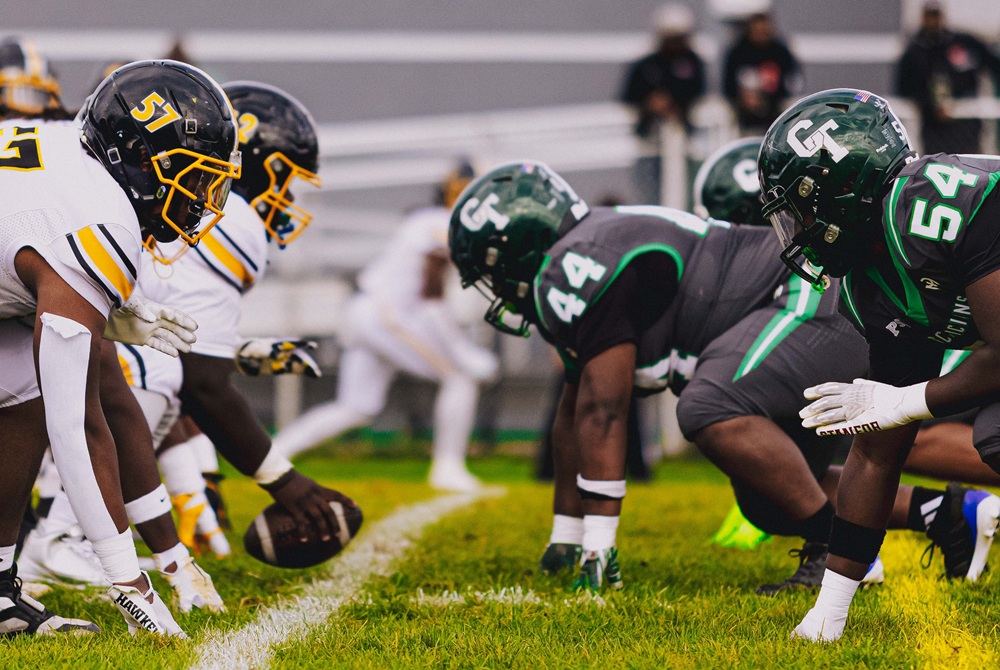
PHOTO Detroit Martin Luther King and Cass Tech linemen line up across from each other during their Week 5 matchup. (Click for more from Olivia B. Photography.)