

Lumen Christi 'Adds to Tradition' Once Again, This Time in Record Fashion
By
Tom Kendra
Special for MHSAA.com
November 29, 2024
DETROIT – The more things change in high school football – with the proliferation of spread offenses and sophisticated passing attacks – the more things stay the same at Jackson Lumen Christi.
The Titans won their state-record 14th title of the MHSAA playoff era Friday with an old-fashioned power running attack which didn’t look a whole lot different than what they rode to their first championship at the Pontiac Silverdome back in 1977.
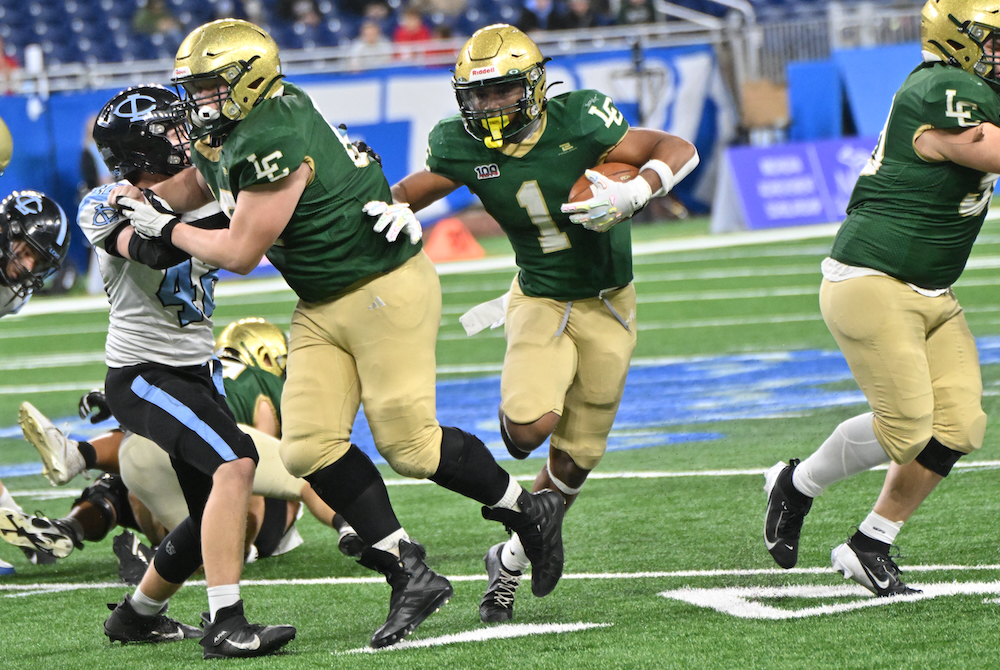
Only the names have changed, and the big name for these Titans was senior running back Kadale Williams (6-foot-1, 180 pounds), who rushed 27 times for a Finals-record 314 yards and five touchdowns in a 56-18 victory over Lansing Catholic at Ford Field.
“It’s a very special moment,” said Williams, who had been committed to Central Michigan, but re-opened his recruiting after the recent retirement of head coach Jim McElwain.
“I couldn’t have done it with those guys up front. We have a special chemistry and bond and, honestly, it’s going to be sad moving on.”
 Lumen Christi, which finished 13-1 with its only loss coming at Pontiac Notre Dame in Week 2, simply couldn’t be stopped Friday – as its offense (which features 10 senior starters) scored touchdowns on its first eight possessions, building up a 21-6 lead after one quarter, 42-12 by halftime and 56-18 with a running clock after three quarters.
“I thought we played great,” said 45th-year Lumen Christi coach Herb Brogan. “That was a very, very dangerous offense over there on the other side, and to hold them to 18 points is something that hasn’t been done in a while.
“On offense, we were just relentless. We blocked well, and Kadale had a great game.”
Williams registered scoring runs of 36 and six yards in the opening quarter, 76 and five yards in the second quarter and, finally, a two-yard run in the third quarter.
Williams was able to get a head of steam on many of his runs behind the offensive line of senior center Tim Smiley, senior guards Drew Sweeney and Andy Salazar, senior tackle Maverick Stergakos and junior tackle Antwon Baker. Salazar was also 8-for-8 on extra-point kicks.
Also making key blocks on Williams scoring runs were fullback Isaac Rehberg and tight end Charlie Saunders.
Lansing Catholic (10-4), which lost three games in the Capital Area Activities Conference White but found its stride in the postseason, tried to keep up with the Titans through the air.
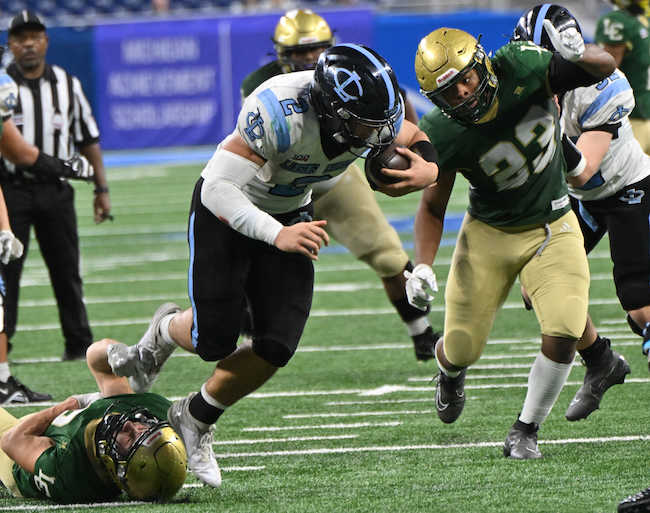
Cougars senior quarterback Alex Fernandez (6-3, 230) was outstanding, completing 21-of-29 passes for 284 yards and two touchdowns – both to senior wideout Xavier Luea, covering six and 41 yards – while rushing 18 times for 82 yards and another score.
 The difference was on the ground, where Lumen held a commanding 435-87 edge.
“I am very proud of this team, to go from 3-6 last regular season to Ford Field, which is every boy’s dream in this state,” said fourth-year Lansing Catholic coach Jim Baker, who led the Cougars to a Division 6 championship in his first season in 2021.
“We ran into a very good team and tried to throw some different things at them, but at the end of the day, we just couldn’t stop No. 1 (Williams).”
The Titans also came up with some huge individual defensive plays to keep the Cougars from drawing closer.
Senior safety Adam Fuller made a big hit on Fernandez as he scrambled toward the end zone on the final play of first half. Junior Jack Fitzpatrick also tackled a Lansing Catholic receiver short of the first down on a key fourth-down play, and junior defensive lineman Antwon Baker was regularly in position to stop Fernandez on scramble plays.
Amarion Clay led the Titans with nine tackles, while Josh DuMont and Saunders each had seven stops.
The Cougars were led defensively by Noah Jungwirth and Braden Rabideau with eight tackles and David Magaway and Fernandez with seven stops.
Brogan, who now has been the head coach for 12 of Lumen Christi’s 14 titles, picked up career win 421, leaving him trailing only John Herrington (443 at Farmington Hills Harrison) and Al Fracassa (430 at Royal Oak Shrine Catholic and Bloomfield Hills Brother Rice) in the MHSAA record book.
A closer look at his record reveals that Brogan, 75, appears to be getting better with age.
Brogan, who took over as Lumen Christi’s coach in 1980 at the age of 30, won six state championships during his first 36 years as head coach – and has won six more over the last nine years.
“It’s too much fun,” said Brogan, when asked about retirement. “As long as, God-willing, I’m healthy enough, I want to be out there.
“We have a great tradition at Lumen Christi, and I ask the kids every year: ‘Are you going to try to live off that tradition, or are you going to add to it?’ These kids certainly added something to it.”
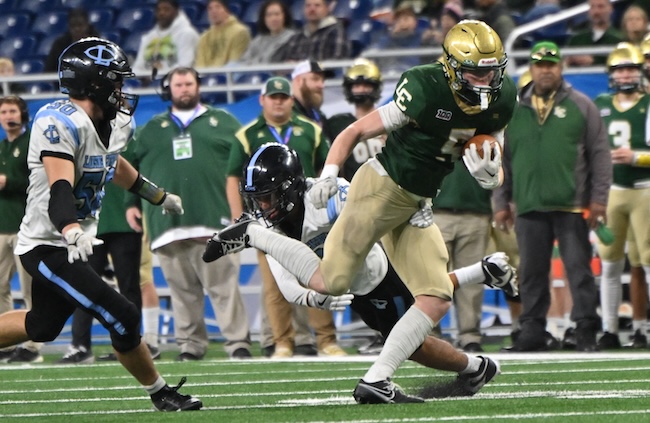
PHOTOS (Top) Lumen Christi’s Kadale Williams (1) follows his blocker into an opening Saturday at Ford Field. (Middle) The Titans’ Josh DuMont attempts to elude a Lansing Catholic tackler. (Below) The Cougars’ Alex Fernandez (2) breaks a tackle as Cassius Griffin (23) closes in. (Photos by Hockey Weekly Action Photos.)
Thank Roosevelt for Football Weekends
December 20, 2013
By Rob Kaminski
MHSAA benchmarks editor
The next time you find yourself immersed in a tense crosstown football rivalry on a Friday night followed by a Saturday pilgrimage to the nearest college campus and a Sunday afternoon with a remote and your favorite snacks and beverages, take a moment to consider what the weekend would be like if it weren’t for Teddy Roosevelt.
The man who became our 26th President shortly after the turn of the 20th Century following the assassination of William McKinley in 1901 was a football fan like you. Maybe more so.
Today’s game of football has reached a critical crossroads. Player size and speed have increased across the board. Savage use of equipment as weapons rather than protective gear has been glorified on television networks and social media. Leaders of the game at all levels have recognized the need for change, employing new rules and widespread educational efforts to aid in preserving the sport.
History, as they say, is repeating itself.
In an ironic twist, it was Roosevelt who saved the then-brutally violent game of football from itself more than 100 years ago. Yes, the same “Rough and Ready Teddy” who led the charge up San Juan Hill during the Spanish-American War and often sparred in the boxing ring while in office from 1901-09 opined that football was becoming so gruesome that he delivered an ultimatum: clean up the game or it would be outlawed.
The Chicago Tribune reported that in 1904 alone, there were 18 football deaths and 159 serious injuries, mostly among prep school players. Football deaths suffered by younger players were reported on a nearly weekly basis, as outraged citizens called on colleges and high schools to banish football outright.
In stepped Roosevelt, who called head coaches and representatives from Harvard, Yale and Princeton – college powers at the time – to the White House in 1905 urging them to eliminate excessive violence and set an example of fair play for the rest of the country. When the casualties actually rose by one during the ensuing season, Roosevelt reacted with greater resolve and convened leading football authorities for the purpose of authoring drastic rules changes. What emerged was an intercollegiate conference which was the predecessor of the NCAA.
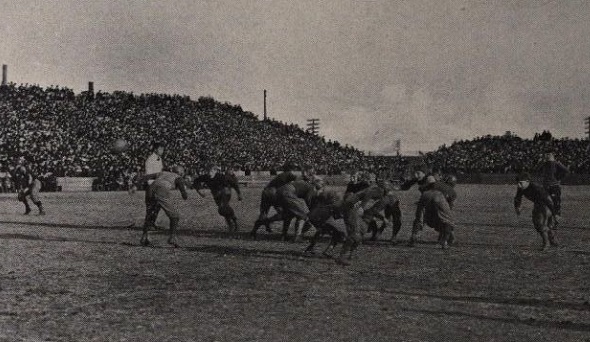
Among the most effective changes for the 1906 season were the legalization of the forward pass, the elimination of mass formations, and the creation of a neutral zone. Football fatalities fell to 11 in each of the next two seasons, and severe injuries fell drastically.
Thanks to the introduction of protective equipment and ever-evolving rules changes, football during the 100-plus years to follow has become an exponentially safer game. Yet, the game’s leaders always will need to adjust and react to scrutiny that comes with the territory.
So, as the game once again undergoes rules modifications in the name of safety, give a tip of the cap to President Roosevelt while you enjoy college bowl season and the NFL playoffs and begin to think ahead to the first high school practice of 2014.