

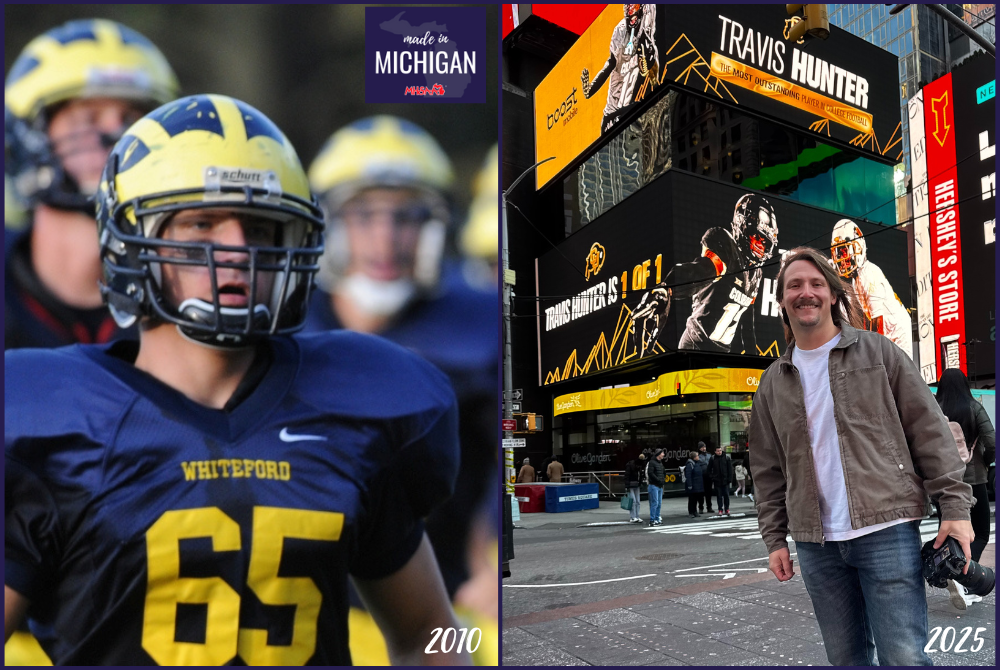
Marckel Supplies Marketing Magic to Hunter's Heisman-Winning Campaign
By
Doug Donnelly
Special for MHSAA.com
July 29, 2025
When he was hired at the University of Toledo in 2016 as assistant director of creative services, Derek Marckel thought he had found his dream job only a few months after graduating from college.
 Then he became Colorado University’s graphic designer for football in 2019 and thought he had finally landed the job he’s always wanted.
After stops at the Michigan State University to work with former football coach Mel Tucker, and University of Southern California to work with Lincoln Riley, Marckel, 32, is back in Colorado and certain he’s living the dream.
“This was the stuff I thought about doing when I was a kid,” said Marckel, who graduated from Ottawa Lake Whiteford High School in 2011. “I used to sit and draw pictures of all of my favorite University of Toledo football players, and then I’d take them and give them to the players or have them sign them. This is definitely what I’ve dreamed of doing someday.”
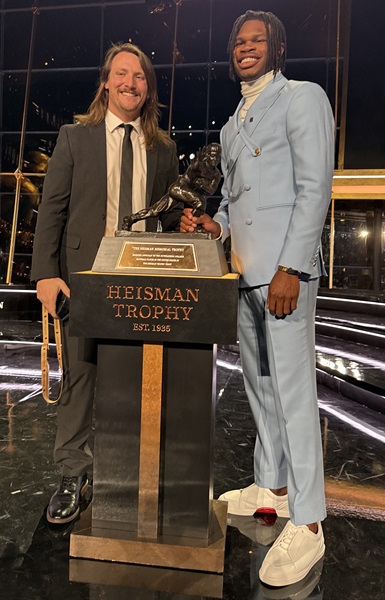
Last winter, Marckel was in New York City when his favorite subject – Colorado football player Travis Hunter – won the Heisman Trophy. It was a surreal moment for Marckel, who led a team of creative content makers who spent months last fall promoting Hunter for the biggest prize in all of college football.
“Going into the season, we knew he was going to have a pretty good chance,” Marckel said. “Once the games started playing out, we knew he had a legitimate shot.”
As senior art director at Colorado, Marckel led the Hunter-for-Heisman campaign. He was on the sidelines of every game, home and away, documenting Hunter and the rest of the Buffaloes. He designed billboards that were strategically placed around Denver and one in Times Square in New York City. Marckel’s team met weekly to plan a regular dose of social media posts and content promoting Hunter’s candidacy.
Heisman Trophy candidates emerge based on their on-field performances. But, behind the scenes, winning the trophy has long taken some pushing by colleges and universities.
“There’s a lot that goes into a campaign,” Marckel said. “You have to work with sponsors and donors who helped fund all of that. It’s a lengthy operation.”
As the season drew to a close, Colorado published a packet of information that Marckel designed and sent it to Heisman Trophy voters and the media. ESPN showcased his work.
“Almost everything we were doing was going viral,” Marckel said.
When it became clear Hunter was going to be a finalist for the award, Marckel was called upon to document the entire process. He and a member of his team went to New York City two days ahead of Hunter to be prepared when he landed in the city. Next were Heisman Trophy promotional appearances, photoshoots and the Heisman ceremony itself, and Marckel was there for all of it.
“It was Travis from sun-up to sun-down,” Marckel said. “We’d have little breaks during the day. I designed the billboard for him in Times Square. We had a photo shoot there.”
Helpfully, Hunter was a wonderful participant.
“We put a lot of work into it,” Marckel said. “Obviously it was his award, and he earned it, but it was very rewarding to us, too, to see our hard work pay off. I’ve been around thousands of athletes, and he’s probably my favorite one. He doesn’t necessarily love doing all of the media stuff, but he was comfortable around us.”
 Marckel was born in Toledo but grew up in southeast Michigan. He was football team captain for the Bobcats as a senior and began his interest in design, art and photography during his time at Whiteford.
“I knew from a young age that I wanted to work professionally in sports,” Marckel said. “During my time at Whiteford, I spent a lot of my high school career around the football program. I was lucky to have my first two years of varsity with Coach (Jack) Luettke and my senior year with Coach (Matt) Garno, who had a background in graphic design. This ended up being a great foundation for me to combine my passion for football and graphic design as I was heading into the real world.”
Marckel graduated from Bowling Green State University in 2016 with a bachelor's degree in technology & visual communication technology. He landed an internship with the University of Toledo where he started designing team schedule posters, pocket schedules and souvenir tickets. That’s when social media started revolutionizing the industry, especially college football.
“Social media was kind of secondary to everything else when I started there,” he said. “It started to shift. I got in at the perfect time. Things were really starting to pick up. That’s when I knew sports was going to be what I wanted to do.”
After getting a full-time job at Toledo, his work caught the eye of someone at Colorado, and Marckel went west to become a graphic designer with the Buffaloes. When Tucker left Colorado for Michigan State, Marckel followed him to East Lansing.
At first, he missed Colorado.
“Even on the drive to East Lansing, I was thinking, ‘Why am I leaving Colorado?’” Marckel said.
He stayed two years, then landed the role as director of creative media at USC, working sun-up to sun-down in Los Angeles. When the opportunity came to return to Boulder, he jumped at it, becoming senior art director.
The Buffaloes went 1-11 his first season back at Colorado. The entire football coaching staff was let go.
That’s when Marckel’s world took another big turn.
“The rumors started flying about Coach Prime,” Marckel said, referring to Deion Sanders. “There are always these theoretical situations about who the coach is going to be. We found out about 8 p.m. that it was Coach Prime. We had to be on the tarmac at 1:30 a.m. I don’t get starstruck anymore just because of what I’ve been able to do and who I’ve been able to be around, but as soon as he stepped off the plane, I realized I was getting myself into something huge.”
Pro football hall of famers regularly makes stops at Colorado practices. Warren Sapp joined the Colorado staff. Terrell Owens stops by regularly. A steady wave of Sanders’ former teammates from the Dallas Cowboys attended practices as well.
Marckel documents it all, through his camera – a skill he’s honed along the way.
“When I started at Toledo, I would shoot all of those games, but I wasn’t a great photographer,” he said. “As time has gone on, it’s become such an emphasis. I’ve really had to refine everything I do to become the best at it.”
Initially he had to win the trust of Sanders, who brought some of his own content creators with him to Colorado.
“It took a little while to get us into a groove,” Marckel said. “Now we work side by side every day. It’s a smooth operation now. We bounce ideas off of each other.”
Day to day, Marckel works on social media, marketing, photoshoots of recruits and documents workouts and practices for Colorado social media channels.
He works with the football team exclusively, sometimes long hours during the season.
“You get kind of get burned out by end-of-season, but it's worth it,” Marckel said. “You are on the field every day with Heisman Trophy winners, hall of famers and first-round picks. It’s a cool job when you step back and look at it. This is most fun I’ve had working in college football in 10 years.”
2025 Made In Michigan
July 28: Union City to Omaha: Skirka Takes Murray State Baseball to 1st College World Series - Report
July 22: TC West's Wheelock Still 'Living My Dreams' as CMU Assistant Soccer Coach - Report
July 17: Stevenson's Travels Following Lake Orion Success Include Space Force, Penn, NYC - Report
July 15: 'Who Will Cheer for the Nimrods?' Peterson IV, Watersmeet Found Fans Worldwide - Report
July 10: Feeding 'Drive to Win,' Loy Norrix Grad Morgan Impresses with Strong USBC Showing - Report
July 9: After Blazing Multiple Volleyball Trails, Bastianelli Charting Next Career Path - Report
PHOTOS (Top) At left, Whiteford's Derek Marckel takes the field as a senior in 2010. At right, Marckel poses for a photo this year in front of the Times Square display he designed to promote Colorado's Travis Hunter. (Middle) Marckel stands for a photo with Hunter during the Heisman Trophy ceremony. (Photos courtesy of Derek Marckel.)
State Champs! Network: 2024 8-Player Football Division 2 Highlights
December 11, 2024