


New Football Practice Policies
March 25, 2014
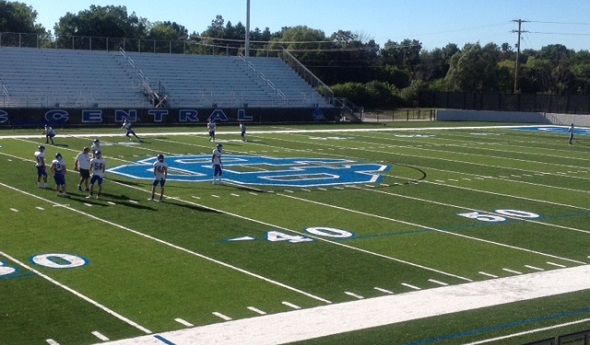
GR Catholic Central Unveils New Home
By
Dean Holzwarth
Special for MHSAA.com
August 23, 2016
GRAND RAPIDS – Former Grand Rapids Catholic Central football player and current assistant coach Kyle Shelton didn’t know if he would ever see the day – the day when the football program would have a place to call home.
 And it wasn’t until he witnessed shovels digging dirt that Shelton knew it was going to become a reality.
Cougar Stadium was unveiled to the community over this past weekend, the crown jewel of a nearly $10-million project at the Cougar Athletic Trails (CAT) athletic complex.
“It’s long overdue, that’s for sure,” said Shelton, a 1999 Catholic Central graduate. “It’s nice from a functional standpoint, having a surface always ready for practice, which we haven’t had in the past, and to have all of our teams in one spot, which we haven’t been able to do.
“From a teaching standpoint, we have brand new team rooms where we can watch film, and that’s just the football side of things.”
Cougars senior running back Antonio Strong may be biased, but ranks his new digs among the tops in the area.
“It’s one of the best complexes around, and I think one of the best in the state,” he said. “It felt like it was meant to be.”
Last week, the CAT was re-dedicated and blessed. It was the first of several events throughout the weekend to celebrate the facility’s re-opening.
Several thousand people braved severe weather Saturday to attend the first Catholic Central Hall of Fame induction while getting a glimpse of the new turf field and surrounding amenities.
“This place is amazing,” fifth-year Cougars varsity football coach Todd Kolster said. 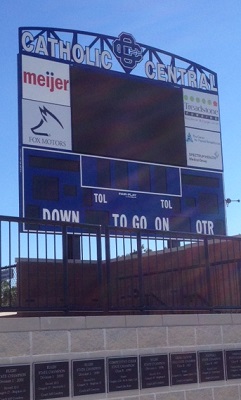 “I think it’s second to none, and it shined pretty brightly on Saturday night when the weather was bad. We had probably over 3,000 here during a tornado getting ready to hit just to see the place.
“It’s just awesome for our community to have a place to call home. It’s awesome for our kids to call this home.”
While a majority of football programs boast home stadiums or fields, Catholic Central has never been among them.
The school is celebrating its 110th birthday this season, and this is the first time in school history it will have a place to call its own.
For more than a century, Catholic Central has had to travel and play its home games at other venues.
Houseman Field in downtown Grand Rapids was where the Cougars played a majority of their “home games.” In recent years, they’ve had to travel to surrounding schools, including Grand Rapids Christian and Ada Forest Hills Eastern, to play.
It will be an entirely new experience for the Cougars when they host East Grand Rapids on Friday to open the 2016 season.
“We don’t have to get on a bus to play football,” Kolster said with a smile. “It will be different in how it impacts our schedule. What do we do for a home game now? Before we didn’t have much time. It was school, then we went to chapel, and then we came out here for a walk-through before getting on a bus and leaving. That was every week.”
The freshmen and junior varsity football teams played at the complex in past years on a makeshift field, but the varsity didn’t due to lack of lights and space.
Last season during construction, all three teams were bused to games.
“There wasn’t a single time last year that we didn’t get on a bus to play a football game,” Shelton said. “Last year was trying in that respect. Game days, (it) now saves us a good hour in travel time to a football game.
“We finally have a place to call home. We have a home that we can take pride and hopefully a tough environment for teams who come here and play. A home-field advantage so to speak, something we’ve never had.”
Catholic Central athletic director Trevor Hinshaw remains awestruck by the sight of the school’s decorated surroundings.
“It’s unbelievable, and I get goose bumps every time I walk out here,” Hinshaw said. “It’s a pretty amazing facility, and we are beyond blessed to call it home. To have no more home games on the road will be weird, but I think we will get used to it quickly and come to appreciate our new reality.”
 The tradition of Catholic Central was not forgotten in the process. A plaza honoring legendary football coach Ted Sowle sits on the concourse, as do plaques commemorating past MHSAA championships.
Other influential people in the community from days past also are recognized throughout the stadium.
“It’s important that our kids understand the traditions that came before them and the people that came before them to make this happen,” Kolster said. “I’ve talked to guys that I’ve coached, and they’re sad they don’t get to play here, but excited for the guys who are and for the future of our school. Those guys laid the foundation for us to play here.”
Friday night will mark another historic date in school history, and the players are eagerly anticipating the opportunity to play their first “home game.”
“I’m looking forward to it a lot,” Strong said. “I’ve been waiting for this all year.”
“It’s going to be live here,” senior cornerback Mike Brown added.
Hinshaw said the undertaking of hosting the first game involves a lot of logistics, but he hopes to cherish the moment.
“Ultimately, I want to make sure that through the stress I find time to enjoy the experience as well,” he said.
 Dean Holzwarth covered primarily high school sports for the Grand Rapids Press and MLive for 16 years and more recently served as sports editor of the Ionia Sentinel and as a sports photojournalist for WZZM. Contact him at[email protected] with story ideas for Allegan, Kent and Ottawa counties.
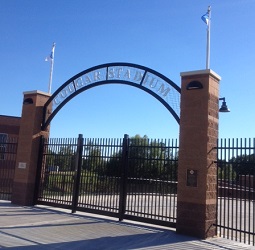
PHOTOS: (Top) Players work out on the freshly-completed Cougar Stadium turf. (Middle) The stadium scoreboard overlooks plaques dedicated to past GRCC champions. (Below) Gates will open for a varsity game for the first time Friday. (Photos by Dean Holzwarth.)