


New Football Practice Policies
March 25, 2014
'Why I Cried After Losing a Football Game'
October 5, 2015
By Dallas Lintner
Owosso athletic director
Our varsity football team lost last Friday night to St. Johns High School 55-19. It was certainly a tough loss for our team. Often times, players, coaches, and fans may indicate they feel like crying after such a loss; occasionally they may literally shed a tear.
Let me share the story of what brought me to tears following our team’s loss. I will tell you, it was not the loss. … It was the story of two strangers, Logan Turner and Blake Thelen.
Owosso senior Logan Turner was diagnosed with leukemia over a year ago. While still a part of the Owosso football program, Logan’s condition prevents him from participation in football, or even attending school; yet each week, with permission from his medical team, Logan may occasionally attend OHS football activities. I will tell you that his attendance has been an uplift for our players and coaches nearly as much as seeing his classmates has been an uplift for Logan.
Logan has never met Blake Thelen, yet they share a remarkable bond. Blake Thelen is a member of St. Johns varsity football team. Last year while on spring break, Blake had read an online article about Owosso’s Logan and the struggles he was going through. He remarked several months ago to a few family members and friends that he would like to do something for this kid from Owosso.
Many times, our children will make remarks like this and forget the sentiment all together after a short time. Blake did not forget this sentiment. Several months later, Blake kept his word and offered support to a stranger … to a brother of the gridiron … to a friend he has never met. This is why I cried last Friday night.
On the Wednesday before our game with St. Johns, I received a phone call from Blake’s mother, Shannon. Shannon informed me about her son’s awareness of our Logan and his plan to offer support. Blake had mobilized students and parents to “pass the hat” in the stands and to place donation collection tubs at the concession stand area. Blake’s plan had been announced by the St. Johns public address announcer between the first and second quarters. From witnessing the event personally, this story of Logan and Blake had received as strong of an ovation from the spectators in attendance as the St. Johns Homecoming royalty did at halftime. What a display of character, integrity, and love. This is why I cried.
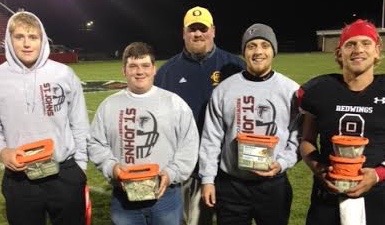
Logan was in attendance at the game and was on the sideline for a short time before the cold weather forced him to leave for home. Following the game, Blake, his mother, and a few other members of Blake’s group met me on the field immediately after the two teams shook hands. St. Johns’ athletic director Chris Ervin introduced me to Blake and his helpers and also to his mother Shannon, the woman I had met on the phone two days prior. Shannon was holding a gift bag filled with plastic food containers. As we greeted each other at midfield, there was an array of emotions. The Redwing players were elated, following a convincing victory; the Trojans were dejected following the defeat, and I was standing between the two groups smiling with tears running down my face as I tried to utter a few inspired works to Blake and his group expressing our gratitude, our surprise, and our awe for him and his generous deed.
I fear that I was only able to mumble a few incoherent syllables to that group. I spent most of the weekend attempting to determine how best to express today what I couldn’t express Friday night. This is why I cried.
When I returned home Friday evening, I sat in my chair with those plastic food containers and began to sort and count the donations from the evening. I was impressed that there was a great deal of pocket change in those canisters. Most likely from children who emptied their pockets into the tubs. At halftime, my own son purchased one less sucker at the concession stand so that he would have a quarter left over to donate to Logan. Shannon Thelen indicated that fans were flagging their people down in the stands with cash in hand. You wouldn’t believe the number of donations that came in denominations of 10 and 20 dollars, all for a stranger.
At the end of the night, I sat in my chair with $923.11 for Logan and his family. This is a remarkable sum that came from strangers … that came from Blake.
While the donations are very impressive, this is not what choked me up then and still. It is the notion that a student was moved by someone else’s story, took initiative, and gave a gift of far more value than $923.11. He gave friendship, he gave compassion, he gave love. School sports are often judged by scores, records, and stats. In this case, no score, record, or stat can do justice to this inspirational story.
It is these types of moments that inspire me to do what I do; to be associated with children who do amazing things. This high school football game transcended high school athletics and became a great human interest story on a very personal level.
This is why I cried after losing a football game.
God Bless you Blake.
God Bless you Logan.
PHOTO: Owosso athletic director Dallas Lintner, middle, stands with (from left) Jake Dorn, Adam Webb, Tyler Luznak and Blake Thelen after Friday's football game between the teams. (Photo courtesy of St. Johns athletic department.)