


New Football Practice Policies
March 25, 2014
A Game for Every Fan: Week 4
September 17, 2015
By Geoff Kimmerly
Second Half editor
By a quick count, there are 11 matchups statewide this week of MHSAA football teams entering with 3-0 records.
That means that at most only 119 teams will be undefeated after this week – and looking at the rest of the schedule, it wouldn’t be a surprise if the total after Saturday was much lower.
Read on for some of the best games to watch no matter where you live in Michigan or traveling to this weekend. And, as always, tune in to our Score Center on Friday for scores as soon as we receive them – usually all statewide by 11 p.m. – plus updated standings and the only place you’ll find updated playoff point averages throughout the weekend.
Bay & Thumb
Goodrich (2-1) at Flint Beecher (3-0)
Beecher has rolled to another impressive start, building on last season’s 9-0 regular-season finish with shutouts the last two weeks. Genesee Area Conference Red rival Goodrich was one of only two teams to come within 20 of the Buccaneers during that run last season – and is seeking its first win in this series since 2012. The Martians’ loss this season was by a point on opening night to still-undefeated Ortonville Brandon.
Others that caught my eye: Fenton (2-1) at Ortonville Brandon (3-0), Millington (2-1) at Birch Run (1-2), Yale (1-2) at Croswell-Lexington (2-1), Davison (2-1) at Flint Powers Catholic (2-1).
Greater Detroit
St. Clair Shores South Lake (3-0) at Clinton Township Clintondale (3-0)
The Macomb Area Conference Silver is one of the most competitive conferences rarely brought up west of Detroit, and Clintondale’s reputation is along that same line although it's reclaiming a place on the radar – the Dragons won 20 straight regular-season games from 2011-14 before finishing last fall a disappointing 4-5. But they’ve bounced back with two shutouts this fall – although South Lake, which already has surpassed last season’s win total, is averaging 31 points per game and likely won’t be the next to put up a zero.
Others that caught my eye: Warren DeLaSalle (2-1) at Birmingham Brother Rice (1-2), Orchard Lake St. Mary's (3-0) at Detroit U-D Jesuit (3-0), Livonia Churchill (2-1) at Plymouth (2-1), Waterford Our Lady (3-0) at Clarkston Everest Collegiate (2-1).
Mid-Michigan
Portland (3-0) at Lansing Catholic (3-0)
Recent elite-level success and star power gives this matchup the edge over four other meetings of undefeated teams in this region. Portland was the Division 5 champion in 2012 and Lansing Catholic was runner-up in 2014. The Raiders own a 6-4 edge in their 10 recent meetings, but fell 34-6 last year to a Cougars team again led this fall by quarterback Tony Poljan. Portland hopes a defense giving up just under 12 points per game can contain the University of Minnesota prospect.
Others that caught my eye: Midland (3-0) at Mount Pleasant (3-0), Grand Blanc (3-0) at Brighton (3-0), Pewamo-Westphalia (3-0) at Dansville (3-0), Lake Odessa Lakewood (3-0) at Stockbridge (3-0).
Lower Northern Peninsula
Whitehall (3-0) at Traverse City Central (3-0)
An overtime win over Traverse City West last week put Central at 3-0 for the second straight season but with an undefeated opponent making the trip up north this week. This could come down to Whitehall’s defense stopping the Trojans, who have scored 130 points but against opponents that are a combined 0-9. Whitehall has given up only 27 points so far but against opponents half the size or smaller in comparison to Central.
Others that caught my eye: Kingsley (2-1) at Boyne City (3-0), Grayling (2-1) at Charlevoix (2-1), Rogers City (2-1) at Hillman (2-1), Petoskey (2-1) at Traverse City West (0-3).
Southeast & Border
Detroit Loyola (2-1) at Ann Arbor Gabriel Richard (3-0)
Gabriel Richard is off to a 3-0 start for the fourth straight season, but this time outscoring its first opponents by a combined 143-6. The Fighting Irish can make that run look even better by continuing against Loyola, the defending MHSAA champion in Division 7. The Bulldogs’ 12-point loss to reigning Division 3 champion Orchard Lake St. Mary’s during opening weekend was its first defeat during the regular season since 2010, and they bounced back with impressive wins over Muskegon-area powers Oakridge and Ravenna.
Others that caught my eye: Hudson (2-1) at Brooklyn Columbia Central (3-0), Grass Lake (2-1) at Manchester (2-1), Ann Arbor Skyline (2-1) at Monroe (2-1), Monroe St. Mary Catholic Central (3-0) at New Boston Huron (2-1).
Southwest Corridor
Benton Harbor (2-1) at Portage Central (3-0)
Portage Central continues to rank among the class of the southwest, with last week’s one-point win over rival Stevensville Lakeshore a great start to the Southwest Michigan Athletic Conference West schedule. Rival Portage Northern and St. Joseph are major obstacles in the league as well – and Benton Harbor suddenly can’t be overlooked with this season’s wins its first since 2012 and already its most for an entire season since 2006. The Tigers are a seven-point opening loss to Richland Gull Lake from entering this weekend undefeated.
Others that caught my eye: Cassopolis (3-0) at Berrien Springs (3-0), Stevensville Lakeshore (2-1) at St. Joseph (3-0), Edwardsburg (3-0) at Paw Paw (2-1), Kalamazoo Central (1-2) at Battle Creek Central (1-2).
Upper Peninsula
Ishpeming Westwood (2-1) at Ishpeming (3-0)
The story hasn’t changed much in a year – Westwood is still seeking its first win over the neighborhood rival since 1998. Ishpeming won during the regular season and in the playoff opener last year and hasn’t loss a regular-season game to anyone since 2012. But Westwood, coming off its first playoff berth in three seasons, looks even more impressive at this point than when it entered 3-0 a year ago; the Patriots last week handed a solid L’Anse team its first loss and fell only on opening night to a Wisconsin team now 3-1.
Others that caught my eye: Indian River Inland Lakes (3-0) at St. Ignace (3-0), Marquette (0-3) at Escanaba (2-1), Iron Mountain (2-1) at Negaunee (3-0), Munising (3-0) at Newberry (2-1).
West Michigan
Muskegon (2-1) at East Grand Rapids (3-0)
The Pioneers are off to their best start since 2010 and own impressive wins over Grand Rapids Catholic Central and Caledonia – but with the Big Reds this week plus Grand Rapids Christian and Lowell among the scariest teams left on the schedule. Muskegon dealt first losses to Christian and Grandville the last two weeks after opening with a loss to Detroit Catholic Central, and had one of its best defensive games of last year’s Division 3 Final run against EGR, winning 37-7.
Others that caught my eye: Muskegon Mona Shores (3-0) at Caledonia (2-1), Zeeland East (3-0) at Grand Rapids Christian (2-1), Grand Rapids West Catholic (1-2) at Hudsonville Unity Christian (3-0), Comstock Park (3-0) at Zeeland West (3-0).
8-Player
Posen (3-0) at Bellaire (2-1)
Before this season, Posen had scored 60 or more points three times in five seasons of 8-player football. The Vikings have scored 60 or more every week this fall for their best start since 2010; they likely will need to score at least half that many against a Bellaire team that won this matchup 49-0 a year ago. The Eagles fell to upstart Powers North Central last week but remain a consistent 8-player power and a great test as Posen looks to take a step up.
Others that caught my eye: Deckerville (3-0) at Kingston (2-1), Tekonsha (1-2) at Portland St. Patrick (2-1)
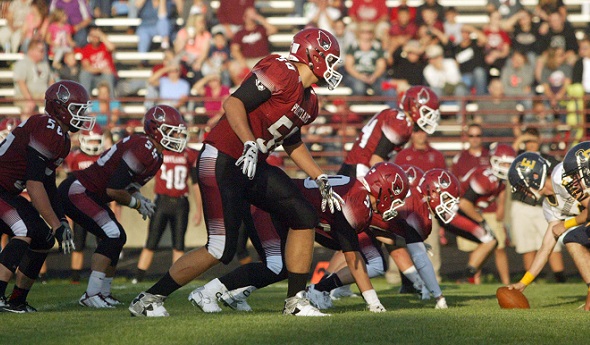
PHOTO: Portland’s defense, here against Ovid-Elsie on opening night, will be charged with shutting down a potent Lansing Catholic offense this week. (Click for more from HighSchoolSportsScene.com.)