

'Patriot Game' Unites Traverse City Rivals
September 9, 2016
By Geoff Kimmerly
Second Half editor
Twenty years ago this fall, Traverse City Central and Traverse City West faced each other in varsity football for the first time as new communities created by the split of the former Traverse City High School.
As was inevitable, the resulting rivalry has become one of the state’s most competitive, with West holding a 12-7 edge in varsity football after winning the first four games of the new series. But an idea five years ago to make the game about more has given an entirely new meaning to the annual neighborly get-together.
The “Patriot Game” was an idea first stoked by West football coach Tim Wooer, who suggested a military salute game in 2012 after the death of U.S. Marine Justin Hansen, who had been serving in Afghanistan and was one of Wooer’s players when the latter formerly coached at Kingsley.
Historic Thirlby Field was packed with 10,000 fans for that first Patriot Game, played Week 6 that fall. And it was just a start.
The Patriot Game has grown to also honor first responders, including police, fire and medical personnel, and for more reasons than football has become the game for the 3,000 students who attend either Central or West.
In their words, two of those students – Central senior Sarah Berry and West senior Dani Priest, the governors of their school’s respective student senates – explain why the Patriot Game has grown to mean so much, and also what it says about their communities.
Both Berry and Priest have attended all four Patriot Games, and of course will be on hand tonight after a full day of festivities at both schools. (Watch the game live with subscription on MHSAA.tv.) The game again is played at Thirlby, which is the shared home of Central and West as well as Traverse City St. Francis and has been hosting football games since 1896.
Priest: “My favorite memory of the Patriot Game was freshman year. Thirlby Field in itself is just a field where not many high school kids get to experience (that kind) of opportunity, because it an incredible thing that we share between the schools. The stands were completely filled, it was my first-ever high school football game, it was under the lights, it was 500+ kids from West, 500+ kids from Central. The whole community (went) back and forth, back and forth, the game was incredibly close and then West ended up winning (17-14). That was the only game since I’ve been in high school that we’ve won. The feeling after that was incredible especially because I was a freshman and it was new; there were no words. … Especially since our community is so intimate and small, that adds another component. No matter what, because we’re in the same conference, we’re going to play each other. But what is so important about the Patriot Game itself is the students are so involved in this game.”
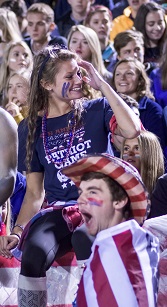
 As has become tradition, the student sections will wear patriotic colors – tonight, West will be a sea of Blue and Central of red. The schools hold various fundraisers, including selling T-shirts leading up to the game. Money raised this year will be donated to Veteran 2 Veteran, a local program that sets up mentors for veterans as they return to civilian life.
Berry: “Last year I helped to build a memorial at our field, so that was really special and really awesome to present that to the veterans who were at the game. This year, something that I think is going to be really special is we’re doing a thing called ‘Bucks for Vets.’ We’re going to bring all the student senators and run through the stands for two minutes and get all the donations from as many people as we can to go toward this organization. The organizations that we support every year are chosen through a council. I’ve been on the council for three years now and meeting with all of the organizations. They’re able to pitch to us why they need the money, where they’re going to use the money so it will affect veterans in the area, and we’re able to choose what organization – they all deserve money – but what organization needs the money. So all of the money from the game is going toward them and not just extra new special things.”
Classes began Tuesday, giving student officers at both schools limited time to drum up enthusiasm for today’s events – although there’s already ample buzz. Both schools will hold assemblies today. At Central, veterans and first responders will be welcomed in to tell some of their stories. At West, student leaders will hold more of a pep rally to make sure the entire student body, especially new classmates, know details for the night and why they should be there.
Berry: “We have an assembly every year right before the game where we honor all of our veterans and all of our first responders, and I think that really explains to (students) why it’s such a big deal. During that assembly, everyone is completely silent. They have so much respect. Our whole school still talks about how astounding that assembly was to thank all of them (last year), and I really think they know how much it means. It’s really hard not to be emotional about it during the assembly because we have families that come in and they lost a loved one in a war, and we have people who came back from combat a few years ago, so it’s really easy to understand how much it means to everyone. Normally, all of our other assemblies, people are rowdy, (but) this one assembly everyone has so much respect. It’s amazing. You always hear, ‘Oh yeah, the veterans are losing their lives in the war. They’re fighting for our country. They’re risking their lives.’ But to actually hear from someone who has experienced the death firsthand, it really opens your eyes.”
 Both teams are 2-0, and this will be the first time they'll match up with perfect records. Both also are expected to contend in the Big North Conference; Central won the league title and West was third a year ago. But those teams make up only a part of what is, of course, an educational event.
Priest: “What we learn from the Patriot Game is there’s so much more than just high school. There’s so much more than just a Central/West rivalry. There are people out there fighting for our country, and we all stand together. Both of our schools are at one place realizing there’s more than just us. We have to be thankful that we have the opportunity to be at this game, cheering on our teams.”
Berry: “People definitely learn a lot about respect. You definitely notice how much respect everyone has during the game, toward other people; it’s amazing. Definitely in past years, I’ve learned how much veterans do for us. And not only veterans, but the responders, police, everyone. It’s astounding. I guess I just wasn’t aware previously how much they really risk and how much they really do. That’s the main thing I learned, and I think a lot of people in the school could say the same thing. And you really learn a lot about your community as well. (The game) is sold out every single year. The student sections are covered in a sea of blue and red, and you just learn how much support can be given to our community.”
Ticket sales at the stadium gate begins at 2 p.m. Veterans, reservists, active military and first responders will be admitted free of charge through special entrances, and later student senators from both schools will camp out at the entrances to make sure no special guests are waiting in line when festivities begin. A motorcade of American Legion Riders, local motorcycle police and North Flight emergency medical transport personnel will ride into the stadium, and colors will be presented by member of the U.S. Coast Guard Color Guard and first responder Honor Guard.
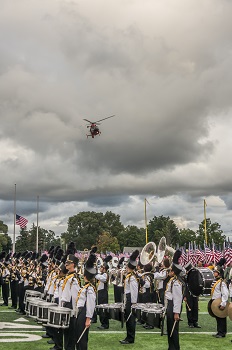 As the West marching band plays, student senators from both schools will form a tunnel for veterans and first responders to walk through as they enter the field and then line up at the 50-yard line, where they will be greeted by both football teams.
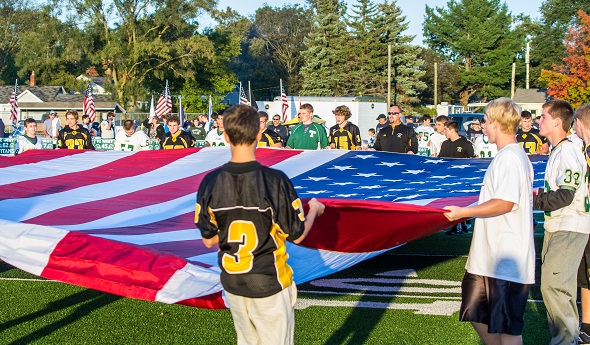
After the playing of taps and a memorial announcement of names, the junior varsity football teams from both schools together will take hold of a giant American flag stretching sideline to sideline as the band plays the national anthem. There will then be a flyover before the coin toss and opening kickoff.
Berry: “I think doing (the Patriot Game) with West makes it extremely special. Because not only do we have friends on the other side, but using the game in this way is extremely smart. We’re able to come together for a common cause, on common ground, in that we want to honor all these people and honor what they’ve done for us, and that really ties it all together. … I’ve been asked if I want more people to be in the student section from Central supporting the veterans or more people from West, but really, we want everyone there. We want everyone to do well. We want everyone to be able to thank everyone, and it’s just an extremely supportive thing. Of course we want to win, but win or lose, it’s a great experience.
Priest: “I think what makes it special with Central is honestly, we know these kids. We see them, we’re friends with them. The only thing that makes us different is we go to different schools. We live in the same town, we do the same things, in our free time we go to the same ski hills, we go to the same beaches, we go to the same restaurants, we see each other around town, we participate in the same social events. Seeing your friends and people that you care about as well, not only as your rival but you care about them, makes it so much better.”
An estimated 100-150 veterans and first responders attended the 2015 Patriot Game, and 150 or more are expected tonight with moderate temperatures and mostly clear skies expected. The schools are preparing for a crowd that could eclipse 8,000 fans total.
 Priest: “I know people who don’t have kids in high school. My neighbors, actually, have elementary school kids, and they’re like, ‘We’re coming to the game. We bought T-shirts.’ Because they just want to help out with the cause. It’s broadcast on the news, it’s on the radio, it’s everywhere. It just shows so much how no matter if it’s your school or if it’s your kids, people just want to get involved and they want to know how they can help.”
Berry: “It explains so much about Traverse City’s personality and just how giving the entire community is, and accepting. Traverse City is such a special place in that everyone comes at you with open arms. Our community is so giving towards veterans. The hearts of everyone grow bigger during this game. Going there can definitely affect the way you view the city.
“There’s so much love in that stadium. And everyone wants to be there. It’s the event of Traverse City for the high schools. If you’re going to go to any of the games, I would tell you, you have to be at the Patriot Game.”
Click for more information from the Patriot Game website.
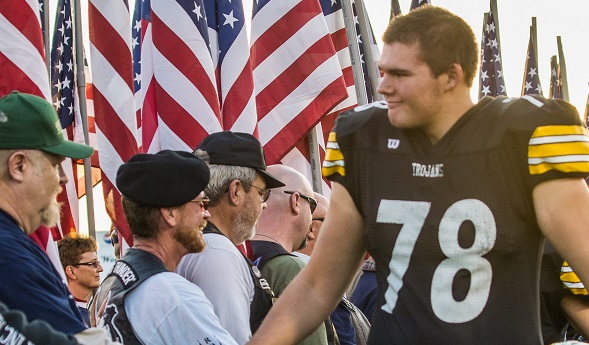
PHOTOS: (Top) Traverse City Central players shake hands with veterans before the first "Patriot Game" in 2012. (Top middle) Junior varsity players from Central and West hold the giant flag during last season's national anthem. (Middle) West players converge on a Central ball-carrier in front of a packed Thirly Field in 2015. (Below middle) A helicopter provides a fly-over as the Traverse City Central band takes the field. (Below) Students dress in blue and red in support of veterans and first responders saluted during the game. (Photos by Rick Sack/TC Rick Photo.)

Lessons Learned, Goodrich Laughs Last
By
Paul Costanzo
Special for MHSAA.com
October 25, 2017
The joke wasn’t incredibly original, nor was it incredibly funny, especially if you had any connection to the Goodrich football program.
 But when you suffer through a winless season like the Martians did in 2016, people are going to have jokes.
This one was a knock-knock joke, and Owen was at the door. Owen Nine.
Goodrich senior defensive back and captain Ryan Aylmer can at least smile now when he tells it, because with the Martians having just completed an 8-1 regular season, there are no more jokes.
“This year, people go through the school and they talk about who we got next week, and what we’re looking like in the playoffs,” Aylmer said. “Now teachers are talking about the games in school, and I’ve got little kids recognizing who I am. People are back into the program now that we’re succeeding. It feels great, especially after last year when it felt like we were nothing, that forgotten team. But now we’re back in the community.”
This isn’t a story of some moribund program finally finding its way to the postseason. In fact, when Goodrich hosts Pontiac Notre Dame Prep on Friday in the first round of the MHSAA Division 4 playoffs, it will be in a familiar spot.
From 2008 through 2015, Goodrich qualified for the playoffs six times, and had a losing record just once.
The question in Goodrich was how does 0-9 happen?
“That team we had last year, they weren’t an 0-9 team,” Goodrich coach Tom Alward said. “I should have done a better job last year, and we should have won several games. It just didn’t happen. This year, kids are making things happen that we couldn’t make happen last year.”
Alward took over the Goodrich program in 1993, and in 1995 led the Martians to the postseason for the first time ever. His 146 wins since are the most in program history, and he already has been inducted into the Michigan High School Football Coaches Association Hall of Fame.
Despite all of that previous success, a moment at the end of last season led Alward to say he had never been more proud of any team he had ever coached.
“After our ninth game last year at St. Johns, when we just got beat 52-0 to finish an 0-9 season, that entire team stayed on the St. Johns football field for probably a half hour, 40 minutes just talking to one another, hugging one another -- they knew it was the end,” Alward said. “They played their tails off all year. I can’t say enough about them. I just feel so bad that they have that 0-9 stigma. I’ve got that stigma myself from when I played at Tampa on the 0-14 team (for the NFL’s Buccaneers in 1976). But I just feel bad, because they didn’t deserve that.”
Alward and his staff didn’t panic and make drastic changes following the winless season, but in his 25th with the Martians, he was able to look at all aspects of the program, including himself, to see where things needed to be different.
 “We did exit interviews at the end of last year, because we were concerned about the culture,” Alward said. “We’ve been able to win here for a number of years, and we didn’t want to all of the sudden have kids thinking that they couldn’t win because we went 0-9. We wanted to address that part of it, so we did exit interviews, we did a lot of offseason bonding exercises, team building and all of that stuff. This team is pretty close. We were fortunate to get off to a good start, and the rest has kind of just taken care of itself.”
That bond, players say, is what has sparked the rebound.
“We would go out to dinner together, we would do everything together all summer long,” senior defensive lineman and captain Sebastian Foglio said. “We would work out together, we would push each other. There’s no age, there’s no ‘freshmen get the water,’ none of that stuff. We just came together and did what we had to do. Everybody is close with everybody, nobody dislikes anybody. If we do, we’ll talk and change that.”
And the start, well, it couldn’t have been much better.
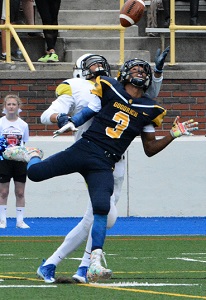
In Goodrich’s opening game against Burton Bendle, freshman Tyson Davis returned the opening kickoff for a touchdown. It was an immediate announcement that the 2017 season would be different.
“It was a sigh of relief,” Aylmer said. “Last year we scored (66) points all year. Seeing, literally, the first play of the brand new year getting taken back, and scoring (44) points our first game, it was just a sigh of relief getting that out of the way and realizing that we can do that this year.”
Goodrich rolled to a 3-0 start, outscoring opponents by a combined score of 132-12 before falling 20-7 in Week 4 against Genesee Area Conference Red rival Lake Fenton. But a resounding 42-0 win the next week against Otisville-LakeVille started a five-game winning streak to end the regular season for the Martians, who outscored opponents by an average of nearly 26 points on the year.
Suddenly all of the social media chatter from the area was gone, along with the jokes. But the lessons learned from an 0-9 season were not.
“There’s been a chip on our shoulder,” Aylmer said. “It seems like every week these guys last year thought we were bad, or we played them last year and they beat us. We had a chip on our shoulder and everybody has taken it to heart, and it seems like we’ve been fighting every week as an 0-9 team, but we’re really a good team this year.”
 Paul Costanzo served as a sportswriter at The Port Huron Times Herald from 2006-15, including three years as lead sportswriter, and prior to that as sports editor at the Hillsdale Daily News from 2005-06. He can be reached at [email protected] with story ideas for Genesee, Lapeer, St. Clair, Sanilac, Huron, Tuscola, Saginaw, Bay, Arenac, Midland and Gladwin counties.
PHOTOS: (Top) Goodrich celebrates seeing itself on the playoff bracket during Sunday’s selection show on FOX Sports Detroit. (Middle) Goodrich freshman Tyson Davis contends for a loose ball during the season opener against Burton Bendle; he returned the opening kickoff that game for a touchdown. (Top photo by Paul Costanzo; bottom photo by Terry Lyons.)