


Pellston Writing Unforgettable Story
November 1, 2019
By Chris Dobrowolski
Special for Second Half
PELLSTON — It’s a story that could easily derive from Hollywood.
 Only, this script is being written in Pellston.
Leading up to the 2019 season, the narrative for the Pellston football team has been mostly a tale of woe.
Zero playoff appearances.
Twenty-three years without a winning season.
A .260 winning percentage since 1950.
This year, however, the plot has turned into a feel-good story as the Hornets have put together a season that’s only been dreamed about over the years, posting an 8-1 record and earning their first postseason berth.
“To go 8-1, it was great,” said Pellston head coach Jack Carter, a 1987 graduate of the school. “I knew we had some really good players, some great seniors. Strong leadership on that end. It all kind of came together for us, at least through the regular season. I don’t know if it’s being a miracle worker as much as we’re at the right place at the right time.”
Pellston quarterback Glenn Bonter is one of those seniors. Bonter moved to town two years ago from Grand Haven and immediately found his niche within the confines of the weight room. The other players who were there made him feel welcome, and they quickly became friends. They also filled him in on the school’s history in football.
“(I heard) that it was a struggle,” said Bonter. “That they hadn’t had a whole lot of success. That was something where we looked at it and all of us wanted it to change. Looking around in the weight room, I saw how much hard work and dedication kids were really putting into it. Pretty much the whole entire team would go to weight room in the summer. We would all go out to the field and just pass and do some running. I think it was a whole team thing. We were like, ‘You know what? We want to win, and we’re going to do it.’ We just kind of put our foot down and went for it.”
Carter is in just his third year leading the Hornets, though he is well-versed in how difficult it has been for the school to win on the football field having off-and-on been a part of the program in one capacity or another since 2001. He’s seen players and coaches come and go, working to get things heading in the right direction but often finding that to be an insurmountable hurdle.
 “If you look at it strictly from wins and losses, it wouldn’t tell the complete story because we have not been that great,” said Carter. “But we’ve had, every single year, guys that went out there and worked so hard. Played with as much heart and emotion as you could expect. For me, I think that was the template, or the groundwork for us to build off.”
Pellston also laid some of the foundation for this season during last year’s 4-5 campaign. What might seem like a rebuilding year for some was a breakthrough for the Hornets. It was the most wins they had recorded in six years. Three of those wins came in succession, too — the first time the program had strung together consecutive victories since it opened the 2012 season with four straight victories.
That propelled the Hornets into the offseason with a ton of hunger. The team’s four seniors — Bonter, running back/defensive back Lakota Worthington, and linemen Evan Cameron and Joey Rizzardi — spearheaded the team’s participation in summer training. When the full squad met for the first time in August, it came in with good fitness, strength, talent and desire.
“We made sure to make the weight room a thing,” said Worthington. “We made sure to come in during the offseason and put in the work and made sure we worked on our routes.”
It didn’t take long for Pellston to reap the benefits of its hard work as it started the year with six wins in a row — the longest winning streak in school history. Among those victories were dramatic triumphs over Posen (42-38) and Au Gres-Sims (32-30) where the Hornets overcame halftime deficits of 16 and 18 points, respectively, to remain undefeated.
“Normally you just don’t come back from those type of deficits,” said Carter. “This group of guys, they just keep fighting. They keep believing, and they keep their heads up. Their positive outlook and attitude is first rate.”
“For us to rally back and win those games, it was unbelievable,” said Bonter.
Three games into his junior season, Bonter switched from running back to quarterback. He’s been dynamic in running the Hornets’ spread offense, accounting for 16 touchdowns rushing and 13 through the air. Junior David Jamroz, like Bonter, has rushed for more than 1,000 yards. Worthington joins them in a backfield that features a great deal of speed. He also provides electricity in the return game.
“(He’s a) special returner,” Carter said of Worthington, a four-year varsity player. “He’s been that sparkplug and that catalyst that we’ve been needing for quite a while. In 8-man football a lot of times teams choose not to really kick to guys who are like that. It seems like every time a ball did go to him, he made the most of it. If he didn’t get a touchdown out of it, he certainly flipped the field for us and gave us great starting position on offense.”
The Hornets have averaged 46 points per game. The only time they’ve been held under 30 points was a 38-14 loss to Hillman in the seventh week, a game where injuries hampered Pellston’s chances.
“I think we just had an off night,” said Bonter. “They’re a really good football team. A lot of respect to Hillman. They should go far; but yeah, that was a tough loss.”
 “We learned that sometimes only going in with 11 players can get you in trouble,” said Carter. “We did get hit with some injuries that night. Secondly, Hillman was the first team that really came out and really played good, sound, hard-hitting football, especially on the defensive side. They have a history of being able to make the playoffs, and they’ve had success in football. They showed why they’re at where they’re at.”
The Hornets were able to rebound and finished the regular season with a pair of convincing wins over St. Helen Charlton Heston and Central Lake.
If the current football playoff system was in place in 1995, Pellston wouldn’t have had to wait until this season to gain its first postseason bid. That year the Hornets went 8-1 but did not qualify because they ultimately didn’t have enough playoff points.
Twenty-four years later Pellston finally buzzed its way into the postseason. It opens the MHSAA 8-player Division 1 tournament with a Pre-Regional on Friday against Gaylord St. Mary.
“I’m so ready. I’m ready today,” said Worthington. “I just want to go out there and show everybody what we can do. I know Gaylord (St. Mary) is pretty good, but I’m ready to get them.”
The Snowbirds come into the game with a 4-5 record, but four of their first six wins were forfeited for using an ineligible player.
“St. Mary is coming in with a really, really good football team,” said Carter. “I look at them as an 8-1 football team, and we have to look at them that way.”
As magical as this season has been for the Hornets, they feel like there is still more of the story to be told and are looking to add a few more chapters in the coming weeks as the playoff scenario unfolds.
“Hopefully we have a good Hollywood ending with it and keep it going into the playoffs,” said Carter.
 Chris Dobrowolski has covered northern Lower Peninsula sports since 1999 at the Ogemaw County Herald, Alpena News, Traverse City Record-Eagle and currently as sports editor at the Antrim Kalkaska Review since 2016. He can be reached at [email protected] with story ideas for Manistee, Wexford, Missaukee, Roscommon, Ogemaw, Iosco, Alcona, Oscoda, Crawford, Kalkaska, Grand Traverse, Benzie, Leelanau, Antrim, Otsego, Montmorency, Alpena, Presque Isle, Cheboygan, Charlevoix and Emmet counties.
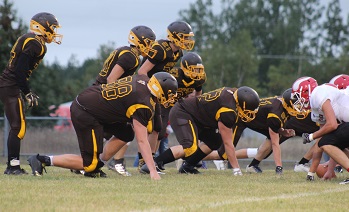
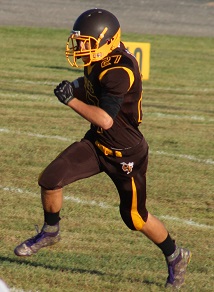
PHOTOS: (Top) Pellston’s David Jamroz (20) races through the Au Gres-Sims defense during a Week 3 win. (Middle) The Hornets stack the line during a Week 2 victory over Posen. (Photos courtesy of the Pellston athletic department.)
Let's Not Forget These Winning Coaches
December 15, 2015
By Ron Pesch
Special for Second Half
Buried deep within the MHSAA’s list of coaches with 200 career football wins is the name Oscar Johnson. Sharp eyes will note that Johnson began his coaching career in 1925 – 90 years ago.
Following graduation from Western State Normal School (today, Western Michigan University) in Kalamazoo, Oscar E. Johnson coached two seasons at Mount Pleasant High School before moving on to Muskegon Heights in 1927. Known by his nickname, like most from the time period, “Okie” coached multiple sports including football, basketball and baseball. After 37 years (1927 to 1963) and six mythical gridiron championships (as well as three Class A basketball titles), he retired and moved to Baldwin.
During a teacher’s strike in 1979, Johnson, now in his 70’s, came out of retirement to coach Baldwin’s football team for four contests, earning three wins against a single loss. In 40 seasons, Johnson’s teams posted 209 victories against 106 defeats and 28 ties.
In 1975, his was the lone name that would have appeared on the MHSAA’s list of coaches with 200 football wins.
In 1980, Bill Maskill, a graduate of Michigan State University and head coach for six seasons at Sheridan, then Galesburg-Augusta for 29 years, was the second to join the list. Jack Castignola, who started his coaching career in Ohio before becoming varsity coach at Monroe Catholic Central and then Trenton, was added to the list in 1981.
They were followed by Dick Mettlach, long of Crystal Falls and that school’s successor, Crystal Falls Forest Park, Jack Streidl who led Plainwell for 37 seasons, and Dick Soisson, who coached for a combined 41 seasons at Owosso St. Paul, Kalamazoo St. Augustine and Kalamazoo Hackett. Each posted his 200th win in 1984. Leo “Smokey” Boyd, who coached 40 years at Standish-Sterling, Saginaw Sts. Peter and Paul and Saginaw Nouvel, notched his 200th win in 1985, becoming only the seventh coach to accomplish the task in 90-plus years of high school football in Michigan.
Only two additional names were added over the next five years. Walt Braun, long of Marysville, joined the exclusive group in 1986. Al Fracassa, who spent a combined 46 seasons coaching at Royal Oak Shrine and Birmingham Brother Rice and turned down the chance to join Muddy Waters’ coaching staff at MSU in 1980, picked up his 200th win in 1988. That brought the list to nine total.
Twenty five years later, the list totals 58 names. So what changed?
Of course, it was the addition of the MHSAA football playoffs, which debuted in 1975.
A look at two coaches helps illustrate the issue.
Fracassa, the list’s current leader in all-time wins with 430, took 29 seasons to tally his first 200 victories. It took only 23 more seasons for him to gain the next 200. Farmington Hills Harrison’s John Harrington took 24 years to total 200 wins, but picked up his 400th after only 20 more.
Between 1960, Fracassa’s first season, and 1988, Fracassa’s teams played an average of 8.30 games a season. Between 1970, Herrington’s first year and 1993, the year of his 200th, his teams averaged 9.64 games per season.
Between 1988 and 2011, when Fracassa won his 400th game, his teams played an average of 11.61 games a season. Between 1994 and 2013, Herrington’s 400th, his teams played an average of 11.09 games per year. Fracassa’s teams compiled 68 victories in the MHSAA postseason. Herrington’s teams lead the state with 87 victories in the state playoffs.
Simply put, with the arrival of the postseason, it became easier to get to 200.
While no one would debate the accomplishments of any of the 58 gentlemen on the list, all but a few benefit from a baseline that few others who coached only 40 years before them were unlikely to reach.
Of course, those previous years included an amazing array of mentors. In hindsight, perhaps the list should include a mark for coaches from who assemble 150 varsity wins during the regular season only.
Johnson, and many others on the current list, certainly fall within such a category. But so would people like Ted Sowle, who, according to extensive research by former state historian Dick Kishpaugh, compiled a combined 171-47-10 mark between 1937 and 1963 as varsity coach at Grant, Algonac, Cathedral Prep in Erie, Pa., and Grand Rapids Catholic Central. At the time of his retirement from coaching in 1963, he ranked second in the state on the career wins list, behind only Johnson.
Ray Rynberg, a Grand Rapids Union and Central Michigan graduate, began his coaching career at Cedar Springs in 1939. After 12 years, he stepped away from the coaching ranks to pursue a degree in school administration from the University of Michigan. In the fall of 1955 he returned to the sidelines at Grant. He remained for 21 years, compiling a record of 189-62-9 (including seven unbeaten seasons) surpassing Sowle on the list upon retirement following the 1975 season.
Elmer Engel, who is honored in Bay City with his name attached to the city’s beautiful football stadium, also would appear on such a list. A three-year starter at the University of Illinois, Engel arrived in 1950 and installed the T-formation. He worked the sidelines for the Wolves through the 1972 season, compiling a 165-34-8 record and mythical Class A state titles in 1958, 1965, 1967, 1969 and 1972 according to the Associated Press polls ranking the state’s top teams.
Traverse City’s Jim Ooley led the Traverse City Trojans to a 164-56-4 regular season record (and a 179-60-4 record overall). Muskegon’s C. Leo Redmond led the Big Reds to a 156-29-13 record and six mythical Class A state titles between 1923 and 1946.
Certainly, there are others, many long-forgotten by most to the sands of time, who would qualify for the list. But who are they?
Incredibly successful coaches, like Flint Northern’s Guy Houston, would still fall shy. Playing in the incredibly tough Saginaw Valley Conference, Houston’s teams posted a remarkable 148-41-13 mark in 24 seasons as head coach of the Vikings. Nick Annese, who rolled up a 55-29-2 mark (including 38 straight victories) in 10 seasons at New Lothrop, then led Corunna to a 91-32-3 mark over 14 seasons but falls several games short.
So will many other of the state’s more well-known names, like Lloyd Carr, best known for his years at the University of Michigan, (who served as an assistant at Detroit Nativity and Belleville, before becoming head coach at Westland John Glenn for a few years), University of Nebraska’s Bob Devaney (who spent years 14 years coaching in Birmingham, Keego Harbor, Saginaw, and Alpena) and Colorado’s Bill McCartney (who assisted under his brother Tom at Detroit Holy Redeemer, then served as varsity football and basketball coach at Dearborn Divine Child). All moved on to the college game as assistants before reaching 150 high school wins.
Nick Annese’s son, Tony, who coached at Montrose, Ann Arbor Pioneer, Jenison and Muskegon tallied 169 regular season wins (and 195 victories overall) at the prep level before moving on to the college ranks at Grand Rapids Community College, then Ferris State University.
Can you name others, missing from the list of 200-game winners, with 150 varsity victories in the regular season? If so, contact me at the e-mail address below.
 Ron Pesch has taken an active role in researching the history of MHSAA events since 1985 and began writing for MHSAA Finals programs in 1986, adding additional features and "flashbacks" in 1992. He inherited the title of MHSAA historian from the late Dick Kishpaugh following the 1993-94 school year, and resides in Muskegon. Contact him at [email protected] with ideas for historical articles.
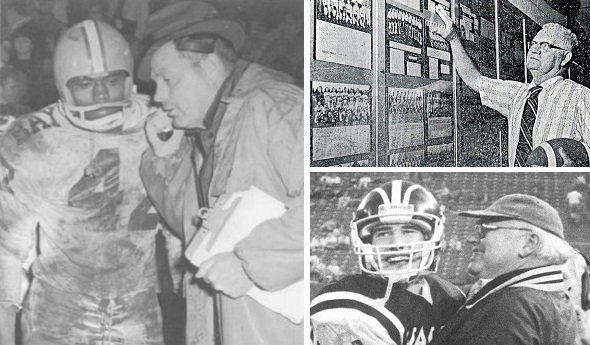
PHOTOS: (From left) Longtime Bay City coach Elmer Engel with a player from the 1968 Bay City Central yearbook, legendary Grant coach Ray Rynberg from the Muskegon Chronicle and championship-winning coach Jim Ooley of Traverse City.