

Rondy Joins Record-Making Ithaca QBs Past in Leading Yellowjackets to Finals Glory
By
Scott DeCamp
Special for MHSAA.com
November 28, 2026
DETROIT – In the mind of a young Gibson Rondy, trips to Ford Field on Thanksgiving weekend seemed almost like a birthright for Ithaca’s football team and its fans.
After all, the Yellowjackets captured five MHSAA Finals championships – including four in a row – during the six-year span from 2010-15.
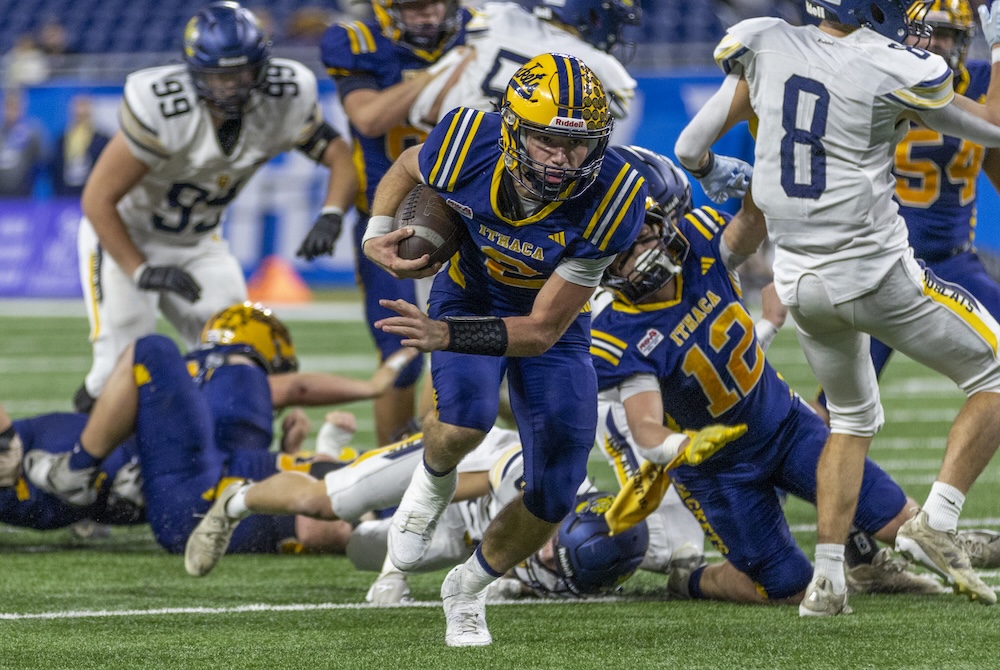
Now the program’s senior quarterback, Rondy has realized the dream. He powered his the Yellowjackets to their latest title with his legs and his arm, in the meantime etching his name in the MHSAA record books.
Rondy racked up 450 yards of offense and had a hand in seven touchdowns as Ithaca overpowered Ottawa Lake Whiteford, 49-24, in the Division 7 Final on Saturday at Ford Field.
“It means a lot. I feel like I grew up at Ford Field every Thanksgiving weekend because we were here so much,” Rondy said. “It’s pretty special and I get emotional thinking about what it means to this community to win another one, especially my senior year to go out this way with this group of guys. It’s really special.”
The championship was Ithaca’s sixth overall and first since 2015 and also the first for Yellowjackets head coach Jordan Hessbrook, nephew of former coach Terry Hessbrook, who guided the program to all of its previous titles. Jordan Hessbrook was part of Ithaca’s championships as a player from 2010-12.
Rondy has been the latest in a string of great Ithaca quarterbacks. He now sits third in MHSAA Finals history for total offense and rushing for 240 yards on 18 carries (13.3 average) and four TDs while connecting on 10 of 15 passes for 210 yards and three scores with no interceptions.
Not every standout Ithaca QB has gotten the chance to play at Ford Field and win a state title. Rondy joins the company of those who have, however.
“These guys have done everything that we’ve asked them to do along the way, and above and beyond that maybe even so. They were able to reap the benefits of that today,” Jordan Hessbrook said. “I just can’t express my pride and appreciation for these guys and our whole team, really from freshman through senior and all the guys that have come before over the last how many years whether they were at Ford Field (or) didn’t get that opportunity.”
Ithaca (13-1) outgained Whiteford (11-3) in total offense yardage, 501-289. The Yellowjackets rushed for 291 yards, while their defense made the Bobcats and standout senior running back Brek Ruddy earn everything.
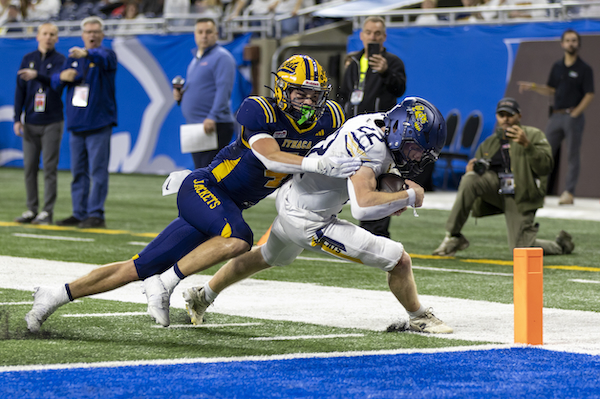
Whiteford finished with 224 rushing yards – Ruddy responsible for 147 of them on 28 carries with two TDs (27, 17 yards). Senior QB Tre Eitniear, a four-year varsity player and dual threat in his own right, ran 13 times for 61 yards and a score and threw for 65 yards for the Bobcats, who made their fifth Finals appearance and were seeking their third title.
Rondy got things started right away with a 24-yard TD run less than three minutes into the game. He connected with junior Greyson Merchant on a 35-yard scoring pass midway through the opening quarter to make it a 14-0 lead.
Whiteford responded on Eitniear’s 1-yard TD run during the first 30 seconds of the second quarter as the Bobcats pulled within 14-8.
Ithaca pulled away in the next quarter and a half on two more Rondy scoring runs (24, eight yards) along with a 28-yard TD pass to senior Connor McMurphy en route to building a 36-8 lead by the midway point of the third quarter.
Rondy later added a 67-yard scoring gallop and 72-yard TD pass to Merchant.
“When you have a quarterback that can (run and throw), you can try to set your defense to try and stop the run and then he’s going to hurt you with the pass; and then you try to do some things to (defend) the pass and he’s going to hurt with you the run,” said Whiteford coach Todd Thieken, noting that there was no way for his squad to replicate with its scout team what Rondy can do.
“Hats off to him. He had a tremendous year. He’s a heck of a football player.”
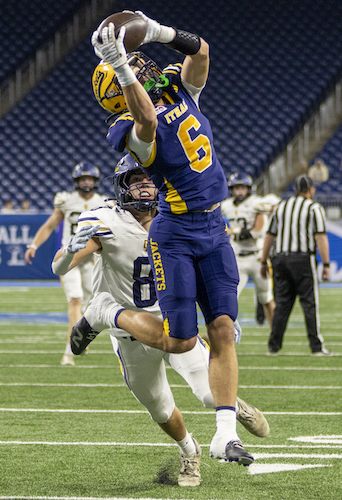
Impressive as Rondy was, he did experience one humbling moment as a safety on defense during the final seconds of the first half. On a laser of a pass fired by Eitniear, the ball smacked Rondy in the facemask, which seemed to stun him – just not enough to throw him off his game from his QB spot.
Rondy laughed it off in the postgame press conference.
“I was hoping this wouldn’t come up,” he said with a big smile amid laughter in the press room. “I did see the ball come at me, and I thought it was going to kind of come into my chest. I think the kid, like, deflected it kind of off his hands. It was a rocket, but yeah, it went straight into my facemask. I saw my defensive coordinator kind of shaking his head.”
Hessbrook interjected: “He plays quarterback, not receiver,” prompting more laughter.
Ithaca and the Yellowjackets got the last laugh, hoisting the championship trophy.
For Whiteford, getting to Ford Field did not seem like a realistic possibility following an 0-2 start to the season, but the Bobcats turned up their focus and intensity and they reeled off 11 straight wins entering Saturday.
Ithaca’s lone loss came in Week 9 at Beal City (29-26), which capped a perfect season with a Division 8 title on Friday.
For Ithaca, football has been a family affair over the years, starting with the Hessbrooks and continuing with the Merchant brothers this season.
Senior linebacker Harper Merchant led the Yellowjackets’ stingy defense with 10 tackles, including a sack and 2½ tackles for loss. He and younger brother Greyson sat next to each other at the press conference.
“I mean, the whole team’s brothers,” said Greyson Merchant, who finished with four receptions for 112 yards. “We’re all very close, hang out almost every weekend. We’re just like brothers.”
Said Harper Merchant: “It’s really awesome. All of us on the team have a lot of love for each other, me and him especially just because we’re brothers, and it feels really awesome to win a state championship.”
PHOTOS (Top) Ithaca quarterback Gibson Rondy breaks into the open Saturday against Ottawa Lake Whiteford. (Middle) Whiteford’s Brek Ruddy (22) steps out of bounds just shy of the goal line with Connor McMurphy attempting to wrap him up. (Below) Ithaca’s Greyson Merchant (6) pulls in a pass. (Photos by Adam Sheehan/Hockey Weekly Action Photos.)
Caledonia Football Set to Open Season by Welcoming Fans to New Home
By
Ron Pesch
MHSAA historian
August 25, 2025
Community banter dated back to April 1948, or before. Caledonia football followers were anxious for “an athletic plant of their own.” Members of the local Commercial Club were pushing to build a true place to call home.
At the time, home games were played on a clearing at Lakeside, a local county park in the heart of the village near Emmons Lake. Thanks to the success of the team and the popularity of games, locals felt the Scotties had outgrown the site.
Members of the Class C Bar-Ken-All league, coach Thornton K. Auwater’s squads started to win consistently, grabbing conference championships in 1945, 1946 and 1947. The league began in 1937 with the school as a charter member, along with Byron Center, Hopkins, Kelloggsville, Martin, and Wayland.
The Club proposed building a lighted field to the PTA with the thought that it could be done for between $12,000 and $15,000. According to an article in the area newspaper, the Grand Rapids Press, “It is expected the money will be raised by the sale of bonds locally.”
In 1949, a design was approved. However, in hopes of significantly lowering the cost, the plan was for volunteers to assist in the layout and construction of the site. According to the Press in April 1950, the race was on to finish the project before the arrival of the upcoming season:
“Sod, trucks, and tractors for the job have been donated by local residents. It is estimated that at least 100 more volunteers will be required to complete the field in time for regular season play.”
Auwater’s crew was expected to do well during the fall of 1950. The football team had fallen to Kelloggsville, 19-0, in the second game of the 1949 season, and the defeat meant the Scotties finished second in the league standings to the Rockets. But, of particular note, in the games that followed, Caledonia’s defense was flawless, shutting out its final six opponents. By all measures, it was an exciting time.
Come the new school year, and thanks to the efforts by the community, the field was ready for the team’s nonconference season home opener with Grant on Sept. 15.
Changes
The 1935 season was Caledonia’s first playing football, marking this as the school’s 91st year on the gridiron. Since the fall of 1970, the team has competed in the Ottawa-Kent Conference, and in 2016, moved to the league’s Red division.
Prior to the 1970s, the Scottish terrier – a breed of dog popularly known as the Scottie, originally bred to hunt vermin – was Caledonia High School’s mascot. Around 1974, students decided to change the nickname to the Fighting Scots – depicted by a Scottish warrior dressed in the school colors of purple and gold.
Fast forward to this 2025-26 school year and Caledonia is Class A and among the largest 65 high schools in the state based on enrollment. And 75 years after unveiling their first true home field, Caledonia Community Schools is debuting the team’s reimagined home.
Approved bond issues from 2020 and 2023 have funded the latest updates and renovations to the site. “Preserving the heritage” of the district, a synthetic turf system was added to the current site in 2023. This season, heated team rooms, updated seating, concessions, and restrooms will be unveiled.
For fans, the curtain opens Thursday when the team squares off against Holy Names Catholic from Windsor, Ontario.
“This stadium tells the story of Caledonia. It is a story of community, tradition, and pride,” said Kelly Clark, community and public relations coordinator for the district. “As we celebrate 75 years, we honor those who built the foundation and look forward to the next generation writing their own chapter on this field.”
A souvenir dedication program will be distributed at the home opener. Within, special thanks are extended to many who have helped bring the story to life: “We are especially grateful for the work Steve Poll has done to uncover and preserve so much of this history so that our community can fully appreciate the legacy we carry forward.”
Poll, himself, was a graduate of Grand Rapids South Christian. His dad, Gordon Poll, played right tackle and was a co-captain as a senior on the 1950 Caledonia team.
“He was not one to live in the past,” recalled Steve Poll, “so unless we were at a football game and something triggered a thought, he didn't talk much about the 1950 team accomplishments. … I met one of his teammates at my dad’s funeral, who shared a few things (with me). I intended to interview him (however) he passed away before that happened. I finally decided to dig in and find what I could.”
Poll captured details from old newspaper articles, photos, and memorabilia. “I started investigating before I knew anything about the current rebuild of the stadium,” he said.
Also planned for the celebration is a three-minute video featuring interviews with players – present and past – including a member of the 1950 team who recalled players laying sod on the field at their first practice that season.
MHSAA Executive Director Mark Uyl, a 1992 Caledonia graduate, will speak at the event.
A season to remember
“Grant High’s fighting team almost spoiled the dedication of a new lighted football field … last night,” reported the Press when covering the first game of the 1950 season, “throwing a real scare into the bigger, highly favored Caledonia High team before tumbling, 6 to 0.” A 30-yard pass from Bob Higley to Don Moffatt was the game’s only score.
In hindsight, it was perhaps the biggest play of the year.
A true stadium dedication ceremony was planned for the second game of the season. Among those scheduled to attend and speak were Caledonia Schools Superintendent Andrew B. Cherpes, Board of Education President Orlo Good, Village President Stan Stawski, and Coach Auwater. Also planning to make the trip from Washington was U.S. congressman Gerald R. Ford, Jr., who held Michigan’s 5th district seat in the House of Representatives. Unfortunately, due to scheduling issues, Ford was unable to attend but did send a telegram to explain his absence and, within, congratulated the community on its outstanding achievement. (Uyl will read the content during this year’s celebration.)
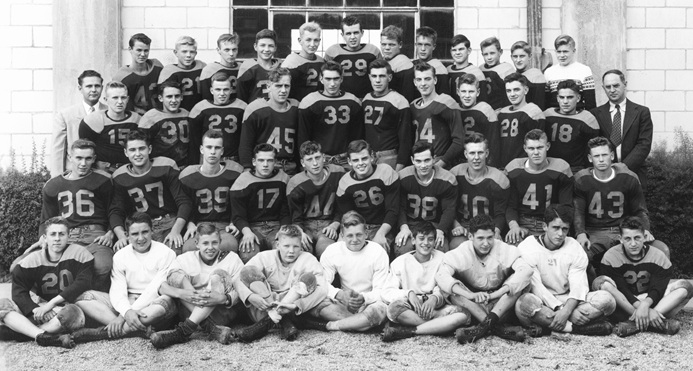 The opponent was Middleville. For several years, the teams had scheduled a two-game nonleague “home-and-home” rivalry series. That continued in 1950, but this time, the Trojans were now members of the Bar-Ken-All. (Kelloggsville had left the league after the 1949-50 school year. The conference expanded, adding Middleville and Delton. To allow time for scheduling transition, the 1950 opening contest of the series did not count in the league standings.)
The Scotties emerged with another slim 7-0 win. According to the Kalamazoo Gazette, the result of the game “only added fuel to the rivalry which will reach a heated state at Middleville in a regular conference game Oct. 20.”
Caledonia plowed through the remaining games. Martin fell 27-0, Coopersville was trounced, 40-0, and Byron Center was easily defeated, 27-0. The highly-anticipated rematch with Middleville was close for the first half, as Caledonia clutched to a thin 7-0 lead at the break. It turned into a rout as “the Scotties flashed a passing attack that netted three more TDs and a 26-0 win.”
Wayland was disposed of 28-0, giving the Scotties possession of the “Cowbell Trophy” donated two years previous by a Wayland merchant. Then the team completely overwhelmed Hopkins in the season’s finale, 73-0. That margin was the state’s largest of the season, according to Dick Kishpaugh of Kalamazoo, who assembled season-ending totals for consumption by the state’s media. The Scotties were also statewide news as one of 26 teams that had posted unbeaten and untied marks on the year. Caledonia was one of just two to finish the year unbeaten, untied, and unscored upon. Garden City had done the same but had played just six games.
Although not rediscovered until recently, the team’s streak of 14 consecutive shutouts with no tie games included (six to end 1949, and eight in 1950) ranks second in the MHSAA football record book, just a single game behind North Muskegon teams that straddled three seasons, 1940-42.
Dedicated to a super volunteer
Besides location, one other item remains unchanged at the “athletic plant” in Caledonia.
“Even though his children go to school in Middleville,” noted the Press back in 1950, Ralph E. Myers thought of Caledonia as “his town.” A member of the Commercial Club Committee that helped plan the project, he followed through as the site’s dedicated lead volunteer, working with others “to get the job done,” according to a community newsletter.
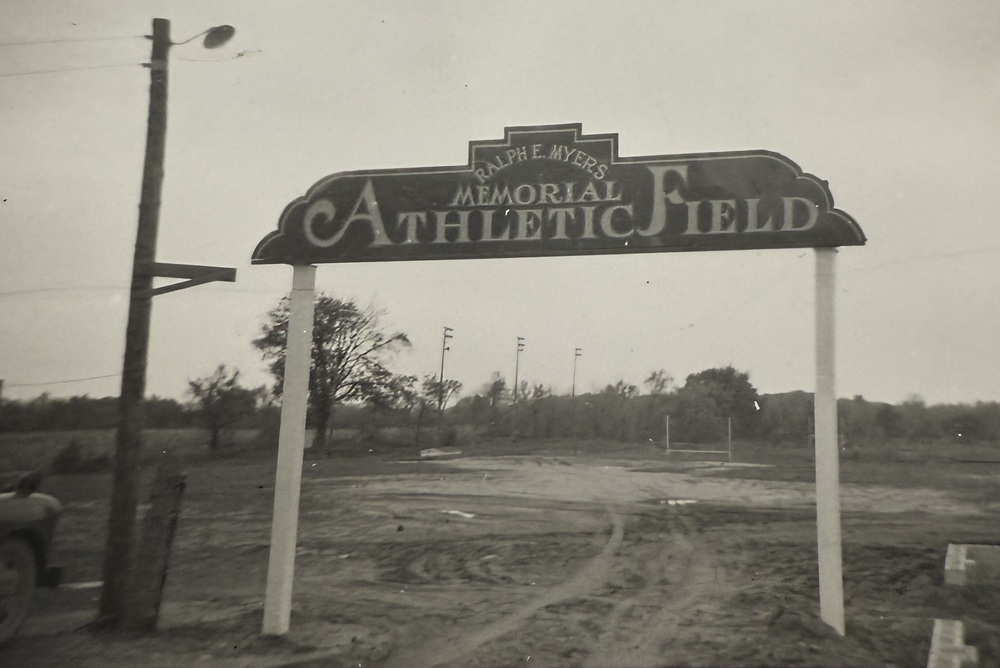
In July 1954, at age 46, Myers died tragically in an automobile accident. His wife, Henrietta, had died a year before. They left behind three daughters. That fall, Caledonia christened the site as Ralph E. Myers Athletic Field.
Over the years, proposals were made to rename the place in honor of others, but Caledonia Community School stood behind the original decision. In September 1998, after a $1.9 million renovation for football and track & field, the site was rededicated with new signage as Ralph E. Myers Memorial Stadium.
With the latest efforts by all involved to capture the stories and communicate the legacy, future students will have the opportunity to easily understand and appreciate the stadium’s humble beginnings and the importance of all, then and now, who pitched in to create a place to call home.
PHOTOS (Top) A sign welcomes visitors to Caledonia’s home field in 1954. (Middle) The 1950 Scotties: Back row William Price, Walter Jousma, Jack Moreland, Peterson, Harvey Jacobsen, Allan Vander Laan, Forrest Clark, Gerritt Nordhof, Arthur Benedict, Larry Schroder, Larry Lind, Donald Williams (Manager). Third row Assistant Coach Wisner, Donald Moffatt, Ramon Schantz, Bob Cisler, Bob Higley, Merle Maier, Wallace Lotterman, Bob Schultz, James Fitzsimmons, Fred Darling, Vern Kayser, Coach Thornton Auwater. Second Row Elmer Velthouse, Bernard Kilmartin, Donald Braendle, Louis Bellgraph, Marvin Eldridge, Allyn Niles, James Porritt, Benjamin Miller, Bill Jousma, Gordon Poll. First Row Gary Cherpes, Joseph Sleeman, Harold Olthouse, Rod Campbell, Garrit Keizer, Carl Yonkers, Clyde Barrett, James Ayers, Hosmer Parks. Not pictured Arnold Benedict, Bob Workman.