

Rose's Legend Grows in Shores Repeat
January 22, 2021
By Jason Schmitt
Special for Second Half
DETROIT – Game planning for an all-state football player like Brady Rose certainly isn’t easy.
In fact, it’s downright awful just to think about.
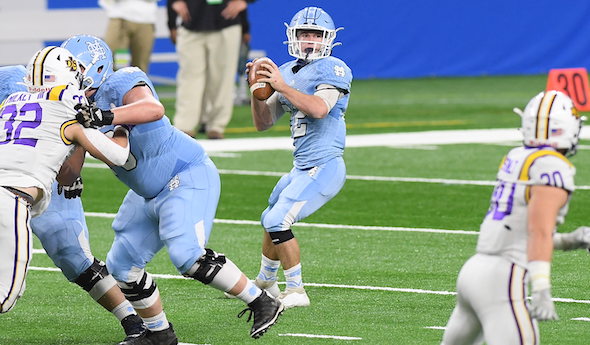
The Muskegon Mona Shores senior quarterback once again proved that point to be true Friday afternoon, leading his team to a 25-19 victory over Warren De La Salle Collegiate and a second consecutive MHSAA Division 2 championship at Ford Field in Detroit.
Rose rushed 22 times for 154 yards and a pair of touchdowns. But it was a 65-yard scamper early in the fourth quarter that proved to be the play of the game – a game filled with key plays by Rose.
“We ran that play quite a bit (today), but I wasn’t being patient, I wasn’t bouncing it to the outside,” Rose said. “(This time) I just let it develop, let it do what it was supposed to do and I bounced it outside and took it down into the red zone.”
The play lifted the spirits of the entire team and provided a much-needed boost of confidence.
“We get the ball down there, everybody is excited again. Everybody is hyped,” he added. “After that run, we knew we were going to punch it in. Anytime we get into the red zone, we have to punch it in, and we did.”
Three plays later, senior wideout Keondre Pierce scored on a 10-yard pitch to the right side, giving Mona Shores a 19-7 lead with 9:25 left in the game.
De La Salle, which trailed 13-0 at halftime, didn’t give up. The Pilots answered right back on a 52-yard touchdown run by senior JC Ford with 7:58 to play. The drive took just 1:21 off the clock and also included a 23-yard pass from Ford to senior running back Brett Stanley to help set up the touchdown run.
After a quick three-and-out, the Sailors then relied on their defense to get the ball back. Coach Matt Koziak’s team came up with a clutch stop on fourth down, on De La Salle’s half of the field. Seven plays later, Rose scored his second touchdown of the game, this time from four yards out to give his team a 25-13 lead with just 1:47 left to play.
De La Salle did move the ball down the field quickly, scoring on a four-yard keeper by sophomore quarterback Brady Drogosh with 16 seconds to play. But it wasn’t enough, as Rose recovered the ensuing on-side kickoff attempt and then took a knee to end the game.
 “They did have us on our heels a little bit,” Koziak said. “We jumped up on them, 13-0 going into halftime, then they come right back in the second half. We said it at halftime, ‘They’re not going to go away. They’re not going to let you win this, you’ve got to go take it.’”
The Mona Shores defense, led by senior Kyree Hamel, who finished with 11 tackles and an interception, held De La Salle to just 50 total yards and three first downs in the first half. The Pilots totaled 62 yards on the ground during their drive to start the second half. Ford provided a change of pace for De La Salle, running the ball six straight times to begin the drive. After runs of 15 and 10 yards by freshman Rhett Roeser moved the ball inside the 5-yard line, Ford capped the drive with a four-yard touchdown run to get his team on the scoreboard.
“We didn’t run a lot of plays in the first half, and we couldn’t get into a rhythm,” De La Salle head coach Dan Rohn said. “So we went into halftime and said, ‘Let’s change things up a little bit and up the tempo.’ It’s kind of been JC’s role all year long. We haven’t needed it in the playoffs because he’s playing two ways.”
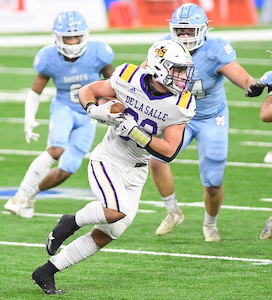
Ford finished with 111 yards on 15 carries and those two touchdowns. Stanley had 42 yards and Roeser added 38 for the Pilots. Defensively, junior Will Beesley had a game-high 20 tackles, while senior Jayden Conklin added 14. Junior Dionte Dandridge had an interception.
Mona Shores (12-0) finished with 311 rushing yards. Along with Rose, junior Elijah Johnson also had a good game on the ground. He carried the ball 14 times for 81 yards and had a nine-yard touchdown in the first half. Rose also returned three kicks for 48 yards, averaged 39 yards on his three punts, blocked an extra point and had eight tackles on the other side of the ball.
“What a legacy for him to leave,” Koziak said of Rose, who will play collegiately at Ferris State University. “Obviously he’s a tremendous player, a tremendous competitor. It’s so easy to root for a dude like that. He’s not 6-foot-3, he doesn’t run a 4.3 40 (yard dash). He’s not a 5 star. But all great stories usually have an underdog in it, so it’s easy for people to get behind him, for his teammates to get behind him. They love him. I think when we look back on one of the great players, and performances, in the state over the past two seasons, he’s got to be in the conversation.”
Rohn, who completed his first year at De La Salle after having won four Division 5 championships at Grand Rapids West Catholic, said he was proud of his team for battling through a lot of adversity over the past year.
“We went against one of the best football teams in the state of Michigan and one of the best football players in the state of Michigan,” Rohn said. “Hats off to Matt (Koziak) and his team. I have nothing but respect for their program and the way they played today. Who would have thought that we’d be sitting here on January 22 with an opportunity to win a state championship?”
Koziak praised Rohn for all his accomplishments at De La Salle, while also crediting players from all over the state for forging ahead despite all the obstacles they faced over the past year.
“I’m proud of our young men. I’m proud of the state of Michigan, the football players,” Koziak said. “These young men have been through the ropes. They’ve been on an emotional rollercoaster. Football prepares you for life. But this season, holy cow, it’s going to teach you disappointment, it’s going to teach you hope, it’s going to teach you surprise, it’s going to teach you humility. I have no doubt these young men are going to be good fathers, and better sons, better husbands because things didn’t go their way this year. Whether it was wins or losses, or COVID, or a pause in the season, whatever it was. They’re all going to be better human beings for it, and I think that’s a special message we tried to preach all year.”
PHOTOS: (Top) Muskegon Mona Shores quarterback Brady Rose drops back to pass during Friday’s Division 2 championship game at Ford Field. (Middle) De La Salle’s Will Beesley makes his move as Shores defenders close in. (Click for more from Hockey Weekly Action Photos.)
A Game for Every Fan: 11-Player Semis
November 20, 2015
By Geoff Kimmerly
Second Half editor
Rain, sleet, or a few inches inches of snow, we expect to know our 16 11-player football finalists by the end of Saturday afternoon.
But even fans of the college football games being played this weekend should make sure to have MHSAA.tv and FoxSportsDetroit.com playing on their computers, tablets or smartphones, as the 16 MHSAA Semifinals should produce at least a few classics.
See below for a brief breakdown of all 16 games, and watch all 16 live by clicking the links above beginning at 1 p.m.
Division 1
Romeo (11-1) vs. Grand Ledge (12-0) at Brighton
The Comets are attempting to make their first MHSAA Final since winning Division 1 in 2000 and after scoring 33 unanswered fourth-quarter points last week to beat Rockford. Grand Ledge has nearly 3,800 yards of offense this fall, with senior running backs Ba Blamo (993 yards/18 touchdowns rushing) and Caden Evert (543/15) carrying much of the load but sophomore quarterback Nolan Bird (1,445 yards/15 TDs passing) also progressing quickly. This is Romeo’s first Semifinal since 1992, and has come after advancing through arguably the toughest road in the tournament – reigning champion Clarkston, undefeated Lapeer and Detroit Catholic Central. Senior quarterback Paul Hurley completed more than two-thirds of his passes for 953 yards and 18 touchdowns through the regular season, and senior Bradley Tanner had scored 19 touchdowns through nine games.
Detroit Cass Tech (10-2) vs. Canton (10-2) at Troy Athens
Playing its sixth straight Semifinal, Cass Tech is looking to get back to the Division 1 championship game for the first time since 2012. The Technicians’ only losses were to Division 2 contender Detroit Martin Luther King – although this game certainly will be a test with play-making quarterback Rodney Hall reportedly out Saturday with an ankle injury. Canton might be a surprise to make it this far, but left no doubt in downing undefeated and 2014 runner-up Saline 27-7 in the Regional Final. The Chiefs have reached this round for the first time since 2006 after rebounding from a pair of consecutive losses midseason and on a rushing attack that has gained 4,388 yards – including 2,184 with 27 touchdowns by junior Markus Sanders.
Division 2
Walled Lake Western (12-0) vs. Lowell (11-1) at Alma College
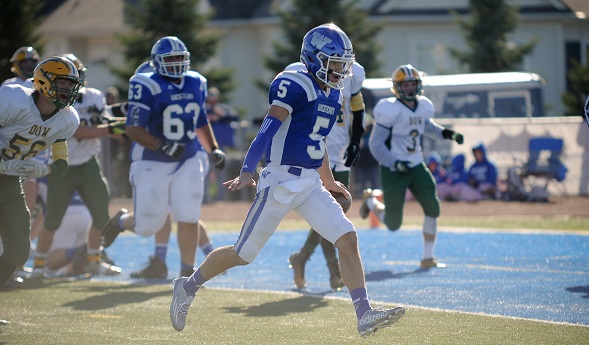
These two met in one of the most exciting games of opening weekend, with Walled Lake Western coming away with a 42-40 victory. The Warriors are trying to reach their first MHSAA Final since 1999 and will follow senior quarterback Kyle Thomas, who has thrown for 2,154 yards and 24 touchdowns and run for 743 yards and 10 scores. Lowell hasn’t lost again, instead rolling up more than 5,500 yards in total offense with no other opponent coming within 14 points. The Red Arrows too are led by a dynamic dual-threat quarterback; senior Ryan Stevens has thrown for 2,230 yards and 28 TDs and run for 872 yards and 13 scores.
Detroit Martin Luther King (12-0) vs. Livonia Franklin (9-3) at Dearborn
King is playing in its third MHSAA Semifinal in five seasons, but looking to return to Finals weekend for the first time since the perfect run in 2007. The Crusaders are loaded with offensive standouts who have drawn statewide attention all season – notably, senior running back Martell Pettaway (1,180 yards/14 touchdowns rushing through nine games), senior quarterback Armani Posey (1,319 yards/12 TDs passing) and senior receiver Donnie Corley (858 yards/9 TDs receiving). Franklin was on no one’s Semifinal radar after a 2-3 start, but has won seven straight to make its first Semifinal since winning the first Class A title in 1975. Senior quarterback Denzel Adams (1,623 yards/23 touchdowns) and junior running back Jacob Clark (1,446 yards/15 TDs) have combined for more than 3,000 of the team’s 4,545 yards on the ground, and Adams also has thrown for 1,029 yards and 13 scores.
Division 3
Orchard Lake St. Mary’s (10-1) vs. East Grand Rapids (9-3) at Howell
Reigning champion St. Mary’s is playing to make its fifth MHSAA Final in six seasons and has outscored its first three playoff opponents by a combined 160-35. Running back Justin Myrick (1,049 yards/13 touchdowns rushing) and quarterback Brendan Tabone (1,020 yards/5 TDs passing) have led the way for the second straight season. East Grand Rapids hasn’t played a game of this magnitude since ending a string of six straight Semifinals in 2011. The Pioneers haven’t given up a point in two weeks and only 14 over the last month, and on offense ride the legs of senior running Bryce Henkey (1,152 yards/20 touchdowns rushing through the District Final).
Chelsea (11-1) vs. Coldwater (12-0) at Jackson
This will be the first Semifinal for an otherwise annually successful Chelsea program. The Bulldogs can make their first championship game and break the team record for wins with one more. They had a string of five straight shutouts during the first half of this season and have given up only 34 points total during the playoffs. Junior quarterback Jack Bush has thrown for 1,603 yards and 14 touchdowns and run for eight more scores. Coldwater also is playing in its first Semifinal – it made the playoffs for the first time only two seasons ago – and hasn’t let an opponent within 14 points since Week 2. The Cardinals have thrown for only 250 yards – because they’ve run for 4,261, with junior Sam DeMeester (1,154 yards/14 TDs), senior Spencer Burns (1,120 yards/17 TDs) and senior Luke Beckhusen (1,107 yards/12 TDs) all crossing the 1,000-yard rushing milestone.
Division 4
Zeeland West (12-0) vs. Ada Forest Hills Eastern (11-1) at East Kentwood
West has won 36 of its last 37 games, with that lone defeat in a Semifinal a year ago. The secret to the Dux’ success hasn’t been a surprise for a while; they run, run and run some more. Senior fullback Darius Perisee leads the rush this time with 1,796 yards and 28 touchdowns. Forest Hills Eastern is a field goal from perfection during its most successful season, which will now include its first Semifinal. The Hawks take a more balanced approach on offense, led by senior quarterback Jack Clark (1,932 yards/22 touchdowns passing, 752 yards/19 touchdowns rushing).
Detroit Country Day (11-1) vs. Flint Powers Catholic (10-2) at West Bloomfield
Country Day is playing in its third Semifinal in four seasons and seeking to return to Ford Field for the first time since 2012. The Yellowjackets’ only loss was Week 2 to Detroit U-D Jesuit; they’ve given up only 45 points total over the last 10 weeks and 75 for the season. Junior quarterback Steve Mann is the player to watch on offense, with 1,369 yards and 18 touchdowns through the air and six more scores on the ground. Powers is trying to get back to Ford Field for the first time since 2011 led by a similarly stellar defense giving up only nine points per game. Like that championship team, the Chargers are keyed on offense by a dangerous dual threat quarterback in senior Noah Sargent, who has run for 941 yards and 14 touchdowns and thrown for 1,466 yards and 17 scores.
Division 5
Lansing Catholic (11-1) vs. Grand Rapids West Catholic (10-2) at Greenville
This is a rematch of last season’s MHSAA Division 5 Final, a 24-20 West Catholic win. The Falcons have played in four of the last five championship games and five straight Semifinals. This year’s leaders have different names, but similar impact. Senior Denny Alt has run for 1,291 yards and 17 touchdowns, and sophomore Gaetano Vallone stepped in at quarterback and has thrown for 2,347 yards and 26 scores while running for 738 yards and 10 TDs. A return to Ford Field would be Lansing Catholic’s third in five seasons, and senior quarterback Tony Poljan would love another chance to lead his team to the school’s first title since 1985; he’s thrown for 1,746 yards and 14 touchdowns and run for 1,156 yards and 24 scores.
River Rouge (11-1) vs. Ida (12-0) at Novi
River Rouge will play in its first Semifinal, the next step of a successful run of six straight playoff appearances. The Panthers are four points from perfection this fall and have tied a team record for wins led by a pair of 1,000-yard rushers including senior quarterback Antoine Burgess (1,040 yards/11 touchdowns rushing, 1,270 yards/24 TDs passing). Ida also will play in its first Semifinal after winning 10 of 12 games by at least 10 points. The Bluestreaks have thrown only 36 passes because they’ve run for 4,247 yards. Senior Eric Bugg has 1,865 yards and 32 touchdowns on the ground, and junior Nick Levicki has totaled 1,328 yards and 17 scores.
Division 6
Ithaca (12-0) vs. Traverse City St. Francis (12-0) at Clare
The senior-laden Yellowjackets have been playing all season for an opportunity to return to Ford Field after watching their 69-game winning streak come to an end in last season’s Final. Ithaca’s roster is loaded with players who have started at least two seasons including senior quarterback Jake Smith, who has run for 1,485 yards and 29 touchdowns and thrown for 1,162 yards and 22 scores. St. Francis is back in the Semifinals for the first time since 2009. The Gladiators have given up only 75 points against a strong schedule, a solid complement to an offense that’s run for 3753 yards and 61 touchdowns led by senior Joe Trucco (1,207 yards).
Clinton (12-0) vs. Grand Rapids NorthPointe Christian (12-0) at Battle Creek Harper Creek
Clinton’s lineup of defeated playoff opponents rivals Romeo’s in Division 1 – reigning champion Monroe St. Mary Catholic Central, plus Madison Heights Madison and Jackson Lumen Christi. The Redskins are looking to reach Ford Field for the second time in three seasons. Senior running back/linebacker Mathew Sexton has run for 2,065 yards and 33 touchdowns and also scored twice each on kickoff and punt returns. NorthPointe Christian has made its second straight Semifinal after surviving two straight games decided by three points or fewer. The Mustangs will attempt to lock down Clinton like it did their opponents Weeks 2-9, when they didn’t give up more than eight points in a game.
Division 7
New Lothrop (12-0) vs. Ishpeming (11-0) at Northern Michigan University
Ishpeming is trying to add to its streak of three straight MHSAA Finals appearances, while New Lothrop is trying to get back for the first time since 2006 after one of the most impressive regular-season runs in MHSAA history. The Hornets haven’t lost a regular-season game since 2009, but also haven’t made it past the Semifinals during that run. Junior quarterback Erik Birchmeier leads the way with 1,330 yards and 24 touchdowns rushing and 905 yards and 12 touchdowns passing. Ishpeming fell in last season’s Final after two straight wins in 2012 and 2013, but senior quarterback Ozzy Corp is back for another try and has thrown for 1,047 yards and seven scores while also leading the team in rushing with 644 yards and seven scores. The defense has been arguably the most impressive of the tean's recent run, giving up only 85 points in 11 games.
Detroit Loyola (10-2) vs. Pewamo-Westphalia (12-0) at Fenton
Loyola is playing to make its fourth straight MHSAA Final as well, and also with a different cast than in past seasons. The Bulldogs have thrown only 75 passes this season because they’ve run for 3,870 yards; three players could end up over 1,000 yards rushing, although leading rusher and freshman fullback D’Anthony Robinson was injured Week 9 and isn’t expected to return Saturday. Senior quarterback Blaine Woodland has run for 891 yards and 19 touchdowns and averages 13.9 yards per carry. Pewamo-Westphalia’s famed rushing attack will face its toughest test as it runs to return to Ford Field for the first time since 2011. Junior Jared Smith broke the MHSAA single-season rushing touchdown record last week and now has 50 this fall, and with 2,908 yards needs only 55 more to break the single-season rushing record.
Division 8
Muskegon Catholic Central (9-2) vs. St. Ignace (11-1) at Traverse City’s Thirlby Field
MCC’s two-season title streak looked to be over after graduating a number of significant contributors in the spring. Instead, the Crusaders will play in their fourth straight Semifinal. Junior LaTommy Scott is the program’s next great running back; he’s gained 1,089 yards and 16 touchdowns. St. Ignace is playing in its third Semifinal in five seasons hoping to make its first championship game since 1985. The Saints have gained nearly 4,700 yards keyed by senior quarterback Gage Kreski. He’s run for 851 yards and 13 touchdowns and thrown for 1,235 and 16.
Ottawa Lake Whiteford (10-2) vs. Waterford Our Lady (12-0) at Hazel Park
Whiteford has reached 10 wins and a Semifinal for the first time by avenging a regular-season loss, then beating a second rival from its conference, and then downing undefeated Climax-Scotts. A cast of running backs has contributed to more than 3,000 yards rushing, while sophomore quarterback Thomas Eitniear has thrown for 1,030 yards and 14 scores. Our Lady has returned to the form of its successful past with its first Semifinal berth since 2006. Seniors Clay and Devin Senerius are a dynamite receiving combo; Clay has thrown for 2,688 yards and 32 scores, and Devin has caught 61 passes for 1,213 yards and 11 scores.
PHOTO: Walled Lake Western quarterback Kyle Thomas (5) runs toward the end zone during last week's Regional Final win over Midland Dow. (Click for more from HighSchoolSportsScene.com.)