

Ruddy, Whiteford Run Into Record Book with Championship Rushing Attack
By
Geoff Kimmerly
MHSAA.com senior editor
August 25, 2023
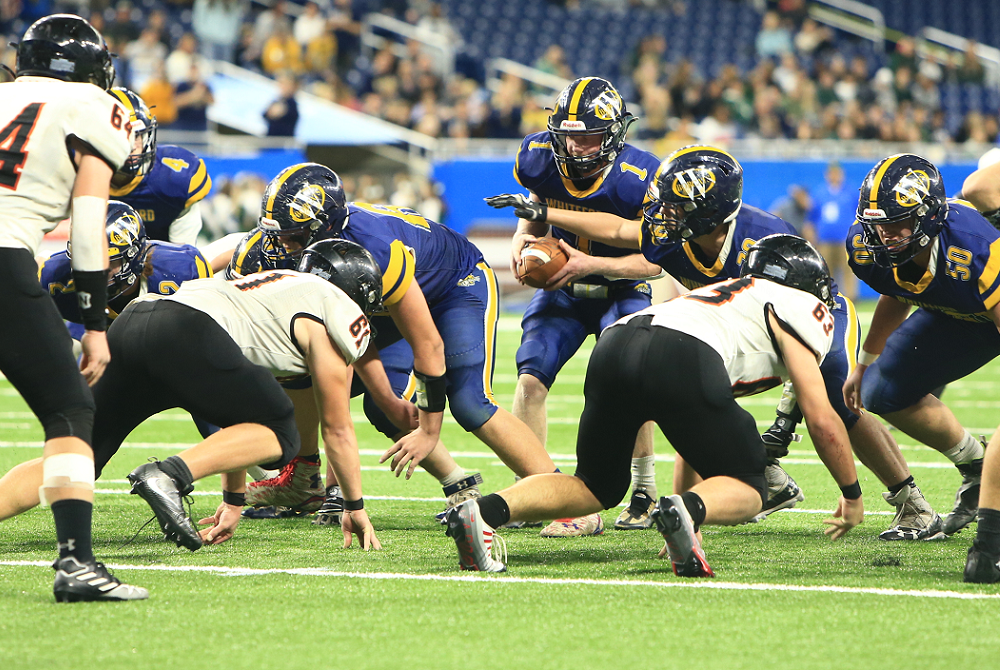
Ottawa Lake Whiteford won its second Finals championship in 2022 with a power rushing attack that’s become expected of the program, but also with a record-setting quarterback leading the way.
Senior Shea Ruddy was added to the MHSAA record book for 4,461 yards and 52 touchdowns passing over four seasons, plus five touchdown passes in a half last season against Kalamazoo Loy Norrix.
Whiteford, meanwhile, made the record book for 664 points scored, 5,756 total yards and 87 total touchdowns, 4,515 rushing yards, 635 rushing attempts and 68 rushing scores. Whiteford’s 2021 team also was added for 64 rushing touchdowns, 5,468 total yards and 628 points after a Semifinal run. Ruddy is playing now at Hillsdale College.
See below for more recent updates to the 11-player record book.
11-Player Football
Portland lost a 39-34 heartbreaker to DeWitt on Sept. 1, 2022, but a pair of Raiders top a record book list for one of the game’s biggest highlights. Marc Nobis found receiver Chris Battley for a 99-yard touchdown reception, tying the record for longest scoring pass. Nobis was a senior, and Battley was a sophomore.
Rochester Hills Stoney Creek senior Quentin Ubaydi earned a record book listing for a flawless kicking performance last Aug. 25. He made all 10 of his extra-point tries in his team’s 70-0 win over Detroit Mumford.
The list of football programs with at least 500 wins over their histories is short – but growing. St. Joseph was added with a 563-376-34 record dating to its first season in 1913. The Bears also were added for 706 total yards in their Sept. 30, 2022, game against Portage Northern, a 62-49 win.
Walled Lake Western’s Jaxon Lippert became the 21st player to return a kickoff 99 yards for a touchdown when he did so against Davison on Sept. 30, 2022. Lippert is a senior this fall.
Kalamazoo Loy Norrix was part of one of the highest-scoring games of the 2021 season, and a pair of then-senior standouts earned individual record listings that day. Quarterback Tyler Roberts threw for 424 yards, and received Kevin Lucas had 223 yards and four touchdowns through the air, although Whiteford prevailed 76-40. Roberts is playing football and baseball at Hope College, and Lucas is playing football at Albion College.
Four decades later, Flint Kearsley standout John Yancer had been added for his 19 sacks over nine games in 1983, including five in the season finale against Flushing. Yancer was a senior that fall.
Holton quarterback Austin Fowler capped his high school career in a big way as a senior in 2021, making the record book seven times for passing – most notably for 2,265 yards, 153 completions and 33 touchdown tosses over nine games. He threw for 463 yards on 32 completions as Holton and Muskegon Heights Academy combined for 108 points that Oct. 30. He’s played baseball at Muskegon Community College this spring.
Tarik Ahmetbasic finished his high school career in 2022 having made 48 straight extra points dating back to the final game of his junior season, and he made the record book three times total for Clinton Township Chippewa Valley. He was added also for 87 extra points over 90 attempts over two seasons as the team’s point-after kicker, and for making all nine of his field goal attempts last fall. Ahmetbasic also just missed the career field goals list with 16 in 18 attempts, having kicked all 16 over the last two seasons after attempting one as a sophomore. He is continuing at Michigan State.
Boyne City seniors Jack Neer and Alex Calcaterra didn’t take long to make memories last season. Both made the record book in an opening 51-35 win over Benzie Central, Neer with seven touchdown passes (tied for eighth-most in a game) and Calcaterra catching five of those (tied for third). Neer signed with Hillsdale College, and Calcaterra is playing basketball at Michigan Tech.
Hudson’s 43-0 win over Blissfield on Oct. 8, 2021, was memorable for a few reasons. But arguably the most notable was achieved by the Tigers’ defense, which held Blissfield without a first down.
Mio’s Grant Price earned two listings over a month near the end of the 2010 season, rushing for six touchdowns in a win over Au Gres-Sims on Oct. 8 and then six again in a win over Cedarville that Nov. 5. He was a junior that season.
Mason set a school record for wins in finishing 12-1 last fall, and expectations are high again with junior Cason Carswell and senior Derek Badgley among returnees this season. Carswell was added to the record book three times including for 2,403 yards and 34 passing touchdowns, and Badgley was added for catching four of Carswell’s six touchdown passes in a Regional Final win over Trenton. Sophomore Collin Winters also was added after connecting on 58 of 62 extra-point tries, and the Bulldogs as a whole made the season scoring list with 554 points.
Senior Charlie Martyn joined a group of accomplished Ithaca kickers with his achievements over the last three seasons, earning record book entries for nine straight extra points in a game last fall, 53 extra points in 57 tries total over 11 games and 82 extra points in 95 tries over a three-year career with nearly all of those points coming as a junior and senior. He will next play baseball at Alma College. Ithaca also was added for holding St. Louis to only three first downs during their 2022 meeting.
A pair of Coopersville standouts capped their careers last fall with multiple entries in the record book. Four-year varsity quarterback Colton Bosch was added for 329 completions, 572 attempts and 4,574 passing yards, while three-year receiver Ryan Serba was added for 129 receptions and 1,975 yards for his career. Additionally, then-junior teammate Nick Gordon was added for 14 receptions in a game against Hudsonville Unity Christian on Sept. 9 and four touchdowns against Allendale on Oct. 7. Bosch will continue his career at Concordia-Chicago.
Semaj Morgan capped a magnificent three-season career at West Bloomfield last fall with four record book entries, most notably for his receiving. Morgan was added for 116 receptions and 1,876 yards over 34 career games, including 1,015 yards as a junior in 2021. He also earned a listing for a 100-yard interception return against Lake Orion last Sept. 24. He is continuing his career at Michigan.
Brandon Soltis completed his DeWitt football career in the fall with the career-record 207 extra points over his 47 games and four seasons – 46 more than the previous record holder. He drilled 55 of 57 tries last season to move to the top of the list, including a stretch of 38 consecutive. Teammate Bryce Kurncz was added for his 23 touchdown catches over 21 games and two seasons, and DeWitt as a team was added for 623 yards in a game against Grand Ledge, 5,056 yards over its 12 games for the season and for allowing only four first downs in its season-opening win over Haslett. Soltis is continuing at Hope College, and Kurncz is playing at Michigan Tech.
M'Khi Guy became the latest Muskegon star quarterback to reach the record book, doing so with six rushing touchdowns in his team’s 49-21 Division 3 Semifinal win over DeWitt on Nov. 19. Guy is a senior this fall.
A trio of Bloomfield Hills Brother Rice standouts were added for accomplishments last season or over careers that finished in 2022. Senior Henry Garrity made the single-game receiving yardage list with 225 against Warren De La Salle Collegiate on Sept. 16, and senior Griffin Pardi made the longest-punt list that game with a 72-yarder. Senior Owen Pardi finished his three-season varsity career last fall with 85 extra points in 95 tries. Jake Coulter also was added to the longest-punt list for his 71-yarder in 2020. Garrity is continuing at Notre Dame, and Owen Pardi is continuing at Sacred Heart University in Connecticut. Coulter plays baseball at Central Michigan.
Belleville kicker Brayden Lane made the single-season extra point list for the second time last season, connecting on 74 of 79 attempts. He’s also now on the career list with 126 in 144 attempts heading into his junior season this fall.
Edwardsburg continued to achieve among the state’s highest-producing offenses the last two seasons, ranking among the all-time leaders with 5,227 total yards, 4,634 rushing, and 89 total touchdowns with 78 rushing in 2021, plus 4,343 rushing yards in 2022. Trevor Houseworth was a senior on the 2021 team and made individual lists with 73 extra points in 79 attempts and a long punt of 81 yards. He’s kicking at Saginaw Valley State.
Reed City continued its run of success in 2022, finishing 11-2 and making the MHSAA record book with 544 points total including 73 touchdowns – with 54 rushing, 13 passing, four on special teams and two scored while playing defense.
PHOTO Ottawa Lake Whiteford quarterback Shea Ruddy takes a snap to start an eventual touchdown run during last season’s Division 8 Final at Ford Field.
Simple Act Sets Example Nationwide
October 29, 2015
By Geoff Kimmerly
Second Half editor
In many respects, Dansville junior Clay Soule is your average high schooler from a small town.
He plays sports all year long, and when he’s not playing basketball in the winter he’s definitely snowmobiling. He’s not sure at first when asked his favorite class, but zoo-bot – zoology and botany – was pretty interesting last year. Like a lot of high school football players, sometimes he loses focus and his coaches have to reel him in. Soule also isn’t a fan of chopping and unloading firewood, which is pretty typical too.
 And when his minute of fame came on a national television show generations know by name, Soule missed it. At 7 a.m. Sundays, he’s sleeping.
“I’m just a normal kid, I guess, in Dansville,” Soule said Wednesday during a break from gym class.
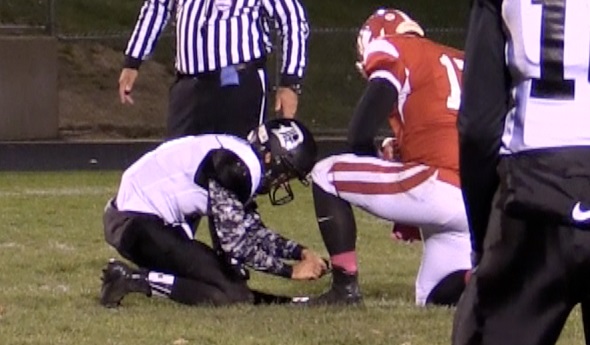
Two weeks ago, at a break in play during his football game against Laingsburg, Soule shuffled across the line of scrimmage and tied the shoe of the Wolfpack’s Kevin Koenig, who was wearing gloves and having a hard time getting them off.
Soule didn’t think it was a big deal.
He can’t believe how big a deal it’s become.
The video clip of Soule literally lending two hands has been viewed in its original YouTube post nearly 200,000 times, and after being picked up by multiple national media entities reportedly has been watched nearly 1 million times.
 Arguably the topper? Soule’s assist made ABC’s Good Morning America on Sunday.
“I didn’t really think it was that big of a deal, to be honest. I just tied a kid’s shoe,” Soule said. “I really didn’t think it would be going anywhere. I just thought, ‘Oh well, I tied a kid’s shoe.’
“I guess it’s a big deal because you don’t really see that, but I didn’t think it was that big of a deal as it is right now. It should be something people should do, but a lot of people don’t do it. I guess it’s sportsmanship, helping another team out. (For me), it’s just a normal thing.”
More than a moment
The Aggies were leading 14-0 during the second quarter of an eventual 35-20 win over Laingsburg on Oct. 16. The Wolfpack were driving when Koenig, the quarterback, dropped down to tie his shoe.
Koenig is towering for a small-school football player, at 6-foot-3 and 220 pounds and a two-time MHSAA Division 4 wrestling champion. But there’s Soule, playing the defensive side of his atypical quarterback/defensive end combo, trotting over and kneeling down as he asked if Koenig wanted some help.
A couple Aggies know Koenig from wrestling, but Soule doesn’t wrestle. The only conversation Soule recalls was when he asked Koenig if he wanted a double-knot, and was told no. Aside from what might have been a puzzled look on Koenig’s part, that was that. Soule shuffled back across the line and could hear a blend of laughter and clapping from the crowd as play resumed.
But his simple act is being hailed as much more.
 The shoe-tie started gaining attention the last week, when it was submitted to the Lansing State Journal for its Video of the Week contest. The State Journal is owned by the same company as USA Today, which picked up the video. Then Huffington Post did the same. Then 530 Project Productions, which films Dansville’s games and posted the original clip to YouTube (watch it below) was contacted by CBS Sports and Good Morning America. Their coverage led to an appearance on Fox Sports' national network.
As of Tuesday, the video had been viewed in all 50 states and 173 counties, according to the 530 producers.
USA Today called Soule “a nice guy doing a nice thing for someone else.” From Huffington Post: “In an age where athlete celebrations and taunting are amusingly received as viral sensations, the reaction after the play almost supersedes the play itself.”
“I’m not trying to make it a big deal. I’m just trying to let it go, let it run its own course,” Soule said.
But …
“It’s pretty cool.”
Above average
To be honest, Soule really isn’t an average high schooler.
He carries a 3.8 grade-point average, and a discussion from that zoo-bot class about the science of raising crops has him thinking already about studying in college something related to agriculture with the idea of becoming a farmer like his grandfather was when Soule was a kid.
He plays three sports, and stands out. He joined the varsity for both baseball and basketball as a sophomore, and he quarterbacks an 8-1 football team that takes on Carson City-Crystal in a Division 7 District opener this weekend and can tie the program record for single-season wins with one more victory.
Football coach Mike Galbreath called Soule “an all-around good kid. The young man is a great leader, and he has led our team tremendously this season.”
“He’s clearly someone with excellent character,” athletic director Julie Odom added.
And humility. His school has 300 students, and Soule knows them all by name. Yes, he slept through the Good Morning America segment, so he caught up by watching later that day on Facebook. He read some of the comments that went with the story, but not all of them – he’s just not into social media that much, and not into being the center of attention.
His brother Garrett is an infielder at Saginaw Valley State University, and they talked about the shoe-tie a little. Mostly, Clay and his parents joke about it, in disbelief of how the video has taken off. “(My parents) expect it out of me. That’s the way me and my brother were raised – to help out people,” Soule said.
Classmates joked with him Monday, asking for help tying their shoes. A student from Concord – this week’s playoff opponent – direct messaged him on Twitter, asking if Soule was that guy from the video. Soule said, “Yeah, that was me,” and that was it.
The whole thing is a little ironic; in preschool, Soule was afraid to tie the shoelaces on a practice shoe in front of his class. Clearly, he’s mastered the skill – and then, unintentionally, used it to set an example of sportsmanship for athletes all over the country.
“People should expect it out of other people. Maybe it happens but it never gets videotaped and made a big deal,” Soule said. “(But maybe) tying a shoe goes above and beyond what most people would do.
“People would just wait for him to tie his shoe. But I just went over there and tied it for him. I didn’t really think twice about it. I just went over there and did it.”
 Geoff Kimmerly joined the MHSAA as its Media & Content Coordinator in Sept. 2011 after 12 years as Prep Sports Editor of the Lansing State Journal. He has served as Editor of Second Half since its creation in Jan. 2012. Contact him at [email protected] with story ideas for the Barry, Eaton, Ingham, Livingston, Ionia, Clinton, Shiawassee, Gratiot, Isabella, Clare and Montcalm counties.
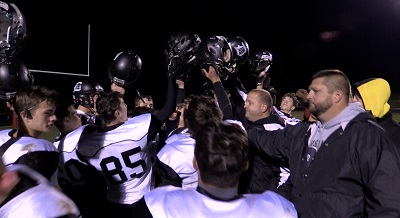
PHOTOS: (Top) Dansville's Clay Soule kneels to tie Kevin Koenig's shoelace during a break against Laingsburg two weeks ago. (Middle) Dansville celebrates another victory from one of the best seasons in program history. (Photos courtesy of Dansville High School.)