


#TBT: Searching for The Hinker Bell
September 28, 2017
By Geoff Kimmerly
Second Half editor
Menominee will host Escanaba on Friday in the 121st meeting between two of the Upper Peninsula’s largest high schools and proudest football programs – but with the trophy celebrating the game still missing after it first disappeared more than half a century ago.
The two teams from 1948-1962 played for the The Hinker Bell, a locomotive bell that hasn’t been seen since 1963.
A decade ago, Escanaba Daily Press sports editor (and now Second Half correspondent) Denny Grall wrote about a newfound search for The Hinker Bell. But the mystery continues, and Grall’s story below tells of many of the twists and turns that to that point that had come in trying to locate it.
ESCANABA — Another search is underway to find the Hinker Bell.
The former locomotive bell went to the winner of the Escanaba-Menominee football game for about 15 years but has been missing for more than 40 years. It came from a locomotive owned by the Bay de Noquet Company and used on the LS&I Railroad that operated in Delta and Menominee counties.
The locomotive was built in 1906 by Baldwin Locomotive Works in Philadelphia and the bell was believed to have been cast in the railroad foundry, according to a 1953 newspaper clipping.
In 1948, one of the locomotive owners presented the bell to his friend, John Hinker of Menominee, an ardent sports fan who donated materials for the press box at Menominee’s Walton Blesch Field.
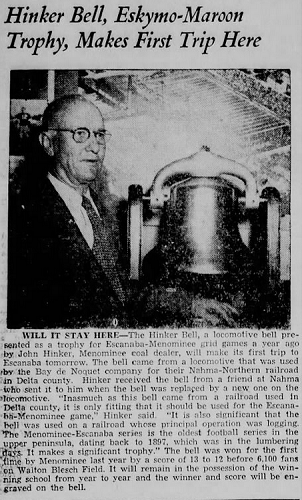 Hinker gave the bell to then Menominee coach Mickey McCormick and indicated proper use for the bell would be as an award for the gridiron rivalry.
Now Hinker’s great great nephew is trying to find the bell, which has not been seen since Escanaba’s current high school opened in 1963.
Tim Waters of Land O’ Lakes, Wis., who has launched the search, became interested by researching his family tree. “It is a big trophy (between 80 and 150 pounds by various estimates) and it is odd that it is missing,” Waters said in a recent telephone chat.
“One theory is that it is in somebody’s hunting camp or a home and they are using it as their own trophy,” said Waters.
“We have a pretty good investigation going on and all help is appreciated. If somebody does have it, we’re not looking to prosecute them. We’re just looking to get the darn thing back. Nobody will be in trouble.”
Waters refuted the old idea the bell was melted down. He has contacted numerous bell collectors, and they said a junk yard would have known it was worth a lot more than melted metal.
“The bell was not destroyed. We’ve come to that conclusion,” he said. “It was not put in a scrap yard.”
Waters contacted Coplan Iron and Metal of Escanaba and learned that bells were not melted or crushed and said the firm never accepted a bell with engravings matching the Hinker Bell.
Waters learned those businesses would sell them for the weight value to people who wanted them for yard ornaments/dinner bells, or to collectors.
“It is a treasure and it needs to be found,” said Waters.
Waters said the last known photo of the bell was with then EHS football coach Al Sigman and Esky players John Fisher and Phil Davidson in 1960. Escanaba beat Menominee from 1959-63 but could not find the bell in 1964 when the Maroons won. No one he has talked to remembers seeing the bell present at the first three games during the tenure of coach Jerry Cvengros.
The current Escanaba High School opened in 1963 and Bay de Noc Community College then occupied the old facility, which has since been demolished.
“Records indicate there was no report (of a missing bell) filed by Escanaba school district to the police department,” Waters said.
“The Hinker Bell is part of U.P. Michigan’s history, as is football and the railroads,” Waters said. “The people of Escanaba and Menominee deserve to have this trophy returned to their high schools.”
Waters, who has never seen an Escanaba or Menominee football game but is planning to rectify that omission this season, is hoping students at the two schools will join in the treasure hunt and talk about it with their parents and grandparents.
He has already contacted EHS athletic director Rob Ryan, who plans to thoroughly search the school basement.
He would like to find a photo of the bell to help collectors in their search. “Each bell was for a special locomotive,” said Waters.
“If they have a good picture we can pass it around and say we are looking for this bell. If they can pinpoint what this bell was on, they can help get the word out.”
He has also extended the search to the website at upfootball.com, which has generated interest but no bell. “If the bell is in the area still today, I don’t think it will take long to surface,” he said.
“If we don’t find this bell, we are going to try to make up a replacement as close as possible if the two schools are interested in that,” he said.
Waters is hoping that real estate agents, postal workers, delivery personnel, construction workers, etc., may have seen the bell during their travels and can help retrieve it.
Generations of Jonesville Reunite to Say Good-Bye to Old Field, Await New
By
Doug Donnelly
Special for MHSAA.com
November 11, 2025
As the old saying, and more recent song lyric goes, "Every new beginning comes from some other beginning's end."
 A new era of Jonesville football will begin next fall when the Comets begin playing on a new field at a new sports complex on the high school campus.
It’s a new beginning. But, before that new era was launched, the Comets had one final game on its old football field this fall – a nearly 75-year-old relic that sits just outside Jonesville Middle School.
“I have a lot of memories of playing on that field,” said Comets football coach Frank Keller. “It’s been home to a lot of big games, good times.”
The final home game on the field was Week 8 against Vandercook Lake. Keller temporarily relinquished his play-calling duties when his former head coach – and recent Michigan High School Football Coaches Association Hall of Fame inductee – Greg Morrison came to the sidelines for a series after some convincing from his former player.
Morrison showed he hadn’t lost his touch. The third and final play he called – “tight end delay” – went for a touchdown.
“It was one of his favorite plays,” Keller said. “He called it, and we scored. It couldn’t have gone any better. He got to call the last touchdown on the old field.”
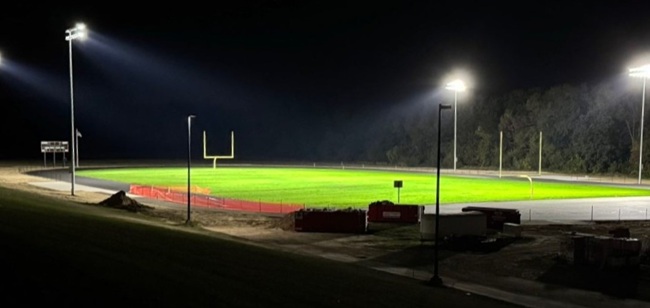
About a year ago, an anonymous donor gave a $4 million donation to the school to build a new track and football field, along with an accompanying concession stand and restrooms. The field is in a picturesque spot, tucked among trees.
 The donation came from a Jonesville family that has had four generations of athletes play sports for the Comets. Athletic director Jeff Turner said the family stepped forward when it became apparent it would be difficult for the district to pass a bond issue or a new tax to fund such a large-scale project.
"We are certainly grateful for them coming forward," Turner said. "We couldn't have done this without them. They wanted to help the school district and the community, and we are fortunate that we are able to build such a nice facility."
The track will be ready for events this spring. Sod was laid on the football field, inside the track, this fall and has been mowed a few times. New bleachers were constructed on both sides of the field recently, and the concession building is almost ready for business.
It’s a dramatic change for the district.
The current football field has been in use for decades and was home to league championship teams, playoff games and more great Jonesville memories.
“Growing up as a kid I always watched football games, there and I played there,” Keller said. “I have mixed feelings about it. It’s great to get a new facility, but sad to see the old one go.”
Morrison recalled a game during his coaching tenure when the opposing team hid in the nearby woods, and then just before kickoff came running onto the field.
Jonesville won by several touchdowns. Clearly the ploy didn’t exactly work out as intended.
“It was a great field to play,” Morrison said. “It was unique.”
These days, Jonesville is a Division 7 football school with an enrollment of 299 students. The Comets play in the Cascades Conference West and went 6-4 this season, falling in the first round of the playoffs.
 The football team has been in the playoffs four of the past seven seasons, went 9-0 during the regular season in 2019 and has 16 playoff appearances.
Keller graduated from Jonesville in 1999. He was on the Comets varsity for three seasons, from 1996-1998. Turner is a Jonesville graduate as well. He said several past players, cheerleaders and band members returned to the field for its final game, stirring a lot of memories.
“I don’t know how much of the game I got to watch that night,” Turner said. “It was great to catch up with a lot of people I may not have seen in quite a while. It was great.”
Turner said the athletic complex will be great for the district.
“It looks wonderful,” he said. “Our kids are excited about running track this spring and playing on the new field. Everyone is excited about it.”
As with any new facility, the complex is creating a buzz around athletics at Jonesville.
“We’re hoping we get more kids out just because they want to play on the new field, maybe even get new kids to the school,” Keller said. “We’re hoping it helps bring in more kids. Track looks awesome. The whole facility looks great.
“For us to get a new facility like that is unbelievable.”
 Doug Donnelly has served as a news and sports reporter at the Adrian Daily Telegram and the Monroe News for 30 years, including 10 years as city editor in Monroe. He's written a book on high school basketball in Monroe County and compiles record books for various schools in southeast Michigan. He is now publisher and editor of The Blissfield Advance, a weekly newspaper. E-mail him at [email protected] with story ideas for Jackson, Washtenaw, Hillsdale, Lenawee and Monroe counties.
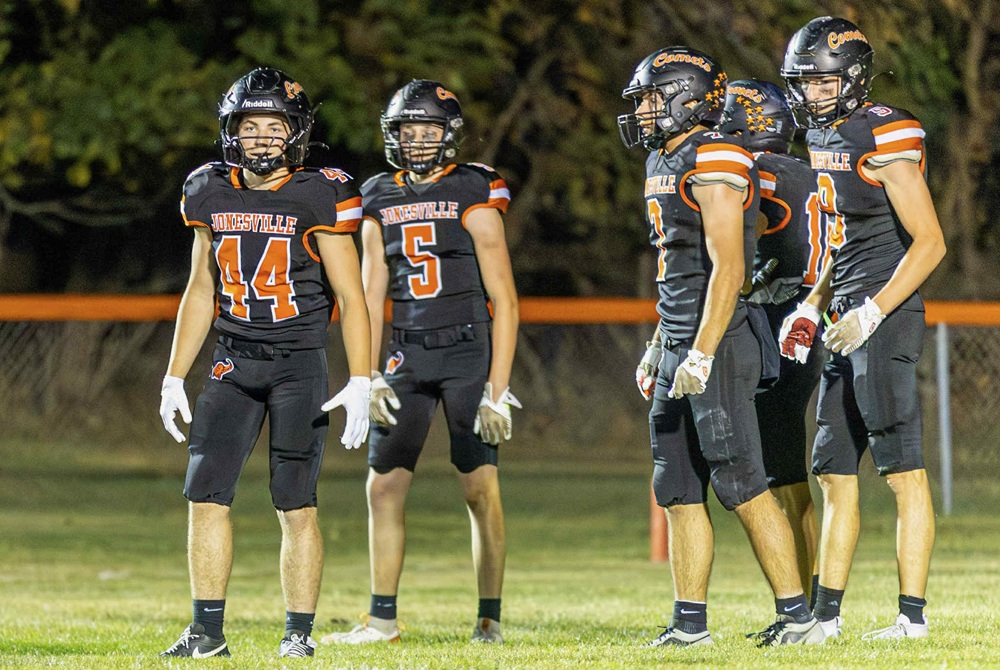
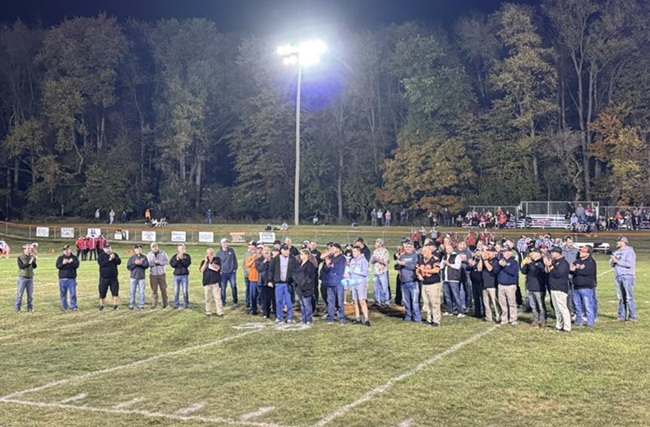
PHOTOS (Top) Jonesville players take the field for their final home game last month at their now former field. (Middle) Past Jonesville players line up with retired coach Greg Morrison during the final game. (Below) Jonesville’s new stadium sits under the lights and will be ready for the spring track & field season. (Photos courtesy of the Jonesville football program.)