

Thank Roosevelt for Football Weekends
December 20, 2013
By Rob Kaminski
MHSAA benchmarks editor
The next time you find yourself immersed in a tense crosstown football rivalry on a Friday night followed by a Saturday pilgrimage to the nearest college campus and a Sunday afternoon with a remote and your favorite snacks and beverages, take a moment to consider what the weekend would be like if it weren’t for Teddy Roosevelt.
The man who became our 26th President shortly after the turn of the 20th Century following the assassination of William McKinley in 1901 was a football fan like you. Maybe more so.
Today’s game of football has reached a critical crossroads. Player size and speed have increased across the board. Savage use of equipment as weapons rather than protective gear has been glorified on television networks and social media. Leaders of the game at all levels have recognized the need for change, employing new rules and widespread educational efforts to aid in preserving the sport.
History, as they say, is repeating itself.
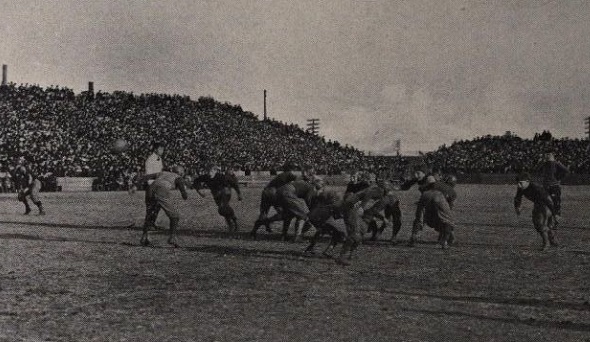
In an ironic twist, it was Roosevelt who saved the then-brutally violent game of football from itself more than 100 years ago. Yes, the same “Rough and Ready Teddy” who led the charge up San Juan Hill during the Spanish-American War and often sparred in the boxing ring while in office from 1901-09 opined that football was becoming so gruesome that he delivered an ultimatum: clean up the game or it would be outlawed.
The Chicago Tribune reported that in 1904 alone, there were 18 football deaths and 159 serious injuries, mostly among prep school players. Football deaths suffered by younger players were reported on a nearly weekly basis, as outraged citizens called on colleges and high schools to banish football outright.
In stepped Roosevelt, who called head coaches and representatives from Harvard, Yale and Princeton – college powers at the time – to the White House in 1905 urging them to eliminate excessive violence and set an example of fair play for the rest of the country. When the casualties actually rose by one during the ensuing season, Roosevelt reacted with greater resolve and convened leading football authorities for the purpose of authoring drastic rules changes. What emerged was an intercollegiate conference which was the predecessor of the NCAA.
Among the most effective changes for the 1906 season were the legalization of the forward pass, the elimination of mass formations, and the creation of a neutral zone. Football fatalities fell to 11 in each of the next two seasons, and severe injuries fell drastically.
Thanks to the introduction of protective equipment and ever-evolving rules changes, football during the 100-plus years to follow has become an exponentially safer game. Yet, the game’s leaders always will need to adjust and react to scrutiny that comes with the territory.
So, as the game once again undergoes rules modifications in the name of safety, give a tip of the cap to President Roosevelt while you enjoy college bowl season and the NFL playoffs and begin to think ahead to the first high school practice of 2014.
Beaudrie's Rebuild of Jefferson Football Gaining Speed with Fast Start
By
Doug Donnelly
Special for MHSAA.com
September 17, 2025
NEWPORT – Rob Beaudrie has found the secret formula to building a winning football team.
 Take over as head coach. Tap his freshman son (even if unexpectedly) as the starting quarterback. Mix in a couple of years hitting the weights, consistent offseason workouts and getting the underclassmen to buy into the playbook and new culture.
Oh, and winning a few games doesn’t hurt.
“Kids like to win,” Beaudrie said. “They don’t want to go out and practice two or three hours every day and go 0-9. It’s not fun for them. These kids have bought in. They’ve been playing football together since they were in youth football. It’s a good experience for them.”
Beaudrie is the head football coach at Monroe Jefferson, a Division 6 school in Newport, along the shores of Lake Erie and home to the Fermi 2 nuclear power plant. The Bears were once a football power, winning the Class BB championship in 1994, but have struggled for the last 20 years or so.
Being from the area, Beaudrie knew all about Jefferson. He took the job three seasons ago. He stayed on the course and things slowly improved.
This year, everything has come together as the Bears are off to a 3-0 start for the first time since 2006. One more win and they’ll have more victories than in any one season since 2016, which was the last time Jefferson qualified for the playoffs.
“We’ve come a long way,” Beaudrie said. “We are doing a lot of things right. We are attacking the ball, pursuing. We’re blocking together. There are still some growing pains. We are young in some areas, but they’ve come along well. They are very talented.”
Beaudrie inserted his son Luke, then a freshman, into the starting quarterback role his first year as head coach. It was an unexpected move because Luke had been a slot receiver or running back while playing youth football and middle school football. When the player Beaudrie expected to be the starting quarterback quit the team, Beaudrie turned to his son.
“He’s not a true quarterback, but he’s learning,” Beaudrie said. “He’s learned to understand the offense and read the defense. He’s a leader.”
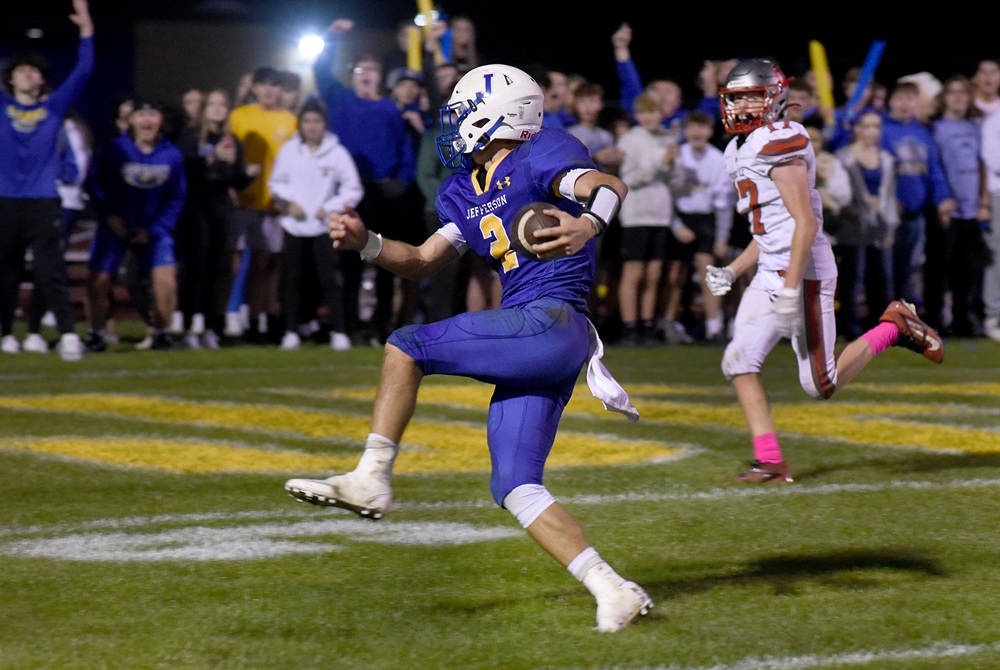
In Jefferson’s 52-21 win over Milan on Friday, Luke Beaudrie returned a kickoff 99 yards, had touchdown runs of 65, 2, 50 and 32 and returned an interception 89 yards for a touchdown – all in the first half.
“He’s a special athlete,” Rob Beaudrie said. “He was never tackled in middle school. He’s very fast and has great vision.”
Luke said he has adapted to being the quarterback.
“When I first started, I didn’t think it was for me,” he said. “But you have to have the mindset ‘whatever is best for the team.’ I started learning it, and now I’m more comfortable.”
 Through three games, Beaudrie has 487 yards rushing, 243 yards passing and has scored 13 touchdowns.
The Beaudries have used this same game plan before, but at a different school. Rob was head coach at Erie Mason, a program that had struggled. His son Noah became the starting quarterback as a freshman, went through some growing pains, but developed into an all-stater his senior season as Mason won a league championship.
Noah went on to play college football at Mount Union University (Ohio) where he quarterbacked the Purple Raiders into the Division III national championship game last season. This year, Noah transferred to Adrian College where he is the starting quarterback and has the Bulldogs off to a 2-0 start.
Being close to home has allowed him to serve as an assistant coach for Jefferson.
“The schedules line up really well,” Rob Beaudrie said. “He can be at (our) practice just about every Sunday and Monday and can be at most of our games. He helps Luke out a lot. He’s brought a lot of college experiences with him to the playbook.”
Another former player Rob had at Mason, Tanner Herrera, is helping coach the Jefferson offense.
“I didn’t want to do it all,” Beaudrie said. “I offered him the OC (offensive coordinator) job, and he’s run with it.”
Beaudrie said he thought this could be the year Jefferson turned things around. The Bears still have a difficult Huron League schedule ahead of them. This week they take on Riverview, then have Flat Rock and Division 7 No. 1-ranked Monroe St. Mary Catholic Central.
“The good thing is, these kids don’t know what they don’t know,” Beaudrie said.
Roster numbers have gone up steadily since Beaudrie took over. His first season the Bears had 23 players in the entire program. Last year they had 36 players in all and no seniors. This year Jefferson counts 61 players – plenty enough for a JV and varsity program.
“That has been a huge help,” he said.
The first two years weren’t easy as he brought his system to Jefferson. He faced skepticism over the team’s passing attack. For years, even decades, Jefferson was known for its rushing offense; at one time, the Bears would go weeks without attempting a pass.
“This is all new at Jefferson. People would tell me, ‘They don’t know anything about passing the ball; you can’t do that,’” Beaudrie said. “I told them, ‘You’d be surprised what kids can learn.’ We came in and did our thing. We were out-manned a bit the first few years.
“Sometimes the first couple of years you get a new coach in, and some people don’t like what you are doing. It wasn’t going to ruffle my feathers. I have thick skin. There’s a plan, and you have to trust the process, trust the system.
“Now, the kids are excited, the parents are excited, everyone is excited. Everybody likes a winner. I’m excited to see what happens next year as well, but we are going to enjoy these wins right now.”
Jefferson athletic director Alyssa Eppler said the football success has brought excitement to the games and district.
"There’s an incredible buzz in our school and community right now, and it’s been building for a few years now,” she said. “It’s exciting to finally see it all come together. You can feel the energy in the hallways and see it in the stands on Friday nights. Or first home game truly had the atmosphere of a homecoming. We’re proud of the momentum and what it means for our kids."
Luke Beaudrie is happy with how things have worked out, even if he had to learn a new position.
“The first few years were a little rough,” he said. “Now, everyone is starting to buy in, and everyone expects some good things the next couple of years. It feels amazing. This hasn’t happened here in a while.”
 Doug Donnelly has served as a news and sports reporter at the Adrian Daily Telegram and the Monroe News for 30 years, including 10 years as city editor in Monroe. He's written a book on high school basketball in Monroe County and compiles record books for various schools in southeast Michigan. He is now publisher and editor of The Blissfield Advance, a weekly newspaper. E-mail him at [email protected] with story ideas for Jackson, Washtenaw, Hillsdale, Lenawee and Monroe counties.
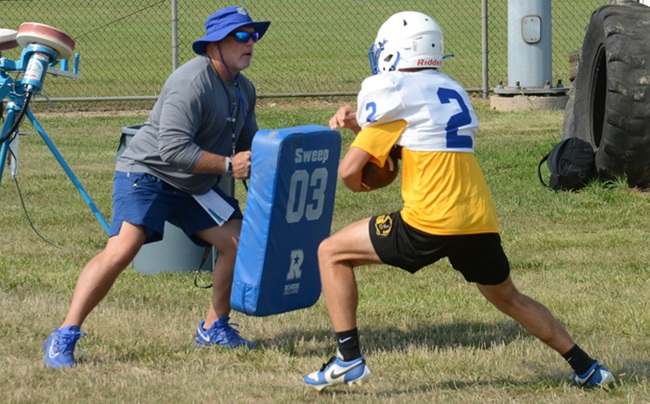
PHOTOS (Top) Monroe Jefferson’s Luke Beaudrie sprints toward the end zone during a game last season. (Middle) Jefferson coach Rob Beaudrie holds a pad while Luke works on making a cut during practice. (Photos courtesy of the Monroe News.)