

Thank Roosevelt for Football Weekends
December 20, 2013
By Rob Kaminski
MHSAA benchmarks editor
The next time you find yourself immersed in a tense crosstown football rivalry on a Friday night followed by a Saturday pilgrimage to the nearest college campus and a Sunday afternoon with a remote and your favorite snacks and beverages, take a moment to consider what the weekend would be like if it weren’t for Teddy Roosevelt.
The man who became our 26th President shortly after the turn of the 20th Century following the assassination of William McKinley in 1901 was a football fan like you. Maybe more so.
Today’s game of football has reached a critical crossroads. Player size and speed have increased across the board. Savage use of equipment as weapons rather than protective gear has been glorified on television networks and social media. Leaders of the game at all levels have recognized the need for change, employing new rules and widespread educational efforts to aid in preserving the sport.
History, as they say, is repeating itself.
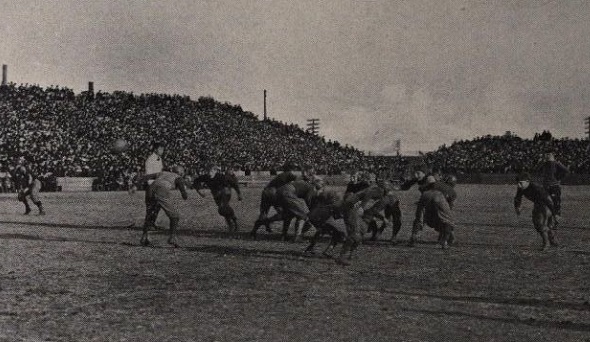
In an ironic twist, it was Roosevelt who saved the then-brutally violent game of football from itself more than 100 years ago. Yes, the same “Rough and Ready Teddy” who led the charge up San Juan Hill during the Spanish-American War and often sparred in the boxing ring while in office from 1901-09 opined that football was becoming so gruesome that he delivered an ultimatum: clean up the game or it would be outlawed.
The Chicago Tribune reported that in 1904 alone, there were 18 football deaths and 159 serious injuries, mostly among prep school players. Football deaths suffered by younger players were reported on a nearly weekly basis, as outraged citizens called on colleges and high schools to banish football outright.
In stepped Roosevelt, who called head coaches and representatives from Harvard, Yale and Princeton – college powers at the time – to the White House in 1905 urging them to eliminate excessive violence and set an example of fair play for the rest of the country. When the casualties actually rose by one during the ensuing season, Roosevelt reacted with greater resolve and convened leading football authorities for the purpose of authoring drastic rules changes. What emerged was an intercollegiate conference which was the predecessor of the NCAA.
Among the most effective changes for the 1906 season were the legalization of the forward pass, the elimination of mass formations, and the creation of a neutral zone. Football fatalities fell to 11 in each of the next two seasons, and severe injuries fell drastically.
Thanks to the introduction of protective equipment and ever-evolving rules changes, football during the 100-plus years to follow has become an exponentially safer game. Yet, the game’s leaders always will need to adjust and react to scrutiny that comes with the territory.
So, as the game once again undergoes rules modifications in the name of safety, give a tip of the cap to President Roosevelt while you enjoy college bowl season and the NFL playoffs and begin to think ahead to the first high school practice of 2014.
1st & Goal: 2024 8-Player Finals Preview
By
Geoff Kimmerly
MHSAA.com senior editor
November 22, 2024
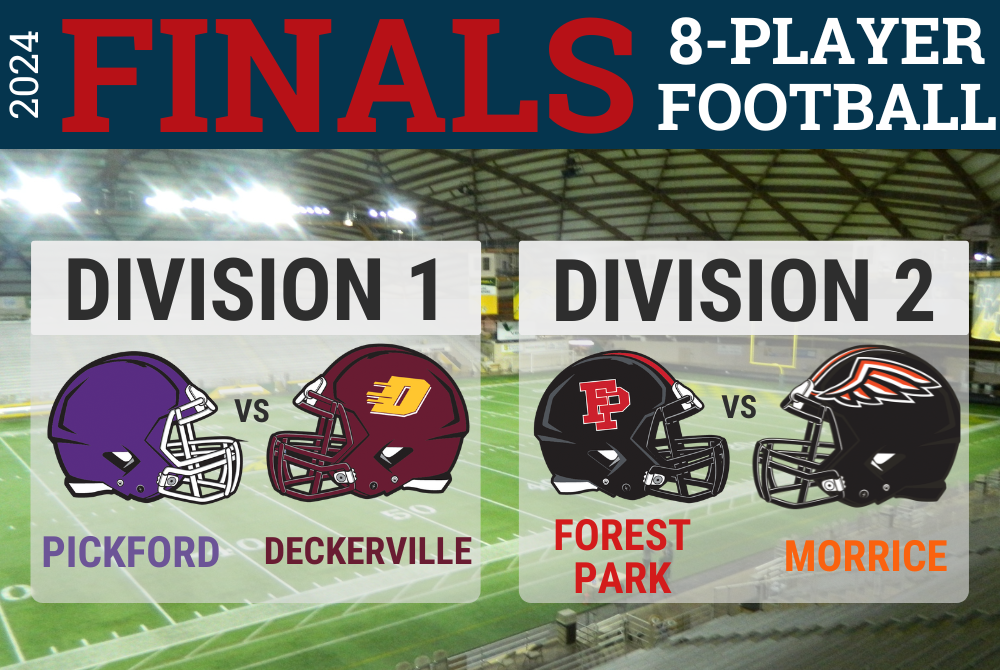
For the first time since 8-player football was split into two divisions in 2017, all four teams playing in this season’s MHSAA Finals are past champions.
 Deckerville and Pickford in Division 1, and Crystal Falls Forest Park and Morrice in Division 2 have all won one title during the first 13 years of 8-player playoffs. All four also are making their first championship appearances this decade.
Deckerville and Pickford kick off at 11 a.m. Saturday at Northern Michigan University’s Superior Dome, and Morrice and Crystal Falls Forest Park follow at 2 p.m. Tickets cost $10 and are good for both games, and may be purchased online through NMU or at the door – click for details. Both games will be broadcast live on MHSAA.tv, and audio of both games will be streamed live on MHSAANetwork.com.
Below is a look at all four finalists:
Division 1
DECKERVILLE
Record/Rank: 12-0, No. 1
Coach: Bill Brown, 32nd season (258-90)
League finish: First in Big Thumb Conference Blue
Championship history: 8-player (single division) champion 2012, two runner-up finishes.
Best wins: 49-32 over No. 7 Mendon in Semifinal, 40-6 (Regional Final) and 44-0 over No. 8 Kingston, 54-34 (Regional Semifinal) and 50-16 over Bay City All Saints, 50-42 over No. 2 Alcona, 30-28 over Brown City.
Players to watch: QB Hunter Garza, 6-1 sr. (1,488 yards/26 TDs rushing, 804 yards/10 TDs passing); SE/DB Ian Flanagan, 6-1 jr. (230 yards/3 TDs receiving); RB/DB Parker Merriman, 5-10 sr. (1,003 yards/14 TDs rushing); RG/DE Preston Holman, 6-1 sr. (Weights not provided. Statistics through Regional Final.)
Outlook: Deckerville will be playing in its first championship game since finishing runner-up in both 2016 (single division) and 2017 (Division 1), and after reaching the Semifinals a year ago. Alcona and Brown City were the only opponents to get within 17 points of the Eagles this fall. There are only seven seniors, but they combine to fill seven of the 16 starting spots. Holman made the all-state second team last season, and Garza earned an honorable mention.
PICKFORD
Record/Rank: 12-0, No. 3
Coach: Josh Rader, 21st season (153-66)
League finish: First in Great Lakes Eight Conference East
Championship history: Division 2 champion 2019, Division 1 runner-up 2018.
Best wins: 34-18 over No. 5 Indian River Inland Lakes in Semifinal, 44-6 (Regional Final) and 65-14 over No. 10 Ishpeming, 51-6 over Norway, 40-12 over Division 2 No. 6 Powers North Central.
Players to watch: QB/DE Tommy Storey, 5-9/175 sr. (1,656 yards/28 TDs passing, 954 yards/16 TDs rushing); RB/DB Gunner Bennin, 6-0/165 jr. (828 yards/19 TDs rushing, 386 yards/8 TDs receiving); TE/DE Ian Browne, 6-3/175 sr. (206 yards/4 TDs receiving); OG/DT Haydn Rader, 6-1/210 sr.
Outlook: Storey is a returning all-state first-teamer who also quarterbacked the team to the Semifinals a year ago. He leads an attack that’s rushed for 3,768 yards – at more than 10 a carry – but can keep defenses honest with a passing game as well. In addition to being the team’s second-leading rusher and leading receiver, Bennin has a team-high four interceptions and has also scored on defense and as a kick and punt returner. Haydn Rader made the all-state second team last season and with Storey, Browne and Bennin is among eight players who start on both sides of the ball.
Division 2
CRYSTAL FALLS FOREST PARK
Record/Rank: 11-1, No. 3
Coach: Brian Fabbri, fifth season (35-11)
League finish: Second in Great Lakes Eight Conference West
Championship history: Division 2 champion 2017, three MHSAA titles and 10 runner-up finishes in 11-player.
Best wins: 34-12 over No. 6 Powers North Central in Regional Final, 49-24 over No. 8 Onekama in Semifinal, 42-20 over Norway.
Players to watch: RB/DB Dax Huuki, 6-0/175 soph. (1,424 yards/20 TDs rushing); QB/DB Vic Giuliani, 6-2/165 soph. (908 yards/14 TDs passing, 7 TDs rushing); RB/DE Grayson Sundell, 6-1/190 sr. (899 yards/17 TDs rushing); TE/DT Kevin Giuliani, 6-5/270 sr. (277 yards/6 TDs receiving).
Outlook: Forest Park will play in its first championship game since its title-winning season in 2017 and picked up major steam with its Regional Final win over rival North Central, which avenged a 45-34 league title-deciding loss from Week 9. No other opponent got within 20 points of the Trojans this season. Kevin Giuliani made the all-state second team last season and is one of seven two-way starters. Junior Trent Kannich is another and has 406 yards and seven touchdowns rushing and a team-high 364 yards receiving from his fullback spot. Senior linebacker Brody Starr has five interceptions and has returned two for touchdowns, and senior linebacker Nik Stephens has four picks and one for a score.
MORRICE
Record/Rank: 11-1, No. 5
Coach: Kendall Crockett, 11th season (96-25)
League finish: Tied for first in Mid-State Activities Conference Red
Championship history: Division 1 champion 2018.
Best wins: 36-0 over No. 4 Britton Deerfield in Semifinal, 46-14 (Regional Final) and 38-6 over Mount Pleasant Sacred Heart, 28-22 over No. 7 Portland St. Patrick in Regional Semifinal, 22-0 over Fulton.
Players to watch: RB/DB Joel Fisher, 5-7/139 sr. (1,687 yards, 19 TDs rushing); WR/DB Wyatt Valentine, 5-10/163 soph. (50 tackles, 10 interceptions); RB/OLB Wyatt Cartier, 5-7/150 sr. (1,468 yards, 27 TDs rushing), OG/DE Travis Smith, 6-0/215 sr.
Outlook: Morrice also avenged its lone regular-season loss to advance this postseason, having lost to St. Patrick 29-12 in Week 4 before opening the playoffs with a win over the Shamrocks. Fisher and Cartier are a dynamite 1-2 punch in the backfield, and Fisher made the all-state second team last season. Smith earned an honorable mention in 2023 and is joined on both lines by 6-foot-3, 215-pound junior Oliver Long, who has 12 sacks. Junior linebacker Austin Gutting is the leading tackler for a defense giving up only 10 points per game.
MHSAA.com's weekly “1st & Goal” previews and reviews are powered by MI Student Aid, a division within the Department of Lifelong Education, Advancement, and Potential (MiLEAP). MI Student Aid encourages students to pursue postsecondary education by providing access to student financial resources and information. MI Student Aid administers the state’s scholarship and grant programs that help make college Accessible, Affordable and Attainable for you. Click to connect with MI Student Aid and find more information on Facebook and Twitter @mistudentaid.