

Thank Roosevelt for Football Weekends
December 20, 2013
By Rob Kaminski
MHSAA benchmarks editor
The next time you find yourself immersed in a tense crosstown football rivalry on a Friday night followed by a Saturday pilgrimage to the nearest college campus and a Sunday afternoon with a remote and your favorite snacks and beverages, take a moment to consider what the weekend would be like if it weren’t for Teddy Roosevelt.
The man who became our 26th President shortly after the turn of the 20th Century following the assassination of William McKinley in 1901 was a football fan like you. Maybe more so.
Today’s game of football has reached a critical crossroads. Player size and speed have increased across the board. Savage use of equipment as weapons rather than protective gear has been glorified on television networks and social media. Leaders of the game at all levels have recognized the need for change, employing new rules and widespread educational efforts to aid in preserving the sport.
History, as they say, is repeating itself.
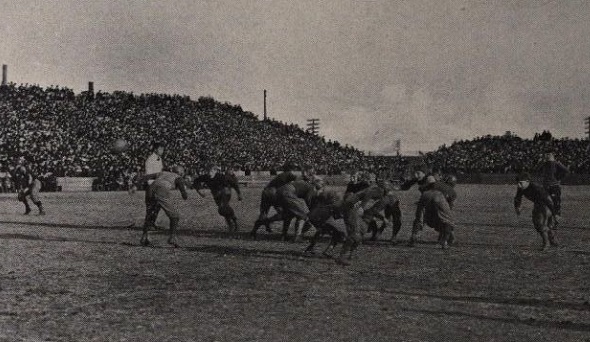
In an ironic twist, it was Roosevelt who saved the then-brutally violent game of football from itself more than 100 years ago. Yes, the same “Rough and Ready Teddy” who led the charge up San Juan Hill during the Spanish-American War and often sparred in the boxing ring while in office from 1901-09 opined that football was becoming so gruesome that he delivered an ultimatum: clean up the game or it would be outlawed.
The Chicago Tribune reported that in 1904 alone, there were 18 football deaths and 159 serious injuries, mostly among prep school players. Football deaths suffered by younger players were reported on a nearly weekly basis, as outraged citizens called on colleges and high schools to banish football outright.
In stepped Roosevelt, who called head coaches and representatives from Harvard, Yale and Princeton – college powers at the time – to the White House in 1905 urging them to eliminate excessive violence and set an example of fair play for the rest of the country. When the casualties actually rose by one during the ensuing season, Roosevelt reacted with greater resolve and convened leading football authorities for the purpose of authoring drastic rules changes. What emerged was an intercollegiate conference which was the predecessor of the NCAA.
Among the most effective changes for the 1906 season were the legalization of the forward pass, the elimination of mass formations, and the creation of a neutral zone. Football fatalities fell to 11 in each of the next two seasons, and severe injuries fell drastically.
Thanks to the introduction of protective equipment and ever-evolving rules changes, football during the 100-plus years to follow has become an exponentially safer game. Yet, the game’s leaders always will need to adjust and react to scrutiny that comes with the territory.
So, as the game once again undergoes rules modifications in the name of safety, give a tip of the cap to President Roosevelt while you enjoy college bowl season and the NFL playoffs and begin to think ahead to the first high school practice of 2014.
Stine Bringing Championship Formula to Lumen Christi After Marvelous Arbor Prep Run
By
Doug Donnelly
Special for MHSAA.com
November 25, 2025
One of the first things Scott Stine noticed when he started his new gig as girls basketball head coach at Jackson Lumen Christi wasn’t the historic dome where the Titans play or the trophy cases just inside the entrance to the school.
 It was the fellow coaches on staff at Lumen Christi.
“Everybody knows who (football coach) Herb (Brogan) is, but he is not only one of the greatest coaches ever, but probably the nicest guy you will ever meet,” Stine said. “He’s so humble. I very much enjoy getting to know him better.”
There’s more.
“Here, you are just surrounded by so many great coaches. I think the cross country coach (Mike Woolsey) has 12 state championships. The golf coach (Dave Swarthout) has 18 or something like that. We have coaches who are complete Hall of Famers who are around here every day.
“Everybody has been welcoming. It’s gone as good as I could hope for.”
Stine was a highly-successful girls basketball coach at Ypsilanti Arbor Prep for the past eight seasons, winning eight District, five Regional and three Finals titles during his tenure. Last season was perhaps the biggest surprise of all when he led an Arbor Prep team that was 10-12 during the regular season to seven straight wins in the MHSAA Tournament and the Division 3 championship.
“For my last year there, it couldn’t have worked out any better,” Stine said. “I think even I didn’t expect that one.”
Stine, however, turned some heads across the state when he decided in May to leave Arbor Prep and a program he has been around since the launch of the school 14 years ago to coach girls basketball at Lumen Christi. He left the job of athletic director and assistant principal as well and is now teaching world history and economics in Jackson.
He said those close to him probably weren’t surprised by the move – although he loved coaching at Arbor Prep.
“It will always have a huge, special place in my heart,” he said. “Leaving the basketball program was one of the toughest decisions I’ve had to make in my life.”
He takes over the Lumen Christi team that was 19-7 last winter with one of the most celebrated freshmen in the state in Kenna Hunt. Athletic director Jesse Brown coached the team but helped lure Stine and his 157-47 record to Jackson. The Titans actually ended their season with a 31-28 Quarterfinal loss to Stine’s Gators.
 “The transition here has been everything I hoped it would be,” Stine said. “You have a community that definitely care about excellence. Faith comes first, then academics. Sports are a big priority. At this point, there’s no reason not to be successful here.”
He noted the positive environment at Lumen Christi.
“There is just an excitement at the school in general,” he said. “I have a lot of football kids in class. They’ve been excited since day one to see what can happen with the girls program. It’s a great community.”
Stine graduated from Muskegon Oakridge in 1996 and Grand Valley State University in 2002. He was on the Arbor Prep staff under Rod Wells when the Gators won their first Finals title in 2016.
At Lumen Christi, he will build around four returning starters, including Hunt, Lucy Wrozek, Lily Ganton and Ruby Boyce. He also has a talented group of freshmen and sophomores and a host of multi-sport athletes.
“Our fall workouts were pretty much all freshmen and sophomores,” he said. “The seniors will help us. They have things to offer. I’m really excited about our freshmen.”
Freshman Tristin Johnson will be on varsity from day one. She’s a point guard who plays on the Lumen Christi football team.
“She’s tough,” Stine said.
One of his first tasks at Lumen Christi was to upgrade the schedule.
“Our schedule has to be one top five toughest in the state,” Stine said. “In the Catholic League we play (Toledo) Notre Dame twice, (Toledo) Central Catholic is going to be pretty good. We play Ann Arbor (Father Gabriel) Richard twice. Those are six games that are pretty tough.
“We play Michigan Center in our opener and they are solid. We are playing Salem. Rod (Wells) and I get to go against each other. That will be tough because he’s one of my best friends.”
Also on the schedule is Detroit Country Day, Anthony Wayne from Ohio – which won 25 games last year – and Rockford.
“Maybe it didn’t need to be quite as tough as it ended up,” Stine said. “I had to tell our parents, ‘Listen, we want to win every game. There’s no one who wants to win every game more than I do. But we’re going to lose some games, probably. That’s just the way it is. The key is, once we get to March, we’ll be ready. We’ll be challenged. We’ll have seen every type of team, every style.
“That recipe proved to work at Arbor Prep. We’re sticking to that.”
 Doug Donnelly has served as a news and sports reporter at the Adrian Daily Telegram and the Monroe News for 30 years, including 10 years as city editor in Monroe. He's written a book on high school basketball in Monroe County and compiles record books for various schools in southeast Michigan. He is now publisher and editor of The Blissfield Advance, a weekly newspaper. E-mail him at [email protected] with story ideas for Jackson, Washtenaw, Hillsdale, Lenawee and Monroe counties.
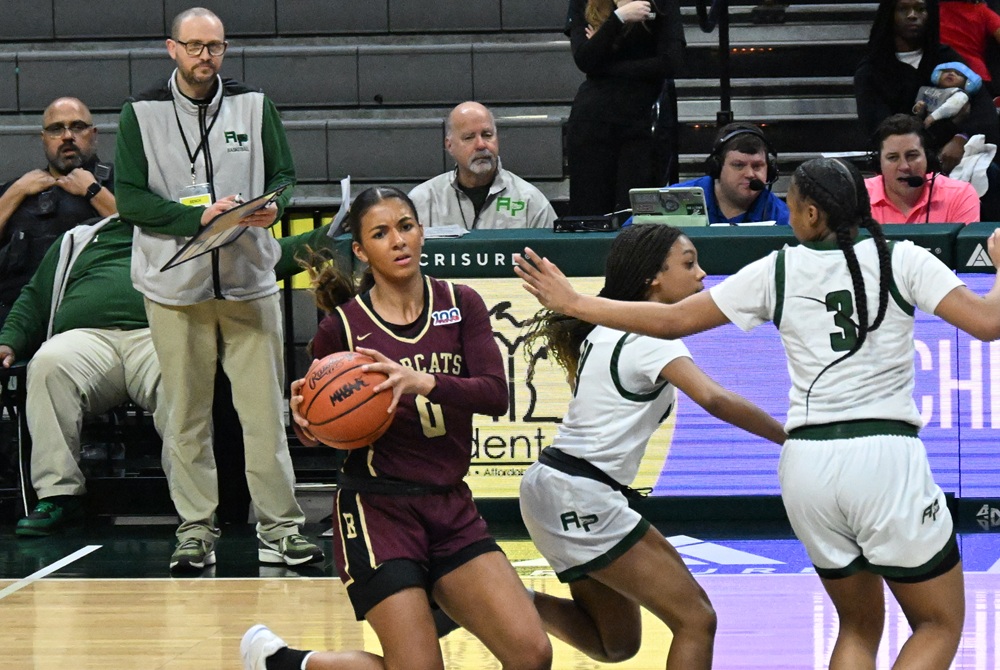
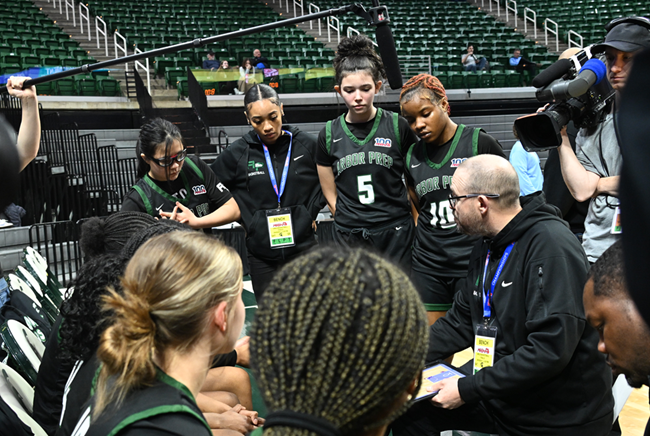
PHOTOS (Top) Then-Arbor Prep coach Scott Stine pulls out his clipboard while monitoring his team’s play during last season’s Division 3 Semifinal against Niles Brandywine. (Middle) Stine talks things over with his Arbor Prep players during a break in the championship victory.