

Thank Roosevelt for Football Weekends
December 20, 2013
By Rob Kaminski
MHSAA benchmarks editor
The next time you find yourself immersed in a tense crosstown football rivalry on a Friday night followed by a Saturday pilgrimage to the nearest college campus and a Sunday afternoon with a remote and your favorite snacks and beverages, take a moment to consider what the weekend would be like if it weren’t for Teddy Roosevelt.
The man who became our 26th President shortly after the turn of the 20th Century following the assassination of William McKinley in 1901 was a football fan like you. Maybe more so.
Today’s game of football has reached a critical crossroads. Player size and speed have increased across the board. Savage use of equipment as weapons rather than protective gear has been glorified on television networks and social media. Leaders of the game at all levels have recognized the need for change, employing new rules and widespread educational efforts to aid in preserving the sport.
History, as they say, is repeating itself.
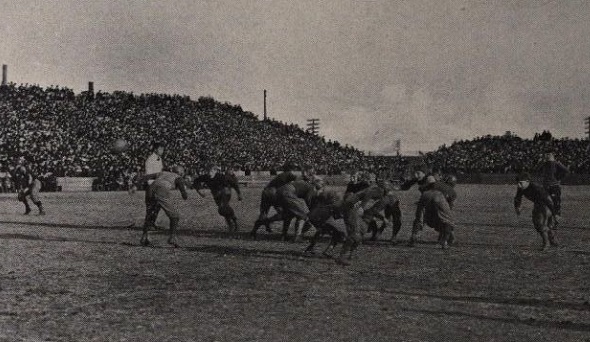
In an ironic twist, it was Roosevelt who saved the then-brutally violent game of football from itself more than 100 years ago. Yes, the same “Rough and Ready Teddy” who led the charge up San Juan Hill during the Spanish-American War and often sparred in the boxing ring while in office from 1901-09 opined that football was becoming so gruesome that he delivered an ultimatum: clean up the game or it would be outlawed.
The Chicago Tribune reported that in 1904 alone, there were 18 football deaths and 159 serious injuries, mostly among prep school players. Football deaths suffered by younger players were reported on a nearly weekly basis, as outraged citizens called on colleges and high schools to banish football outright.
In stepped Roosevelt, who called head coaches and representatives from Harvard, Yale and Princeton – college powers at the time – to the White House in 1905 urging them to eliminate excessive violence and set an example of fair play for the rest of the country. When the casualties actually rose by one during the ensuing season, Roosevelt reacted with greater resolve and convened leading football authorities for the purpose of authoring drastic rules changes. What emerged was an intercollegiate conference which was the predecessor of the NCAA.
Among the most effective changes for the 1906 season were the legalization of the forward pass, the elimination of mass formations, and the creation of a neutral zone. Football fatalities fell to 11 in each of the next two seasons, and severe injuries fell drastically.
Thanks to the introduction of protective equipment and ever-evolving rules changes, football during the 100-plus years to follow has become an exponentially safer game. Yet, the game’s leaders always will need to adjust and react to scrutiny that comes with the territory.
So, as the game once again undergoes rules modifications in the name of safety, give a tip of the cap to President Roosevelt while you enjoy college bowl season and the NFL playoffs and begin to think ahead to the first high school practice of 2014.
Built Right, No Rebuild Needed: Cornelius Taking Gull Lake Back to Tennis Finals
By
Pam Shebest
Special for MHSAA.com
October 21, 2025
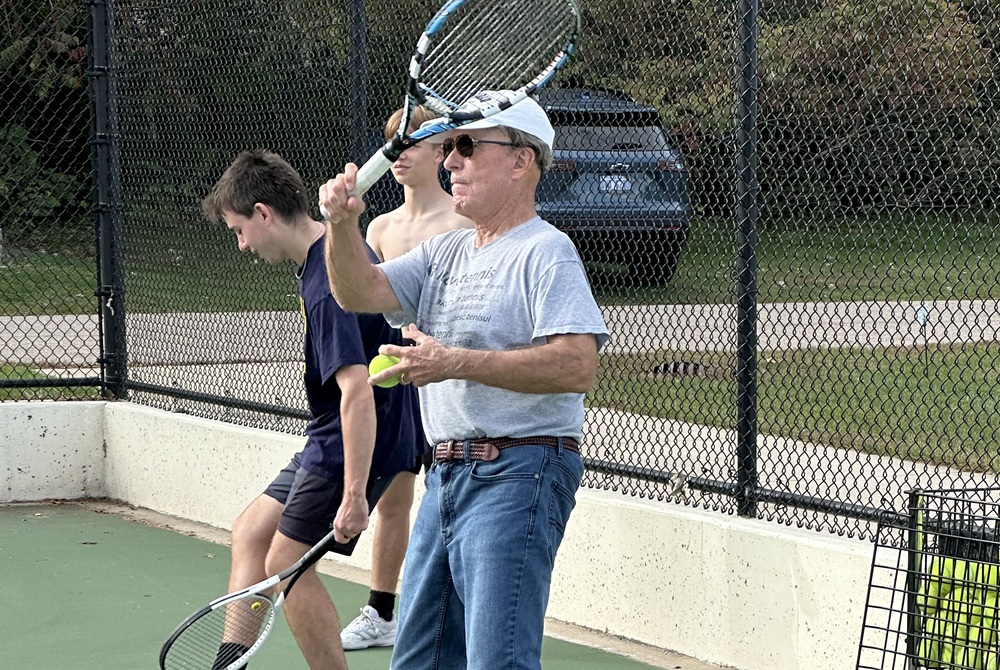
RICHLAND – Once the boys season ends later this week, Roger Cornelius will begin preparing for his 50th year as varsity girls tennis coach at Gull Lake High School.
 That tenure may have been cut short at 22 years, if not for the Gull Lake tennis community.
In January 1998, Cornelius’ 16-year-old daughter, Lindsay, died as a result of a winter car crash.
He had recently ended the fall season with the girls team and “I didn’t know if I could (coach) the boys that spring,” he said, still emotional when talking about the tragedy.
One of his former students, Jason Ryan, now a vascular surgeon at Beacon Kalamazoo Hospital, contacted Cornelius.
“He and one or two other guys talked with me and, if not for them, I would have quit tennis,” Cornelius said. “I decided to continue with tennis, and I’m glad I did. I found out that God was going to carry me through the toughest time of my life. The tennis community was really big for me back then. Richland, especially, came beside me and lifted me up.”
Although tennis is his sport of choice, Cornelius played football at Western Michigan University and was first hired at Gull Lake in 1975 to help with the football program. He jumped at the chance to coach the tennis team that spring and has coached either the boys or girls, and sometimes both, every year since.
He has been named Regional Coach of the Year several times and was enshrined in the Michigan High School Tennis Coaches Association (MHSTeCA) Hall of Fame in 2018.
Cornelius will lead the boys (12-2-1) to the MHSAA Lower Peninsula Division 3 Finals this Friday and Saturday at Midland Tennis Center. The Blue Devils finished 10th the last two years, earning eight points both times.
In a rebuilding year after losing all four singles and two doubles players to graduation, Cornelius was surprised and thrilled that this year’s team earned 20 points at its Regional, finishing second to St. Joseph and qualifying for the Finals.
At the beginning of the season, senior Peyton Orley said he wasn’t sure how good the team would be.
“Last year at the beginning of the season, we could tell we had a really good team,” Orley said. "This year, we lost a lot of our seniors and it didn’t look promising for states.
“Everyone on the team was mission-motivated to get to the state tournament.”
 Orley pairs with senior Sullivan Abegg at No 1 singles and the pair did their part, winning their Regional flight. For Abegg, it was a three-peat after taking the title at No. 3 doubles two years ago and No. 2 doubles last year.
The Blue Devils are led at No. 1 singles by freshman Kade DeMaagd, whose father also played for Cornelius.
“Kade’s got the best strokes on the team,” the coach said.
Lucas Nichols, at No. 4 doubles, is the other freshman in the lineup. The other three seniors are Max Uppal (No 3 singles) and Dylan Piwko and Evan McCann, both doubles players. Three juniors, who all play doubles, are Jaden Jones, Jackson McDermott and McGuire Abegg. Two sophomores round out the singles flights: Jake Worgess at No. 2 and Jacob Nichols at No. 4.
Comparing old & new
Cornelius said there isn’t much difference between the tennis players today compared to those 50 years ago.
“I think what’s changed the most is today’s athletes have so many different options, so many different interest areas,” he said. “A lot of the kids have early college classes, some of them have to come to practice from off site and so many things are happening, whether it’s the Model United Nations or tutoring someone at the high school or DECA. I think that’s the biggest difference.”
While the boys are competing in Division 3, the girls are in Division 2, a more difficult road to the Finals, Cornelius said.
“It does make it pretty tough for the girls to make it out of Division 2 with the Mattawans, Portage Central, St. Joe, Battle Creek Lakeview,” he said.
Orley’s sister, Ava, a junior who plays at No. 1 doubles, said the girls team has already bonded.
“We build our team off loving each other,” she said. “It’s not everyone out for themselves, it’s all of us (working together). We focus on being a good role model.
"We’ve had coaches tell us how we played with class and how it’s an honor to play us because we learned from (Cornelius) that you always want to be a good sport.”
Competitive, compassionate
Cornelius, who taught French at the high school for 32 years, currently tutors French-speaking African and Haitian families for the district.
“I tutor the kids and work with the families,” he said. “It’s vastly different than what I did in the classroom. The greatest thing that’s ever happened to me in my nearly 50 years working with Gull Lake schools was working with a little African boy who was blind.”
Cornelius and some friends pooled money to take the boy to a specialist in Grand Rapids. The specialist asked Cornelius to translate for the mother that he thought he could help the young boy regain some sight.
“The two surgeries were successful,” said Cornelius, choking up a bit with emotion. "He has to wear glasses, but he can see. It’s the high watermark of my life.”
That compassion is visible on the tennis courts, said retired Allegan coach Gary Ellis, now a volunteer assistant tennis coach at the school.
 “I’ve known Roger since 1977,” Ellis said. “We started competing against each other when he started coaching the boys.”
He said that although Cornelius wants to win and likes to compete, “at the same time, he’s got a good perspective on the whole thing and the value of high school sports, and tennis in particular. He’s very positive, both with his team and with the opponents.”
Cornelius was so supportive of opponents that one year Ellis’ girls team invited the Gull Lake coach to their awards banquet at the end of the season.
“He had a conflict and couldn’t attend, but he sent a really nice letter to the girls,” Ellis said.
Cornelius makes it a point to talk with opponents, both coaches and players.
“I love to get to talk to the kids that I would never get to talk with,” he said. “My favorite is Battle Creek Central because they have struggles that most of us at Gull Lake don’t know about.
“For them to commit their spring or their fall to tennis, that’s a major decision. I want to make darn sure that after the match, I get to meet every one of them, talk with them, talk with their coach.”
Cornelius doesn’t expect this to be his last season.
“I will step down when the good Lord says, ‘I think it’s time,’” he said. “And I don’t think it’s time quite yet.
“I wouldn’t mind if they put on my gravestone ‘Loved God, Loved People.’”
 Pam Shebest served as a sportswriter at the Kalamazoo Gazette from 1985-2009 after 11 years part-time with the Gazette while teaching French and English at White Pigeon High School. She can be reached at [email protected] with story ideas for Calhoun, Kalamazoo and Van Buren counties.
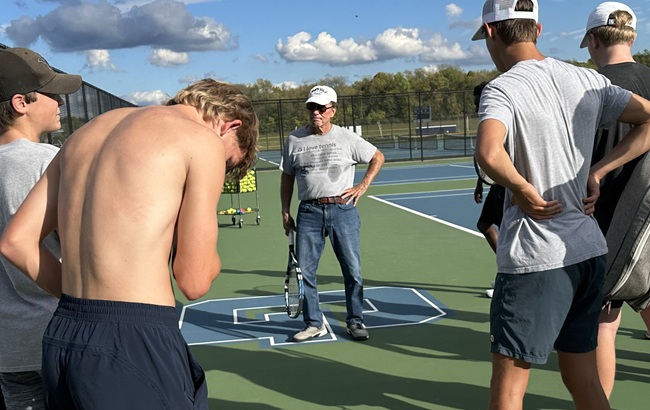
PHOTOS (Top) Richland Gull Lake tennis coach Roger Cornelius hits with his players during practice this season. (Middle) Clockwise from top left: Cornelius, assistant Gary Ellis, junior Ava Orley and senior Peyton Orley. (Below) Cornelius talks things over with his team. (Photos by Pam Shebest.)