

Transformed Shores Continues to Rise
September 8, 2015
By Tom Kendra
Special for Second Half
This is not your father’s Muskegon Mona Shores football team.
Or even your older brother’s.
 This is not the team that went its first 51 years of football without making the MHSAA playoffs and whose only traffic jams leaving its parking lot occurred early in the third quarter – when the band was done performing.
Heading into one of the state’s marquee Week 3 matchups at home against perennial Division 1 powerhouse Rockford, Shores is looking to snap a 10-game losing streak against the Rams, which has included some forgettable affairs like a 49-7 loss in 2000 and 10-7 loss last fall, the Sailors’ lone regular-season defeat.
“Great job tonight,” Mona Shores coach Matt Koziak told his huddled players last Thursday night, allowing them a few seconds to enjoy their 2-0 start and a dominating 55-14 win over host Fruitport, before quickly shifting gears.
“But now we have Rockford coming to our place. We can’t make the mistakes we made tonight, or they will make us pay for it. We have to play top-notch.”
The emergence of Mona Shores as a power has changed the landscape of football, not only in the Muskegon area, but West Michigan as a whole. As other Muskegon-area schools struggle with declining enrollment – most notably Muskegon High, Muskegon Heights and Muskegon Catholic Central – Mona Shores is now the largest school in Muskegon County and a legitimate force, bursting onto the state scene with a memorable run to last year’s Division 2 championship game at Ford Field.
After putting up 55 points in back-to-back wins over Holland West Ottawa and Fruitport to open the season (and with their defense not allowing a single point), the Sailors are showing that the 2014 season was far from a flash in the pan.
“Last year we were the hunters; now we’re the hunted,” explained senior quarterback Tyler Trovinger, who set a school record with six TD passes in the Week 2 win over Fruitport. “We have to be great because no one is looking past us anymore.”
The Sailors’ fortunes, and attitudes, began to change in 2011 with the hiring of Koziak as head football coach. He turned out to be the perfect choice, as a 1994 Mona Shores graduate who cut his coaching teeth at Muskegon High School under Tony Annese, serving as offensive coordinator when the Big Reds won MHSAA titles in 2006 and 2008 and as head coach for one year in 2009.
His words upon taking the Mona Shores job in 2011 were prophetic:
“I'm tired of people badmouthing my school,” Koziak told The Muskegon Chronicle at that time. “I’ve heard people say the Shores kids are cake-eaters. It’s not true. There are a lot of blue-collar kids and families there. I’m excited to change the football culture.”
While Koziak knew Shores football history, he also was smart enough to recognize changes that needed to be made – beginning with the installation of the spread option, veer attack which was so effective across town at Muskegon High.
The most notable player was quarterback Tyree Jackson, who Koziak inserted into the starting lineup as a 5-foot-9 freshman. After struggling mightily and making people question whether the new coach was running the wrong system, Jackson sprouted to 6-4 and started throwing to targets like Asantay Brown and Marquon Sargent.
 Brown is now a starting safety at Western Michigan University, Sargent is at Grand Valley State University and Jackson is a freshman quarterback at the University of Buffalo, but the Mona Shores system and the athletes haven’t missed a beat.
Trovinger (5-11, 200 pounds) has stepped into Jackson’s big shoes and possesses a cannon for an arm and terrific running ability.
Trovinger’s passing options are nothing short of an embarrassment of riches. Three of the starters in the Sailors’ four-wide attack have already made Division I college commitments – Hunter Broersma (6-2, 190) and Darece Roberson (5-9, 165) to Western Michigan and Kobe Burse (6-3, 205) to Miami of Ohio – with the fourth starter being dangerous Deandre Oakes-Owens (6-0, 175), an all-league selection as a defensive back last season.
“We have a ton of weapons, no doubt,” Trovinger said. “When we’re all focused, we’re a force to be reckoned with.”
The defense is led by two more senior standouts who could possibly sign with Division I schools. Dom Shermeta (6-0, 215) is a Chris Spielman clone at middle linebacker and a battering-ram fullback, and Christian Boyd (6-2, 280) is a run-stuffer at left defensive tackle.
Koziak said a big part of the Shores turnaround is the supportive administration, notably seventh-year athletic director Ryan Portenga, the outspoken, energetic and unapologetic leader of the Shores athletic program.
Portenga has written a book about the Mona Shores football turnaround and the storybook 2014 season, entitled: “Flipping Football: A True Story of Resilience and Transformation.” The book, which costs $20, will be released Friday, in conjunction with the Rockford game.
“It’s a story that needed to be told,” said Portenga, who noted that half of the proceeds from the sale of the book will go to the Shores athletic program.
So … with all of this talent, all this excitement, all this momentum (even a book!), are the Sailors ready to take the next step and knock off the biggest kid on the block – Rockford? Or will the Rams’ mystique win out again?
It’s the same question Muskegon-area residents were asking last October, when the upstart Sailors traveled to historic Hackley Stadium to face the Big Reds, which had downed Shores 14 games in a row. Shores matched the athletes for Muskegon and made believers out of many in a convincing 48-27 victory.
While every eye in Muskegon was on that game, many eyes from around the state will now be on Sailor Stadium when a senior-laden Rockford team comes to town Friday, looking to swat away the latest challenger to its perch atop the West Michigan football heap.
Rockford (1-1) is coming off a 47-0 romp over visiting Holt, and will bring its usual big offensive line, bevy of running backs and unparalleled special teams – especially senior kicker and punter Quinn Nordin, who has committed to sign with Penn State University.
The Rams have extra motivation as coach Ralph Munger has 299 career coaching victories over his 36-year career, the first 12 spent at Frankenmuth and the past 24 at Rockford. His next win would make him the 11th coach in state history to register 300 wins.
Shores is not motivated to deny Munger, but rather to avenge last year’s 10-7 loss at Rockford. In that game, Roberson scored on a 79-yard run on the first play from scrimmage, but failed to score again, fumbling twice in the fourth quarter.
With a huge crowd expected for the rematch, Koziak said his players will be motivated to come out and not let another game against the Rams slip away.
“We talked about how Rockford beat us last year,” said Koziak, who is assisted on the varsity level by Brian Sikkenga, Holsey James and Aaron James, Chris Hilliker and Kyle Brott. “They have that in the back of their minds that they let one get away, and that’s motivation for them.
“I think there’s a new energy for football with what we’ve been able to build the last four years. The community has waited forever for this. They’re ecstatic.”
 Tom Kendra worked 23 years at The Muskegon Chronicle, including five as assistant sports editor and the final six as sports editor through 2011. E-mail him at [email protected] with story ideas for Muskegon, Oceana, Mason, Lake, Oceola, Mecosta and Newaygo counties.
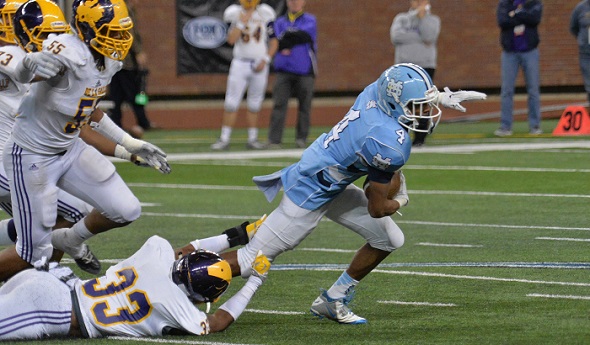
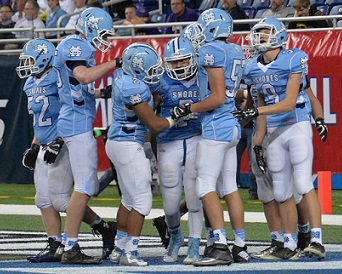
PHOTOS: (Top) Mona Shores’ Darece Roberson strides for additional yardage during last season’s MHSAA Division 2 Final against Warren DeLaSalle. (Middle) Tyler Trovenger, surrounded by teammates, celebrates his third-quarter touchdown catch at Ford Field. He moved to quarterback this fall.
After Lean Years, Ubly Returns to Regional
By
Paul Costanzo
Special for MHSAA.com
November 9, 2016
Aaron Klama sat in the stands in 2008 watching his brothers play for Ubly in the Division 7 championship game at Ford Field.
 Klama was 10, and Ubly was at the peak of the strongest decade in program history. Even though his brothers and their teammates lost against Traverse City St. Francis, Klama remembers wanting to be like them. Wanting to have the same opportunity to play on that field.
There’s plenty of work for Klama and his Ubly teammates left to do, but after some rough years for the program, the Bearcats are 11-0 and two wins from getting back to the pinnacle of high school football in Michigan.
“I feel like it’s amazing just being able to possibly be in the same shoes as my brothers,” Klama, a senior offensive and defensive tackle for Ubly, said. “Hopefully I’ll be able to push my team further than they even went. But everything has just been amazing this year.”
Ubly is in the middle of its best season since 2010. It will play at 1 p.m. Saturday against New Lothrop at Chesaning High School in a Division 7 Regional Final. A win sends the Bearcats to the Semifinals for the first time since 2009 and the fifth time in school history. All four of the previous trips came between 2003 and 2009, during a 12-year playoff streak for Ubly that stretched through 2012.
That streak ended in 2013, when the current seniors were freshmen. Ubly was 3-6 during both the 2013 and 2014 seasons.
“We had a couple years where numbers were really down,” Ubly coach Dave Kaufman, who took over the program in 2011, said. “In (2013 and 2014), we were playing with 14 to 16 kids. We had some small senior classes.
“It was tough. We’re used to being in the 20s, and the first couple years our numbers were pretty good. We had some small senior classes, and the injury bug kicked our butt, too. When you’re down in numbers as it is, that’s when you’re starting to bring up freshmen and sophomores.”
That included running back Derek Brown, who started as a freshman for the Bearcats and has rushed for 1,000 yards in each of his four seasons. It included Klama, running back and defensive back Nate Keller and several others who were playing at the varsity level as sophomores.
As much as it may have hurt at the time, getting that experience is paying dividends now.
“I think (having players play as underclassmen) helped,” Kaufman said. “I think it also helps that we have a really good senior group. Some of these kids have been playing for three or four years, and that definitely helps.”
 In 2015, Ubly was back in the postseason, finishing the year 7-3 and turning the program back in the right direction. What happened between the end of that season and the beginning of this one is what Ubly’s players credit for their current success.
“Everybody was in the weight room all winter, and everybody wants to win on the team,” Keller said. “We didn’t just have two guys in the weight room; it was 15 or 16 guys in there, busting their butts.
“We had guys that would be telling everybody to get into the weight room, because we want to win more than anybody. We had a few leaders that told everybody to get in there.”
After struggling as underclassmen, turning things around in 2015 and setting the tone with a strong offseason prior to this fall, Ubly had high hopes entering its Week 1 game against a tough Unionville-Sebewaing opponent.
Then the Bearcats fumbled on their first offensive play.
“It was kind of like, ‘We can only go up from here, I guess,’” Keller said. “I think that just fueled the fire. We were ready to play from there.”
Ubly responded, and won 28-18, showing its coach something in the process.
“That could have went the wrong way there,” Kaufman said. “That told me a lot about my team right there.”
His team showed him more in a 21-16 win against Cass City, a game in which the Bearcats trailed during the second half. A 54-34 win against Vassar had Ubly sitting at 3-0 after a stretch Kaufman said he would have been happy to finish 2-1.
Ubly rolled through the Greater Thumb Conference East, outscoring opponents by an average of 37.4 points per game. It has picked up playoff wins against Elkton-Pigeon-Bay Port and Unionville-Sebewaing, setting itself up for the matchup with a tough New Lothrop team.
Ubly is back where it expects to be, and it has done it the same way it did during the 2000s, by wearing on its opponents with a strong run game out of the T-formation and a strong defense.
Ubly has rushed for 3,500 yards and 51 touchdowns this season, taking advantage of an offensive line (including tight ends) that features five seniors. Brown has led the way with 1,188 yards and 18 touchdowns on the ground, while senior Jonathon Brandel has 861 yards and 14 touchdowns -- adding four receiving scores plus two interception returns and one punt return for touchdowns. Keller and junior quarterback Matt Maikzrek have combined for nearly 1,000 yards and 14 more rushing touchdowns.
“We have no problem chugging away, eating up clock,” Kaufman said. “When teams haven’t faced (the T-formation) in a little bit, they struggle a little bit with the keys. We try to hide the football as well as we can, and we’re happy getting three, four or five yards a crack. There’s not a better defense than an offense that stays on the field.”
Ubly’s offense is a lot like its attitude through the rough times – just keep moving forward.
“As we walk through the locker room every day, we have a little billboard that says, ‘Those who stay will become champions,’” Klama said. “We slap it on the way out. The coaches even told us that if we stay and work hard, we weren’t going to regret it. They always taught us about loyalty and determination.”
 Paul Costanzo served as a sportswriter at The Port Huron Times Herald from 2006-15, including three years as lead sportswriter, and prior to that as sports editor at the Hillsdale Daily News from 2005-06. He can be reached at [email protected] with story ideas for Genesee, Lapeer, St. Clair, Sanilac, Huron, Tuscola, Saginaw, Bay, Arenac, Midland and Gladwin counties.
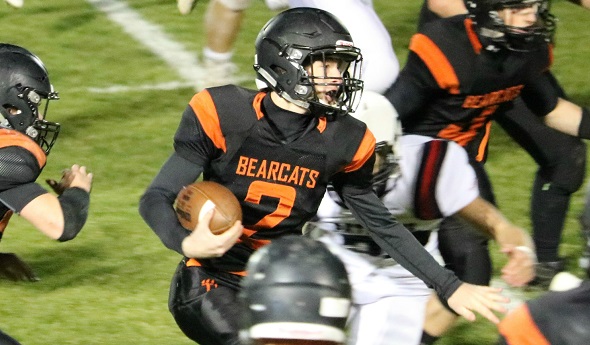
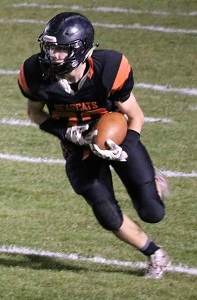
PHOTOS: (Top) Ubly's Casey Sweeney breaks through a pack against Unionville-Sebewaing this season. (Middle) Jonathan Brandel carries the ball for the Bearcats. (Photos courtesy of the Ubly yearbook staff.)