


West Catholic Adds to Ford Field Fame
November 26, 2016
By Geoff Kimmerly
Second Half editor
DETROIT – November has become a regular part of the Grand Rapids West Catholic football schedule. Trips to Detroit are turning into a Thanksgiving weekend tradition.
But what the Falcons accomplished again Saturday was not lost on them.
Grand Rapids West Catholic won its fifth MHSAA football championship and became just the sixth school to win four straight, downing familiar playoff foe Menominee 43-7 in the Division 5 Final at Ford Field.
“There’s no word to describe it. Year after year, competing like that, getting to play 14 games – we’re very, very lucky and blessed,” said senior Sam Neville, who with David Fox played on all four champions. “That’s double what most people get to play over the course of their high school careers.”
This string was as impressive as any of the other three, for a few reasons.
West Catholic finished 12-2, despite playing without junior quarterback Gaetano Vallone for six weeks after he injured an elbow on opening night.
The Falcons, with a Week 3 loss to Zeeland West and a Week 9 defeat to Allendale, were then forced to play all of their playoff games on the road. They navigated a path highlighted by previously undefeated Portland, handed second losses to Lansing Catholic and Algonac and also beat another league champion in Berrien Springs.
They did so under the leadership of a new coach. Joe Hyland was hired this spring after the resignation of Dan Rohn, who had led the team to the first three titles of this streak. Hyland had been highly successful coaching in South Carolina before coming to West Catholic as a teacher and guidance counselor in fall 2015, but as with any change, there was a transition.
And then there was that Finals familiarity. The Falcons defeated the Maroons in 2013’s Division 5 Final to start this streak, and also in a Semifinal in 2014 and Regional Final last fall. It would be hard to find two high school programs 450 drive miles apart that know each other more.
“There’s a lot of people in our community and even statewide who talked about ‘November, November,’ but our discussions were always about today,” Hyland said. “And just feeling like if you do the right thing now, the rest will work out. And if we get beat by a good team on our best day, then you shake their hand and look them in the eye and congratulate them. But we really felt like on our best day, that wasn’t going to happen.”
Saturday had to be one of them.
Junior kicker Liam Putz started the scoring just 2:41 into the game with an MHSAA Finals-record 47-yard field goal, a yard longer that Josh Wuerful’s for Traverse City High against Detroit Catholic Central in the 1988 Class A championship game.
By the end of the first quarter, Vallone had thrown two touchdown passes. By halftime, he’d connected on four. The first, a 91-yarder to senior Brett Myers, was the fourth longest pass play in Finals history.
 Vallone finished 13 of 20 passing for 311 yards, the fifth most in Finals history. He spread the ball nicely with five receivers catching at least one pass; Neville had six catches for 117 yards and two scores, Meyers three for 143 yards and his long touchdown and senior Aaron Hall caught four balls for 66 yards and the other passing TD.
The 5-foot-10, 170-pound quarterback also ran for a team-high 83 yards and a score on 13 carries. His 394 total yards rank sixth on the Finals all-time list.
Menominee did achieve a little history as well. In addition to playing in their fifth Final, the Maroons scored their points on a 76-yard blocked field goal return by senior Hunter Hass – the first blocked field goal return touchdown in Finals history. The kick was blocked by senior Sam Larson, and Hass picked up the loose ball and ran down the left sideline for the score.
“All week we were practicing to block their punt, and it just so happened that we blocked their field goal,” Hass said. “I saw the ball. I just picked it up and ran into the end zone, just trying to get some points to get some momentum going for our team.”
But the rest of the afternoon was a struggle. The Maroons (12-2) gained only 163 yards and tied a Finals record held by two others teams with seven turnovers – three coming on fumbles.
They also played once more without all-state tailback Keifer Rasner, who missed the end of the season with an injury.
“When you turn the ball over that many times to a good team, you don’t have much of a shot,” Menominee coach Joe Noha said. “But I’m really proud of my guys. We really hung in there. We’ve had a lot of things happen in the last couple of weeks, but I’m really pleased with our effort and our fortitude to get here. And once you get here, finishing is difficult. Today was not our day.”
The MHSAA Football Finals are sponsored by the Michigan National Guard.
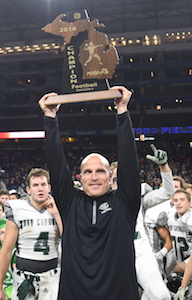
PHOTOS: (Top) Grand Rapids West Catholic’s Zane Timmer tries to break away from a Menominee tackler Saturday in the Division 5 Final. (Middle) Falcons coach Joe Hyland raises the championship trophy.
A Game for Every Fan: Week 4
September 18, 2014
By Geoff Kimmerly
Second Half editor
How much does each game of the MHSAA football season count?
It’s only Week 4. But on one hand, 108 teams enter this weekend winless and one more loss from missing their chance at automatic playoff qualification. On the other hand, the elite already are beginning to separate – with six of our eight featured matchups pitting a pair of 3-0 teams.
That said, each of the last five weeks of the regular season matter just as much as well – little is decided before the midpoint. But the following should help set the paths for many as we reach halfway next week.
West Michigan
Rockford (3-0) at Hudsonville (3-0)
From 2003-08, this was one of the best matchups in the entire Ottawa-Kent Conference and on more than one occasion THE game in West Michigan for that particular season – all six were decided by eight or fewer points, with Hudsonville claiming a 4-2 advantage. Rockford has won the last four meetings, all by multiple scores – but this one has the feel of another potential classic.
Others that caught my eye: Grand Haven (3-0) at Holland West Ottawa (2-1), Whitehall (3-0) at Mason County Central (2-1), Caledonia (2-1) at Muskegon Mona Shores (2-1), Muskegon Catholic Central (3-0) at Spring Lake (2-1).
Greater Detroit
Plymouth (3-0) at Livonia Churchill (3-0)
This pair of Kensington Lakes Activities Association South foes has played a pair of classics over the last two seasons – Plymouth winning 23-22 last season and Churchill claiming a 35-31 victory in 2012. Churchill is surging again after winning two games last season, beating returning playoff teams Brighton and Westland John Glenn over the last two weeks. Plymouth also missed the playoffs last season but owns an impressive three-point win over Pinckney.
Others that caught my eye: Birmingham Brother Rice (3-0) at Warren DeLaSalle (3-0), Detroit Cody (2-1) at Detroit Martin Luther King (3-0) on Saturday, Warren Michigan Collegiate (3-0) vs. Detroit University Prep (3-0) on Saturday at Detroit Osborn, Lake Orion (2-1) at Oxford (3-0).
Mid-Michigan
Coldwater (3-0) at Parma Western (2-1)
This matchup is overflowing with storylines. Parma Western has had two winning seasons over its last 24 and few games of consequence over that time – but has blown into 2014 with two early wins including over Battle Creek Pennfield, and the Panthers barely fell to Marshall last week, 45-44. Parma Wester also has never made the MHSAA playoffs, even starting 5-1 in 2009 before finishing 5-4. Enter this week’s opponent, Coldwater, coming off its first playoff berth ever last season and outscoring its first three 2014 opponents – including Pennfield and Marshall as well – by a combined 97-6.
Others that caught my eye: Mason (1-2) at St. Johns (3-0), Eaton Rapids (2-1) at Williamston (3-0), Portland (2-1) at Ionia (2-1), Grand Ledge (1-2) at Okemos (2-1).
Upper Peninsula
Ishpeming (3-0) at Ishpeming Westwood (3-0)
This game has been similarly highly anticipated a few other times in recent history – although Ishpeming won the 2008, 2009 and 2011 games, Westwood entered all of those undefeated. This one has to have Patriots supporters just as amped – Westwood hasn’t beaten Ishpeming since 1998, is coming off two losing seasons and has outscored its first three opponents by a combined 140-30. Ishpeming? The two-time reigning MHSAA Division 7 champion has run its winning streak to 24 while beating this season’s first three opponents by a combined 126-32.
Others that caught my eye: Lake Linden-Hubbell (2-1) at Bessemer (3-0), Escanaba (1-2) at Marquette (2-1), Gladstone (3-0) at Menominee (3-0), Newberry (1-2) at Munising (2-1).
Lower Up North
Detroit Catholic Central (1-2) at Traverse City Central (3-0)
The Trojans have momentum after last week’s 20-13 win over rival Traverse City West, and this week could claim arguably their most impressive nonleague win since the schools split in 1997. Detroit Catholic’s Central’s lone win this fall came against a Canadian team, but its losses are to Muskegon by seven and Ohio power Toledo Whitmer – and there’s no reason to think the Shamrocks won’t be in Division 1 title contention again in two months.
Others that caught my eye: Traverse City West (1-2) at Petoskey (2-1), Alpena (2-1) at Cadillac (3-0), Charlevoix (2-1) at Grayling (1-2), Standish-Sterling (1-2) at Whittemore-Prescott (3-0).
Southwest and Border
St. Joseph (3-0) at Stevensville Lakeshore (3-0)
Niles also is undefeated to give the Southwest Michigan Athletic Conference West three 3-0 teams to open the season, but St. Joseph and Lakeshore are annual favorites and own the most impressive victories so far. St. Joseph, last season’s league runner-up, got a leg up last week by beating 2013 third-place Portage Northern by 10. Lakeshore, last season’s fourth-place team and an eventual District winner, beat reigning league champ Portage Central last week 20-17.
Others that caught my eye: Parchment (1-2) at Constantine (3-0), Gobles (3-0) at Decatur (3-0), Plainwell (3-0) at Edwardsburg (2-1), Vicksburg (3-0) at Paw Paw (3-0).
Bay and Thumb
Millington (3-0) at Frankenmuth (3-0)
Frankenmuth has turned a four-game losing streak to the Cardinals into a two-game winning streak, with the victor going on to claim the Tri-Valley Conference East championship the last four seasons. Millington’s opening-night win over Essexville-Garber is the most impressive by either so far, but Frankenmuth did avenge last season’s loss to Hemlock and beat a returning playoff qualifier in North Branch.
Others that caught my eye: Flint Beecher (3-0) at Goodrich (3-0), Brighton (2-1) at Grand Blanc (2-1), Mount Pleasant (2-1) at Midland (2-1), Grosse Pointe South (2-1) at Port Huron (2-1).
8-player
Dryden (3-0) at Peck (3-0)
Dryden is a Class C school and as such cannot qualify for the MHSAA playoffs in 8-player. But the Cardinals are making a run at the North Central Thumb 8-Man League title as one of three undefeated teams atop the league – Peck and Deckerville are the others. Dryden has scored an incredible 176 points in three games; Peck, however, is the reigning MHSAA champion and has outscored its first three opponents by a combined 149-0.
Others that caught my eye: Engadine (2-1) vs. Cedarville (3-0) at DeTour, Morrice (2-1) at Deckerville (3-0), Burr Oak (2-1) at Battle Creek St. Philip (3-0) on Saturday.
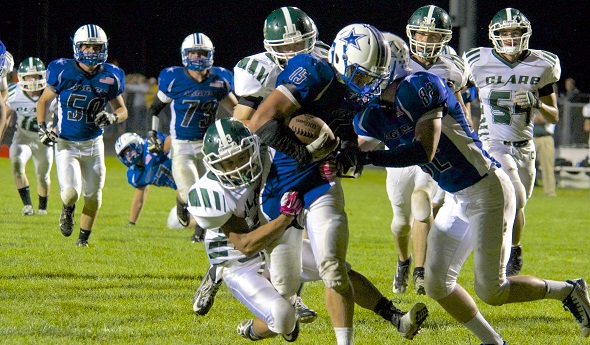
PHOTO: Beal City (carrying the ball) hopes to be among those moving to 4-0 this week after earning its second win two weeks ago, 15-14 over Clare. (Click to see more from HighSchoolSportsScene.com).