

Byron 'Family' Filled with Family Ties
January 15, 2020
By Tim Robinson
Special for Second Half
BYRON — Every team refers to itself as a family in athletics.
 But the Byron girls basketball team takes that concept to a new level.
There are two sets of sisters, a set of cousins, and three of the four coaches on the team coach their own daughters.
But, assistant coach Brandy Forgie said, there’s more than that.
“The family aspect doesn’t just come from being blood-related,” she said. “We’re all from Byron, born and raised, all but one of us as coaches, too. We kept our families in Byron, raised our kids here. All of our friends here, we have their kids. We started the basketball when they were little. They played together and grew up together.”
Sarah Marvin, who has averaged a double-double the last two seasons, agrees.
“I think it helps because we all know each other,” she said. “We know what agitates some people and what agitates others. Every day we come ready to work, and because we’re so close, we rely on each other to push each other and keep each other accountable to keep working hard.”
So far, so good.
The Eagles sit atop the Mid-Michigan Activities Conference standings and 8-0 overall with a team that has lofty aspirations.
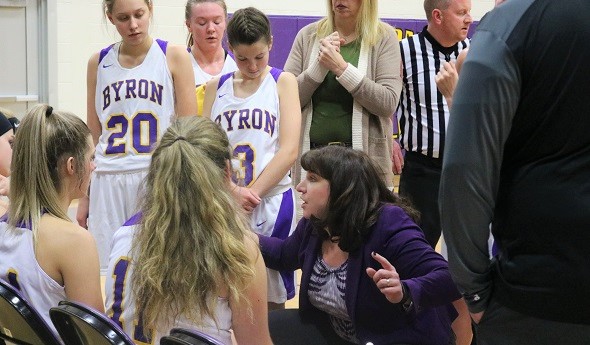
Coach Theresa Marvin, whose fraternal twin daughters are Becky and Sarah, points out that there’s still a long season ahead.
“It’s just keeping it going through the winter,” she said. “You have to get through illnesses and exams in the middle of the winter and just being tired. It’s a long season. For us, the focus is winning the MMAC outright. We tied for the championship the last two years we were in the (Genesee Area Conference), and we tied for the MMAC title last year. We haven’t won an outright league title in a long time.”
Sarah, who plays guard offensively but also defends the post, played four sports last year as a sophomore. She was a two-way lineman on the JV football team, competed in last year’s inaugural Michigan Wrestling Association girls state tournament (at 215 pounds) and took home two MHSAA Finals championships in track & field, breaking school records set by her older sister Jessica and her mother, who competed in the throwing events at the University of Michigan.
Sarah didn’t play football this past fall, and wrestling might be a non-starter this winter.
 “We’re focused on what the basketball team can do this year,” Theresa Marvin said as Sarah nodded in agreement. “We don’t want to take away from that.”
The Marvin twins have been playing together since the third grade and enjoy having each other as teammates — and as sounding boards.
“It’s always nice to have someone, even if we do sometimes get at each other like sisters do,” Sarah Marvin said. “But we can take practice home and talk about things that worked or didn’t work on the court. It’s really good to have her there and people you like to be around at practice.”
The other set of sisters on the team, junior Makayla and freshman Makenna Clement, are in an opposite situation. This is the first high school season they have been teammates.
“It’s pretty fun,” Makayla said. “I honestly forget she’s my sister when we’re on the court. We’re one big family. Everyone’s a sister to me.”
To a point.
“Sometimes I give her little pep talks,” Makayla said. “I do get after her sometimes. I’ll say, ‘Shoot the ball!’ I say that to my other teammates, but I don’t get as personal as I do with her.”
“It’s all good,” Makenna said, laughing, “She’s definitely a good resource. She’ll help me on different post moves and tips on better passing. All that.”
During a recent win over Montrose, Sarah Marvin looked to the bench and barked, “MOM!” to get Theresa’s attention, which came as a shock to Theresa Marvin when she was asked about it after the game.
“Did she? That’s not normal,” she said. “Sarah always says ‘Coach.’ She must have said that to get my attention.”
The other family connections are assistant coach Jim Passig and junior Olivia Passig, and cousins Haley (a senior) and junior Allison Hooley.
Brandy Forgie said that, after years of being a travel head coach, she had to adjust to both coaching her daughter Raegan, a senior, and being an assistant.
 “In the beginning, it was hard for me to be there and watch someone coach my daughter,” she said. “But it got a lot easier. Coach Marvin is a fantastic coach and she knows how to deal with Raegan now.
Sort of a good cop/bad cop situation?
“Oh, I’m the good cop,” Brandy said as Raegan snickered.
Overall, Raegan added, it’s been a good experience.
“Not a lot of people get to experience (playing for a parent),” she said. “It can be hard sometimes because there are two different relationships (mother/daughter, coach/player) meshing together. But I really enjoy having her there.”
Theresa Marvin, in her sixth year as girls basketball coach, has coached with Passing and Forgie in the Byron youth program for more than a decade.
Marvin coached her oldest daughter, Jessica, during Jessica’s high school career, and coached Sarah from her freshman year on and Becky also as a sophomore.
“You have to be a coach first, absolutely,” she said. “You have to have guidelines, and we’re really good at it. For example, my girls don’t know anything the team doesn’t know beforehand. I think it puts too much pressure on my girls to be a middleman, and that’s not fair to them.”
After the game, Marvin said, basketball is left at the gym, at least in her case.
“When we get into the car, we won’t even talk about the game,” she said. “Other parents get the opportunity as parents to talk to their kids about the game. I don’t do that. My husband (Tim) will. He’ll play the parent role, but I don’t.”
That doesn’t mean she doesn’t enjoy watching her daughters play.
“I do enjoy that,” she said. “Sometimes, I wish I could be a parent in the stands and just watch them play, because it’s totally different. But my focus on the bench is (on) decisions I need to make for the team. When they’re out there, it’s not, ‘Oh, those are my daughters.’ I’m in basketball coach mode.”
In many ways, the Byron team’s fast start has been years in the making.
“Jim and Brandy and I spent many years and many weekends when these girls were between the fourth and eighth grades taking them around the state in tournaments,” Theresa Marvin said. “Some played on travel teams, but we kept these units together. It’s automatic for them. It’s about chemistry and the way they work together. As a varsity coach, it’s a dream to have a group of girls who grew up playing together and who all get along.”
There’s a long way to go in the 2019-20 season, but the Eagles hope their family ties, both literal and metaphorical, can lift them to new heights when the postseason begins.
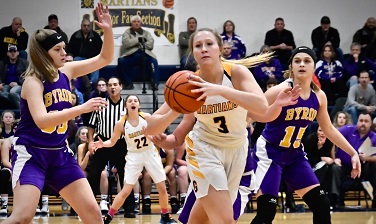
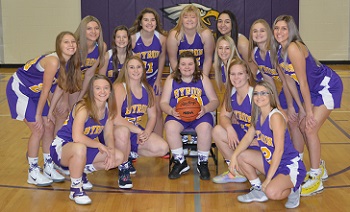
PHOTOS: (Top) Theresa Marvin is in her sixth season coaching the Byron varsity, but has coached most of her players including her twin daughters since they were in the third grade. (Middle) The Eagles defend the lane during a 61-43 win over Goodrich on Dec. 6. (Below) This season's Byron girls basketball team. (Top and below photos courtesy of the Byron girls basketball program; middle photo by Terry Lyons.)
East Kentwood Holds On, Earns Title Shot
March 17, 2017
By Geoff Kimmerly
Second Half editor
EAST LANSING – Few opponents this season had played East Kentwood as close as Southfield Arts & Technology did during Friday’s Class A Semifinal at the Breslin Center.
But Falcons coach Jimmy Carter wasn’t worried. And his players were only a little bit cautious as they set themselves up to play for the school’s first MHSAA basketball title.
East Kentwood led by as many as 20 and by 11 into the final quarter. But although Southfield A&T cut the deficit all the way to two points with 4:45 to play, the Falcons held on for a 55-51 win to earn their first championship game berth.
They’ve claimed 22 of their 26 wins this season by 12 or more points, so their experience in close games is limited.
“Basically, I think we pulled through because I thought we were better than they were, and the kids believed they were better than they were, and everyone else we’ve played we thought we were better than,” Carter said. “That’s not confidence; it’s just a little bit of a fact.
“It may sound a little conceited, but I thought we were underrated all year. We weren’t even ranked in our own area, so we had something to prove that we’re better than what people think. I really like being the underdog, and I think my kids do too.”
East Kentwood, ranked No. 9 in Class A heading into the postseason, will face unranked Flushing in Saturday’s noon championship game. Neither has won an MHSAA championship or played for one.
But the Falcons have been building to this point. East Kentwood won one game in 2012-13, but since have increased that victory total to seven, 11, then 14, and this season sit 26-1 with that only loss in its second game to Grand Rapids Catholic Central.
Moving on Friday seemed all but a done deal after the Falcons’ lead reached 20 with 3:47 to go in the third quarter. But No. 6 Southfield A&T – which beat top-ranked Detroit Martin Luther King on the way to the Semifinals – wasn’t about to go that quietly.
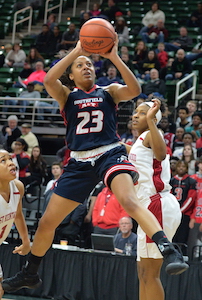 The Warriors – a product of the merger between the former Southfield High and Southfield-Lathrup in the fall – launched a 15-0 run with Miss Basketball finalist Deja Church scoring 10 of her game-high 26 points to lead the way. A Church basket with 4:45 to play pulled A&T to within 44-42.
“In the locker room (at halftime), we went in there, and basically I just started (saying) the game isn’t over. We were down 15 points. That’s nothing,” Church said. “So we just tried to shake off the first half, and the third quarter we came out playing really hard, cut the lead down to four or two, and at that point I felt like we could get it.”
A 3-pointer by junior D’Layna Holliman put the Warriors behind only 52-49 with 1:03 to play. After East Kentwood senior Amari Brown made one of two free throw attempts, A&T had two chances to get within two. A foul put Falcons sophomore guard Mauriya Barnes on the line for two free throws with 25 seconds left – and she connected on both, pushing the lead back to six and the game out of reach.
Carter noted after that his team missed a number of layups and connected on only 9 of 24 free throws. But Barnes showed some necessary poise knocking down her pair at crunch time.
“We were confident, but we couldn’t get too cocky. We can’t ever underestimate a team, because when we do, what happens happened,” Barnes said. “We get overconfident, they make a run, and we have to really humble ourselves and we have to play our game no matter what.”
Barnes scored a team-high 16 points and grabbed six rebounds for East Kentwood, and junior center Corinne Jemison also shined in the clutch with 14 points and 13 rebounds.
Church added 12 rebounds, four assists and five steals for A&T (22-5). Sophomore forward Alexis Johnson added 13 points and 17 rebounds and freshman guard Cheyenne McEvans grabbed 10 boards.
Even with the loss Friday, Southfield A&T turned what could have been an awkward situation this season into an overall win. Church (Lathrup) and Holliman (Southfield High) recalled after how they didn’t care for each other much before becoming classmates and then teammates this school year. Coach Michele Marshall – who led Lathrup for 21 seasons and to the Class A title in 2005 before taking over this new program – offered lasting praise.
“D’Layna spoke about the fact that a lot of people think this is an upset that we even got here. But the thing I love about the kids I inherited from Southfield High is they play with a chip on their shoulder and they believe anything is possible,” Marshall said. “And so after we started to blend together, and we understood that we were going to be one as a team, my coaching staff and I felt we could get to Breslin.
“We fell short of the state championship, but make no mistake about it: I’m more proud of this team than probably any team I’ve coached.”
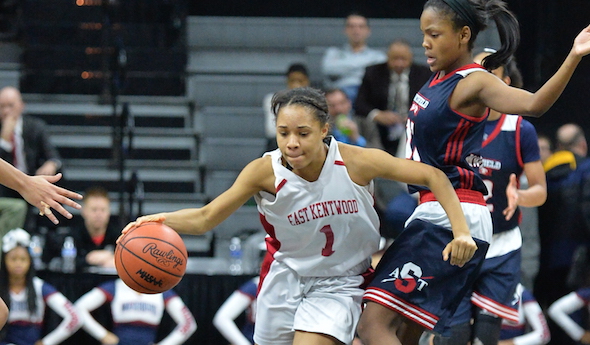
PHOTOS: (Top) East Kentwood’s Mauriya Barnes cuts through traffic during Friday’s Class A Semifinal. (Middle) The Warriors’ Deja Church glides in for a shot.