

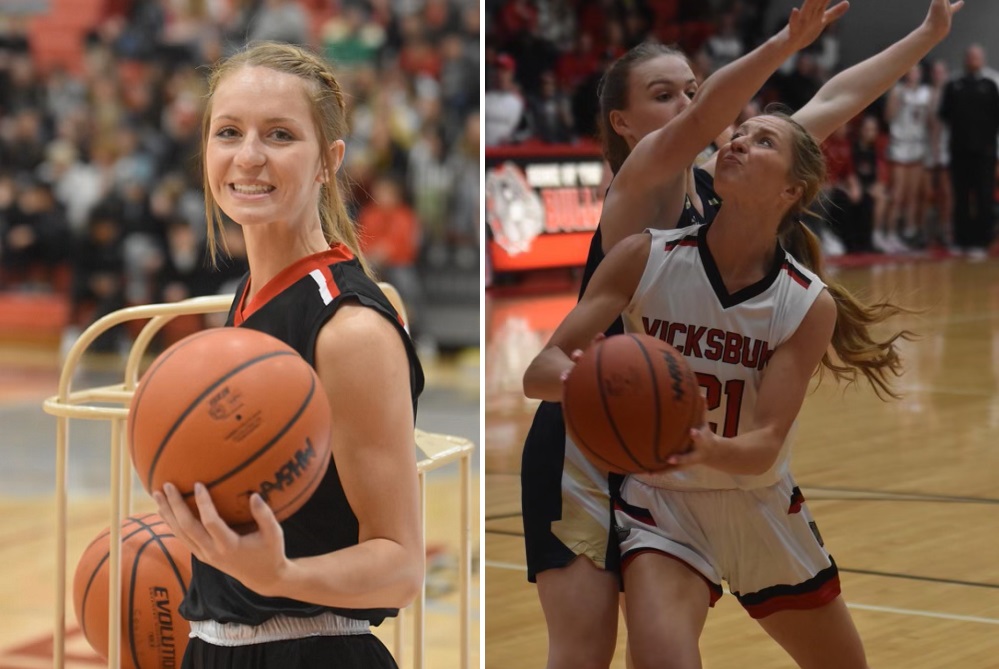
Fearful Start Behind Her, Abnet Continuing to Amaze for Undefeated Vicksburg
By
Pam Shebest
Special for MHSAA.com
February 7, 2023
VICKSBURG – It is not often that a mother calls her child’s concussion a blessing, but it certainly was for Vicksburg senior Tristin Abnet.
 The concussion, sustained her freshman year during a volleyball game, led to tests which led to the discovery of a brain tumor.
Luckily, the tumor was benign and, after the surgery and a long recovery, Abnet is one of two seniors on the undefeated girls basketball team that has set a program record this winter for most wins in a season at 16 and counting, eclipsing the previous mark of 15.
And when it comes to Abnet’s journey over the last three years, Bulldogs coach Tim Kirby said it’s been nothing short of amazing.
After taking a hit during a volleyball game, “I actually got a concussion and I ended up with a headache for about a month or so,” Abnet said.
“I didn’t think too much of it because I always got injuries and always got over them. But this one scared me a little bit.”
It was not until she was playing in a college exposure softball tournament that November that she realized something more was going on.
“Tristin was an up-and-coming softball athlete throughout the country,” her dad, Cheyenne, said. “She won many national championships up to her freshman year (in travel softball).
“We were playing at a college exposure tournament, and she was the youngest on the team. The third day (of the tournament) she started crying because her headache was so bad. She asked me if I would take her out.”
Her mother, Kristina, added, “That was so unlike T. She would battle through anything.”
At that moment, they knew something was terribly wrong.
“She was only making it through maybe two days of school every week because of headaches,” Kristina said. “We took her to her family doctor (in November), and they weren’t comfortable with everything.
“Her doctor (Rosa Maira) said she felt it necessary to do further imaging. Had she not, we’d still never know.”
 The wait during the imaging dragged on, causing a bit of concern for her parents.
“They kept her for so long, and I said there’s something wrong – Mother’s intuition,” Kristina said.
“Then they came out and took us back and showed us what they found and asked to do further testing. Everything snowballed after that.”
Finding out about the tumor, “My world crashed,” Kristina said, with tears in her eyes. “(In 2011) I had a lot of tumors, desmoid tumors, and to think of the battle I went through and the fact that it was on her brain, it was tough.”
In March, doctors performed a biopsy, finding Tristin’s tumor was a low-grade glioma, which is benign.
“We all lost it that day,” Kristina said. “We had our entire family there for her first surgery in March. We left (the hospital) three days later, and then COVID hit.”
With classes online, “She ended up not having to go back to school that year, so that was a blessing too.”
The surgery to remove the tumor was scheduled for August 2020, and during the months between the biopsy and surgery, Tristin said, “I didn’t want to freak myself out because I knew it was coming, I knew what was going to happen and there was nothing I could do about it.”
Her dad said Tristin “never cried in front of me from the day at the tournament all the way to the day of her surgery.
“She was so, so strong, and she was just a little girl. I never saw a tear until they were ready to wheel her away for the surgery.”
One worry for Tristin was the chance of losing her hair to facilitate the craniotomy.
“First they told me they were going to shave my head halfway back and then, as I was getting wheeled back, there were two girl nurses talking about what they were going to do with my hair, so I knew they weren’t going to completely shave my head,” Abnet said.
 The surgery lasted 13 hours at Helen DeVos Children’s Hospital in Grand Rapids, and three days later she was headed home to her bedroom decorated by friends and family.
At first, Tristin was allowed no competition for six months after the surgery. But after a CT scan, doctors added another two months before giving her the OK to play.
“There are (three) metal plates there, that’s why she could not go back to sports for such a long time because that plate had to heal,” her dad said.
Although she could not play basketball her sophomore year, she found a way to stay involved: She became the varsity team manager.
“As a sophomore she literally was here for every practice and every game, even though she wasn’t allowed to participate,” Kirby said.
“At the end of the season, her team unanimously voted her “best teammate” on the entire team, and she couldn’t play. I think that’s a testament to the kind of person she is and the impact she had on the team.”
After taking a year off and after major surgery, Abnet had a lot of catching up to do, both physically and mentally, during her junior year, her coach said.
“Last year, you just wanted to make sure you kept her safe,” Kirby noted. “This year, I haven’t worried about it as much because she’s been through it and we’re all more comfortable with it.
“She knows what her limitations are. Last year, I was a little more leery about it.”
Tristin worked her way back into shape.
 “She goes to the gym four days a week,” her mom said. “She’s literally built up about 10 pounds of muscle.
“She lost 35 pounds after her brain surgery. She went from being a fit athlete to being very tiny, very fragile.”
Those first few games back last year were also nail-biters.
“I was absolutely terrified,” her mom said. “One hit to her head and her forehead could concave.”
They were a bit daunting for Tristin as well.
“I was super, super nervous because I didn’t want to get hit in the head and have to go through that surgery again,” she said.
Her dad added that the surgery changed her.
“She’s not the athlete she was four years ago; she’s not, and that’s fine,” Cheyenne said. “It took me a while as Dad, as (softball) coach, to understand that. I’m proud of her.”
Through it all, she never let her grades suffer and carries a 4.13 GPA.
She is also called the team “mom,” taking snacks to road games and putting out reminders every day in the team’s group chat.
“She inspires me every single day,” Kirby said. “When you’re a young team, you have to have that leadership. She’s a great leader for us. She bonds everybody together.”
That bonding is one thing that is so special about the Bulldogs, Kirby said.
“They work hard every day and they share the basketball like nobody I’ve ever seen before,” he explained. “Every night, someone else leads us in scoring.
“I’ve had seven different girls lead us in scoring this year, and I don’t have anyone averaging 10 points a game right now.”
Amanda Laugher joins Abnet as the team’s seniors. The young roster also includes juniors Brooklynn Ringler, Emma Steele and Maddison Diekman and sophomores Scarlett Hosner, Kendra Cooley, Emily Zemitans, Makayla Allen and Hannah Devries.
As for the school record, that was not the team’s goal at the beginning of the season.
“Our goal this year is to win the (Wolverine) Conference championship,” Kirby said. “Vicksburg has never won a conference championship in girls basketball. That was our No. 1 goal this year.
“We host our District this year, so we’re hoping maybe to follow up a conference championship with a District championship. You get to that point, and it’s all gravy.”
 Pam Shebest served as a sportswriter at the Kalamazoo Gazette from 1985-2009 after 11 years part-time with the Gazette while teaching French and English at White Pigeon High School. She can be reached at [email protected] with story ideas for Calhoun, Kalamazoo and Van Buren counties.
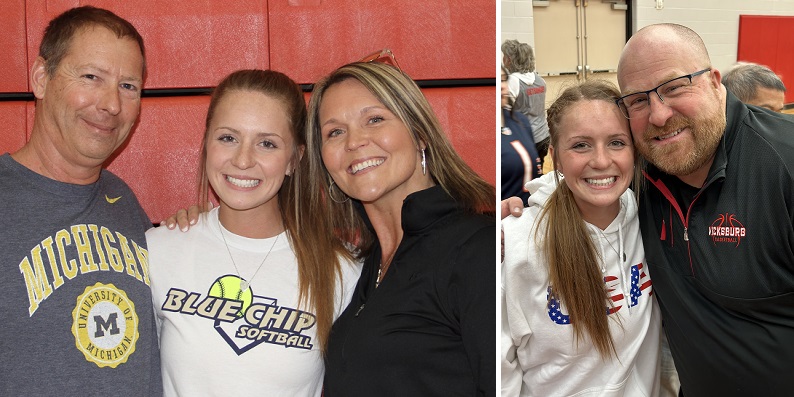
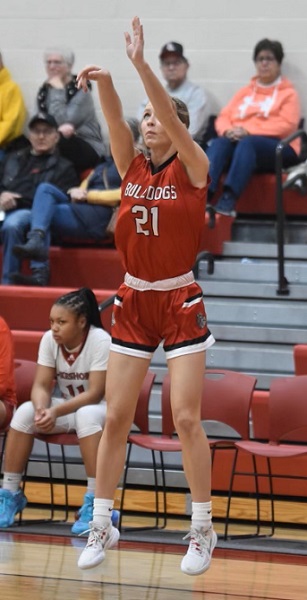
PHOTOS (Top) Vicksburg’s Tristin Abnet is glad to be back on the court, and intense going to the basket. (2) Stitches stretched across Abnet’s scalp as three metal plates and a hinge were applied to her skull. (3) Abnet is surrounded by support including parents Cheyenne, left, and Kristina, and coach Tim Kirby. (4) Abnet launches a jumper during a game with Stevensville Lakeshore. (Photos courtesy of the Abnet family.)
Countdown to Calvin: Girls Regional Preview
By
Geoff Kimmerly
MHSAA.com senior editor
March 11, 2019
While rematches and revenge will be the minds of many playing in Girls Basketball Regionals beginning tonight, rewards will be the end result for only 32 teams fortunate enough to advance past Wednesday and into the winter’s final week.
 All 128 District champions will play Regional Semifinals this evening, with championship games Wednesday and then a long weekend before Quarterfinals roll us toward the Finals at Calvin College.
Below are three Regionals in each division that especially caught my attention, plus some of the District Finals that popped off the page over the weekend.
Countdown to Calvin is powered by MI Student Aid and based on results and schedules posted for each school at MHSAA.com. To offer corrections or fill in scores we’re missing, email me at [email protected].
Week in Review
The countdown of last week’s five most intriguing results:
1. Haslett 44, Williamston 42 – After finishing second in the Capital Area Activities Conference Red to Williamston with losses of 19 and 13 points, Haslett handed the Hornets their first defeat since Dec. 17 to claim a Division 2 District title.
2. Pontiac Notre Dame Prep 71, Detroit Country Day 59 – The Fighting Irish remain one game below .500 this season, but following up an upset of Wixom St. Catherine with this Division 2 victory over the reigning Class B champion is what they’ll remember most about this season.
3. Kalamazoo Christian 42, Gobles 38 – Not only was Gobles undefeated entering this Division 3 District Final, but it had played just three single-digit games all season.
4. East Kentwood 57, East Grand Rapids 54 – The Ottawa-Kent Conference Red champion Falcons held on in Division 1 to edge the winners of the O-K Gold.
5. Brown City 41, Sandusky 31 – Three teams tied for first in the Greater Thumb Conference East, but only Brown City remains after winning this Division 3 District Final matchup of two of those champs.
Regionals at a Glance
These could be among our most competitive brackets. Host sites are in bold:
DIVISION 1
Caledonia
Coldwater (21-1) vs. East Lansing (20-2), Portage Central (16-4) vs. DeWitt (21-2)
This has been a historic season for Interstate 8 Athletic Conference champion Coldwater, as the Cardinals won their first league title since 1992 and are just a four-point loss to another District champ, Ann Arbor Pioneer, from a perfect record. But if Coldwater is to also win its first Regional title since 1991, it will have to break up the anticipated collision of CAAC Blue co-champs East Lansing and DeWitt. The Trojans – last year’s Class A runners-up – won the first meeting between the rivals, lost the second, and their only other defeat was by two points to Saginaw Heritage in a rematch of last year’s title game. DeWitt’s only other defeat came 24 hours after beating East Lansing, by four points to St. Johns. The Panthers, of course, can’t look ahead – Portage Central won the Southwestern Michigan Athletic Conference West, although it may become important to note that the Mustangs fell to Coldwater by 38 in their regular-season finale.
Mount Pleasant
Marquette (20-3) vs. Midland Dow (22-1), Saginaw Heritage (20-2) vs. Flint Carman-Ainsworth (18-5)
Saginaw Valley League Red rivals Midland Dow and Saginaw Heritage may get a rematch, after Dow won their lone regular-season meeting by four on Feb. 1 on Heritage’s home floor. That game ended up deciding the league title. But to get another chance at the Chargers, the Hawks first must defeat another league champion – SVL Blue winner Carman-Ainsworth – after also defeating the Cavaliers by seven on Jan. 9. Dow also has another league champ up first: Marquette won the Great Northern Upper Peninsula Conference, with only a two-point loss to Brighton and defeats to one-loss Ishpeming Westwood and Negaunee helping to make for a strong resume.
Southfield Arts & Technology
Grosse Pointe North (19-3) vs. Bloomfield Hills Marian (21-1), Southfield Arts & Technology (20-1) vs. Warren Cousino (15-8)
Three more league champions highlight this bracket. Macomb Area Conference Red winner Grosse Pointe North and Detroit Catholic League Central and A-B champ Marian face off in a rematch from early December, when the Mustangs won by 13. Marian’s only loss this season was the Division 2 favorite Detroit Edison by six points. Southfield A&T doubled up Detroit Public School League Tournament champion Detroit Mumford in their District Final last week and is a two-point loss to Heritage from a perfect run. This bracket really presents an opportunity for the MAC Red to show again why it’s considered one of the toughest leagues in the state after all six teams finished at least 12-9 this winter. North’s only other losses were to Division 2 powers Harper Woods Chandler Park and Detroit Country Day, and third-place Cousino fell by only three to Marian in both teams’ season opener.
DIVISION 2
Adrian
Carlton Airport (21-1) vs. Dearborn Divine Child (13-9), Chelsea (22-1) vs. River Rouge (12-6)
Airport has won 20 straight games since falling to 2018 Class D champ Adrian Lenawee Christian on Dec. 13, and is playing for its first Regional title. But Divine Child is a dangerous opponent with wins in seven of its last nine games and both losses during that string to Marian. Similarly, Chelsea is playing for its first Regional title as well, and with just a two-point loss to Pioneer on Feb. 28 keeping it from perfection so far. But the Bulldogs first face another league champion in River Rouge, which prepped for the Michigan Metro Athletic Conference Blue schedule by taking on a number of the state’s best from Division 1. The Panthers opened this winter 2-5 against that strong competition, but its only loss since Jan. 8 came nonleague to Carman-Ainsworth.
Coloma
Benton Harbor (4-15) vs. Plainwell (15-6), Hamilton (22-0) vs. Edwardsburg (23-0)
Of course the Hamilton/Edwardsburg matchup tonight is one of the state’s biggest regardless of division. Hamilton won its first Regional title in girls basketball last season, and Edwardsburg is hoping to accomplish the same for its program this week. The Ottawa-Kent Conference Green-winning Hawkeyes haven’t had a single-digit game since Jan. 11. While Edwardsburg won the Wolverine Conference South, Plainwell was second in the North and defeated a league champion in Comstock on Friday to move on to this week. Benton Harbor was one of the statewide surprises of the District round. The Tigers didn’t earn their second win this season until Feb. 19, but have now won three of their last five games and clinched the District title with two victories by a combined six points.
Mount Morris
Freeland (20-2) vs. Corunna (20-2), Stanton Central Montcalm (22-0) vs. Frankenmuth (14-7)
Three more league champs help fill this Regional. Freeland from the Tri-Valley Conference Central and Corunna from the Genesee Area Conference Red both are returnees to Regionals, Freeland making it to the Class B Quarterfinals a year ago. The Falcons’ only losses this winter were to Division 1 contenders Dow and Heritage, while Corunna has bounced back from mid-winter defeats to Fowlerville and Division 3 power Flint Hamady. Central Montcalm is coming off its second straight perfect regular season and Central State Activities Association Gold title, and is seeking its first Regional title. Frankenmuth is the lone non-league champ in this bracket, having finished third in the TVC East. But the Eagles have won nine of their last 12.
DIVISION 3
McBain
Houghton Lake (21-0) vs. Hart (12-10), Oscoda (22-0) vs. Lake City (19-2)
The winner of this bracket will be celebrating something not accomplished in a long time – or ever. A pair of undefeated teams might seem destined to meet in the Regional Final – Oscoda, from the North Star League Big Dipper, is seeking its first Regional title and Jack Pine Conference champ Houghton Lake its first since 1992. But Lake City is only a pair of three-point losses to Highland Conference champion Manton from also being perfect, and the Trojans are seeking their first Regional title since 1976. Hart is also seeking its first since 1992 and on a roll after navigating a number of much larger and successful opponents in the West Michigan Conference.
Michigan Center
Springport (18-3) vs. Michigan Center (19-3), Adrian Madison (21-1) vs. Laingsburg (19-4)
Michigan Center is riding high after avenging losses to Manchester on Wednesday and then Cascades Conference champion Grass Lake with a 49-44 overtime win Friday to clinch last week’s District. The Cardinals made the Class B Semifinals a year ago and can continue to put that tournament experience to work against Big 8 Conference champ Springport, although the Spartans have won 17 of their last 18 since starting 0-2. Adrian Madison slipped up against Manchester two weeks ago but otherwise won the Tri-County Conference by four games and has nearly doubled up last season’s 11 wins. Laingsburg provides an interesting wild card to this bracket – the Wolfpack don’t get much attention coming from the same Central Michigan Athletic Conference as Division 3 favorite Pewamo-Westphalia. But aside from two losses to the Pirates, Laingsburg hasn’t fallen since the first week of this season.
Sault Ste. Marie
Iron River West Iron County (19-2) vs. Ishpeming Westwood (22-1), Charlevoix (18-2) vs. Elk Rapids (17-5)
The Western Peninsula Athletic Conference Copper and Iron champs, respectively, face off on the Upper Peninsula side of this bracket. Westwood has been making good on high aspirations all season and is now playing for its first Regional title since 2008. The Patriots’ only loss came to Negaunee, and they then avenged it twice on the way to league and District titles. Westwood beat West Iron by 15 all the back on Dec. 11, and the Wykons haven’t lost since on the way to also winning a league title. They’re seeking their first regional title since 1986. From the other side of the Bridge, Charlevoix is playing for its first Regional title since 2004 after also winning its league and seeing junior Elise Stuck become the program’s all-time leading scorer. Charlevoix beat Elk Rapids twice on the way to winning their Lake Michigan Conference. But the Elks upset Manton on the way to winning last week’s District and would love to add a first Regional title since 1993.
DIVISION 4
Lansing Christian
Hillsdale Academy (14-8) vs. Portland St. Patrick (17-6), Athens (18-4) vs. Adrian Lenawee Christian (21-2)
The reigning Class D champ Cougars, led by sophomore standout Bree Salenbien, are a comfortable favorite this week with losses to only Division 3 powers Grass Lake and Michigan Center this winter. But Athens is surging. The Indians began last week’s District by avenging an opening night loss to Battle Creek Calhoun Christian, and then got past rival Bellevue in their District Final after losing twice to the Broncos during the regular season. On the other side, Hillsdale Academy has flipped last season’s 7-14 finish and won 10 of its last 13 games. And quite quietly, Portland St. Patrick followed up Division 3 District winners P-W and Laingsburg in the CMAC to tie for third in that league under six-time Class D champion coach Al Schrauben.
Mendon
Mendon (17-3) vs. Martin (18-3), Fruitport Calvary Christian (18-5) vs. St. Joseph Michigan Lutheran (18-2)
Calvary Christian is seeking its first Regional title and Martin its first since 1995 in what could be one of the most unpredictable brackets in any division. Martin and Mendon both finished second in their leagues to Division 3 teams, and all six of their combined losses were to Division 3 opponents. Calvary Christian’s losses all were to Division 3 teams as well as the Eagles went undefeated in the Alliance League. Mendon last won a Regional title in 2014, but Michigan Lutheran has the most postseason experience of the quartet making the Quarterfinals in 2017 and the Regional Semifinals a year ago. The Titans enter as Berrien-Cass-St. Joseph White champs and coming off avenging one of their two defeats by beating Three Oaks River Valley in the District Final.
Pellston
St. Ignace (23-0) vs. Hillman (12-11), Newberry (12-10) vs. Mackinaw City (22-1)
The Saints are a Division 4 favorite with wins over Detroit Mumford, Goodrich and Reese augmenting the usual run through league and area opponents. But on the other side of Mackinac Bridge is a hopeful Comets team seeking its first Regional title and with only a Dec. 10 loss to Brimley keeping them from perfection so far. St. Ignace and Mackinaw City wouldn’t meet until Wednesday, though, and their Regional Semifinal opponents have the needed momentum to make tonight challenging. Hillman opened this season with six straight losses and nine in its first 12 games, but the Tigers bounced back to go 9-2 over their last 11 games. Newberry survived a string of seven losses in nine games through January and February to win its last five and get past Brimley by a point in last week’s District Final.
Second Half’s weekly “Countdown to Calvin” reports are powered by MI Student Aid, a part of the Student Financial Services Bureau located within the Michigan Department of Treasury. MI Student Aid encourages students to pursue postsecondary education by providing access to student financial resources and information, including various student financial assistance programs to help make college more affordable for Michigan students. MI Student Aid administers the state’s 529 savings programs (MET/MESP) and eight additional aid programs within its Student Scholarships and Grants division. Click for more information and connect with MI Student Aid on Facebook and Twitter @mistudentaid.
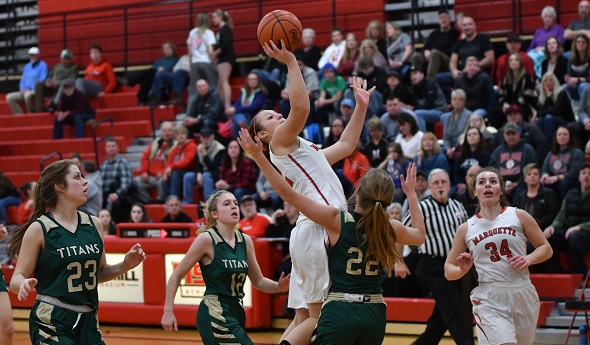
PHOTO: Marquette's Kaeleigh Talbacka drives to the basket as Traverse City West's Tacey Looze (22) stands her ground. (Photo by Cara Kamps.)