


Be the Referee: Abnormal Course Condition
By
Paige Winne
MHSAA Director of Brand Management
October 1, 2024
Be The Referee is a series of short messages designed to help educate people on the rules of different sports, to help them better understand the art of officiating, and to recruit officials.
Below is this week's segment – Abnormal Course Condition - Listen
We’re on the golf course today and our approach into 18 has gone from bad to worse. Or has it?
Our shot lands in a puddle, in the middle of a bunker, which certainly isn’t good. But because water in a bunker is an abnormal course condition, we’re allowed free relief.
We’re able to go to the nearest spot of relief, no closer to the hole, and drop within a club’s length of that spot while still playing from the bunker.
Or relief can be taken outside of the bunker, no closer to the hole, and within line of the shot – but a penalty stroke is added.
So you have two options if you find water inside a bunker; only one requires you to take a penalty stroke.
Of course the best course of action is to avoid the bunkers all together!
Previous 2024-25 Editions
Sept. 25: Tennis Nets - Listen
Sept. 18: Libero - Listen
Sept. 10: Cross Country Uniforms - Listen
Sept. 3: Soccer Handling - Listen
Aug. 24: Football Holding - Listen
Bath Finishes Unforgettable Fall with Historic Championship Sweep
October 17, 2026
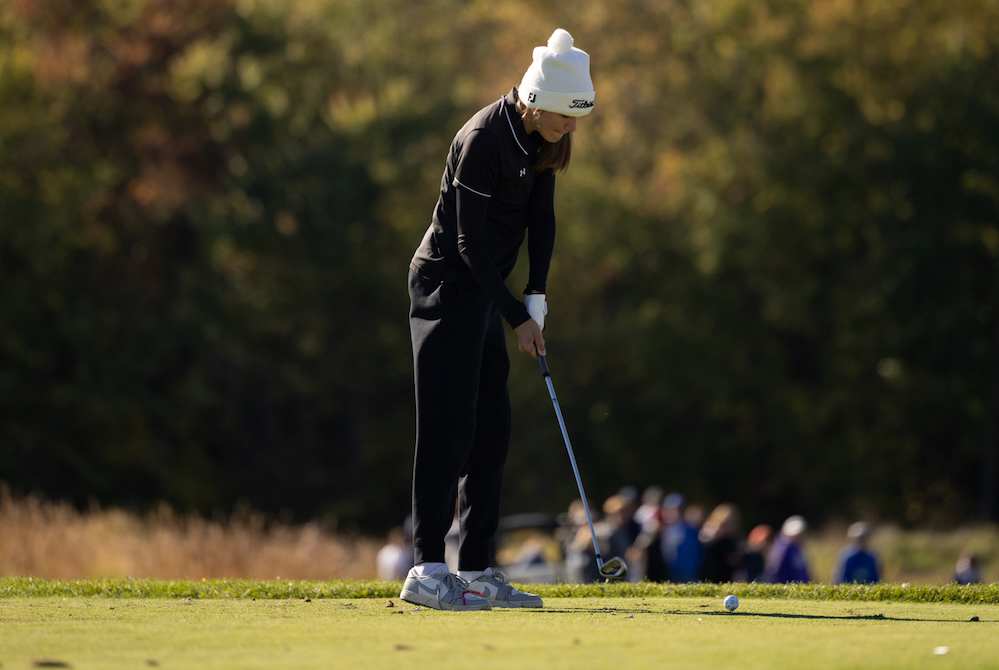
ALLENDALE – The Bath High School sports community will never forget this fall’s girls golf team, which capped the program’s sixth season Saturday by winning its first MHSAA Finals championship.
And coach Chad Vietzke will remember the pivotal details.
“That they go play golf all the time together, they love being together as a group, and just how close they are,” he said. “Last February, six of these girls met up in stocking caps, and there was snow, and they were hitting range balls at a heated area. And I knew then that we had something special.”
And this weekend, unstoppable.
The Bees carded a two-round 739 at The Meadows at Grand Valley State University, holding off runner-up Kalamazoo Christian as a 19-stroke first-day lead faded to only 14 by the end of the second round. Bath also celebrated sophomore Addilyn Duflo’s 14-stroke individual victory as she carded 152 strokes over 36 holes.
Sophomore Hattie Lalonde tied for 10th individually at 183, while senior Sophia Perales tied for 25th and juniors Mya Vietzke and Brooke Kares rounded out the scoring, contributing one round apiece over the two days.
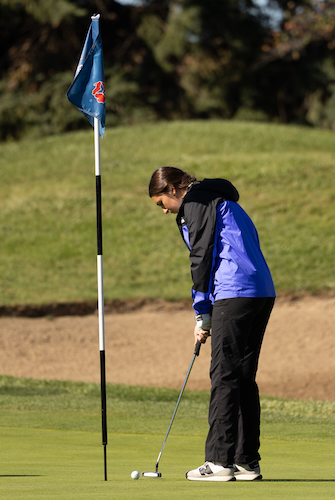
Bath’s girls golf team has reached the Finals all six seasons of its existence, with the Bees’ previous high finish fifth in 2023. They officially began making their move on this championship Oct. 7 when they claimed a Regional title for the first time. But they’d been building toward this weekend for much longer.
“We’ve grown so much. We were out there working in the winter, out there working in the summer. Every day it’s always drive, drive, drive,” Perales said. “We started (this season) great, and we just got better throughout the year. It just kept getting better and better.”
Duflo is doing the same after a magnificent high school debut. She finished second at the LPD4 Final last season as a freshman, and continued to surge this season. She was medalist at the Regional two weeks ago and entered Saturday’s final round with a nine-stroke lead.
She was the only golfer to break 80 on the weekend – doing so both rounds – and her first-round 73 and two-round score fell just outside the top 10 all-time in LPD4 Finals history.
“I didn’t really think about it, like I could do this sophomore year,” Duflo said. “Knowing last year what happened, it was like yeah, maybe I could do it. But I didn’t think it would be this year.”
Elk Rapids sophomore Piper Smith, Fowler senior Noelle Krepps and Byron junior Adalen Brown all tied for second in the individual standings, carding matching scores of 166.
Elk Rapids as a team finished third, followed by Millington among those that broke 800.
(Photos by High School Sports Scene.)