

Yunke Shares Soccer Across States, Seasons
By
Pam Shebest
Special for MHSAA.com
April 24, 2017
BANGOR — When it is spring, Dennis Yunke can be found coaching girls soccer in Bangor.
 But in the fall, he spends three months in Minnesota as the Mankato West High School assistant varsity and head junior varsity coach.
Each position has resulted in unique experiences that he would not trade for anything.
When then-superintendent Ron Parker wanted to start a girls soccer team at Bangor High School, Yunke stepped up.
“It was a situation where I know quite a few people in the soccer culture, and at least four of them turned down the job so it fell to the old guy,” quipped Yunke, who had started club programs from scratch when he lived in Holland.
“I went out and got some good people to help me.”
The first season, Yunke had 25 girls on the team and “maybe one knew how to play soccer,” he said. “I had to go to a charity group in Holland and get totes full of cleats to give out to the girls because they were showing up for tryouts in sandals.
“They had never worn cleats, shin guards. They had played soccer in the backyard with their siblings, but none of them knew anything about soccer.”
That first season, eight years ago, the team won two games – both against junior varsity teams.
Three years ago, Yunke took the job in Mankato to be closer to his grandchildren.
“My two adult sons (Justin and Corey) live in the Twin Cities area in Minnesota and my two grandchildren (Lydia and Lauren) live there,” he said.
“The reason I was looking for something to do there is that when I called my boys and said I wanted to come to stay for a couple weeks or a month, I sensed a lot of panic that neither one of them wanted Dad around for that long.”


 The Minnesota girls season runs from Aug. 10 through Nov. 10 which fit perfectly with the Michigan soccer season. So Yunke started looking for a fall job. He discovered a few schools were looking for soccer coaches.
“Two days before their season started, the Mankato Scarlets called me and asked if I was still interested because the person they had selected had to back out,” he recalled.
“They were desperate and had to take the old guy.”
Last season, Class A Mankato ended the year with a 19-3 record, losing in the Minnesota state final.
“Since I arrived in 2014, neither the varsity nor JV has had a losing season,” Yunke said. “They are a talented group of dedicated, committed, hard-working girls.”
Yunke’s junior varsity team was 11-2 in the fall, scoring 89 goals and allowing just eight. In six games, opponents never got off a shot, Yunke said.
"Our JV has continued to thrive under Dennis' leadership,” Mankato varsity coach Chrissy Makela said. “We had a strong JV before he arrived, and he has continued that tradition.
“While that might seem an easy task, Dennis doesn't see these kids the other eight or nine months out of the year as he is in Michigan.”
She said Yunke brings passion and knowledge about the game to the program.
“He is constantly seeking new ideas and learning about the game,” she said. “Then he shares his ideas with the rest of the staff.
“He has some unique team-building exercises with his JV that are different than varsity. This way his team can distinguish themselves as a group, and whatever we do with varsity does not seem redundant to the players.”
Coaching in two states provides several challenges for Yunke, especially since his wife, DeeDee, a medical secretary, stays in Bangor.
Living in a tent
Living arrangements posed a big problem since “they don’t pay enough money to go out and rent an apartment short-term,” he said.
“The first year, I actually camped in a campground in a tent and just loved it. As it got colder, one of the parents came up and said they wanted me to come stay with them.
 “I stayed with them next year and last year stayed with the varsity coach. Essentially, I just throw myself out to look for a host family. I kind of hold a sign saying ‘Homeless Coach.’”
He gets back to Bangor at least once during the three fall months and uses email and social media to keep in touch.
“I remind the girls of any soccer events they may be interested in as well as keep an eye on the players who are playing fall and winter sports,” he said.
A Class C school, Bangor has no junior varsity team, so freshmen begin their high school careers on varsity.
Because of that lack of experience, Yunke started a feeder program in the middle school three years ago.
“Tony Keh took over the second year of middle school,” Yunke said. “He has solidified that middle school program. We have five very talented middle school players who will be freshmen next year.”
Mary Spade, Bangor’s athletic director, said Yunke loves soccer – and it shows.
“He brings years of experience, knowledge of the sport, dedication off the charts and loyalty and compassion for coaching,” she said. “He’s very dedicated.”
The Vikings lost five seniors, including leading scorer Maggie Ring (24 goals, 20 assists), from last year’s team that went 7-10.
“We lost the heart of the team,” Yunke said. “Our leading scorer, midfield leader and defensive leader.”
But this year’s team has started 4-1-1. Junior Madi McGuire leads with eight goals, senior Megan Watkins has seven and senior co-captain Janet Ibarra six.
Although “soccer is soccer,” Yunke said there are some big differences between his two teams.
“The difference has a lot to do culturally and socio-economically,” he said. “The girls in Mankato have more opportunities when it comes to clinics and training. They all play club soccer, they all go to camps in the summer.
“Sometimes we have to hold off on our tryouts because they’re in Europe playing soccer. They go for three or four weeks, going on tours and playing against European clubs. There’s just a lot of opportunities there that these (Bangor) girls just don’t have.”
'Soccer is Soccer'
“The level of competition (in Minnesota) is much higher,” he said. “Every game is a dog fight because you’re playing against a pretty level playing field.
“(In Michigan) it’s up and down. The Kalamazoo area schools have more club players. The kids are better funded. We don’t have that (in Bangor). What we do have is a really great fighting spirit. These girls have a lot of heart, and that’s what I like about them.”
Even the way the girls address their coaches is different.
 “(In Bangor) they call me Coach,” he said. “In Minnesota they asked me what I wanted to be called. I said Coach because that’s what I’m used to being called.
“They said, Nah, we’re going to call you Dennis. They call the varsity coach Mac.”
The Bangor players also have chocolate milk, courtesy of the United Dairy Industry of Michigan.
“They granted us with $1,100 for the season, and I go out and get the chocolate milk and give the girls a cooler full of chocolate milk every day," Spade said. "It’s very good for recovery. We wouldn’t be able to do it without the grant.”
Senior co-captain Gisella Lorenzo said the guaranteed refreshment also serves as good incentive.
“We have it after every practice and every game,” she said. “I think that’s what pushes us, and we look forward to the end of practice.”
Lorenzo was one of the girls who had never played soccer before trying out for the team as a freshman.
“I didn’t really know anything,” she said. “In the beginning of the season, Coach sets up drills and usually there are captains already set up.
“Coach and captains work together to show us how to pass balls and communicate with each other.”
Ibarra said Yunke uses 10 core values to bond the team.
“We do a lot of team bonding, and that really helps us work together as a team,” she said. “That’s very important. We really use those values throughout the season.”
Yunke said the Bangor community is a soccer community, and “our fans are great. I hope I can coach forever. I’m having a ball.”
Other seniors on the team are Brenda Garcia, Olivia Moore and Taylor Watkins.
Other juniors are Nina Ring and Sam Zordan.
Sophomores are Yasmeen Burton, Marilin Carrillo, Elena Guel and Laisha Ramirez. Freshmen are Maritza Barajas, Jennifer Garcia, Jocelyn Ponce, Jennifer Quinones, Bella Amarissa Serratos and Summer Torres.
 Pam Shebest served as a sportswriter at the Kalamazoo Gazette from 1985-2009 after 11 years part-time with the Gazette while teaching French and English at White Pigeon High School. She can be reached at [email protected] with story ideas for Calhoun, Kalamazoo and Van Buren counties.
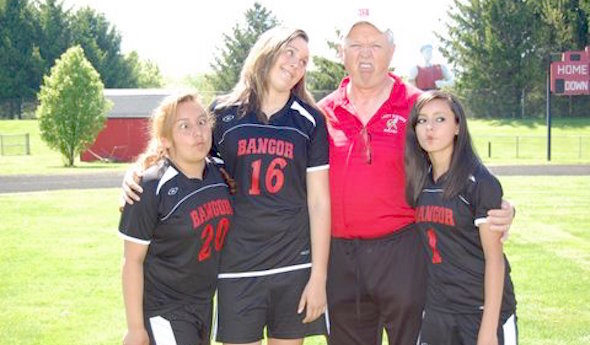
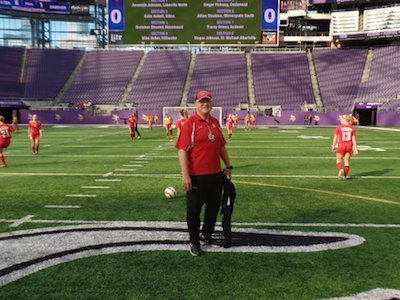
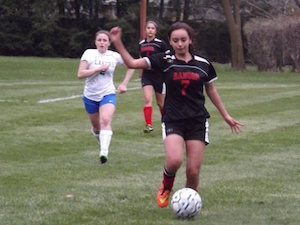
PHOTOS: (Top) Bangor girls soccer coach Dennis Yunke shares a light moment with, from left, Gisella Lorenzo, Olivia Moore and Janet Ibarra. (Middle top) Yunke, Mankato West girls varsity coach Christina Makela, Bangor athletic director Mary Spade. (Middle below) Yunke walks the field at U.S. Bank Stadium in Minneapolis before Mankato West’s state championship game. (Below) Ibarra pushes the ball upfield during a game. (Bangor and Mankato soccer practice and game photos courtesy of Dennis Yunke.)
Preview: Champs Seek to Extend Streaks
June 11, 2015
By Geoff Kimmerly
Second Half editor
The setting is new – at least somewhat – as the MHSAA Girls Soccer Finals return to Michigan State University this spring for the first time since 2012. The format is new, as two Finals will be played Friday and Saturday.
But most of the favorites are familiar as three teams compete to repeat as champions.
Grandville Calvin Christian is playing for its fourth straight title in Division 4, while Richland Gull Lake is looking to make it three straight in Division 2 and Hudsonville Unity Christian is playing for its second straight title but ninth total overall.
The narrative is the opposite in Division 1, where both teams are playing for the first title in program history.
Below is this weekend’s schedule, followed by glances at all eight finalists.
Friday
Hudsonville Unity Christian vs. Detroit Country Day, 1 p.m.
Richland Gull Lake vs. Fenton, 4 p.m.
Saturday
Grandville Calvin Christian vs. Lansing Christian, 1 p.m.
Saline vs. Grand Blanc, 4 p.m.
Tickets cost $8 per day and include admission to baseball and softball games that day also at MSU’s Old College Field. Radio broadcasts of all games can be heard online at MHSAAnetwork.com. All games will be streamed live online at MHSAA.TV and viewable on subscription basis.
All statistics below are through at least the regular season, with most through teams' Regionals. (Click for links to brackets and scores.)
DIVISION 1
GRAND BLANC
Record/rank: 18-5-5, unranked
Coach: Greg Kehler, 17th season (260-80-47)
League finish: Third in Kensington Lakes Activities Association West.
Championship history: Division 1 runner-up 2004.
Players to watch: Annie Walker, sr. F (29 goals, 10 assists), Lara Wheeler, fr. F (17 goals, 5 assists); Amy Puidokas, jr. GK (0.60 goals-against average, 8 shutouts).
Outlook: Grand Blanc is on its best tournament run since making the Semifinals in 2005 after eliminating No. 1 Rochester Hills Stoney Creek, No. 10 Northville and then No. 5 Troy Athens in its last three games. Walker made the all-state first team last season and is again the scorer to stop, with 2014 all-state honorable mention Lexi Trudeau, a junior, among those moving the ball into striking position.
SALINE
Record/rank: 21-0-3, No. 6
Coach: Dana Restrick, sixth season (record at school N/A)
League finish: First in Southeastern Conference Red.
Championship history: Has never played in an MHSAA Final.
Players to watch: Sofia Sweier, sr. GK (0.17 goals-against average, 20 shutouts); Taylor Mulder, sr. F (41 goals, 11 assists); Amanda Zylstra, sr. D (3 goals, 5 assists).
Outlook: Saline is 40-3-6 over the last two seasons and won its first Regional title last week. No. 3 East Kentwood in the Quarterfinal was the eighth straight opponent to be shut out by the Hornets, who have given up only four goals this season. Sweier and Zylstra made the all-state second team last season, and Mulder made the third.
DIVISION 2
FENTON
Record/rank: 15-4-3, honorable mention
Coach: Matt Sullivan, 11th season (record at school N/A)
League finish: Second in Flint Metro League.
Championship history: Has never played in an MHSAA Final.
Players to watch: Brennan Sullivan, sr. M (1 goal, 3 assists); Brianna Costigan, jr. M (9 goals, 11 assists); Abigail Quesnelle, soph. GK (0.60 goals-against average, 14 shutouts).
Outlook: Fenton has reached the Semifinals three of the last seven seasons, but after two one-goal heartbreak losses that ended those first two trips, broke through by beating No. 6 Trenton this week. The Tigers also eliminated No. 4 Warren Regina and No. 8 Linden during the tournament and have won 11 of their last 12 games. Fenton scored 26 goals during the regular season, but has put 17 in the net in six tournament games. Costigan made the all-state second team last season, and Sullivan earned an honorable mention.
RICHLAND GULL LAKE
Record/rank: 24-1-1, No. 2
Coach: Jeff Corstange, fourth season (82-8-4)
League finish: First in Southwest Michigan Athletic Conference East.
Championship history: Three MHSAA titles (most recent 2014), four runner-up finishes.
Players to watch: Hannah Phommavongsa, sr. F (16 goals, 8 assists); Amanda Pavletic, sr. M (14 goals, 8 assists); Olivia Sullivan, sr. D (1 goal, 4 assists); Kirsten Taylor, sr. F (24 goals, 11 assists).
Outlook: Gull Lake has won two straight MHSAA championships and is loaded with veterans as it goes for a third. Taylor made the all-state third team last season, and Phommavongsa, Sullivan and Pavletic earned honorable mentions. Gull Lake defeated No. 10 DeWitt and honorable mention Middleville Thornapple Kellogg during this run, with the lone loss by a goal midseason to Division 1 Grand Rapids Forest Hills Central. Junior keeper Regan Troff took over in net this spring and has saved 96 percent of the shots against her.
DIVISION 3
DETROIT COUNTRY DAY
Record/rank: 18-3-2, No. 3
Coach: Bob Bukari, 29th season (record at school N/A)
League finish: Does not play in a conference.
Championship history: Five MHSAA titles (most recent 2004), four runner-up finishes.
Players to watch: Isabel Nino, soph. D/GK; Jenna Staudt, sr. D/M; Dagny Hill, soph. M; Libby Ronchetto, sr. M/D (Statistics not submitted).
Outlook: Country Day has finished runner-up three times since its last title, but has plenty of key players who experienced last season’s run. Hill and Staudt made the all-state second team in 2014, Nino made the third and Ronchetto earned honorable mention. The Yellowjackets eliminated No. 6 Grosse Ile and then edged No. 2 Flint Powers Catholic in a shootout to advance to this weekend.
HUDSONVILLE UNITY CHRISTIAN
Record/rank: 23-1, No. 1
Coach: Randy Heethuis, 26th season (487-87-28)
League finish: First in Ottawa-Kent Conference Green.
Championship history: Eight MHSAA titles (most recent 2014), three runner-up finishes.
Players to watch: Bethany Balcer, sr. M (38 goals, 13 assists); Maddy VanDyke, jr. D (5 goals, 2 assists); Casandra Besteman, sr. M (3 goals, 3 assists); Elly Brummel, sr. D (4 goals, 5 assists).
Outlook: Unity Christian bounced back from a rare Finals miss by winning its eighth title last spring and second in three seasons. Unity Christian downed the reigning champion, Grand Rapids South Christian, in the Regional Final and also eliminated No. 4 Grand Rapids Catholic Central. Balcer – one of five players with at least 10 goals – and VanDyke are returning all-state first-teamers, while Brummel made the second team and Besteman earned honorable mention.
DIVISION 4
GRANDVILLE CALVIN CHRISTIAN
Record/rank: 21-3, No. 2
Coach: Tim TerHaar, 15th season (255-64-20)
League finish: First in O-K Silver.
Championship history: Division 4 champion 2014, 2013 and 2012.
Players to watch: Allison Keizer, sr. GK (0.88 goals-against average, 14 shutouts); Morgan Buursma, sr. D (20 goals, 4 assists); Hilary Curry, sr. M (24 goals, 16 assists); Emily VanVliet, sr. M (11 goals, 26 assists).
Outlook: Calvin Christian can become just the second team in MHSAA history to win four straight girls soccer championships, following the Unity Christian teams of 2005-10. Keizer and Buursma made the all-state first team last season, while Curry made the third team and VanVliet earned honorable mention. Four Calvin Christian players have scored at least 20 goals this season – junior forwards Whitney Koets (28) and Natalie Honeycutt (22) are the other two.
LANSING CHRISTIAN
Record/rank: 20-4, honorable mention
Coach: Joel Vande Kopple, ninth season (129-41-9)
League finish: Tied for first in Greater Lansing Activities Conference.
Championship history: Division 4 runner-up 2011.
Players to watch: Kasey Jamieson, fr. F (47 goals, 15 assists); Emily Voss, sr. F (27 goals, 16 assists); Rachelle Trafford, sr. GK (0.74 goals-against average, 15 shutouts).
Outlook: Lansing Christian has reached at least the Semifinals four of the last five seasons, giving the Pilgrims as much late-round experience as most left this weekend. Voss made the all-state third team in 2014 and provides an excellent one-two scoring punch with Jamieson, who also had both goals in the Semifinal win over Grosse Pointe Woods University Liggett to push her first-season total to 49.
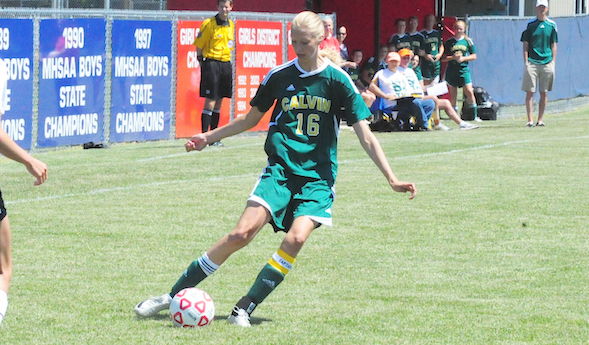
PHOTO: Grandville Calvin Christian's Emily VanVliet controls possession during last season's Division 4 Final win.