

Veteran Coach, Huskies Eye Comeback
By
Pam Shebest
Special for MHSAA.com
December 21, 2015
PORTAGE — Although his hockey team skidded to the worst start during his 30-year coaching career, JD Kalleward and his Portage Northern Huskies still have that positive vibe going.
 “We don’t want to keep losing,” senior co-captain Jack Budnick said last week after the team opened 0-7. “We want to turn it around as soon as we can.
“We’ve had a lot of close games where it’s just come down to a couple mistakes, and we’re working on them in practice.”
Portage Northern closed the 2015 portion of this season's schedule with its first win, 4-2 over Manistee on Friday, to move to 1-8 heading into the new year. And Kalleward is one reason the players are staying positive and focused, said senior co-captain Austin Killman.
“He’s been very vehement about hockey,” Killman said. “If he sees anybody slacking in practice, he’ll get them going.
“He’s been around the game for so long that he knows a lot about hockey and what systems will work in different situations. I have a lot of faith in his style.”
Kalleward said he honed his coaching style while working as an assistant to Art Missias, who passed away from cancer in 2010.
A netminder, Kalleward graduated from Northern in 1980. During his high school years, he helped coach goalies for his uncle, John Kalleward, Sr., and Missias with their squirt and peewee house teams.
It didn’t take long for JD to catch the coaching bug.

 When Missias took over the head coaching job at Portage Northern 30 years ago, he tapped JD Kalleward to be his assistant. Thirteen years ago when Missias retired, Kalleward took his mentor’s place.
One of the lessons learned from Missias is helping Kalleward deal with his team’s record so far this year: “You may have a down game, but it’s just one game.
“You’ve got to move on, learn from your mistakes and take the positives from it. Try and hope in the next game you do better.”
After losing nine seniors to graduation from a team that went 18-9-0 overall, 8-2 in the Southwest Michigan High School Hockey League last season, Kalleward knew this would be a rebuilding season. But he didn’t expect such a challenging start, including 0-2 in the league.
“Six of our (first) seven games have been on the road against very good programs including Traverse City, Forest Hills, East Kentwood, so we’ve had some pretty stiff competition,” Kalleward said.
Besides Budnick and Killman, the Huskies have just two other seniors: forward Scott Verduzco and goalie Tim Fitzgerald.
Scoring other successes
Although the Huskies have struggled early on the ice, Kalleward is most proud of their academic performance.
In his 13 years as head coach, his team has earned academic all-state every season.
“The last two years we were the top academic team out of 160 hockey teams in Michigan,” he said. “Two years ago, our team’s (grade-point average) was 3.94. Last year, it was 3.96
‘We have a number of kids who are academically gifted. Of the nine who graduated last year, we had just one beneath a 3.0; the other eight were above 3.5.”
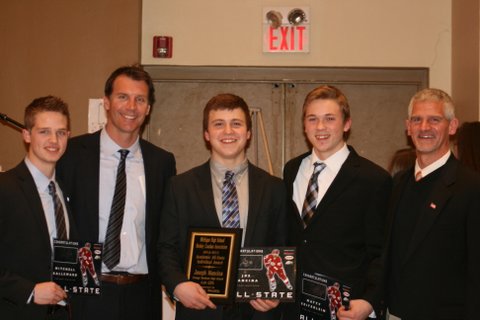
Last season, Joe Mancina, with a 4.65 GPA, became the Huskies’ third top state scholar athlete in the last six years, as measured by grade-point average.
 One main reason Kalleward stresses academics is, “quite frankly, there aren’t too many who are going to sign NHL contracts,” he said. “We know that life after high school means doing well.
“Every Thursday we meet with the players after practice to talk about where they are at school, their grades. We offer tutoring with those who are struggling.”
Over the last 30 years, Kalleward has seen several changes to both the game and the players.
“Relative to talent, you used to have a lot more kids going the route of playing high school,” he said. “Now they have so many options for players depending on what they want to do with their hockey careers.”
He also said players don’t seem as independent as they were in past years.
“What we find is sometimes it’s hard for kids to make their own decisions or make good decisions on their own,” he said. “As a coach, besides the X’s and O’s, we try to help them with that.”
As an assistant coach, Kalleward took note of what worked especially well and wrote a manual of expectations for coaches, parents and players that he distributes every season.
“We have an agreement signed by both parents and players saying they’ve read and understood the 16 points of emphasis, everything in the agreement: ice time, player behavior on the ice, behavior off the ice, academics, and so on,” he said.
Among team requirements are wearing khakis, a shirt and tie when going to games, “The same apparel they’d wear for a job interview,” he said.
“We eat together quite a bit and have rules on behavior. There’s probably a good three pages of rules.”
Turnaround time
Killman said it’s up to the captains to help turn the team around.
“You have to get your guys motivated for games, and if they’re getting down on themselves, try to get them back up,” he said. “If they’re coming to practice slacking, you’ve got to push them.
 “(Being captain) gives me more responsibility and I love responsibility.”
Budnick said Killman is one spark on the team.
“Out on the ice before we go to opening faceoff, we gather around the net and we talk about the key aspects that we want to work on in the game,” Budnick said. “Austin is always taking the responsibility and says exactly what we need to do.
“Austin is definitely the hardest worker on the team, and that’s a great leadership quality from my perspective. It pushes everybody else.”
Kalleward’s three assistants include two Portage Northern alums. Steve Stanley, who works with the forwards, graduated in 1983, and Ken Rogers, who works with the defense, in 1975.
Tom Askey, who played pro hockey, including with the NHL Anaheim Mighty Ducks in 1997-98 and the then-United Hockey League Kalamazoo Wings in 2006-07, works with the goalies.
In 1975, the Huskies made it to the Tier II MHSAA Final before losing to Lansing Catholic Central. They made at least the Semifinals four times under Missias.
In spite of this year’s start, the future looks promising for the Huskies with four juniors, 10 sophomores and two freshmen mixing with the senior leaders.
Juniors are forwards Spencer Brown, Andrew Fitzgerald, Jesse Liebert and defenseman Calvin Voss.
Sophomores are forwards Grant Ernst, Mason Seiferlein, Tyler Simon; blueliners Griffin McLoed, Roarke Ross, Leon Fieber, Dakota Meadmore; two-way players Will Todd, Caleb Martin and goalie Zach Bossch.
The freshmen are forwards Zonjic Singleton-Julian and Connor Sorge.
Northern picks back up this season’s schedule Jan. 2 against Okemos.
 Pam Shebest served as a sportswriter at the Kalamazoo Gazette from 1985-2009 after 11 years part-time with the Gazette while teaching French and English at White Pigeon High School. She continues to freelance for MLive.com covering mainly Kalamazoo Wings hockey and can be reached at [email protected] with story ideas for Calhoun, Kalamazoo and Van Buren counties.
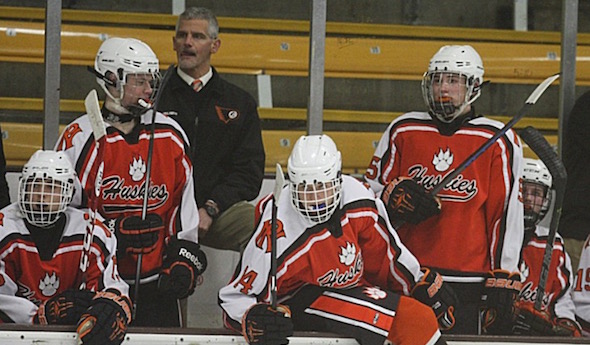
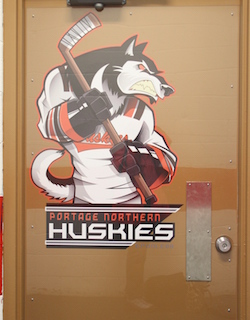
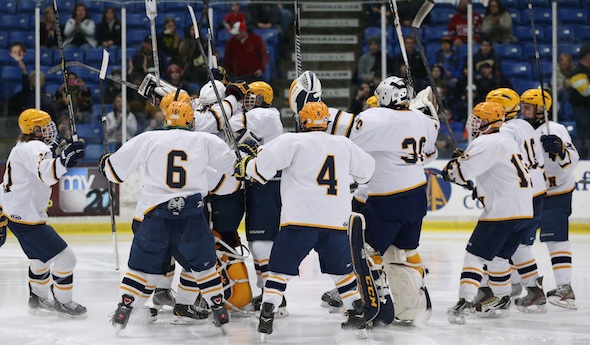
PHOTOS: (Top) Coach JD Kalleward has spent 30 seasons behind the Portage Northern bench. (Middle) Joe Mancina, center, was last season's top state academic athlete with a 4.65 GPA. He is joined by, from left, all-state team selection Mitchell Kalleward, former NHL player Mike Knuble, Northern all-stater Matty Seiferlien and Coach JD Kalleward. (Below) The Huskies' locker room door. (Head shots) From left: JD Kalleward, Jack Budnick and Austin Killman. (Top two photos courtesy of JD Kalleward; bottom photo and head shots by Pam Shebest.)
Seniors Earn Spot in Trenton Title History
March 8, 2014
By Geoff Kimmerly
Second Half editor
PLYMOUTH – Trenton senior Andrew Sawyer remembers attending every Trojans home hockey game growing up. He said his parents didn’t miss one for 15 years.
And he and the rest of Trenton’s seniors had contributed their share of memorable moments to one of the most storied programs in MHSAA history – including helping longtime coach Michael Turner become the state’s winningest at the high school level a few weeks ago.
But until Saturday, they had never been part of an MHSAA Finals championship.
Sawyer and six of his classmates closed their careers by helping Trenton to an 8-3 victory over Hartland in the Division 2 Final at Compuware Arena – and in doing so, became the 14th Trojans team to win the highest title and first since 2010.
“I grew up every day of my childhood, … looked up to every single player,” Sawyer said. “It feels amazing to finally be one of the guys I was looking up to at one point in my life.”
Turner, who upped his career record to 628-126-52 over 28 seasons, took his team in front of Trenton’s championship banners earlier this week to give them one last reminder of Saturday’s opportunity.
The Trojans (26-4-1) also received messages from past players wishing them luck with hopes they might enjoy what those past champions once experienced. Trenton trailed only Bloomfield Hills Cranbrook-Kingswood (16) in all-time hockey titles.
“It’s my best moment ever in hockey. It will be my best memory no matter what happens, whether I go on or whatever I do,” senior goaltender Nick Ramirez said. “It was amazing. And it was great to celebrate with my teammates.”
Trenton opened the weekend with a 7-0 Semifinal win over Warren DeLaSalle, then watched as Hartland – last season’s Division 2 runner-up as well – got on the board first in the Final with a goal 4:17 into the game.
But if the Trojans were worried at all, that was the last time during the 2013-14 season.
 Trenton scored the next six goals, with three from senior Justin Dunn and two within 12 seconds from senior Mitchell Galea to start the third period. Turner preached to his team all tournament to attack the goal, and Saturday the Trojans took 52 shots as Hartland goalie Nick Wineka made 42 saves, fourth most in MHSAA Finals history.
The Eagles finished 20-10-1 after giving coach Rick Gadwa his third Regional title in three seasons leading the program. They fell to Trenton 5-3 earlier as part of a 1-8 skid to finish the regular season. But they battled back with four one-goal wins during the MHSAA tournament.
Wineka was one of six seniors who were part of all three Regional title teams. They led a lineup that rebuilt this winter with a young defensive corps, and leave having helped build Hartland into an elite program.
“They pulled off some things this year that flashed through my head, and I can’t believe it,” Gadwa said. “To come back this year, you’ve got high hopes, you’ve got a target on your back, and we didn’t have all that we’ve had. … Unbelievable.”
Dunn – whose older brother Cory starred for Turner and dad had him as a teacher – also had two assists for Trenton. Galea added an assist on Dunn’s first goal, and junior Philip Pugliese had one of each.
Trenton opened this season 3-3 before winning its next two games by a combined score of 22-2. Turner watched Ramirez raise his game and knew he could have another contender – a point reinforced when the Trojans finished the regular season on a 9-1 run after going 5-5 over the same stretch a year ago.
Six games later, they stamped their place in Trenton hockey history.
“It’s a tradition. It’s a family atmosphere down here,” Turner said. “They can now take their mark. This is one of 14, and they certainly are going to have that memory for a long, long time.”
Click for a complete box score.
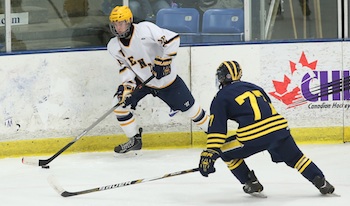
PHOTOS: (Top) Trenton celebrates an 8-3 win and its 14th MHSAA championship. (Middle) Trenton's Nickolas Bondy (10) looks to move the puck around Hartland senior Austin Flores (77).
HIGHLIGHTS: (1) Hartland’s first goal by Josh Ruthig. (2) Trenton’s Justin Dunn completes his hat trick with 1 second left in the second period. (3) Mitchell Galea of Trenton completes his hat trick – all three goals came in the third period.