

Detroit Powers Succeed Amid Lower Numbers
By
Tom Markowski
Special for Second Half
April 20, 2016
Participation in spring sports, following a similar decline in student-aged population in Michigan, has been on a decline statewide over the last decade.
 But while some like baseball have experienced a slight bounce-back over the last few seasons, softball in particular has seen its numbers continue to fall.
Coaches and administrators in the Detroit area point to a number of factors intertwined that produced a snowball-like effect – and now it seems to have come to a head.
Three softball programs in the Catholic League Central, a division that competes at a high level statewide, don’t have sufficient numbers to field a junior varsity this spring. Many programs don’t sponsor freshmen teams for the same reason.
But for schools like Birmingham Marian, Farmington Hills Mercy and Livonia Ladywood not to have a junior varsity softball team is quite shocking to some – especially considering that Mercy enters this season ranked No. 3 in Division 1 and Ladywood is No. 2 in Division 2.
Specialization fallout
Marian athletic director Dave Feldman isn’t among those stunned. He saw this coming. Feldman points to the 2007-08 school year when the Michigan High School Athletic Association was forced, by court decision, to switch the volleyball season from the winter to the fall and the girls basketball season from the fall to the winter.
Feldman has a daughter, a freshman at Marian, who participated on the junior varsity volleyball team this fall. When that season was over she joined a club volleyball team. Feldman said the club volleyball season begins in December and continues on into June.
“It’s not AAU,” Feldman said. “But you need to be an AAU member (to play). They play all of the time. Heck, they played on Easter Sunday. And every club is filled.”
The pressure on athletes to play year-round is arguably greater now than it ever has been, and can come from coaches, peers and family – based on a frequent misconception that if athletes want to earn a scholarship, they better keep up with the Joneses or be left behind.
Feldman said he’ll back his daughter with whatever decision she makes. If she wants to play volleyball nine or 10 months a year, he’ll support that. But Feldman said, financially, it’s getting out of hand. He estimated between the cost of airfare, hotels and meals that he’ll spend $6,500 in support of his daughter playing club volleyball.
And, according to Feldman, the increase in attention on volleyball is affecting participation in other sports.
“(Girls) basketball is fighting for its life,” he said. “Our field hockey program (a fall sport) is fine. Our lacrosse teams are fine.
“We have 15 playing volleyball at all three levels. We had 16 (total) try out for softball and we made two cuts. We haven’t had a JV the last two years. The last time we had a freshman (softball) team was in 2004 or 2005. The last few years the numbers have dropped off. It’s the specialization.”
Simply signs of change?
Warren Regina is another member of the Catholic League Central. Regina athletic director Diane Laffey also is the head coach for softball and basketball, and she said she thinks lacrosse has drawn some athletes away from softball – which makes sense, although the total number of girls playing high school lacrosse in Michigan has increased only about 1,000 over the last decade, while softball participation is down 4,000 athletes over the same time.
One should not use Regina as an example of decline – Laffey’s team won the Division 1 championship last spring and fields a softball team at all three levels. At the same time, Regina also has seen a rise in participation in lacrosse. There are 18 playing for both the varsity and junior varsity this spring, the highest participation in school history.
Mercy varsity softball coach Alec Lesko said, simply, that times have changed. Mercy reached the Division 1 Semifinals last season, just as Ladywood did in Division 2 the year before – yet despite this success, Mercy’s number of softball players also has declined.
 “(The students) have many more options,” Lesko said. “In addition to their school work there’s band, theatre, honors society clubs. In the past kids would play three sports and be in the band. All of my daughters were multi-sport athletes. By their sophomore year they had to make a decision (on which sport they would concentrate).
“It’s also economics. They want to earn a scholarship. You hear horror stories about (the cost of) student loans. Even the big schools have trouble getting the (students to play softball).
“As far as college, and I can only speak about softball, the Big Ten coaches want the player they recruit to play other sports,” Lesko added. “I hope to have a JV program next year. A player that misses 30 JV games, we will feel that crunch later. There are those who think JV softball is a waste of time, that you should just compete in travel (during the summer). We will get some of those kids. Those who compete in travel then come to us as sophomores.”
Reasons for optimism
Don Peters is the softball coach at Clarkston, and between coaching travel and at the high school level he’s put in 35 years. He coached travel before taking over the Clarkston program. Peters said the two complement each another, or at least they should.
“I know some disagree,” he said. “The girls have a lot of choices in the spring. Look at all of the sports they can play. I don’t think lacrosse has cut into the numbers. Not yet, but it’s probably going to. We haven’t been affected. We have 45 (covering three teams) in our program. We really push softball in our community because it’s been established.”
Peters said coaches in softball and baseball need to make the game enjoyable, and one way is to reward those who chose to participate by playing them on a regular basis. A student who is No. 14 or 15 on a squad often will play once a week and, with all of the options available, isn’t willing to put in the practice time for limited game action.
Mercy senior first baseman Abby Krzywiecki played a variety of sports before her freshman year. It was then she decided that softball would be her main sport and she chose to pour all of her energy into it.
She said it’s not all gloom and doom for her sport.
“We had a small freshmen class (last year),” she said. “When I came in we had a large class. It was one of the biggest. It’s not that we’re not getting softball players. In the travel world, it’s becoming more intense. We have more younger people playing. The sport is getting more intense. The talent level is getting higher.”
 Tom Markowski is a columnist and directs website coverage for the State Champs! Sports Network. He previously covered primarily high school sports for the The Detroit News from 1984-2014, focusing on the Detroit area and contributing to statewide coverage of football and basketball. Contact him at [email protected] with story ideas for Oakland, Macomb and Wayne counties.
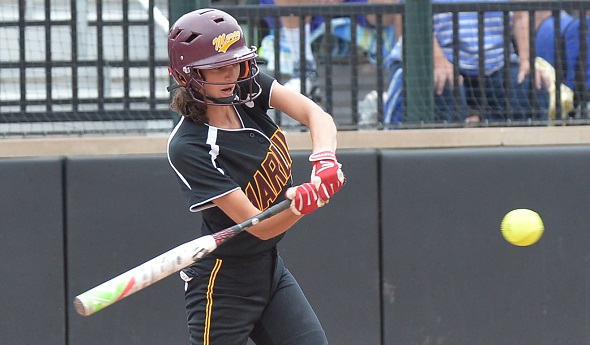
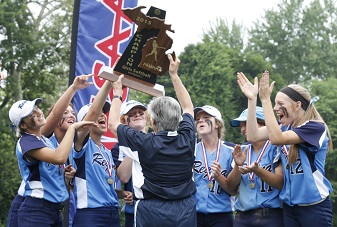
PHOTOS: (Top) A Farmington Hills Mercy hitters prepares to connect during last season's Division 1 Semifinal against Caledonia. (Middle) Warren Regina coach Diane Laffey hoists her team's championship trophy after the Saddlelites downed Caledonia in the Final last spring.
Performance of the Week: Walled Lake Northern's Lyla Turmell
June 18, 2026
 Lyla Turmell ♦ Walled Lake Northern
Senior ♦ Softball
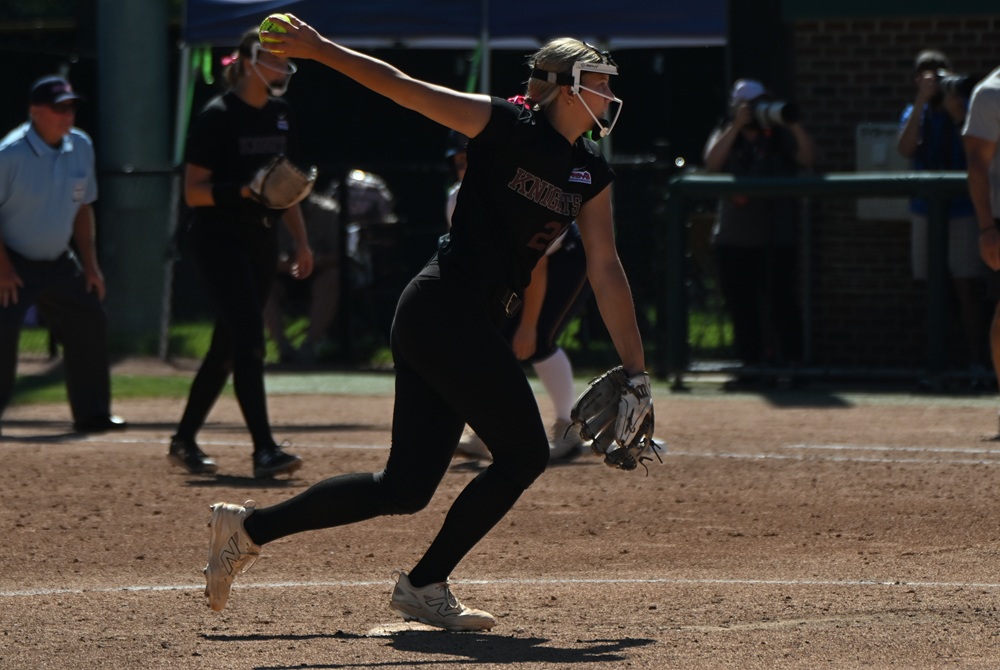
Turmell certainly met the moment of playing in her team's first MHSAA Finals championship game Saturday at Secchia Stadium. Northern's ace pitcher threw a one-hitter and hit a home run as the Knights defeated Grand Haven 2-1, clinching not only the softball program's first championship, but the first Finals team title in any sport in Walled Lake Northern history.
An all-state first-team selection as both a senior and junior, Turmell led the Knights to a 39-3 record this spring. She threw a five-hitter and struck out 11 batters as Walled Lake Northern defeated Northville 2-1 in its Semifinal on June 13, and she struck out nine with the first-inning home run in the championship game win over the Buccaneers. Turmell will continue her academic and softball careers at Toledo, where she will study nursing.
@mhsaasports 🥎POW: Lyla Turmell #walledlakenorthern #softball #highschoolsports #performanceoftheweek #MHSAA @lyla turmell ♬ Girly and cute synth pop - SAKUMAMATATA
@mhsaasports 🥎POW: Lyla Turmell #funfacts #tiktalk #performanceoftheweek #highschoolsports #MHSAA @lyla turmell ♬ Bright and fun upbeat pops, Kids, Animals, Pets, Fun, Cute, Happy, Playful, Upbeat(1465232) - SAKUMAMATATA
Follow the MHSAA on TikTok.
MHSAA.com's "Performance of the Week" features are powered by MI Student Aid, a division within the Department of Lifelong Education, Advancement, and Potential (MiLEAP). MI Student Aid encourages students to pursue postsecondary education by providing access to student financial resources and information. MI Student Aid administers the state’s 529 college savings programs (MET/MESP), as well as scholarship and grant programs that help make college Accessible, Affordable and Attainable for you. Connect with MI Student Aid at www.michigan.gov/mistudentaid and find more information on Facebook and X @mistudentaid.
Previous 2025-26 honorees
June 12: Charlotte Cook, Detroit Country Day lacrosse - Report
June 4: Morgan Emerick, Utica Eisenhower tennis - Report
May 29: De-Mani Roberts, East Kentwood track - Report
May 22: Taleon Guess, Temperance Bedford golf - Report
May 15: Zacchaeus Brocks, Detroit Catholic Central track - Report
May 7: Savanah Thompson, Howard City Tri County soccer - Report
April 30: Eliza Schwass, Ludington track - Report
April 23: Emily Postema, Ravenna softball - Report
April 16: Katie Berkshire, Gaylord track - Report
March 26: Kayla Hairston, Goodrich basketball - Report
March 19: Liam Smith, Otsego swimming - Report
March 12: Jack Sayen, Houghton hockey - Report
March 5: Devin Patrick, St. Clair Shores Lake Shore - Report
Feb. 26: Madison Nieuwenhuis, Plainwell wrestling - Report
Feb. 20: Sophie Ramey, Allen Park competitive cheer - Report
Feb. 13: Cam Ryans, Grand Rapids Northview basketball - Report
Feb. 6: Melanie Kolnitys, Midland Dow basketball - Report
Jan. 29: Stella Musialowski, Huron Valley United gymnastics - Report
Jan. 22: Baylor Perkins, Grand Blanc swimming - Report
Jan. 15: Delaney Vanier, Flint Kearsley bowling - Report
Jan. 8: Stevie Hall, Detroit Cass Tech basketball - Report
Dec. 18: Ethan Martha, Ishpeming Westwood basketball - Report
Dec. 11: Louis Smith, Three Rivers wrestling - Report
Dec. 4: Traverse Moore, DeWitt football - Report
Nov. 28: Elizabeth Eichbrecht, West Bloomfield swimming - Report
Nov. 20: Brady Kieff, Blanchard Montabella football - Report
Nov. 13: Ella Laupp, Battle Creek Harper Creek swimming - Report
Nov. 7: Hunter Eaton, Charlevoix cross country - Report
Oct. 31: Stephen Gollapalli, Lansing Christian tennis - Report
Oct. 23: Talya Schreiber, Pickford cross country - Report
Oct. 16: Avery Manning, Dexter golf - Report
Oct. 9: Brady Van Laecke, Hudsonville football - Report
Oct. 2: Sarah Giroux, Flat Rock volleyball - Report
Sept. 25: Sam Schumacher, Portage Central tennis - Report
Sept. 18: Kaylee Mitzel, Saline field hockey - Report
Sept. 11: Natasza Dudek, Ann Arbor Pioneer cross country - Report
Sept. 4: Kate Posey, Big Rapids golf - Report
PHOTO Detroit Country Day's Charlotte Cook launches a shot during the Division 2 championship game while surrounded by a pair of East Grand Rapids defenders. (Photo courtesy of Hometown Life.)