

Neighbors, Friends & Coaching Legends
April 26, 2018
By Doug Donnelly
Special for Second Half
When Kris Hubbard was asked to coach the fledgling Ottawa Lake Whiteford softball team in the late 1970s, the first person she went to for advice was her neighbor, Kay Johnson.
 Johnson, who already had been coaching the Morenci softball team for about five years, wrote down a couple of pages worth of tips, from offensive situations for practice to drills for outfielders. Those golden rules given from one friend to another helped build the foundation for Hubbard’s career that has spanned 40 years, more than 800 wins and three MHSAA Finals championships.
“I wanted to start a softball program and I said to her, ‘Okay, what do I need to do?’” Hubbard recalls. “I think I still have it. It was a pretty good list.”
“I got her started,” Johnson said. “I don’t know that I taught her a lot.”
Johnson graduated from Whitmer High School in Toledo in 1968 and Adrian College in 1972. She lived in Sylvania, Ohio, only a couple of miles from Whiteford High School, and accepted a teaching and coaching job at Morenci. She coached volleyball, basketball, softball and track. Her 1976 Bulldogs track & field team won the Lower Peninsula Class D championship.
Hubbard grew up in Blissfield and played college basketball at Western Michigan University, graduating in 1973. After college she accepted a teaching job at Whiteford and early on was coaching track, volleyball and basketball for the Bobcats. After the 1978 track season, Hubbard stepped down as head coach for that team. It was then that some of the Whiteford girls came to her and asked if she would be interested in coaching them in a new sport at the school – softball.
“I had played fast-pitch softball, but I didn’t know all of the little things kids needed to know,” Hubbard said. “That’s why I went to her.”
Johnson and Hubbard had met a few years earlier when Johnson was playing on a Toledo city league recreation basketball team. Her team needed more players and her uncle told her about Hubbard, who, come to find out, was a distant relative. The two didn’t know each other, but they lived about a long fly ball from each other at the Michigan-Ohio border.
“My mom’s brother was married to her grandma’s sister,” Johnson said. “We didn’t know each other. I was at Thanksgiving and my uncle said I should call her for the basketball team.”
“So, I talked with her and I thought maybe we could ride together,” Hubbard recalls. “I asked where she lived. Turns out, she lived on the first street into Ohio (across the state line) and I lived on the first street in Michigan. … We have a lot in common. Both of us like sports and have similar interests. We’ve been friends ever since.”
They’ve been more than just rivals in different dugouts. When Hubbard was getting married in the 1980s, she moved in with Johnson after her house sold. For years they have traveled to softball coaching clinics together, even making a presentation on softball drills at least once. This past winter they vacationed together.
“She’s been a good friend,” Hubbard said.
Hubbard had never coached softball but was a fast learner. Her first three Bobcats teams won Tri-County Conference championships from 1979-81. In 1984, the Bobcats won their first of three Class D championships over the next four years.
Ironically, only one of those state title teams won a league championship. That’s because Tri-County Conference opponent Summerfield won the Class C title in 1984 and Johnson’s Morenci team won Class C titles in 1985 and 1986.
The league has been a softball powerhouse from the start. Since 1984, Summerfield and Whiteford have three MHSAA Finals titles each and Morenci and Clinton two apiece. Numerous TCC teams have reached the Semifinals or played in championship games. Whiteford, for example, played in the 2017 Division 4 Final and Morenci in the 2016 Semifinals.
“There have been some good coaches in the TCC, and I’m not talking about us,” Hubbard said.
Hubbard has 11 TCC titles to her credit, including the 2017 win. Robert Taylor (Summerfield) has eight league titles, Johnson seven and Al Roberts (Clinton) five.
The league has also been home to some tremendous talent. Summerfield’s Michelle Bolster played at Indiana University. Whiteford’s Leigh Ross was an All-American at the University of Toledo, later coached at Syracuse and is now a softball analyst for ESPN and the Big Ten Network. Morenci pitcher Renae Merillat was an All-American at Hillsdale College. Summerfield’s Melissa Taylor claimed the statewide Miss Softball Award as the top position player in 1997.
 Johnson entered 2018 with 889 career victories, Hubbard with 813, putting them both near the top of the MHSAA softball coaching wins list. Johnson has more than any softball coach in Lenawee County history, while Hubbard passed Monroe’s Vince Rossi last year to become the winningest softball coach in Monroe County history. This year, both teams are in a loaded Division 4 District that includes Britton Deerfield, Summerfield and Sand Creek.
“There have been times where the District is tougher than Regional,” Hubbard said.
Johnson said both she and Hubbard have the same philosophy when it comes to the regular season – throw out the records and build a team that can contend for an MHSAA championship.
“Our league prepares us for the District tournament,” she said. “We both put teams on our schedule that are going to challenge us. I’d rather lose 3-1 then win 15-0. Winning 15-0 does nothing. It doesn’t teach anything.”
Morenci was a member of the Lenawee County Athletic Association before joining the TCC in the early 1980s. That meant the two friends would be coaching against each other at least twice a year.
“We’ve done it enough now that it’s just another league game,” Johnson said.
It’s no accident the two have similar coaching styles and strategy when it comes to developing pitchers, bunting at key situations in a game and advancing runners.
“We talk about softball a lot, just not about playing each other. That’s not exactly fun,” Hubbard said. “I think we are both pretty laid back. To coach as long as we have, you have to be.”
The game has changed over the years – the ball itself is much different than it was in the 1970s and 1980s. The home run was rare 20 years ago but is now part of the game, something Johnson isn’t thrilled about.
“I hate the home run in fast-pitch,” she said. “I want doubles, triples and relays from the outfield. I want action. You work your defense. I want them to be able to show off. The bats have really livened up the game.”
Hubbard wants to coach the Bobcats at least one more year after this season. This spring her team has seven players back, including its top pitcher, from last year’s runner-up finish. Most are only juniors. She smiles easily when talking about ex-players and their after-school successes.
“I love Facebook for one reason – you get to follow a lot of your former athletes,” she said. “There’s a whole lot of them who are really successful in life. That’s what it is all about. It’s a game. Softball is just a game. It’s (a small part) of your life. If you turn out all right, that’s what it is about.”
Johnson used to identify pitching prospects while teaching physical education at Morenci. She was later a principal and now is athletic director at Morenci along with softball coach.
“It’s sustained over the years,” Johnson said of the program. “We’ve had our low years. One year we only won five games. But, program-wise, year-in and year-out, we bring out the quality kids. They know the expectations. They have a high grade-point average. When you are getting those quality kids out, you know they are going to give you a good effort.”
Johnson and Hubbard will square off this season May 22 in a doubleheader at Whiteford. Before the game, which will be the 106th and 107th meetings between the two all-time, Hubbard will put a Snapple in the dugout for Johnson. Neither coach is interested in knowing who has the upper hand when it comes to the head-to-head series.
“You don’t get real fired up about it,” Hubbard said. “For those two hours I want to kick her butt and she wants to kick mine. We are going to be friends no matter what.”
 Doug Donnelly has served as a sports and news reporter and city editor over 25 years, writing for the Daily Chief-Union in Upper Sandusky, Ohio from 1992-1995, the Monroe Evening News from 1995-2012 and the Adrian Daily Telegram since 2013. He's also written a book on high school basketball in Monroe County and compiles record books for various schools in southeast Michigan. E-mail him at [email protected] with story ideas for Jackson, Washtenaw, Hillsdale, Lenawee and Monroe counties.
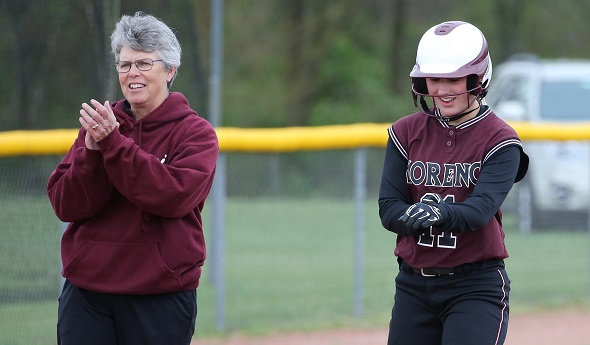
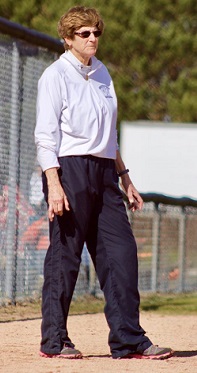
PHOTOS: (Top) Morenci’s Kay Johnson encourages her next hitter as a runner reaches third base. (Middle) Ottawa Lake Whiteford’s Kris Hubbard surveys the field during Wednesday’s sweep of Petersburg Summerfield. (Photos by Mike Dickie and Angela Link, respectively.)
Vicksburg Not Done After Historic Run
By
Pam Shebest
Special for MHSAA.com
May 23, 2017
VICKSBURG — The first time Grace Stock played softball, she absolutely hated it.
 The Vicksburg senior was just 8 or 9 at the time, and that dislike lasted all of one game.
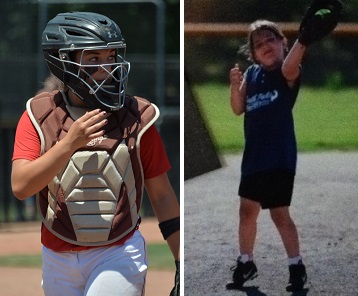
In her second game, “I played second and there was a ball that was hit above me, and I went on tip toes and reached out my mitt,” she said.
“My eyes were closed and I caught it. After that, I just loved it and wanted to play all the time. I have a picture of it, too, which makes it even better.”
She may not be playing all the time, but she and her Bulldogs teammates hope to be playing well into the postseason.
Last year, her team became the first in Vicksburg school history to make an MHSAA championship game, losing 2-0 to Richmond in the Division 2 Final.
Losing just two seniors from that team, “people ask, reflecting back on last year, are your expectations the same?” fifth-year head coach Paul Gephart said. “I say, last year is in the past, and this year we’ve got to focus one game at a time.”
After flying under the radar last season, this year’s Bulldogs are ranked fourth in state with Districts set to start next week.
“It’s absolutely extra pressure,” Gephart said. “I think it motivates other teams. They’re going to bring their best effort against you.
“I think it’s bulletin board material for other teams and kind of fuels them. Now we’re on the other side of that, and there is that pressure as far as expectation.”
The Bulldogs take a 25-9-1 (16-2 Wolverine Conference) record into the final week of the regular season. They have clinched the conference title for the second consecutive year.
Three key seniors – Stock, Carlie Kudary and Shaidan Knapp – earned all-state honors last year and have been starters since their freshman season.
 Sadie Martin – the team’s second pitcher and an “awesome” outfielder, Gephart said – and “really solid” first baseman Raquel Rice round out the senior class. Gephart said in his mind he refers to the seniors at the Fab Five.
“All five of them, the four years they’ve been here, the team has been academic all-state,” he said. “I think that’s huge that they’re that intelligent and that driven.
“The way it works in softball, individual academic all-state you get that award your senior year, and all five will get that award this year.”
Stock is second on the team with a .487 batting average and 44 RBI.
“She is a solid catcher, all-around catching,” Gephart said. “Offensively, defensively, she’s the best catcher I’ve been around or associated with in female softball.”
Stock was behind the plate and Avery Slancik on the mound for every postseason game last season.
“I used to be a pitcher, but I wasn’t too good at that. But I liked that I was in every play, so catching suited me well,” Stock said.
Slancik, a junior, started playing travel ball with the Portage Hurricanes when she was 8 and was coached by her dad, Michael Slancik.
“Dad actually coached nine of the 11 girls we have on the team,” she said. “Back in the day I was a pitcher and a catcher, but my brother was a catcher so I chose to pitch.”
When she was a freshman, her father put up a barn with three batting cages inside.
“Me and my brother (Trace), who is a freshman at Hope and plays baseball there, and a neighbor are out there all the time practicing and getting better every day.”
Slancik has been the Bulldogs number one pitcher since she was a freshman and earned all-state honorable mention last year.
 “He’s coached baseball his whole life until I started playing softball,” she said. “Whenever we went to his house, we’d always play catch.
She and Stock are best friends, which will make for an interesting season in another year. While Stock will play softball at Calvin College after graduation, Slancik plans to play at Hope the following year. “It’s going to be fun,” Slancik said. “They’re big rivals, but we’re going to stay best friends.”
Kudary, meanwhile, is a slap-hitter and one of the fastest players on the team.
“She gets on base a lot for us and since she bats leadoff, that gets us going right away,” Gephart said. “As a freshman, initially she was on the JV and we brought her up when we had an injury, and she’s been a starter ever since.
“She has so much speed, there are teams who would have really good hits in gaps, but she gets to them. That makes us really solid up the middle with Avery pitching, Grace catching, Shaidan at shortstop and Carlie at center.”
Knapp leads the team with a .510 batting average and 50 RBI. Her grandfather, Ed Knapp, got her started playing softball.
“He’s coached baseball his whole life until I started playing softball,” she said. “Whenever we went to his house, we’d always play catch.
“I’d ask to go to the park to hit instead of playing at the playground. I’d want to hit softballs. He’s been with me through the whole experience.”
Ed Knapp, who has coached various sports since 1964 and baseball until 1998, is Gephart’s assistant. He is also a member of the Michigan High School Coaches Association and Vicksburg halls of fame.
Knapp’s sister, Tailynn, is a freshman infielder – but they don’t get special treatment from their grandfather.
“He doesn’t really treat me like a grandchild, but at the same time, he’s such a sweet old man he acts like everyone’s his grandchild,” Shailyn said. “It’s nice to be able to see him on the field because I know him off the field. He’s a really fun guy.”
Ed Knapp said there is a down side to coaching his granddaughters
“People are always going to say, yeah, they’re playing because he’s the coach. They always say that until they look at how they play. No coach can survive if they play favorites.”
 On the up side, “It’s a lot of fun watching them progress and get better. They really listen. It’s easy to work with them because you can do it in more of a grandfatherly approach.”
He hopes to instill words of wisdom to the players from his decades of coaching.
“You have to have fun. That’s the main reason kids play sports, is to have fun,” he said.
“I just cringe when I hear some of these coaches screaming and yelling at their players. You can just see those girls with their heads going down.”
Team bonding plays a big role in Vicksburg’s success.
“The key is how close we are and just trusting that the person behind us has each other’s back,” Slancik said. “For instance, if one of us gets out, the next person will get another hit.
“If one person makes an error, the next person can step up and say, ‘It’s all right, I’ve got you.’ We’ve been implementing that into our game.”
Stock recalled how the team also got a boost from the community when it returned from the MHSAA Finals last year.
“Fans were lining the street and, we got escorted by police officers and fire trucks, so that was pretty cool,” she said. Later that summer, “There was a party at the football field for family and friends. We got all of our awards, and parents told us how proud they were of us.”
Of course, Vicksburg was disappointed to end the Cinderella season with a loss. But being one of two Division 2 teams standing at the end was special.
“You never want to lose,” Kudary said. “We have to look at it from a better perspective and realize we were the second team in the state to get there.
And yet, “We have to keep our focus and keep working hard at practice. We can’t let last year’s season interfere with this year’s season.”
The other junior on the team is third baseman/outfield Lauren Goertler.
The lone sophomore is pitcher/infielder Kali Yant, and other freshmen are catcher/outfielder Camille Wadley and third baseman/pitcher Rylie Richter.
 Pam Shebest served as a sportswriter at the Kalamazoo Gazette from 1985-2009 after 11 years part-time with the Gazette while teaching French and English at White Pigeon High School. She can be reached at [email protected] with story ideas for Calhoun, Kalamazoo and Van Buren counties.
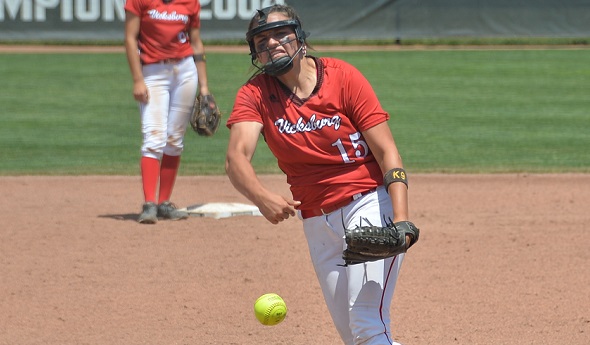
PHOTOS: (Top) Vicksburg pitcher Avery Slancik warms up before an inning during last season’s Division 2 Final at Michigan State’s Secchia Stadium. (Middle top) From left: Carlie Kudary, Avery Slancik, Shaidan Knapp. (Middle below) Vicksburg’s Grace Stock, last season catching the championship game and also as a child catching with her eyes closed. (Below) From left: Bulldogs head coach Paul Gephart and assistant Ed Knapp. (Middle photo provided by Grace Stock.)