

Kubiak Comes Back, Twice, to Lead Mustangs
By
Pam Shebest
Special for MHSAA.com
September 20, 2016
PORTAGE — Mikaela Kubiak is a fierce competitor on the volleyball court. But the Portage Central senior setter had an even harder fight off the court her first two seasons.
 Kubiak, who has been instrumental in the Mustangs’ run to a 23-3 start and No. 5 ranking in Class A, spent her first two seasons rehabbing from injury.
A starter on varsity as a freshman and sophomore, Kubiak tore her anterior cruciate ligament in her left knee, not once but twice, and endured two separate stints of grueling physical therapy.
Looking back, the personable Kubiak remembers every detail.
“It was our first home match against Kalamazoo Central and all my family and friends were here watching,” said Kubiak, who came to Portage from Central as a freshman and whose father Bob Kubiak had coached Kalamazoo Central football from 1993-2003.
But her first home volleyball match wasn’t even close to what she envisioned.
“It was in warm-ups and the second ball I hit, I came down and I blew my knee,” she said.
“Not a very good start. It was our first home varsity match, and I think it was the first or second week of school.”
Her first thoughts were that she could walk it off and continue to warm up.
“Then I was like, whoa, this is way more serious than I thought,” she said. “I couldn’t get up. I kept walking, then I just sat down on the ground. It was throbbing and I was in pain.
 “I was just super mad, super mad at myself that it happened. Of course, that game it would have to happen to me.”
She had knee surgery and spent nine months in recovery, including physical therapy at least three times per week.
“I wasn’t surprised she came back (after the first injury). I was surprised she got hurt again,” said Dawn Jaqua, who has coached the Mustangs for the last 18 years. “I was actually surprised she got hurt the first time because she’s such a strong kid, physically, so that was a shock.
“She is hugely determined and loves the sport. You can’t help but beat yourself up when you’re a coach and any kid gets hurt on your watch.”
 After missing her first season, Kubiak was raring to go as a sophomore.
The team’s setter was Madison Jaqua, who earned all-state first-team honors that year, so Kubiak was once again a hitter.
“Mattawan was like our big rival,” Kubiak said. “We were in the middle of our third set. It was a nitty-gritty, tight match. It was point after point after point, back and forth.
“Madison set me a ball and I came down and just overran it too much and I blew it out again. I knew right away because my knee moved on me.
“I was like, ‘Oh great.’ I think I was even more mad at that. It was like a pin dropped in the room and I was so frustrated. I technically tore it twice in the same year. I actually tore it on 9-11 my freshman year and 9-9 my sophomore year.”
Once again, Kubiak missed the rest of the season. But this time she knew what to expect from the physical therapy and did a lot of work on her own to supplement the workouts.
Giving up volleyball was not an option.
“I was more comfortable going back my junior season because I was back in my original position (as a setter with Madison Jaqua graduating) and I had a huge brace on. I didn’t have a brace my sophomore year.”
Dawn Jaqua said Kubiak’s role changed as a junior.
“She was setting for us,” she said. “The biomechanics are way different. We didn’t have her play front row last year. She set from the back row. We ran a kind of modified system for that.
 “Then she started playing front row a little bit for us at the end of the season. We let her block in controlled situations, and by the end of the season last year, we were running a 5-1 with her.”
The coach’s daughter, senior Devin Jaqua, who has been playing volleyball with Kubiak since seventh grade, was not surprised she returned stronger than ever.
“She’s always been a strong leader, and she’s always worked really hard,” the senior said. “She has a really big passion for the game, so I knew she’d always come back.
“She leads almost like the team mom. You can always depend on her, and she always plays her best. She always knows what to do and when to do it.”
In spite of losing two seasons of both high school and club volleyball, Kubiak earned Class A all-state honorable mention last season.
In November, she will sign to play collegiately with Division II Metropolitan State University of Denver.
Dawn Jaqua said Kubiak is the complete package.
“It’s all the components: her athleticism, her consistency, her decision making,” she said. “But at the end of the day, it’s about her will to want to win. She’s a great leader.
“She is a great problem solver. She’s demanding, but she does it in a very calming way. She’s very controlled. When things aren’t going well, she does a great job figuring out a different way to win. That’s her job.”
Devin Jaqua said this is a special year for the seniors.
“There’s five seniors, and it’s our last year,” she said. “Mikaela and Janell (Williams) are the only two so far going to play in college, so the rest of us really want to make it a memorable last year.”
Williams will sign with Western Michigan University. Jaqua will play soccer collegiately at Michigan State.
Talking from experience, Kubiak offers some advice: “For any other volleyball players out there, work hard all the time because you never know when it can be taken from you.
“Cherish every moment you have on the court with your teammates because it really does fly by.”
Other seniors on the team are Rebecca Barnes and Maddie Goodman. Juniors are Maddie Wojcik, Sara Denison, Olivia Harning, MacKenzie Zook and Jessie Zesiger. The sophomore is Ryann Jaqua and the freshman is Maizie Brown.
 Pam Shebest served as a sportswriter at the Kalamazoo Gazette from 1985-2009 after 11 years part-time with the Gazette while teaching French and English at White Pigeon High School. She can be reached at [email protected] with story ideas for Calhoun, Kalamazoo and Van Buren counties.
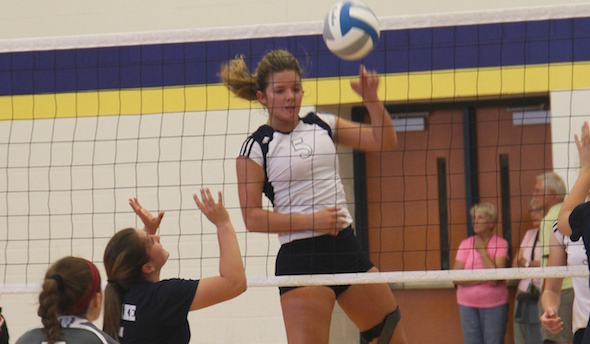
PHOTOS: (Top) Mikaela Kubiak tips the ball over the net during a recent match against Richland Gull Lake. (Middle) Kubiak and Portage Central coach Dawn Jaqua. (Below) Kubiak sets for teammate Janell Williams. (Photos by Pam Shebest.)
Block Party: 2025 Girls Volleyball Week 3 Report
By
Geoff Kimmerly
MHSAA.com senior editor
September 10, 2025
We’re having a party, and volleyball fans everywhere are invited.
Volleyball has become Michigan’s most popular girls high school sport, with nearly 20,000 high school players last season. “Block Party” is our newest MHSAA.com endeavor, and we’ll be providing glances at some of the best and brightest on courts all over the state during the buildup to our annual Finals weekend at Battle Creek’s Kellogg Arena.
We hope these weekly reports – as they have for football and basketball – shine more light on the week-in, week-out competition that shapes every season, and on programs you may already know about but also several more than maybe you’ll read about for the first time.
This season's first matches were played Aug. 20, making this the midst of our third week (and hence, our Week 3 Report). Records, results and schedules below are based on what’s posted for teams and used to calculate Michigan Power Ratings (MPR) on MHSAA.com. Rankings noted below reflect the latest polls posted by the Michigan Interscholastic Volleyball Coaches Association (MIVCA).
Week in Review
The countdown of last week’s five most intriguing results:
1. North Branch d. Monroe St. Mary Catholic Central (25-17, 25-19) The Division 2 No. 3 Broncos finished 6-0 at the Pontiac Notre Dame Prep Invitational, with this toppling of the No. 2-ranked team in Division 3 its best victory.
2. Rockford d. Grand Rapids Christian (25-19, 25-21) The Rams downed the Division 2 No. 2 Eagles and also No. 7 Grand Rapids South Christian among other notables during its Rockford Rumble.
3. Traverse City St. Francis d. Roscommon (25-23, 23-25, 25-20) The Division 3 No. 8 Gladiators’ win over top-ranked Roscommon made a big wave, although St. Francis did also fall to Division 1 Midland Dow on this night.
4. Bloomfield Hills Marian d. Utica Eisenhower (29-23, 19-25, 15-9) This was arguably Division 1 No. 3 Marian’s most impressive win during a MI Elite Program Cup run that also included a two-set sweep of No. 9 Brighton. Eisenhower was ranked No. 6.
5. Monroe St. Mary Catholic Central d. Imlay City (25-18, 20-25, 15-11) SMCC’s only loss at Notre Dame Prep was to North Branch (above), and the Kestrels earned a notable victory over Division 2 No. 5 Imlay City along the way.
Watch List
With an eye toward November, here are two teams in each division making sparks:
DIVISION 1
Bloomfield Hills (15-1-0) The No. 4-ranked Black Hawks did suffer their first loss of the season last week – in two sets to Marian. But they’ve otherwise have been unbeatable with wins over No. 5 Farmington Hills Mercy, honorable mentions Lake Orion and Novi and another Tuesday over Orchard Lake St. Mary’s, which ended Bloomfield Hills’ season last fall in a District Final. The Black Hawks will see Marian again Thursday.
Rockford (16-0-0) As noted above, the top-ranked Rams cruised through their Rockford Rumble, never dropping a set during victories over South Christian, East Grand Rapids, Grand Rapids Christian and Division 1 honorable mention Mattawan. The win over the Eagles was Rockford’s second this fall; they’ve also downed No. 8 Grand Haven, honorable mention Byron Center and Division 2 No. 4 Holland Christian among several impressive squads over the first three weeks.
DIVISION 2
Grand Rapids Christian (7-4-0) The Eagles’ losses have all come to ranked Division 1 teams – twice to Rockford and once apiece to Grand Haven and honorable mention Hudsonville. Meanwhile, Grand Rapids Christian defeated Division 1 No. 7 Jenison and Mattawan at Rockford over the weekend, and most recently Grand Rapids South Christian and Holland Christian at a power-packed tri last week. South Christian had ended the Eagles’ season with a five-set Regional Final loss last year.
Parma Western (9-0-1) The Panthers will pick up Thursday after a two-week match break and are ranked No. 10 in Division 2 coming off last season’s Regional Final run. Their only non-win was a two-set draw with Division 4 honorable mention Adrian Lenawee Christian, and wins over Division 3 No. 4 Pewamo-Westphalia to start the season and No. 9 Hanover-Horton at the Chelsea Invitational stand out most. Parma Western will see No. 9 Tecumseh on Thursday.
DIVISION 3
Monroe St. Mary Catholic Central (10-1-1) The reigning Division 3 champion is off to another fast start, with that loss to North Branch over the weekend and an early two-set tie against New Boston Huron their only non-victories this fall – and the Kestrels have defeated Huron twice since including 25-18, 25-17, 25-12, on Tuesday. SMCC has lost only four sets total, and only one during an eventual match win.
Saginaw Valley Lutheran (9-2-1) The Chargers aren’t ranked at this time but may get some looks soon. They opened the season with a loss to Division 4 No. 7 Crystal Falls Forest Park at the Mount Pleasant Sacred Heart Invitational, but came back to defeat the Trojans in the semifinals that day before falling to still-undefeated Division 1 Greenville in the championship match. Valley Lutheran has lost only one set over six matches since, to Division 2 Williamston at the Owosso Tournament where the Chargers finished 4-0-1.
DIVISION 4
Hancock (8-1-1) The Bulldogs have followed up last season’s run to the Division 4 Semifinals with a fast start, finishing 4-1-1 at the Kingsford Invitational against a field including several larger opponents after finishing 1-2-1 at the same event in 2024. Hancock will have another chance to improve on last season when it heads to The Rock Invite on Saturday at Gladstone – where it went 1-1-1 in 2024.
Mendon (12-1-1) The Hornets are coming off their toughest weekend of these first few, having finished 3-1-1 at the Cereal City Classic with a loss to Division 1 Battle Creek Lakeview and draw with Division 2 Pennfield but wins over Division 1, 3 and 4 opponents. They also opened the fall with a 5-0 run through the St. Joseph County Tournament as they look to build on last season’s Regional Final run.
Can’t-Miss Contests
Be on the lookout for results of these matches and tournaments coming up:
Wednesday – Flint Powers Catholic (7-5-1), Yale (14-2-0), Traverse City St. Francis (9-6-0) at Essexville Garber (9-6-2) – This quad features the No. 8 team in Division 3 – St. Francis – and the Division 2 honorable mention Dukes.
Thursday – Fowler (7-2-1) at Mount Pleasant Sacred Heart (8-3-3) – The Division 4 top-ranked Eagles visit No. 8 Sacred Heart, which reached the Semifinals last season.
Thursday – Frankenmuth (3-3-4), Rochester (1-6-0), Temperance Bedford (9-1) at North Branch (11-0-0) – In addition to North Branch being ranked No. 3 in Division 2, Frankenmuth is No. 8 and Bedford always is a top team in Division 1.
Saturday – Motor City Power Series at UWM Sports Complex in Pontiac – Division 1 No. 4 Bloomfield Hills, honorable mention Northville, previously-mentioned North Branch, Canton, and White Lake Lakeland will make for an intriguing field.
Saturday – Makayla Kohn Memorial Invitational at Caledonia – The field of Mattawan, Edwardsburg, Byron Center, Grand Rapids Forest Hills Northern, Ionia, Portage Central, Cadillac, Ada Forest Hills Eastern, Grand Rapids Forest Hills Central and Traverse City St. Francis includes ranked teams from Divisions 1, 2 and 3.
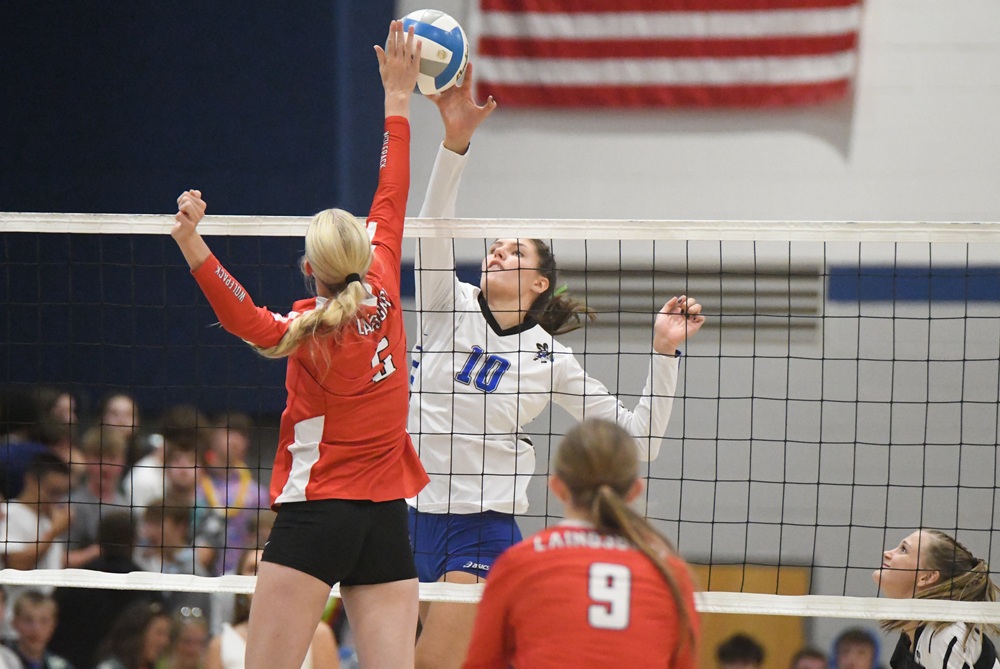
PHOTO Laingsburg and Bath volleyball players meet over the net while connecting with the ball during a match Aug. 27. (Photo by John Johnson.)