


MHSA(Q&)A: Beal City volleyball coach Kelly David
October 6, 2012
By Geoff Kimmerly
Second Half editor
 When people in Michigan’s volleyball community hear the name Kelly David, they might think first of the standout from just a few seasons ago. A four-sport standout for the Aggies, she set the volleyball team into the 2009 Class D Semifinals before going on to play at St. Clair Community College.
David, 20, graduated from high school a little more than two years ago, but is continuing to have an impact on the volleyball court – although now from the sideline as coach of the No. 3-ranked team in Class D. She took over the Beal City program this fall from her former coach, Randy Gallagher and has the Aggies 26-5-1.
Coaching has come naturally for the former floor leader, who already has gained valuable experiences and knowledge to share with her players. She previously coached at the junior high and club levels, the former for her aunt Sue Frederiksen – who coaches Almont’s varsity and is a member of the Michigan Interscholastic Volleyball Coaches Association Hall of Fame.
David is majoring in elementary education at Central Michigan University and sees teaching and coaching in her future for many years to come.
Why did you decide to become a coach?
I played at St. Clair (Community College) for two years, and my aunt had always been into coaching. I ended up coaching her seventh grade volleyball team for two years, and I coached in the Skippers AAU program over there. I found out I liked coaching more than playing.
How have you approached coaching a team that includes players who were freshmen when you were a senior in high school?
Going into it, I knew I wasn’t their friend; I was their coach. I wasn’t close to any of the girls except my sister (Monica, a senior). The people who coached me or were my teachers, (who said) go to class, do this, and you knew they received ultimate respect. I had helped out in previous years, and I knew what I had to do to gain that respect. And (my players) have listened to me.
Did you anticipate questions about you taking over the program only a few years out of high school?
I knew in my head, but I didn’t think it would be a problem in people’s minds. "She’s young, her sister is on the team;" that’s the stuff people might second guess. But I knew how to control the team, and having my sister on it wasn’t a big teal. So far (issues) haven’t happened. I’ve coached teams in previous years, and I’d always been the leader when I did play. I think that helps.
What were your goals coming into the season?
I had a lot of goals. Obviously, I wanted us to go far, like in the past. The biggest thing I noticed playing college from high school, the players knew the game of volleyball. They were smart. They had the same athletic ability as those I played against in high school, but they were just smarter. Knowing how to position the ball on the court, knowing the game, and I wanted to teach (my players) the game of volleyball. It’s important to know the game, and then we can work around the obstacles.
What did you learn by watching your aunt coach?
Just how strong you have to be. When I watch her coach, she’s very enthusiastic. But when someone does something wrong, she lets them know. That’s an important thing.
When did you first know you were interested in coaching?
When I was in high school, when I played, I’d help the other players. I noticed that was something I liked to do. I’d watch someone and pick up things they could fix. I thought about it in high school, and once I actually did it with the seventh graders, it wasn’t a job for me. It’s fun. Coaching is something I want to do. They want to be playing volleyball – that’s why they’re on the team. Everyone wants to be there, and we’re trying to accomplish the same thing.
What has been the biggest challenge during your first season?
The biggest challenge is handling the pressure. I know the team can do well. We’re ranked third in the state right now. But it’s getting them to perform the way they can perform, getting them to come together at the right time.
I’d also like to mention that Beal City (already) had a great program, from (former coaches) Randy Gallagher and before I came, Kelly Knuth. I’m just happy to step in and try to continue what they did.
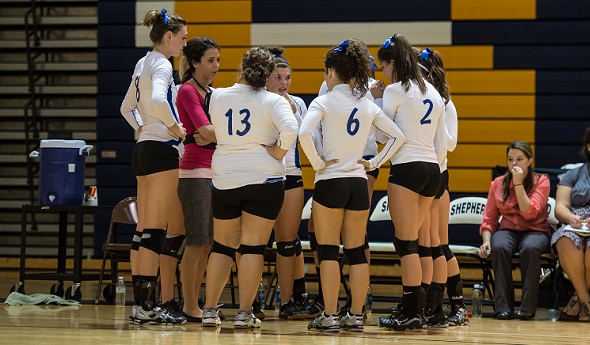
PHOTO: Beal City huddles during a break in its match against Shepherd this season. (Click to see more from HighSchoolSportsScene.com).

Working Through Transfer Trends
December 2, 2015
By Jack Roberts
MHSAA Executive Director
One of the responsibilities that schools have asked organizations like the MHSAA to execute is the management of transfer student eligibility. Historically, many associations have linked eligibility to residence ... thus, for some the regulation has been called the “Residency Rule” or “Transfer/Residency Rule,” not merely the “Transfer Rule.”
Over the years, as society became more mobile and families less stable, these rules became more and more complicated; and now, for most state high school associations, this is the regulation that consumes the most (or second) most pages of their handbooks. Over the years, this has also been the regulation most frequently challenged in court.
Over the years, some states have relaxed their transfer rule and others have refined their transfer rule. In either case, the transfer rule remains an imperfect rule, an imperfect net. Sometimes this net snags students who should not be made ineligible, and for those situations all associations have arranged some kind of waiver or appeal process.
And sometimes, and much less easily solved, the net fails to catch the situations it really should ... the transfers that are not hardship related or the result of some very compelling educational need, but those that are obviously for athletic reasons. It is those that we have been most focused on in Michigan.
Our first effort to get at the most problematic transfers was the adoption for the 1997-98 school year of what we called the “Athletic-MOTIVATED Transfer Rule” ... Regulation I, Section 9(E). Examples of an athletic-motivated transfer are included in the rule. The rule only applies to transfer students who do NOT meet any of the stated exceptions for immediate eligibility and are ineligible for one semester under our basic transfer rule. They become ineligible for 180 scheduled school days if there is a finding that the transfer was more for athletics than any other compelling reason.
This effort has not been successful enough because it requires a school that loses a student to another school to promptly allege to the MHSAA office, with supporting documentation, that the transfer was more for athletic reasons than any other compelling reason. The receiving school then must respond to those allegations. Then the executive director makes the decision. The unfortunate result of applying this rule is that it usually causes hard feelings between the schools, and hard feelings toward the executive director by the school decided against. In 17 years, schools have invoked this rule only 45 times.
Our more recent effort to address the most egregious athletic transfers resulted from requests from the coaches associations for wrestling and basketball, which were watching too many students change schools for athletic reasons, usually related to an out-of-season coaching relationship. The new rule – the “Athletic-RELATED Transfer Rule” – is Regulation I, Section 9(F). The difference between Section 9(E) and the newer Section 9(F) is that in 9(F) one school does not have to make and document allegations before staff can act. If MHSAA staff discover or are informed of any of the circumstances listed in 9(F), we can act. Again, the rule only applies to those transfer students whose circumstances do NOT meet one of the automatic exceptions. It applies only to students who are ineligible for a semester under the basic transfer rule. If there is a finding that one of the athletic related “links” exists (usually an out-of-season coaching relationship), then this transfer student who would be ineligible for one semester is made ineligible for 180 scheduled school days.
So far, it appears that 9(F) may be a better deterrent than 9(E). It has been referenced when students are rumored to be transferring, and it has stopped many of those transfers before they occur. We expect 9(F) to be an even better deterrent in 2015-16 because the rule has been broadened to apply to administrators and parents (not just coaches) and to address directing and coordinating athletic activities (not just coaching).
We have said that if this latest effort does not succeed in slowing athletic transfers, then the next step is 180 days of ineligibility – at least in any sport the student played in high school previously – for all transfer students who do not qualify for an exception that permits immediate play. I fear that would catch far too many students who should not be withheld so long from competition and could lead to a period like the early 1980s when the MHSAA, at the request of the state principals association, adopted the core of the transfer rule we have today and which resulted in a period of busiest litigation for the MHSAA when, at one time, the association had more than a dozen cases in court simultaneously on transfer matters. We’ve got to make the current rules work – with tweaks, perhaps; but not with radical revision.