


Add, Subtract, Divide, Multiply: MHSAA Not Alone
July 25, 2017
By Rob Kaminski
MHSAA benchmarks editor
This is the third part in a series on MHSAA tournament classification, past and present, that will be published over the next two weeks. This series originally ran in this spring's edition of MHSAA benchmarks.
As the MHSAA faces its most recent classification task with 8-Player Football, and opinions continue to swirl about as to the method, timeframe, location and other procedures, a look around the country provides plenty of company among state association brethren factoring variables into their own equations.
In the Pacific Northwest, the Oregon School Activities Association Football Playoffs are under public scrutiny as leadership ponders a five or six classification format beginning with the 2018-19 school year.
The OSAA has crowned six champions on the gridiron since 2006-07. Many of the state’s smaller schools would like to keep it that way, while larger schools lean toward a five-classification system, citing larger leagues, ease of travel and credibility to state championships as the advantages.
Still others would prefer more than six classes, pointing to safety issues and the opportunity to increase participation numbers as positives.
Moving southeast of Oregon, the Nevada Interscholastic Activities Association recently voted to hold serve on a classification proposal that was volleyed to the membership.
However, changes still could be forthcoming by as early as the 2018-19 season which would add a fifth classification in more populated southern Nevada while allowing northern schools to participate in four classifications. Such divisions could mean no state championship for the fifth class in southern Nevada.
Because of that, the NIAA wants equal numbers of schools in each classification on both ends of the state. Complicating the issue is the fact that the 24 largest schools in the state, by enrollment, are all in Clark County in Southern Nevada.
Across Nevada’s border into Arizona, charter schools are asking the Arizona Interscholastic Association to reconsider classification that was voted upon and approved in September 2015. That agreement called for the largest 33 percent of charter schools by enrollment to be placed in the state’s largest school classification, 3A, the middle 33 percent into 2A, and the smallest 33 percent into 1A.
Less than two years later the charter schools have had a change of heart and have asked to be considered the same as other Arizona public schools and be placed appropriately by enrollment beginning with the 2018-19 school year.
The situation in Arizona further illustrates how the public/private debate that all state associations have faced throughout existence now has the added dynamic of rapidly growing charter schools in today’s educational system, along with virtual school enrollment.
In the nation’s heartland, Nebraska has retooled its football classifications by using enrollment of boys students only in its schools rather than total enrollment. The Nebraska School Activities Association football-playing schools will kick off the 2018 season using this alignment.
Nebraska has three classes of 11-player football, with the smallest class divided in two, Class C-1 and C-2. The state also will have 8-player football for boys enrollments under 47, and the NSAA will sponsor a new 6-player tournament in 2018 for schools with 27 or fewer boys.
“This is a good proposal because some schools have a sizable imbalance between the number of boys and girls, and there’s a large gap (in enrollment) between the largest and smallest schools in Classes A and B,” NSAA executive director Jim Tenopir said. “I think this addresses both of those concerns.”
Swimmers in Georgia, meanwhile, will feel like they are moving with the current, rather than upstream in 2017-18, as the Georgia High School Association recently doubled the number of team championship events from two to four.
Swim enthusiasts can also count on longer days at the finals, as the top 30 finishers from the prelims will advance to the finals instead of 20, and all championship events will have three heats versus two.
Concord Multi-Sport Standout Begins Senior Run to Finish Career with 20 Letters
By
Doug Donnelly
Special for MHSAA.com
August 20, 2026
It’s only August but Concord senior Haley Stimer has her mind on the softball season that starts in March – eight months from now.
 “I don't know if we're going to have enough people,” she said. “I'm kind of worried about our numbers.”
For Stimer, having a softball season is how she will finish her career with a stunning 20 letters over her four years of high school. She enters her senior year with 15 varsity letters already on her jacket.
“It took a little bit to get into figuring out how to manage my time,” she said. “I feel like I’m pretty good at it now with communicating with teachers and coaches and everything.”
Stimer runs cross country and plays golf in the fall, plays basketball in the winter and dual-sports between track and softball in the spring. Except for a little bit of JV basketball her freshman season, she’s been on varsity teams her entire high school career.
“I guess I’ve just always played all of the sports,” she said. “When I was younger, I played basketball and softball and golf once in a while. I didn’t really know what I was getting myself into my freshman year.”
With the blessing of Concord athletic director Matt Lehman and all of her coaches, Stimer has set forth a remarkable career of steady success and showing up for everything possible.
“She is one of our top athletes in each sport,” Lehman said. “I've been at Concord for 33 years, and I don't recall anyone even close to (20 letters).”
Her cross country and golf coaches often coordinate practice times. In the spring, she floats between track and softball with ease.
 “They have been really accommodating with what time we need to have practices,” Stimer said of Concord golf coach Mike Bauman. “He normally bumps it back until whenever we finish cross country.
“It can be a lot to figure out,” she added. “I have to watch practice times a lot, just to be sure. The hardest is probably with golf because there are days when you have to miss the entire school day for a meet.”
The Yellow Jackets currently have just two golfers on the girls team. The season began Tuesday at the East Jackson Scramble, and Stimer and teammate Mya Barrett combined to shoot an 82 and finish among the top 10. Unfortunately, they don’t have enough girls on the team to score in dual meets.
“It’s hard to get girls out for golf,” Stimer said. “My sophomore year there were only four of us, and the other three girls were seniors. Last year I had to find three more girls that would do it and two of them were seniors, so now it's just me and one other girl (Barrett).”
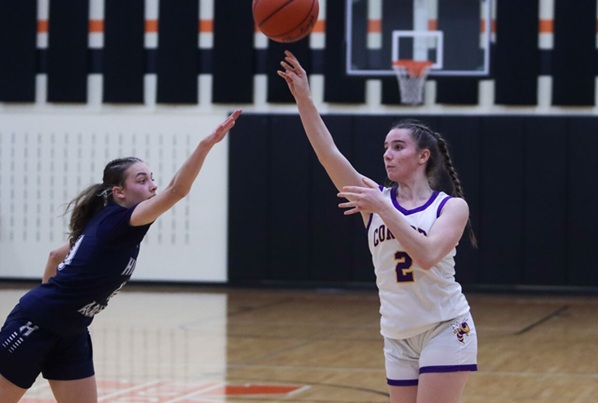
Stimer has been part of some outstanding basketball teams at Concord. Over the last three seasons Concord has won 66 games, two league titles, three District titles, two Regional titles and played in the 2025 Division 4 Semifinals when she started and stayed on the court all 32 minutes in a 34-24 loss to Ewen-Trout Creek.
Stimer admitted she’s never been a fan of running, but that hasn’t slowed her down. She qualified for the 3,200 and as part of the 3,200 relay for the spring’s Lower Peninsula Division 4 Finals. She led off the relay team that would finish fourth in 10:01.31, helping the Yellow Jackets finish seventh as a team at the meet.
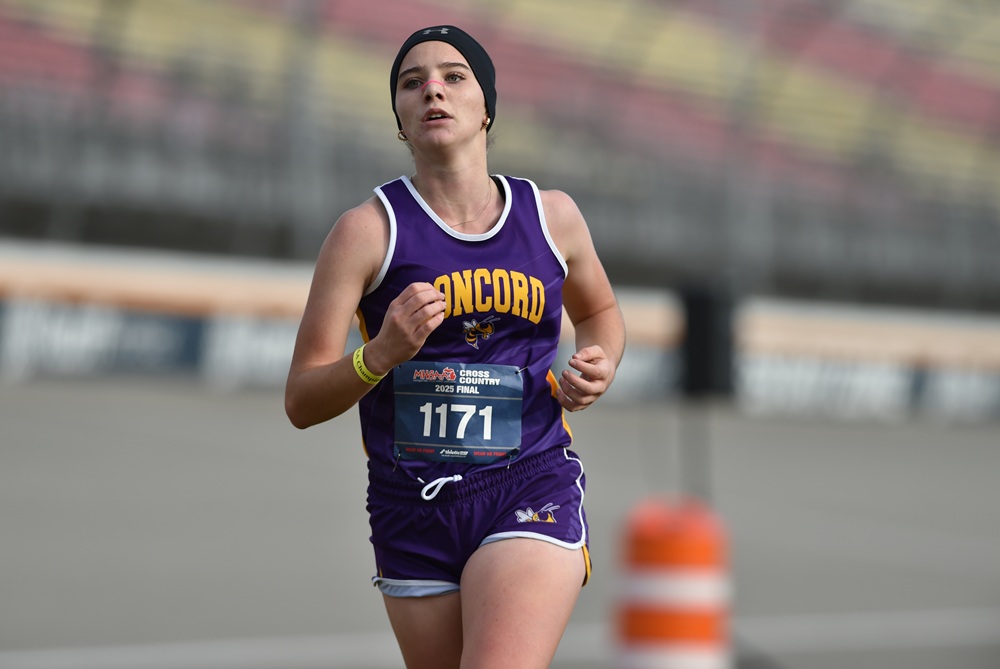
Last fall she placed 29th at the LPD4 Cross Country Finals. As a freshman she was all-state in cross country, placing 13th with a time of 19:31.1, her personal best to date.
At one time basketball was her favorite sport, but she said she’s taking a stronger liking to golf recently. She might try golf in college. She has no idea at this point what she might want to study, although she said she is really strong in math and likes English. She finished her junior year at the top of her class with a GPA above 4.0.
 Stimer, 17, has a younger brother who is going to be a sophomore this year and a sister, Hannah, who is a sophomore in college. The daughter of Bart and Kiersten said her parents and her sister often inspired her in athletics.
“I kind of followed in her footsteps because of all of the sports she did,” Stimer said.
Stimer admits there are some nerves starting her senior year. She’s on the Concord student council and National Honor Society and last year volunteered with some groups in school. Through a leadership class she helped organize a basketball camp for Concord elementary students. This year she is adding something else to the mix – she will be dual-enrolling at Jackson College, her first dive into college courses.
“I’ve taken AP courses, but not college before,” she said.
There’s a lot on her plate, she said, but she is still excited.
“I'm nervous because it's going to be a lot, I think, but I've always done it, so, I know I can do it this year too.”
 Doug Donnelly has served as a news and sports reporter at the Adrian Daily Telegram and the Monroe News for 30 years, including 10 years as city editor in Monroe. He's written a book on high school basketball in Monroe County and compiles record books for various schools in southeast Michigan. He is now publisher and editor of The Blissfield Advance, a weekly newspaper. E-mail him at [email protected] with story ideas for Jackson, Washtenaw, Hillsdale, Lenawee and Monroe counties.
PHOTOS (Top) Concord’s Haley Stimer (1171) approaches the finish line during last season’s LPD4 championship race at Michigan International Speedway. (Middle) Stimer passes the ball during a basketball game against Hillsdale Academy. (Top photo courtesy of RunMichigan.com. Middle photo courtesy of Joseph Miller/JTV. Head shot courtesy of the Concord athletic department.)