


'Anyone Can Save a Life' Aims to Prepare
July 28, 2015
By Rob Kaminski
MHSAA benchmarks editor
It was 2008 when Jody Redman and staff at the Minnesota State High School League developed an emergency action plan to provide guidance and procedure in the event of sudden cardiac arrest during scholastic athletic competition.
The desired response from schools upon receipt of the plan was, well, less than enthusiastic.
“Only about 40 percent of our schools used the information and implemented the program,” said Redman, associate director for the MSHSL. “Our focus was completely on sudden cardiac arrest, that being the worst-case scenario regarding athletic-related health issues.”
The MSHSL asked the University of Minnesota to survey its member schools, and results showed that the majority of schools not on board simply felt a sudden cardiac arrest “would never happen at their school.” Naive or not on the schools’ parts, that was the reality – so Redman went back to revise the playbook.
“We expanded the plan to deal with all emergencies, rather than specific incidents,” Redman said. “Now it’s evolved so that we are prepared to deal with a variety of situations which put participants at risk. We shifted gears and got more schools to participate.”
Did they ever. And not just in Minnesota.
This summer, the “Anyone Can Save a Life” program, authored by the MSHSL and the Medtronic Foundation, is being disseminated to high schools nationwide with the financial support of the NFHS Foundation. The program will reach schools in time for the 2015-16 school year.
Once received, schools will find that there are two options for implementation, via in-person training or online.
“The in-person method is facilitated by the athletic administrator with the assistance of a training DVD” Redman said. “The important element is the follow through, ensuring coaches return their completed Emergency Action Plan (EAP). With the e-learning module on anyonecansavealife.org, individuals will complete an e-learning module that will walk them through the details of their specific plan, and as they answer questions, the information will automatically generate a PDF of the Emergency Action Plan (EAP) which they can edit at a later date as information changes.”
Schools will find five major components of the program to be received this summer: the first is an implementation checklist for the AD, explaining their role. Next are sections for in-person training, online training and event staff training. The last item contains a variety of resources that will ensure the successful implementation of a comprehensive emergency response to all emergencies.
Generally speaking, the program prompts schools to assemble preparedness teams, broken into four categories: a 911 team, a CPR team, an AED team and a HEAT STROKE team. The groups are made up of coaches and their students who will be in close proximity to all after-school activities.
“The reality about school sports is, at 3:30 every day the office closes and any type of medical support ceases to exist,” Redman said. “We then send thousands of students out to gyms, courts, fields and rinks to participate without systemic support for emergencies. This program puts into place that systemic support.”
Another stark reality is that the majority of schools in any state do not have full-time athletic trainers. Even for those fortunate enough to employ such personnel, it’s most likely the training “staff” consists of one person. That one body can only be in one place at one time, and on widespread school campuses the time it takes to get from one venue to another could be the difference between life and death.
“Athletic trainers can champion the program, but someone needs to oversee that every coach has a completed EAP in place,” Redman said. “For every minute that goes by when a cardiac arrest occurs, chance for survival decreases by 10 percent.”
Thus, it’s imperative to train and grant responsibility to as many people as possible, including student-athletes. In fact, students are a vital component to having a successful EAP. Students will be put in position to call 911, to meet the ambulance at a pre-determined access point, to locate the nearest AED, to make sure emersion tubs are filled for hot-weather practices, and for those who are trained, to assist with CPR. Coaches will identify students at the beginning of the season and prior to an emergency taking place. They will provide them with the details of the job they are assigned so they will be ready to assist in the event of an emergency.
“We have game plans for every sport, and for every opponent on our schedule,” Redman said. “But we don’t have a plan to save the life of a member of our team or someone attending a game at our school.
“This is about developing a quick and coordinated response to every emergency so we give someone in trouble a chance at survival, and then practicing it once or twice a season. We have ‘drop the dummy’ drills where we drop a dummy and evaluate how it went, and how everyone performed. In one scenario, it’s the coach that goes down, and then you have a group of 15- or 16-year-olds standing there. That’s why students have to take ownership of this, too.”
The key to an effective emergency action plan is to utilize and empower students in every sport and at every level to be a part of the response team. Following are brief descriptions of the teams.
The 911 Team
- Two students will call 911 from a pre-determined phone and provide the dispatcher with the location and details of the emergency.
- Two students will meet the ambulance at a pre-determined access point and take them to the victim.
- Two students will call the athletic trainer, if one is available, and the athletic administrator and alert them to the emergency.
The CPR Team
- The coach is the lead responder on this team and is responsible for attending to the victim and administering CPR, if necessary, until trained medical personnel arrive.
- One person is capable of providing effective CPR for approximately two minutes before the quality begins to diminish. Having several students trained and ready to administer CPR will save lives.
The AED Team
- Two students will retrieve the AED and take it to the victim.
- Two students will physically locate the athletic trainer, if one is available, and take him or her to the victim.
The Heat Stroke Team
- Two students identify locations of emersion tub, water source, ice source and ice towels.
- Two students prepare tub daily for practices and events.
For more information, visit anyonecansavealife.org or contact the MSHSL.
Van Valkenburg Returns to Madison to Continue Dad's Pole Vaulting Program
By
Doug Donnelly
Special for MHSAA.com
April 8, 2026
Larry Van Valkenburg had two passions in retirement – coaching high school track & field and racing motorcycles.
 In September, only a few months after completing his 25th season as the pole vault coach at Adrian Madison, Van Valkenburg loaded up his motorcycle and headed to Harpster, Ohio, a tiny, unincorporated city of 160 residents in central Ohio.
“He loved racing motorcycles,” said his son, Trevor Van Valkenburg. “Seems like an odd hobby for someone in their 70s, but he loved it. He hadn’t done it for a couple of years and said he wanted to give it one more shot.”
While at a race in Harpster, Van Valkenburg, 78, was involved in a motorcycle crash, had trouble catching his breath and tragically died.
“He took a very hard fall,” Trevor said.
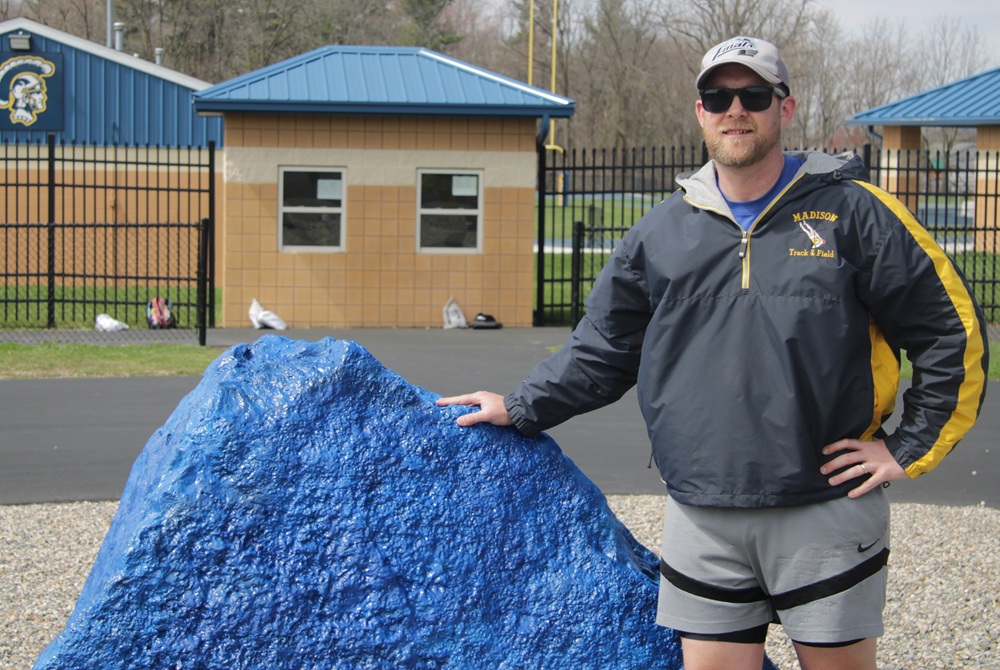
This spring, after months of deliberations, Trevor decided to end his nine-year run as track coach at nearby Onsted and take over for his father as an assistant at Madison. For all intents and purposes, he’s coming home.
“It really is like coming home,” Trevor said. “I have crazy Madison ties that go way back.”
Trevor was a big reason why his dad began coaching at Madison. He was a high school sophomore in the early 2000s when he switched from baseball to track.
“When Coach (Josh) Powers took over the program in 1999, Madison didn’t have pole vault,” Van Valkenburg said. “Most of the schools in the 1990s had gotten rid of it. As a sophomore, I said if you have pole vault, I’ll run track. That is how my dad got involved.”
Trevor knew his dad had some background in pole vault.
“He was a vaulter in high school,” he said. “He always told us he had the school record. He vaulted in the 1960s where he would land in a pit of saw dust. As a junior, he broke his arm vaulting. He had a scar he would show us from time to time. His proud accomplishment was he came back as a senior and set the school record.”
With Trevor a senior, the Van Valkenburgs were part of Madison’s run to a Michigan Interscholastic Track Coaches Association (MITCA) track & field team state championship.
“He ended up staying 25 years,” Trevor said, speaking of his dad. “He loved it.”
Pole vault is a tough event to learn – and teach.
 “In my opinion, it’s probably the most complicated high school sport,” Trevor said. “There are so many variables, how long your pole is, what the wind rating is, the flex rating and you have to set up your steps. You can move the bar so you have to know where to put it. It’s almost impossible to do well without a good coach. There are too many things an outside person needs to watch and give you feedback on.
“I always tell the kids every time you focus on one thing in pole vault about 30 other things go wrong – and that’s fine. It’s a very complicated high school thing to do. If you don’t have a good coach, it’s really hard to be successful.”
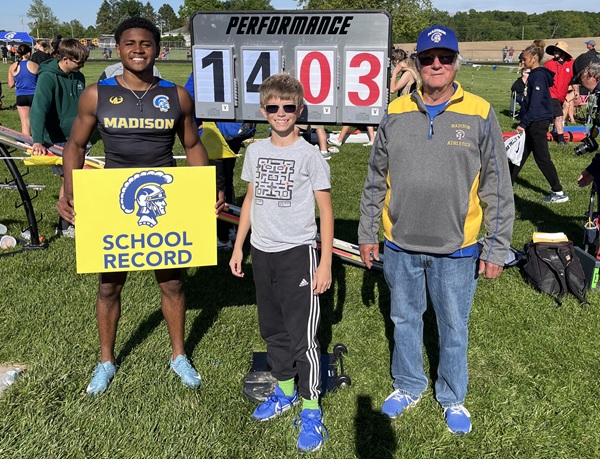
Last year, Trevor’s son Noah was on the Trojans middle school track & field team and chose the pole vault as one of his events. His grandfather was able to coach him.
“I am thankful for that,” Trevor said.
Over the years, the elder Van Valkenburg coached numerous league, county and Regional champs. Trevor joined his high school friend, Kyle Cessna, at Onsted, first coaching the pole vault but later coaching distance runners and the Wildcats cross country team. Madison and Onsted were in the same league, the Lenawee County Athletic Association, for the last several years.
“Over the years my dad and I had plenty of good pole vault coaching and team battles,” Trevor said. “We were really competitive at first. Over time, that relaxed a little bit.”
Returning to Madison to coach was an emotional decision for Trevor.
“I’ve coached Onsted for nine seasons,” Van Valkenburg said. “It was kind of always in the back of my head that if my dad was ever done, I’ll go back to Madison. I knew he would hold on as long as he could. It didn’t end up the way we thought it would, but it finally happened and I’m back home.”
Another reason it is home is because his wife, Kathryn, has taught at Madison schools for more than 20 years. His younger son, Dominque, also attends Madison schools.
“When I’m here after school, my whole family is here,” he said. “My wife is in the building. My one son is getting out of elementary at 3:30, my other son is on the middle school track team.”
Larry Van Valkenburg was an ex-Marine who retired as an air traffic controller in 2011. His legacy will remain at Madison, mainly because he teamed with Powers and the rest of the coaching staff to form a powerhouse track & field program that won numerous league championships and made an impact at MHSAA Finals.
“Larry was a great coach,” Powers said. “Trevor is a lot like him. We are really happy he came back to coach.”
Trevor Van Valkenburg is the director of the Lenawee District Library, a system that has six branches and a bookmobile. They circulate more than 150,000 items a year. Each spring, he adjusts his schedule to allow for coaching. He feels at home at Madison – and the track & field athletes can take comfort knowing a Van Valkenburg is still coaching them.
“We’re pretty similar,” Trevor said. “I learned a lot of it from (my dad), so it makes sense we would be similar. We both are pretty laid-back people. We’re not going to scream in kids’ faces. I might be a little more drill-heavy instead of just practicing jumping over the bar. I learned everything I know from him.”
 Doug Donnelly has served as a news and sports reporter at the Adrian Daily Telegram and the Monroe News for 30 years, including 10 years as city editor in Monroe. He's written a book on high school basketball in Monroe County and compiles record books for various schools in southeast Michigan. He is now publisher and editor of The Blissfield Advance, a weekly newspaper. E-mail him at [email protected] with story ideas for Jackson, Washtenaw, Hillsdale, Lenawee and Monroe counties.
PHOTOS (Top) Adrian Madison track & field assistant coach Trevor Van Valkenburg stands at the entrance to the school’s track this spring. (Middle) At left, JaLonn Borders stands for a photo with Larry Van Valkenburg and Larry’s grandson Noah after breaking the school’s pole vault record during last season’s Lenawee County Championships. (Top photo by Doug Donnelly. Middle photo courtesy of Trevor Van Valkenburg.)