

Health & Safety: A Look Back, Gallop Ahead
By
John E. (Jack) Roberts
MHSAA Executive Director, 1986-2018
August 7, 2015
We are just completing year six of eight during which we have been addressing the four important health and safety issues that, for ease of conversation, we call the “Four Hs.”
During the 2009-10 and 2010-11 school years, our focus was on Health Histories. We made enhancements in the pre-participation physical examination form, stressing the student’s health history, which we believe was and is the essential first step to participant health and safety.
During the 2011-12 and 2012-13 school years, our focus was on Heads. We were an early adopter of removal-from-play and return-to-play protocols, and our preseason rules/risk management meetings for coaches included information on concussion prevention, recognition and aftercare.
Without leaving that behind, during the 2013-14 and 2014-15 school years, our focus was on Heat – acclimatization. We adopted a policy to manage heat and humidity – it is recommended for regular season and it’s a requirement for MHSAA tournaments. The rules/risk management meetings for coaches during these years focused on heat and humidity management.
At the mid-point of this two-year period, the MHSAA adopted policies to enhance acclimatization at early season practices and to reduce head contact at football practices all season long.
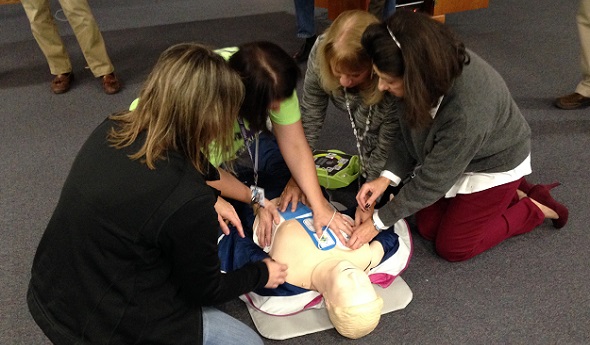
Without leaving any of the three previous health and safety “H’s” behind, during the 2015-16 and 2016-17 school years, our focus will be on Hearts – sudden cardiac arrest and sudden cardiac death.
Coinciding with this emphasis is the requirement that all high school level, varsity level head coaches be CPR certified starting this fall. Our emphasis will be on AEDs and emergency action plans – having them and rehearsing them.
On Feb. 10, bills were introduced into both the U.S. Senate and House of Representatives, together called the “Safe Play Act (see below),” which addressed three of the four health and safety “H’s” just described: Heat, Hearts and Heads.
For each of these topics, the federal legislation would mandate that the director of the Centers for Disease Control develop educational material and that each state disseminate that material.
For the heat and humidity management topic, the legislation states that schools will be required to adopt policies very much like the “MHSAA Model Policy to Manage Heat and Humidity” which the MHSAA adopted in March of 2013.
For both the heart and heat topics, schools will be required to have and to practice emergency action plans like we have been promoting in the past and distributed to schools this summer.
For the head section, the legislation would amend Title IX of the 1972 Education Amendments and eliminate federal funding to states and schools which fail to educate their constituents or fail to support students who are recovering from concussions. This support would require multi-disciplinary concussion management teams that would include medical personnel, parents and others to provide academic accommodations for students recovering from concussions that are similar to the accommodations that are already required of schools for students with disabilities or handicaps.
This legislation would require return-to-play protocols similar to what we have in Michigan, and the legislation would also require reporting and recordkeeping that is beyond what occurs in most places.
This proposed federal legislation demonstrates two things. First, that we have been on target in Michigan with our four Hs – it’s like they read our playbook of priorities before drafting this federal legislation.
This proposed federal legislation also demonstrates that we still have some work to do.
And what will the following two years – 2017-18 and 2018-19 – bring? Here are some aspirations – some predictions, but not quite promises – of where we will be.
First, we will have circled back to the first “H” – Health Histories – and be well on our way to universal use of paperless pre-participation physical examination forms and records.
Second, we will have made the immediate reporting and permanent recordkeeping of all head injury events routine business in Michigan school sports, for both practices and contests, in all sports and at all levels.
Third, we will have added objectivity and backbone to removal from play decisions for suspected concussions at both practices and events where medical personnel are not present; and we could be a part of pioneering “telemedicine” technology to make trained medical personnel available at every venue for every sport where it is missing today.
Fourth, we will have provided a safety net for families who are unable to afford no-deductible, no exclusion concussion care insurance that insists upon and pays for complete recovery from head injury symptoms before return to activity is permitted.
We should be able to do this, and more, without judicial threat or legislative mandate. We won’t wait for others to set the standards or appropriate the funds, but be there to welcome the requirements and resources when they finally arrive.
Safe Play Act — H.R.829
114th Congress (2015-2016) Introduced in House (02/10/2015)
Supporting Athletes, Families and Educators to Protect the Lives of Athletic Youth Act or the SAFE PLAY Act
Amends the Public Health Service Act to require the Centers for Disease Control and Prevention (CDC) to develop public education and awareness materials and resources concerning cardiac health, including:
- information to increase education and awareness of high risk cardiac conditions and genetic heart rhythm abnormalities that may cause sudden cardiac arrest in children, adolescents, and young adults;
- sudden cardiac arrest and cardiomyopathy risk assessment worksheets to increase awareness of warning signs of, and increase the likelihood of early detection and treatment of, life-threatening cardiac conditions;
- training materials for emergency interventions and use of life-saving emergency equipment; and
- recommendations for how schools, childcare centers, and local youth athletic organizations can develop and implement cardiac emergency response plans.
Requires the CDC to: (1) provide for dissemination of such information to school personnel, coaches, and families; and (2) develop data collection methods to determine the degree to which such persons have an understanding of cardiac issues.
Directs the Department of Health and Human Services to award grants to enable eligible local educational agencies (LEAs) and schools served by such LEAs to purchase AEDs and implement nationally recognized CPR and AED training courses.
Amends the Elementary and Secondary Education Act of 1965 to require a state, as a condition of receiving funds under such Act, to certify that it requires: (1) LEAs to implement a standard plan for concussion safety and management for public schools; (2) public schools to post information on the symptoms of, the risks posed by, and the actions a student should take in response to, a concussion; (3) public school personnel who suspect a student has sustained a concussion in a school-sponsored activity to notify the parents and prohibit the student from participating in such activity until they receive a written release from a health care professional; and (4) a public school's concussion management team to ensure that a student who has sustained a concussion is receiving appropriate academic supports.
Directs the National Oceanic and Atmospheric Administration to develop public education and awareness materials and resources to be disseminated to schools regarding risks from exposure to excessive heat and humidity and recommendations for how to avoid heat-related illness. Requires public schools to develop excessive heat action plans for school-sponsored athletic activities.
Requires the CDC to develop guidelines for the development of emergency action plans for youth athletics.
Authorizes the Food and Drug Administration to develop information about the ingredients used in energy drinks and their potential side effects, and recommend guidelines for the safe use of such drinks by youth, for dissemination to public schools.
Requires the CDC to: (1) expand, intensify, and coordinate its activities regarding cardiac conditions, concussions, and heat-related illnesses among youth athletes; and (2) report on fatalities and catastrophic injuries among youths participating in athletic activities.
Przystas Helps 'Shape' Fitness for Future
By
Geoff Kimmerly
MHSAA.com senior editor
December 20, 2016
By Geoff Kimmerly
Second Half editor
Scott Przystas had plans earlier this week to “crash” a Grand Haven schools party with vegetables grown in his classroom’s hydroponic garden. It may be winter outside, but in his physical education class, it’s time to harvest.
But the Michigan chill doesn’t mean his students – ranging from Young 5’s to fourth grade – will be restricted to the gym for the next three months. When they return in 2017, they’ll head outside and give snow-shoeing a try.
Teaching includes a lot more than daily dodgeball or rolling out the basketballs for Przystas, a member of the MHSAA Multi-Sport Task Force and this fall’s honoree as Michigan Physical Education Teacher of the Year by the state’s chapter of Society of Health and Physical Educators (SHAPE).
The task force over its first few months has determined that the message on the many benefits of participating in multiple sports must be delivered to students and their families long before these students reach high school and even junior high – making passionate educators like Przystas especially key. He passes on a perspective that “PE is the most important thing we can teach kids, how to be physically active for life” while teaching students at Grand Haven’s Mary A. White and Rosy Mound elementary schools.
“That’s our goal with the elementary PE department in Grand Haven, to make it relevant again,” Przystas said. “Because it’s really easy in our profession (to say) here’s the ball kids, do you want to do. But it’s not gratifying at all. It’s not satisfying to the kid or the teacher.”
Przystas brings the MHSAA task force a wealth of experience as a coach – he’s in charge of the high school’s girls cross country team, serves as freshman coach and varsity assistant for girls basketball and leads the middle school track & field teams. But he also provides an important voice for physical education, an area the task force considers crucial to growing interest in playing many sports instead of specializing in one – which studies have shown can lead to chronic injuries when playing that one sport while leading those children to become adults who are less likely to be physically active and fit. He is in his eighth year in the Grand Haven district and has taught in nine buildings at the elementary, middle, high school and alternative education levels.
“Scott has been instrumental in leading changes to the PE program in Grand Haven,” Mary A. White principal Valerie Livingston said in a report for the Grand Haven Tribune. “His excitement about life-long fitness and nutrition is contagious in the school. Under Scott's direction we have students who look forward to smoothie bars at lunch and are excited to see our new tower garden grow.”
Many teachers
Przystas’ philosophy is deeply-rooted in the positive experience he had growing up in Gladwin, a much smaller community than Grand Haven located north of Midland and Mount Pleasant.
His father Ronald – who formerly worked at the Lansing State Journal and Cadillac Evening News before becoming a reporter, editor at later publisher at the Gladwin County Record – died in a car crash in 1996. But he left his then 10-year-old son a love for sports photography – Scott minored in journalism at Michigan State University – and also plenty of familiarity with athletics. A track & field meet hosted by Gladwin Junior High School bears Ron’s name.
Sports provided an outlet during that tough time. During middle school, Scott would go from a basketball game to hockey practice that same night, filling his time with those sports, golfing and a variety of other like activities.
A few years after his dad’s death, Przystas became a manager for the Flying G’s boys basketball varsity coached by Kirk Taylor, who had gotten to know Ron well over the years. Ron had made sure Kirk understood the importance of Gladwin beating county rival Beaverton – they play for a trophy dating back to 1937 – and so it was memorable when Scott, as a senior during the 2005-06 season, scored a career-high 25 points to help the Flying G’s beat the Beavers despite the fact he really wasn’t a scorer as much as a solid all-around player.
“Scott was part of the best group of captains I have had here at Gladwin in the past 23 years,” Taylor said. “One of his co-captains was quiet and out-worked everybody. Another of his tri-captains was very direct with players. Scott was a little of both, but he always delivered the message with the most positive manner.
“I did not know that Scott would become a teacher and/or a coach, but I did know that he would be very successful at whatever profession he chose.”
Przystas made the all-Jack Pine Conference second team as a senior in 2004 while also earning all-league honors in golf and serving as a pinch-runner in baseball for a couple of seasons – but that was just a start on his athletic endeavors. At MSU, as he was studying toward a degree in kinesiology, Przystas played on the practice scout team that daily took on the women’s basketball team as the Spartans prepped for multiple NCAA Tournament runs. He knew he wanted a career in sports, and that experience got him interested in coaching. He also participated on the MSU triathlon club team, which got him into endurance sports.
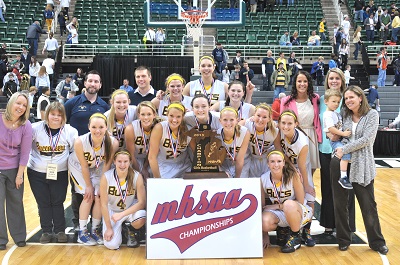 He graduated from MSU and before the fall of 2009 latched on at Grand Haven. His first call was to Buccaneers girls hoops coach Katie Kowalczyk-Fulmer, and he was on her bench as an assistant for the program’s back-to-back Class A championships in 2012 and 2013 – while also for a time living in her basement before marrying his wife Renee.
Przystas also inherited the high school’s girls cross country program, which he coaches with Renee, and which has made the MHSAA Finals 17 straight seasons. In addition, he became the Lakeshore Middle School track & field coach – and he sees all of these as being related.
“At a Class A school like this, I’d like to say having most (students) participating in high school sports is because of the elementary PE teachers rocking it,” Przystas said. “Our numbers in cross country are up there (50-60 athletes the last few seasons), our numbers in track are getting up there, and the kids are seeing a familiar face and enjoying the process and sticking with it.”
Passing those lessons on
In addition to Taylor and Kowalczyk-Fulmer, Przystas credits his high school golf coach Ben Ball and Gladwin’s former girls varsity and boys subvarsity boys basketball coach Andy Miceli among those who helped shape his growing up. He also gained valuable experience during his student teaching as an assistant with the Bath High School girls under Craig Poppema, and retired longtime Grand Haven boys hoops coach Craig Taylor – Kirk’s dad – has provided plenty of mentoring.
Przystas – who has served a two-year term on the Governor’s Council on Physical Fitness, Health and Sports – teaches from a philosophy based on a pyramid. The bottom level is health and knowing how to take care of oneself, with the middle level physical literacy and the body’s ability to solve movement problems to avoid injury. The top of his pyramid is adventure, and that’s what he’s trying to deliver to his students.
But to do so, he also has to be able to relate and communicate with them.
“Scott makes it fun. He’s just very organized – and he connects with whatever age group, whether it’s kindergarten kids or high school girls,” said Kowalczyk-Fulmer, recalling how excited her 5-year-old son was to have “Coach P” as a teacher. “Freshman girls can sometimes be an interesting group to coach … but he never changes who he is. I’ll stand in the locker room after games and listen to the things he says. Just the quality of person he is, he’s a role model, he and his assistant Kelly Kieft. He’s just a good, positive role model for young people.”
Przystas noted how SHAPE America is pushing for the generation of children being born now becoming an “active” next generation, and as a newer father this hits home – and also helps fuel his desire to help.
He said it’s harder to plant that seed when students are older – but that’s where his responsibility as a cultivator at the elementary level comes in.
“I had a great childhood experience,” Przystas said. “That was the big thing. I fully remember all of the pickup games we had in our neighborhood, the outdoor adventures exploring, playing ping-pong on a chipped-up table.
“(That’s why) I promote to kids in middle school, elementary school, to go check out a lacrosse game. Go to swim camp. Be active this summer. Don’t just be sitting around. We’ve just got to get them outside more and have kids be active.”
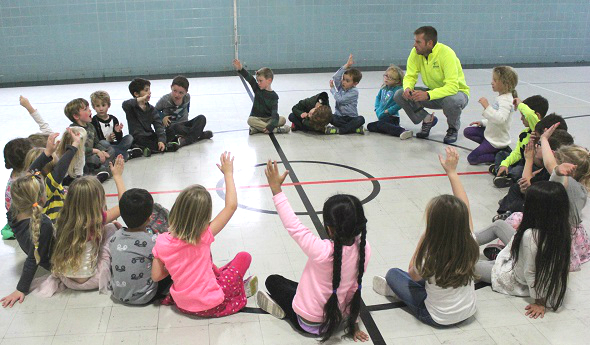
PHOTO: (Top) Teacher Scott Przystas (kneeling) works with one of his elementary school classes in Grand Haven. (Middle) Przystas (back row, second from left) has been an assistant on two Class A girls basketball championship teams. (Top photo courtesy of the Grand Haven Tribune.)